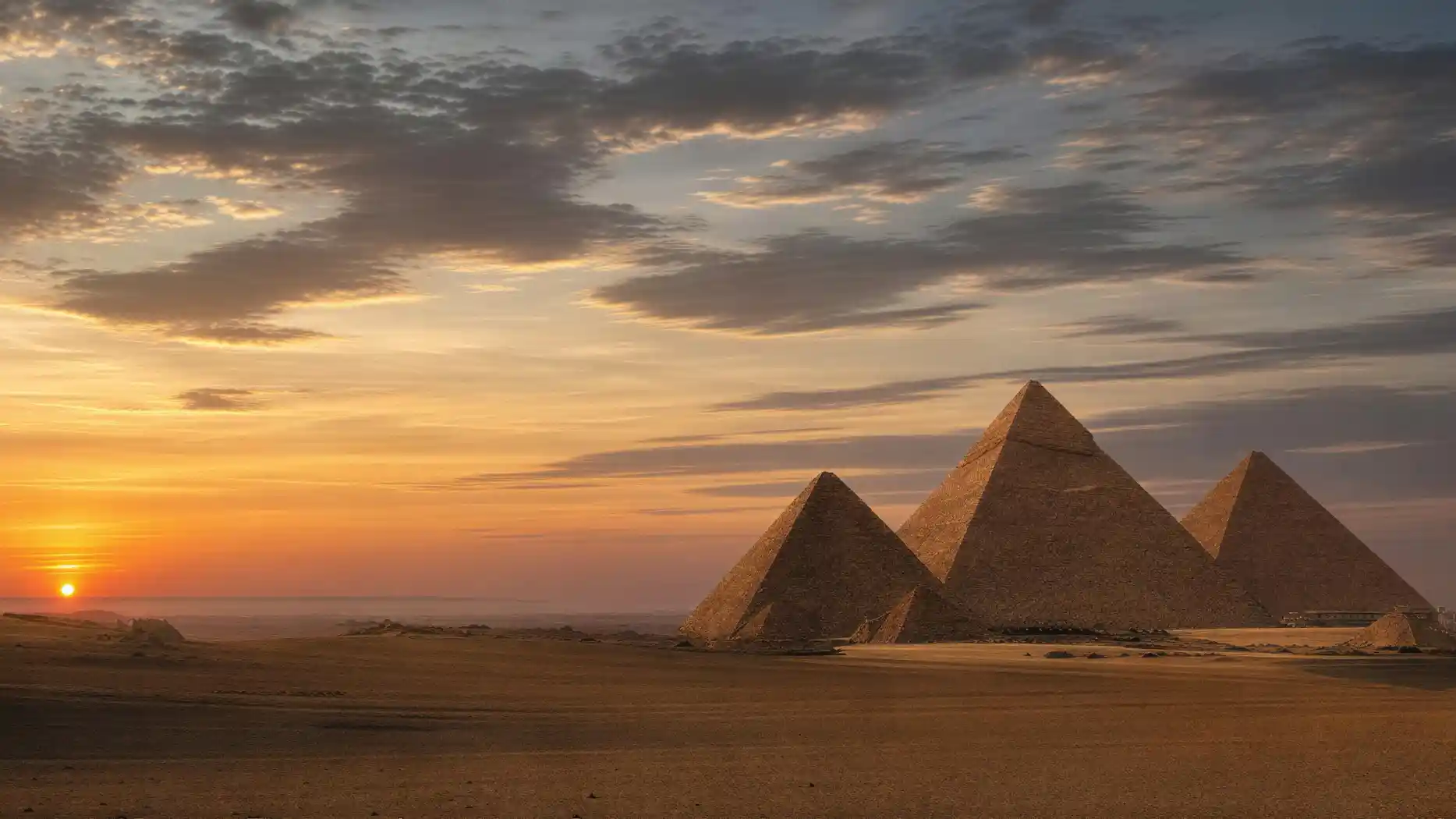
The short answer is: Egyptians. Paid, fed, housed, and medically cared for – organized into named crews, with a management structure, and led by a known building director. The long answer is more interesting, because it is one of the best-documented questions in ancient Egyptian archaeology.
Who asks which civilization built the Pyramids of Giza gets an unusually well-supported answer. For hardly any other ancient large-scale construction site do we know so much about the people who worked there. We know their accommodations, their bakeries, their graves, their bone fractures, the names of their crews, and in one case even the duty log of a middle-ranking official with delivery schedules.
That is remarkable because the same question has been treated for centuries as a great mystery. It is not one. It was one only as long as one had nothing but ancient authors and the buildings themselves. Since 1988, when systematic excavation began, it has ceased to be a mystery.
It remains interesting, however, for a different reason. The real achievement was not lifting stones but organizing: feeding, housing, and scheduling tens of thousands of people over decades – in a state without money, without writing in the modern sense, and without any model to copy.
This page goes through it in order: who was involved, who ordered it, who led it, and who did the work.
Client and builder are not the same
First, a distinction that is constantly blurred in German as well as in English: the client and the builder are not the same person.
Who commissioned the Great Pyramid is a question about the king. The answer is Khufu, the second ruler of the 4th Dynasty, known in Greek as Cheops. He ordered the construction, financed it, and had it built for himself. He did not build it himself. The same applies to his son Khafre and his successor Menkaure for the other two large pyramids.
This distinction is more than pedantry, because it explains why the buildings bear the names they do. A pyramid bears the name of the person who was to be buried in it, not of its builder. In the Old Kingdom, that was the point: the building was a statement about the king, and whoever executed it played no role in that statement.
A comparison makes the scale tangible. A king of the Old Kingdom decided with the start of construction about a substantial part of the state's resources for the coming two decades. There was no parliament, no budget, and no way to stop the project later without leaving one's own tomb unfinished. Whoever ordered a pyramid thus bound his entire reign to it.
That also explains why the pyramid form became smaller after the 4th Dynasty. Not because skill declined, but because priorities shifted. The resources were no longer available in that concentration – and the state had learned that such a project could also be done differently.
The three builders
- Great Pyramid
- Khufu, 4th Dynasty, around 2560 BC
- Pyramid of Khafre
- Khafre, son of Khufu
- Pyramid of Menkaure
- Menkaure, successor of Khafre
- Period of all three
- roughly eighty years, three successive reigns
- Known building director
- Hemiunu, vizier and nephew of Khufu
- Documented crew names
- among others “Friends of Khufu” and “Drunkards of Menkaure”
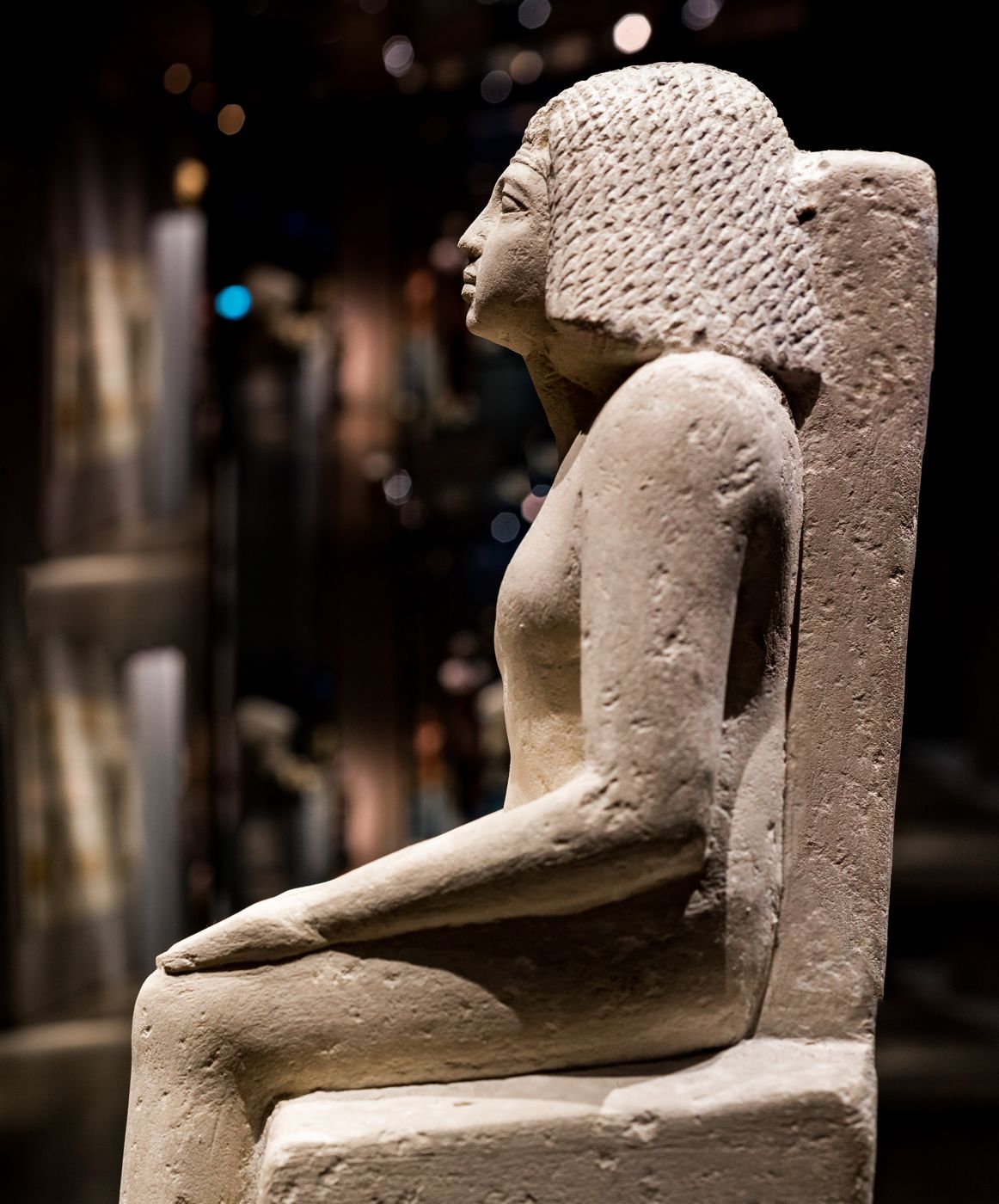
Hemiunu, whose statue stands in Hildesheim
There is one man whose name is directly connected to the construction of the largest pyramid, and whose portrait can be seen in Germany.
Hemiunu was vizier under Khufu, thus the second-highest official in the state, and in addition a nephew of the king. His father was Prince Nefermaat, his grandfather King Sneferu, under whom the smooth pyramid form had been developed. He thus came from the family that had brought the building method to maturity over two generations.
Decisive is one of his titles: overseer of all the king's construction works. Whoever bore this title was responsible for the crown's major building projects, and during Khufu's reign that meant the Great Pyramid. No construction plan with his signature survives, and no one can prove that he made the structural decisions himself. That he bore the responsibility, however, is well documented.
What survives is a seated statue from his tomb on the plateau – an unusually lifelike piece: a stout, clearly overweight man of middle age, which in Egyptian art was read as a sign of prosperity and success. This portrait of the building director is today in the Roemer- und Pelizaeus-Museum in Hildesheim.
For German-speaking visitors, that is an unusual opportunity: one can come face to face with the man probably responsible for the Great Pyramid without traveling to Egypt.

Crew, phyle, ten-man group
Below the management level it becomes interesting, because the work organization is so well documented that its structure can be reconstructed down to small groups.
The largest unit was the crew. Such a crew comprised roughly one to two thousand people and bore a name referring to the king. Documented include a troop that called itself the Friends of Khufu, and a later one whose name can be translated as the Drunkards of Menkaure. Such names sound familiar because they resemble club names, and they probably served a similar purpose: belonging and competition.
Each crew was divided into five subunits, for which Egyptology uses the Greek term phyle. Strikingly, their names come from ship terminology, e.g., for starboard or for the bow. That is no coincidence. A considerable part of the material transport went by water, and the organizational form of a ship's crew was evidently transferred to the building site.
Below the phyle stood small groups of ten to twenty people, each named with a single sign that often expressed a concept such as life, endurance, or perfection.
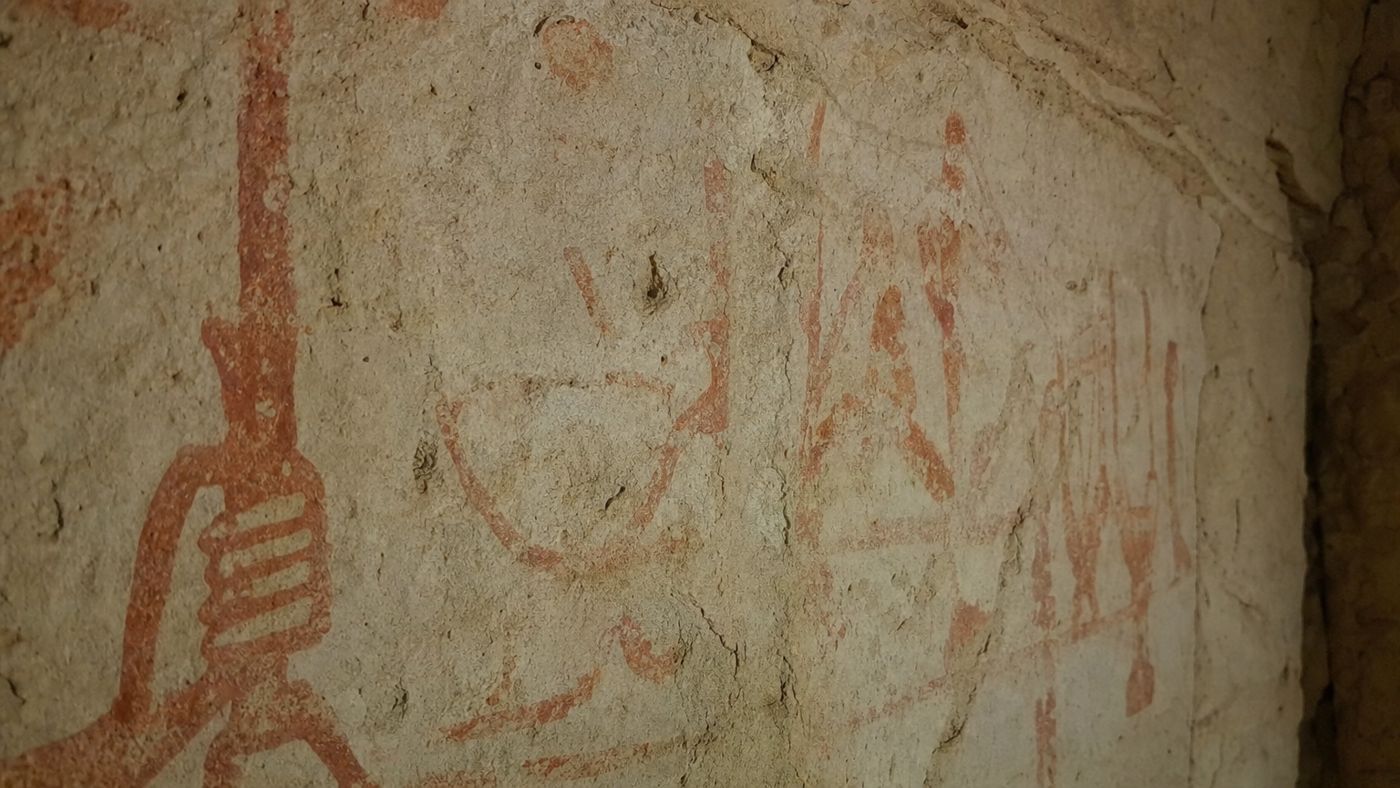
Where these names appear says almost as much as the names themselves. They are found as red paint marks on blocks, and predominantly in places that no one could see after the work was finished: in the relieving chambers above the king's chamber, on block sides facing the wall, in joints. So they are not signatures for posterity but operational script. A crew marked its material so that it was clear whose delivery was built where.
That is exactly what makes them so valuable as a source. Whoever writes an inscription for an audience shapes it. Whoever applies a block number has no reason to lie. The crew names are therefore more reliable than any official representation of the same period – precisely because they are casual.
This yields a four-tier structure, from the individual via the ten-man group and the phyle to the crew. That is not a reconstruction from analogies but follows from marks and titles in the sources.
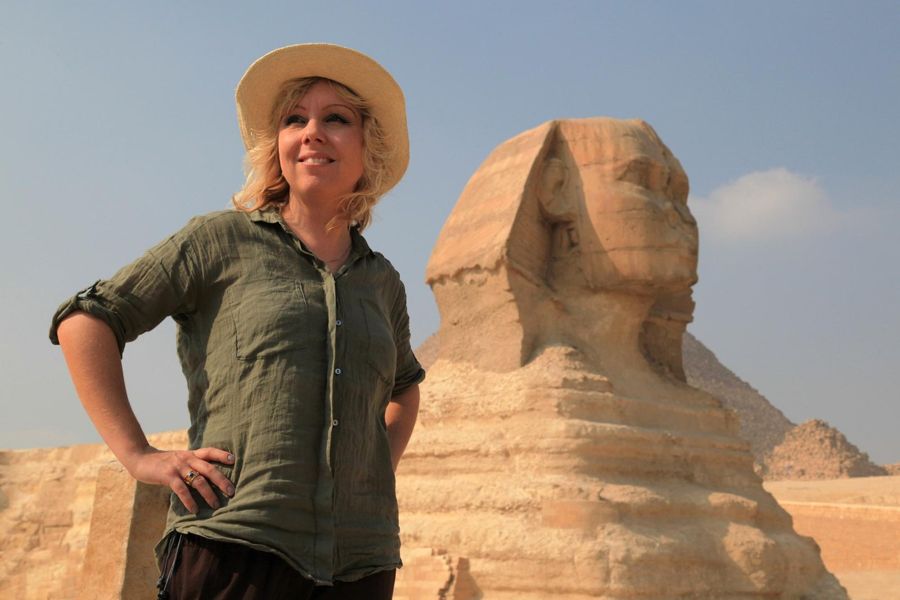
Half-day tour to the Pyramids of Giza and the Sphinx
- A licensed guide explains on site where the settlement lay and how the building site worked
- Plateau entry, German-speaking guide, and pickup are included
- Five to six hours, the classic format for a first visit
- Free cancellation up to 24 hours before
The structure of the workforce
From bottom to top, with what the sources provide at each level.
| Level | Order of magnitude | Naming | Evidence |
|---|---|---|---|
| Small group | 10 to 20 people | Single signs such as life or endurance | Marks on blocks |
| Phyle | five per crew | terms from ship terminology | titles and administrative texts |
| Crew | about 1,000 to 2,000 | names referring to the king | red paint marks in the structure |
| Permanent workforce | a few thousand on site | craftsmen, overseers, supply | settlement evidence |
| Seasonal workers | at times significantly more | farmers during the flood season | sleeping galleries, supply quantities |
| Management | individual persons | vizier, overseer of construction works | titles in tombs |
- Order of magnitude
- 10 to 20 people
- Naming
- Single signs such as life or endurance
- Evidence
- Marks on blocks
- Order of magnitude
- five per crew
- Naming
- terms from ship terminology
- Evidence
- titles and administrative texts
- Order of magnitude
- about 1,000 to 2,000
- Naming
- names referring to the king
- Evidence
- red paint marks in the structure
- Order of magnitude
- a few thousand on site
- Naming
- craftsmen, overseers, supply
- Evidence
- settlement evidence
- Order of magnitude
- at times significantly more
- Naming
- farmers during the flood season
- Evidence
- sleeping galleries, supply quantities
- Order of magnitude
- individual persons
- Naming
- vizier, overseer of construction works
- Evidence
- titles in tombs
The often-cited hundred thousand workers come from Herodotus and are not supported archaeologically.
Where so many people came from
The decisive economic question is where so many people came from at all without the agriculture collapsing. The answer lies in the river.
The Nile flooded every year and put the arable land under water for about three months. During that time farming was impossible, and the rural population was unemployed – but still had to be fed. The state thus had a yearly window in which very many workers were available without their absence being missed anywhere.
Exactly into this window fell a considerable part of the construction work. The people were conscripted under a service obligation, came for a limited time, were housed and fed, and then returned to their villages. Transporting heavy loads by water worked best in this season anyway, because the river reached closer to the building site.
That explains two things at once. First, why the project was affordable at all: it used a resource that was lying fallow anyway. Second, why it did not need a slave economy. A system that exchanges labor for supplies and dissolves again after three months works better with conscripts than with unfree people who would have to be permanently guarded and fed.
How large this supply apparatus was can be read from the finds. In the bakeries stood clay bread molds significantly larger than anything from contemporary houses, designed for output rather than household size. For the animal bones, quantity and age distribution suggest that cattle, sheep, and goats were systematically brought in from the hinterland, predominantly young animals – the expensive option. Meat in this quantity was not a matter of course, and it says something about how seriously the state took provisioning.
If one extrapolates, a picture emerges that is hard to reconcile with coercion: a building site where people ate better than in many of the villages they came from.
This interpretation is not a modern gloss. It follows from the finds: from the size of the accommodations, from the quantities of cattle and grain that the administration recorded, and from the fact that the facility was built for rotation, not for permanent occupation.
The permanent workforce was something else
Alongside the seasonal workers there was a permanent workforce, and professionally it was something completely different.
Pulling stones can be taught to unskilled people. Dressing granite to a tenth of a millimeter, leveling a surface over hectares, or setting a corbelled vault – that cannot be taught. For these tasks one needed craftsmen who had learned over years, plus surveyors, scribes, overseers, carpenters, coppersmiths, rope makers, and bakers.
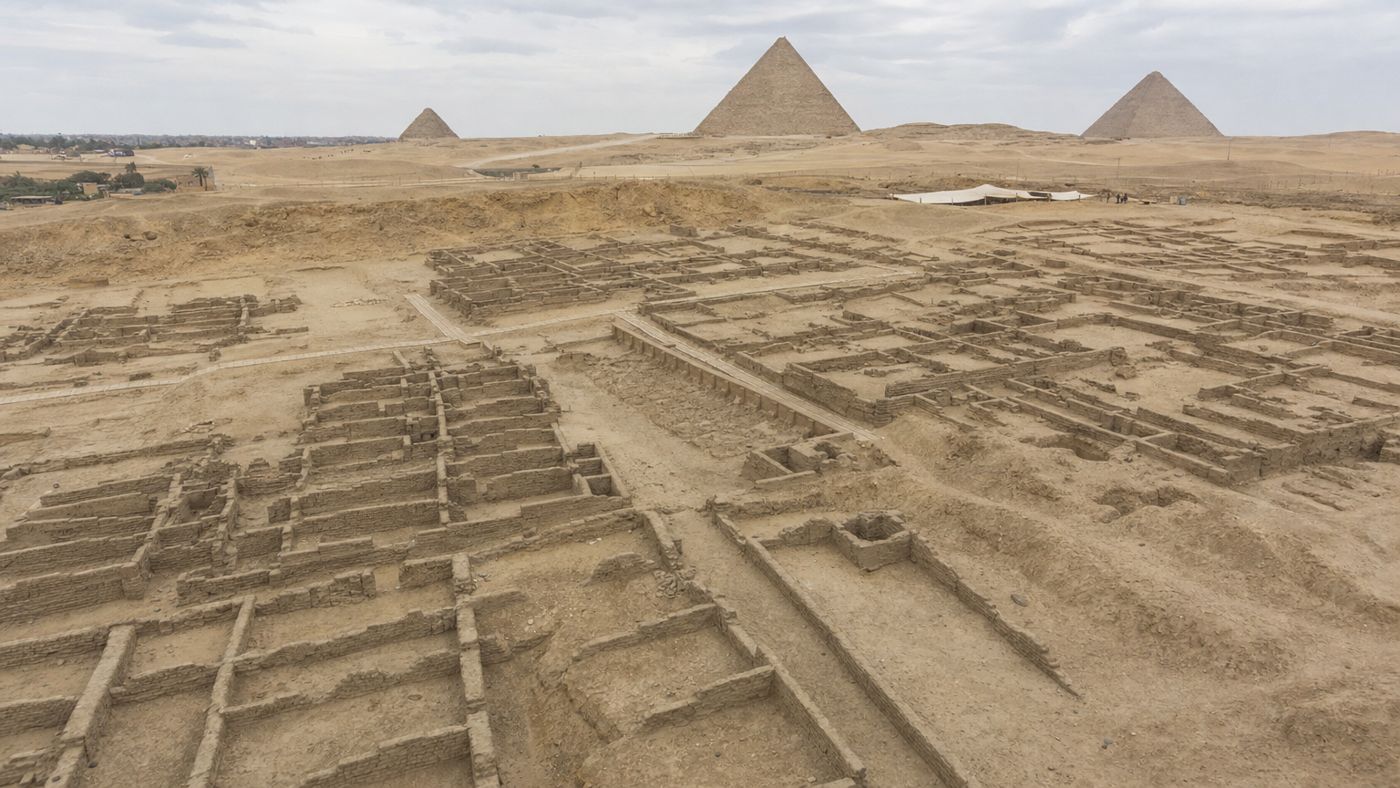
These people lived permanently on site, in the settlement southeast of the buildings, and their number, according to the excavation findings, was a few thousand. They are also the ones whose tombs were found within sight of the pyramid, some with their own small tomb chapels and titles.
The social difference is visible in the burials. Simple workers lie in plain mud-brick graves; foremen and master craftsmen in larger structures with inscriptions. So it was not a society of equals but one with a clear hierarchy, in which even the simple worker received a grave.
The titles in these graves also reveal how fine the division of labor was. Documented include overseers of stonemasons, leaders of craft groups, administrators of deliveries, and scribes. So there was not only the distinction between management and execution but an entire intermediate level of technical supervision, as every large building site needs to this day.
What is more remarkable is that these graves are there at all. Whoever uses people for forced labor does not set up tomb complexes for them next to the king's tomb.
Where we know all this from
Where we know all this from is the question that distinguishes this account from older ones, because the evidence is new.
Until the 1980s, almost every statement about the builders rested on ancient authors, above all Herodotus, who wrote two thousand years after the construction and named a hundred thousand forced laborers. There was simply nothing better.
In 1988 a systematic excavation began southeast of the pyramids, and what came to light there changed the picture completely: sleeping galleries, bakeries on an industrial scale, breweries, granaries, workshops, and an administration that kept accounts of deliveries. The excavations at this settlement continue to this day.
How these tombs were found is one of the better stories in Egyptology. According to the account of the then excavation director, in 1990 the horse of a visitor stumbled at the edge of the site over a hidden mud-brick wall. The follow-up investigation of this spot led to the cemetery of the pyramid builders, which had been unknown until then, although it lay in the immediate vicinity of one of the most visited places in the world. The report on this discovery comes from the excavator himself.
Added to this were the tombs of the workers themselves and the examination of their skeletons. They show heavy physical strain, wear on the spine and joints, and at the same time healed bone fractures that had been properly splinted. So there was medical care. Scholarly analyses of the work organization connect these findings with the administrative texts.
The newest piece is a chance find from 2013. In harbor galleries on the Red Sea, the duty log of an inspector named Merer surfaced, in which he noted how his crew of about two hundred men brought limestone by boat to Giza. It is the only known text written during the construction period by someone involved.
No slaves, but also no contractual freedom
At this point a clarification is worthwhile, because the phrase “no slaves” is often taken too far.
The evidence refutes two things with certainty: that the buildings were erected by an enslaved population, and that this population was the biblical Israelites – which is chronologically off by more than a thousand years anyway.
What it does not mean is modern contractual freedom. A service obligation toward the king was an obligation, not an invitation, and no one could decline it. Payment was not in money but in provisions: bread, beer, meat, lodging, and treatment in case of illness. The physical strain was considerable, as the skeletons show, and some workers died young.
The most precise formulation is therefore: obligated, provisioned, and organized labor in a state that disposed over the labor of its subjects. That is something different from slavery and also something different from an employment relationship.
This distinction is more important than it sounds, because both simplifications share the same weakness: they replace a concrete historical finding with a familiar category. The Old Kingdom had neither a slave-holding society nor wage labor in the modern sense, but an order for which we lack the word.
Four answers one often hears to this question
- False
Slaves built the pyramids.
The settlement shows provisioning, medical treatment, and honorable burial within sight of the pyramid. That fits no slave economy.
- False
The Israelites built the pyramids.
Chronologically, that is over a thousand years apart. For the construction period, there is no evidence in Egypt for the population group in question.
- False
A hundred thousand people worked on it simultaneously.
The number comes from Herodotus. The excavation evidence speaks of a few thousand permanently on site and larger contingents during the flood season.
- Partially
We do not know who was in charge of the construction.
No construction plan with a name exists. But the title overseer of all the king's construction works is documented for Hemiunu, and he was a nephew of the client.
Plateau entry as QR code on your phone
The craftsmen's cemetery and the surroundings of the settlement lie in the freely accessible area. For the walk, the basic ticket suffices.
What remains open
Less remains open than one might expect, but what remains is interesting.
We know the structure of the crews, but not their total number over the construction period. The common figure of about twenty thousand participants is an extrapolation from accommodation capacity and supply quantities, not a count, and it varies considerably depending on the assumption.
We know the names of individual troops, but almost no names of ordinary workers. What is preserved are titles of overseers and master craftsmen, because only they received tombs with inscriptions.
We know that women lived in the settlement and that the site's supply would not have functioned without them, especially bread production and textile work. About their share in the actual construction work, the sources say practically nothing, and serious accounts hold back at this point.
And we do not know how the structural decisions came about. Whether Hemiunu himself calculated, whether there was a staff of specialists, whether experiential knowledge from the buildings under Sneferu was passed on in writing: all that is plausible and none of it is documented.
Also open is how the knowledge was passed on. Between the first pyramid ever and the Great Pyramid lie less than two hundred years, and in that time the building form was fundamentally changed several times, including after at least one failure. Someone must have learned from these attempts and passed the result on to the next generation. How that happened – orally in families of master builders, through workshop practice, or in records that have not survived – no one knows.
What can be said is that the error rate was extremely low. A building with this precision does not arise from trial and error, but from people who knew what they were doing and could communicate with each other.
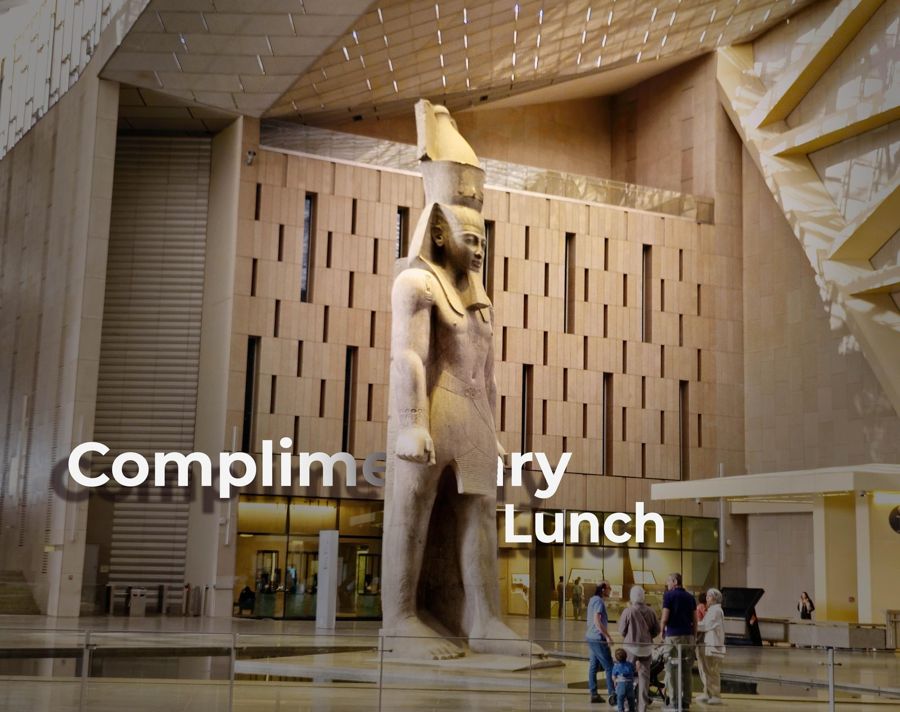

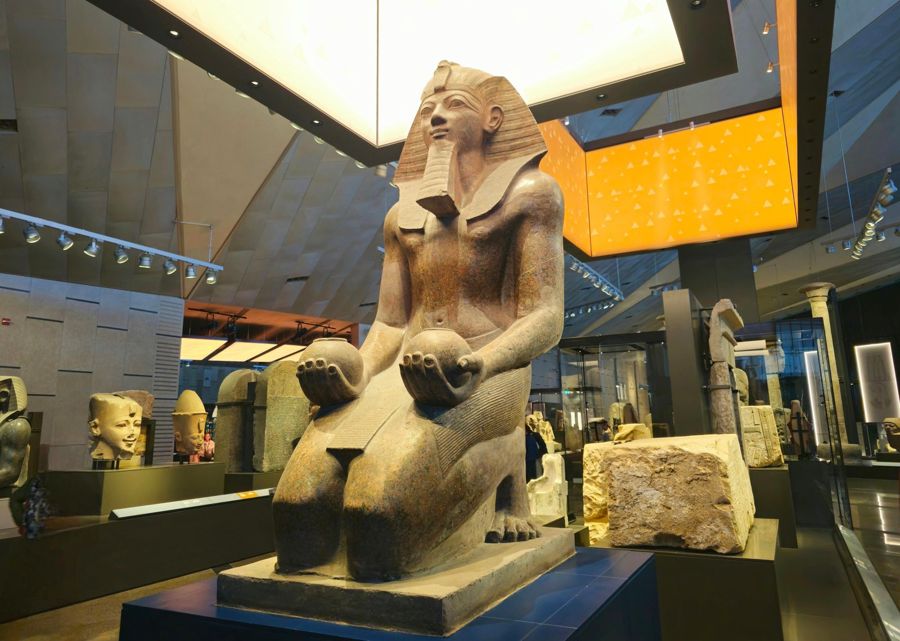
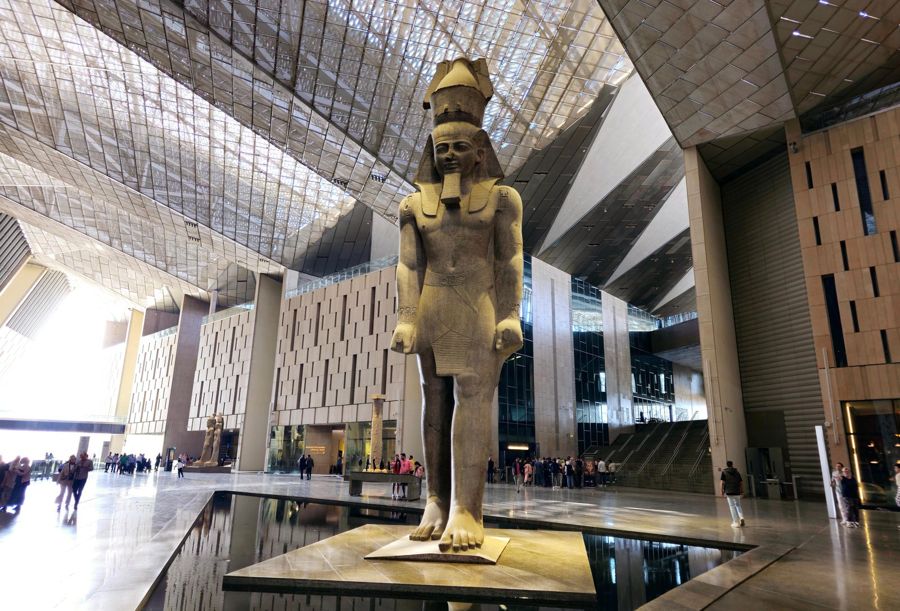
Full-day tour to the Grand Egyptian Museum, the Pyramids, and the Sphinx
- In the museum lie the finds on which today's picture of the builders is based
- Plateau and museum in one day, without organizing two trips yourself
- Entry fees, German-speaking guide, pickup, and lunch are included
- Free cancellation up to 24 hours before
Frequently asked questions
Who built the Great Pyramid?
It was commissioned by King Khufu. The construction management was with high probability in the hands of his nephew Hemiunu, who bore the title overseer of all the king's construction works. It was executed by Egyptian crews.
How many people were involved?
A few thousand permanently on site, plus larger seasonal contingents. Over the entire construction period, the order of magnitude of twenty thousand is mentioned, which is an extrapolation.
Were the workers paid?
Not in money, which did not yet exist in that form, but in provisions: bread, beer, meat, lodging, and medical care.
Are there names of those involved?
Yes, but mostly of management personnel. From the crews, group names are preserved; from individual workers, almost nothing.
The real achievement was the administration
If one had to summarize the answer to this question in one sentence, it would not be the sentence most expect.
It is not “Egyptians instead of slaves,” true as that is. It is: these buildings are the product of an administration. Someone had to calculate how much bread three thousand people eat in a month, how many cattle for that come from which province, when which crew arrives, and where it sleeps. Only then did it come to stones.
This administrative achievement also has a consequence that extends beyond the construction. A state that learns to register, supply, and allocate tens of thousands of people can subsequently do other things as well: maintain canals, build reserves, levy taxes, secure borders. Several scholars therefore hold the view that the pyramid building not only cost the Egyptian central state but actually brought it into being. That cannot be proven, but the sequence of developments fits.
That is exactly the part one does not see on site. The pyramid stands there as a geometric body and says nothing about bakeries, delivery lists, and shift schedules. The excavations southeast of it say that, and therefore the workers' settlement is more important for understanding this complex than any chamber inside.
That the entire necropolis has been protected as World Heritage since 1979 explicitly includes this settlement. It belongs to it, even if nothing spectacular is to be seen there.
And whoever travels to Hildesheim can see the man who probably was responsible for the whole thing. He sits there, stout and self-confident, for four and a half thousand years in the same posture.
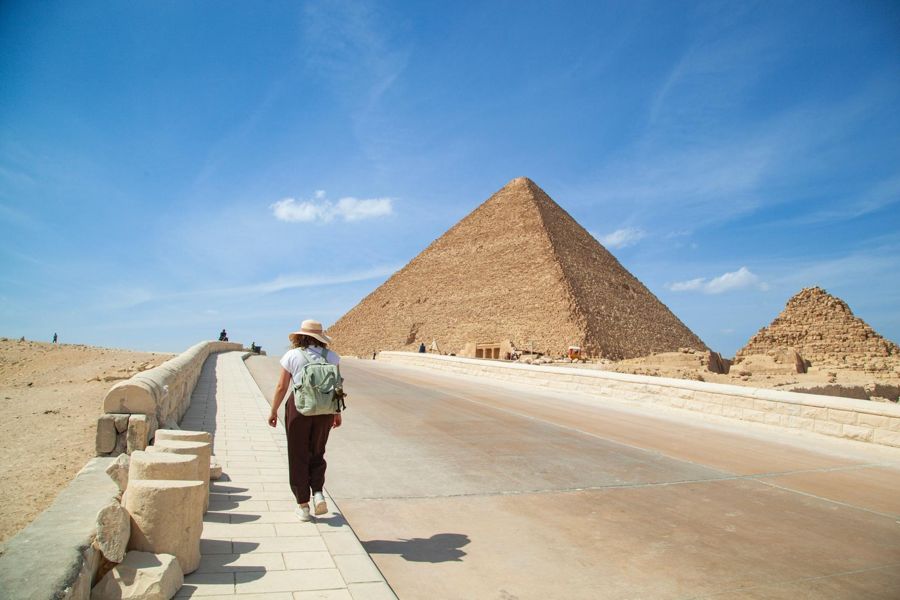
Short guided walk across the plateau
Three hours, on foot, with a view of cemeteries and quarries instead of only the three large buildings.