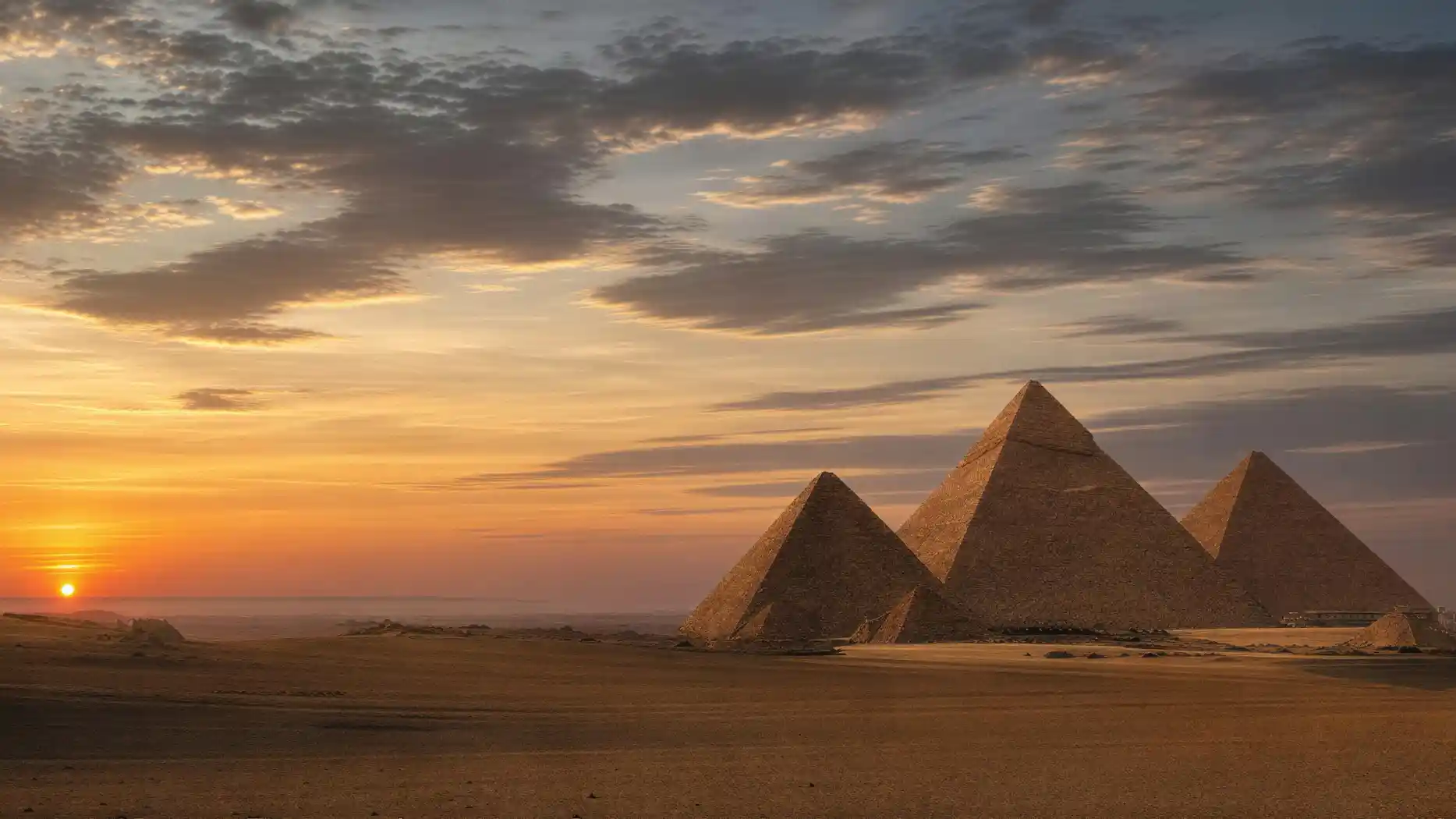
The first thing to know before you stand in front of it: you are not seeing the finished structure, but its core.
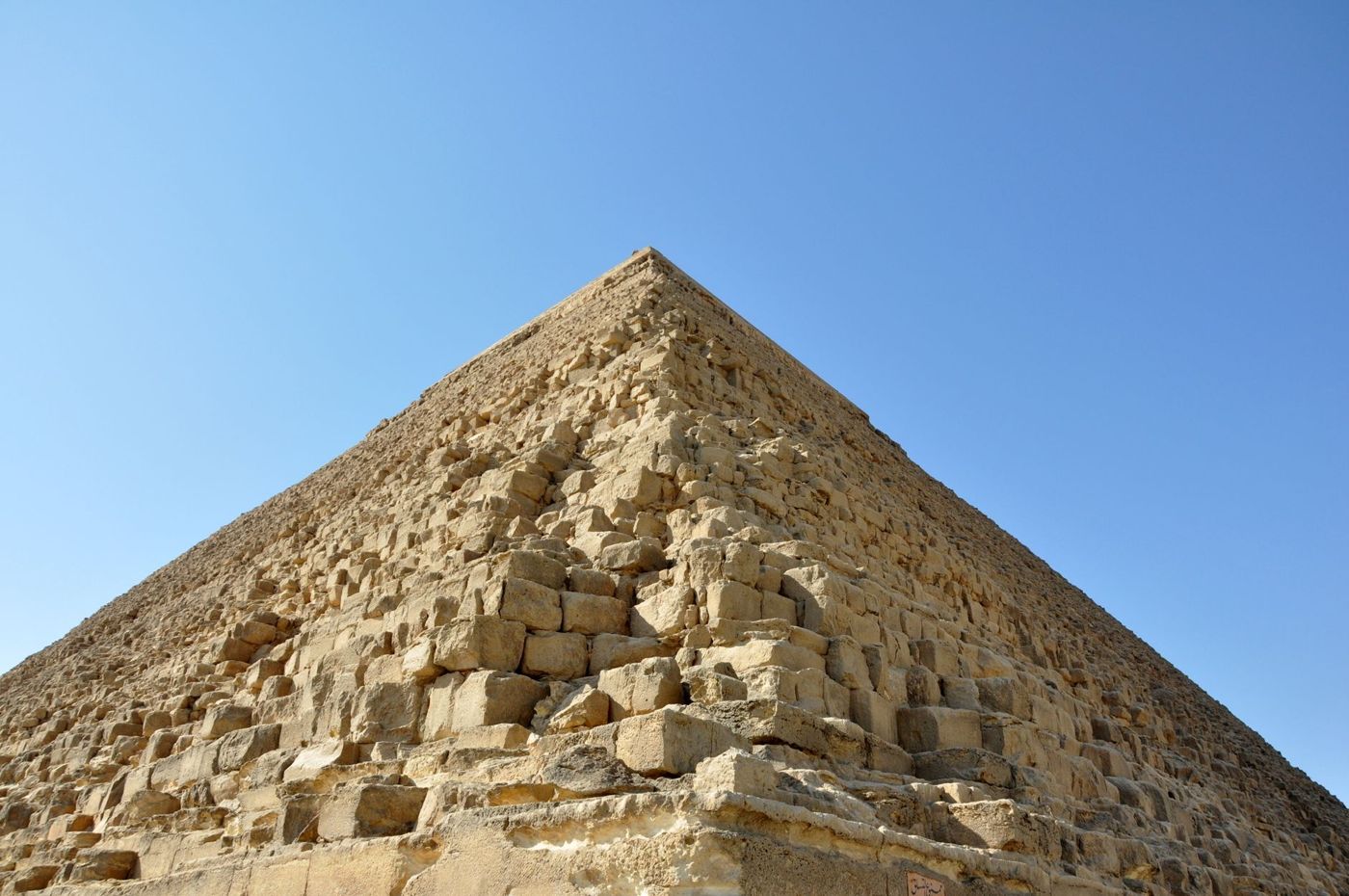
The spelling varies: Cheopspyramide without a hyphen, Cheops-Pyramide with one – both are common and refer to the same structure. Originally, it was smooth. A seamless skin of fine, almost white limestone covered all four sides, polished, without visible steps, and topped with a separate capstone. What you see today is the masonry beneath: about two hundred layers of rough blocks never intended for outside eyes. The famous step-like appearance is a damage pattern.
The height is no longer accurate either. When completed, the structure stood 146.6 meters tall. Today it is about 138.8 meters, because the top layers and the capstone are missing. If you see a small platform at the top, you are seeing a gap.
Nevertheless, the Pyramid of Khufu at Giza is the only one of the seven ancient wonders of the world that still stands. The other six have vanished, burned, collapsed, or been dismantled, and in several cases even their locations are uncertain. This one structure has outlasted them all and was also the tallest building in the world for about 3,800 years, until Gothic church spires surpassed it.
What often gets overlooked: it is not a mystery object but one of the most thoroughly studied structures in human history. The builder, purpose, materials, origin of the stone, organization of labor, and approximate construction time are known and supported by finds. Open questions are matters of detail, and it is precisely these details that are significant.
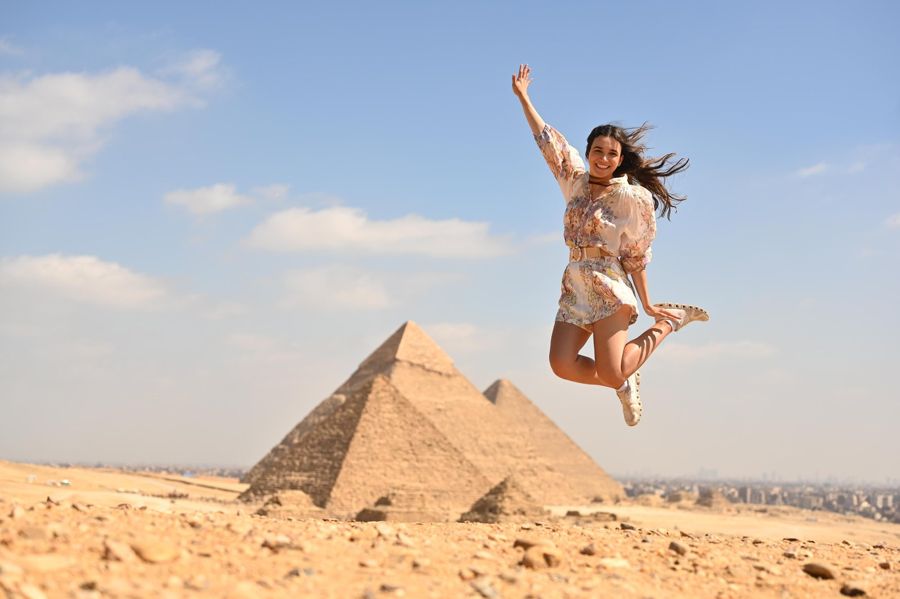
One more clarification upfront, because it regularly causes confusion on site: of the three pyramids on the plateau, this one is the largest, but in many photos it looks smaller than its neighbor. There are two reasons. The middle pyramid stands on higher ground, and it has retained its capstone along with some of its casing. In terms of base area, height, and volume, the Pyramid of Khufu is clearly ahead, not only here but before every other pyramid ever built.
This page provides an overview of the structure as a whole. For the individual chambers, the newly discovered voids, and the construction techniques, there are separate pages, which are referenced at the appropriate points.
Key Facts
- Original height
- 146.6 m, equivalent to 280 Egyptian cubits
- Current height
- about 138.8 m
- Base side
- about 230.3 m, the four sides differ by only centimeters
- Slope of the sides
- 51 degrees 50 minutes
- Blocks
- about 2.3 million
- Mass
- nearly 6 million tons
- Completion
- around 2560 BC, 4th Dynasty
- Current entrance
- a tunnel from the 9th century AD
Cheops or Khufu: Who Was the Builder?
The builder was not called Cheops. He was called Khufu.
Cheops is the Greek rendering of the Egyptian name, passed down by Herodotus and from there into all European languages. In German, the Greek form has prevailed, while in specialist literature the Egyptian form is often used. So if you come across the Pyramid of Khufu, it refers to the same structure.
The structure itself also had a name, and it is revealing. It was called Akhet-Khufu, roughly translated as "Horizon of Khufu." In Egyptian thought, the horizon is the place where the sun passes between worlds. The structure was therefore not a tomb in the sense of a monument, but a machine for a transition: the place where a king changes sides.
Surprisingly little is known about the man Khufu. He ruled in the Fourth Dynasty; the Turin Papyrus king list gives him 23 years, other sources suggest more. Herodotus, writing two thousand years later, describes him as a tyrant who closed the temples, but there is no Egyptian evidence for this, and the story bears all the marks of a late legend.
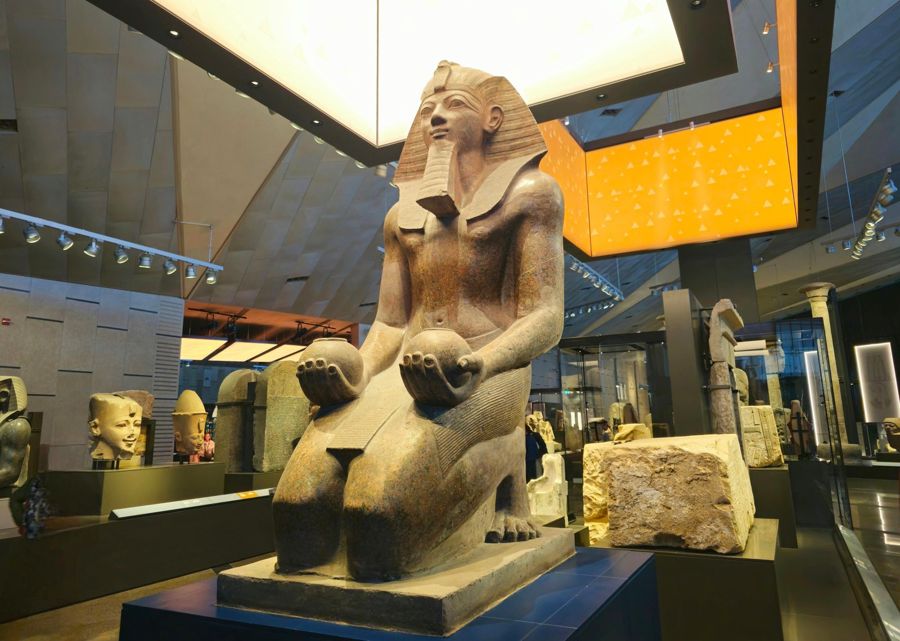
The most striking evidence concerns his depiction. Of the king who built the largest stone structure on Earth, only one fully preserved round sculpture exists: an ivory figurine just 7.5 centimeters tall. Flinders Petrie found it in 1903 in Abydos, in two parts. First the body came to light, the head only three weeks later, after Petrie had systematically sifted the excavated soil. Where it is displayed should be checked before a museum visit: with the opening of the Grand Egyptian Museum, many objects have changed location.
That this structure can be attributed to him at all is thanks to a casual find. In the relieving chambers above the burial chamber, rooms that were never meant to be entered, there are red-painted markings on the walls left by the work crews. They name gang names, and in these names the king's name appears. They are work notes, not dedicatory inscriptions, and that is exactly what makes them so reliable: no one would have bothered to place a forgery in an invisible spot.
A structure of six million tons and a portrait that fits in one hand: this disproportion says more about the state of preservation of the Old Kingdom than any number.
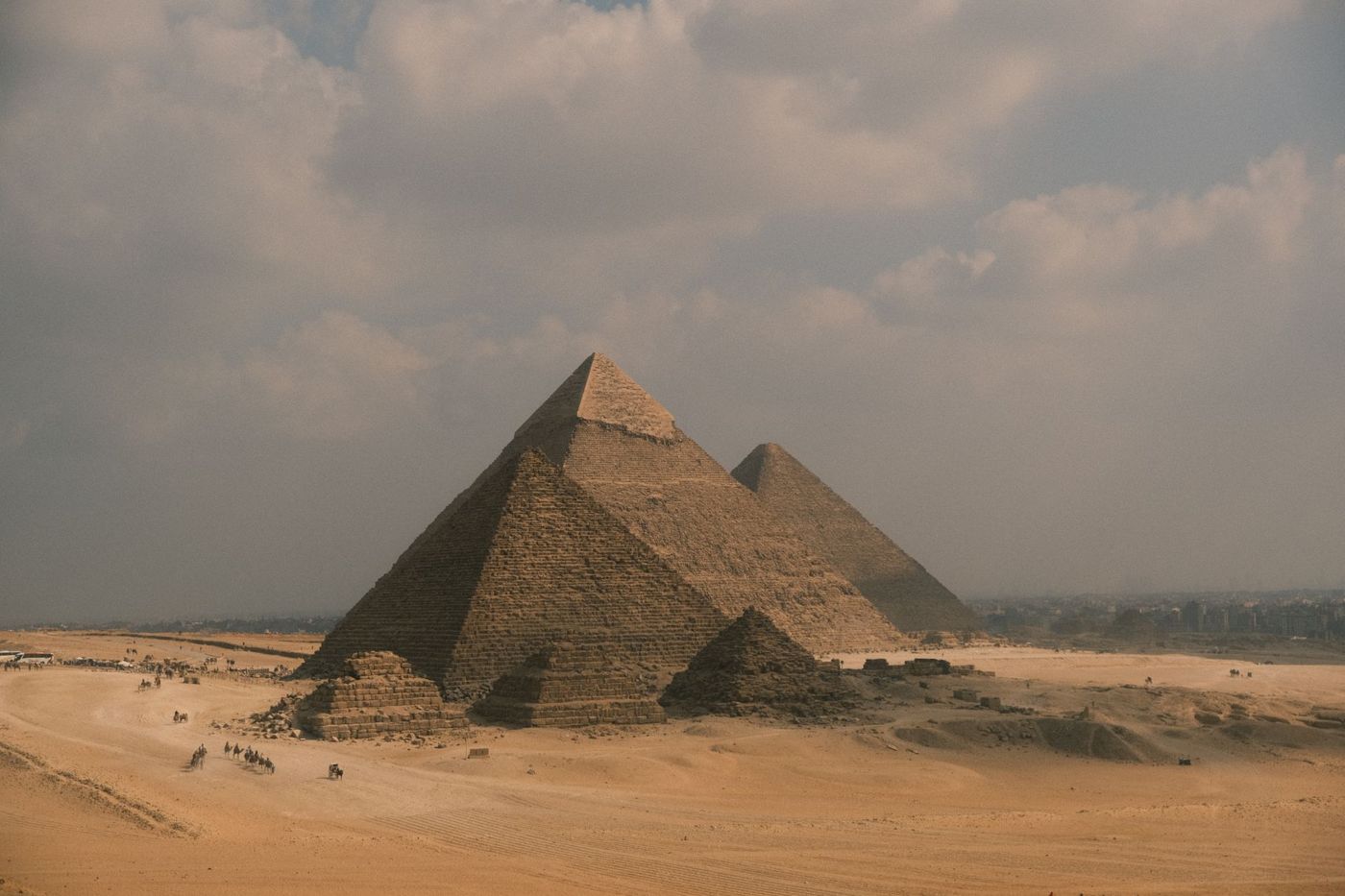
The Dimensions of the Great Pyramid of Khufu
The exterior is where the precision of the construction can be read, and the numbers are the real reason this structure has been measured for two hundred years.
The base is a nearly perfect square with sides of about 230.3 meters. The four sides differ by only a few centimeters, which is fractions of a per mille. The corners are nearly right angles. And the whole thing is not just placed in the terrain but aligned to true north, with a deviation in the range of arc minutes. That is more accurate than what could be achieved with a hand compass.
The slope of the sides is 51 degrees 50 minutes. It was not expressed as an angle but as a ratio of horizontal offset to vertical rise, and in that system it yields a clean value. The Great Pyramid of Khufu is therefore not a product of chance but a calculated design that could be checked on every single block with a simple angle board.
One peculiarity is only visible from the air and only when the sun is low: the four sides are not perfectly flat but slightly concave in the middle. Each side thus consists, strictly speaking, of two very gently inclined halves. Whether this was intentional, a result of construction processes, or a settling effect has not been conclusively determined. It has been visible in photographs since the 1940s.
Remnants of the original white casing survive, and they are in the best place: at the bottom of the north side, where the current entrance is located. A few dozen blocks in their original position, with joints that are barely visible. Standing there, you see on a few square meters how the entire structure once looked.
Two details put the often-quoted number of blocks into perspective. First, the ground is not a level platform but was incorporated into the construction: in the lowest section, a natural rock core is embedded that was never removed. How large it is cannot be determined from the outside, which is why all block counts remain estimates. Second, the surrounding area still had to be leveled, and that was achieved with an accuracy of a few centimeters over the entire base area of more than five hectares.
The top has been missing for a long time. Whether a gilded capstone ever sat there, as is documented for later pyramids, cannot be said. It has never been found.
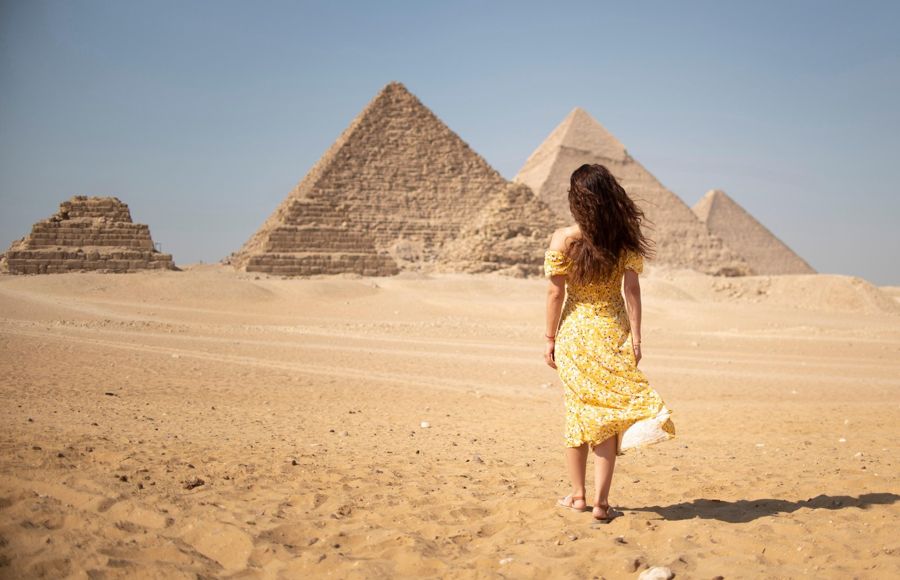
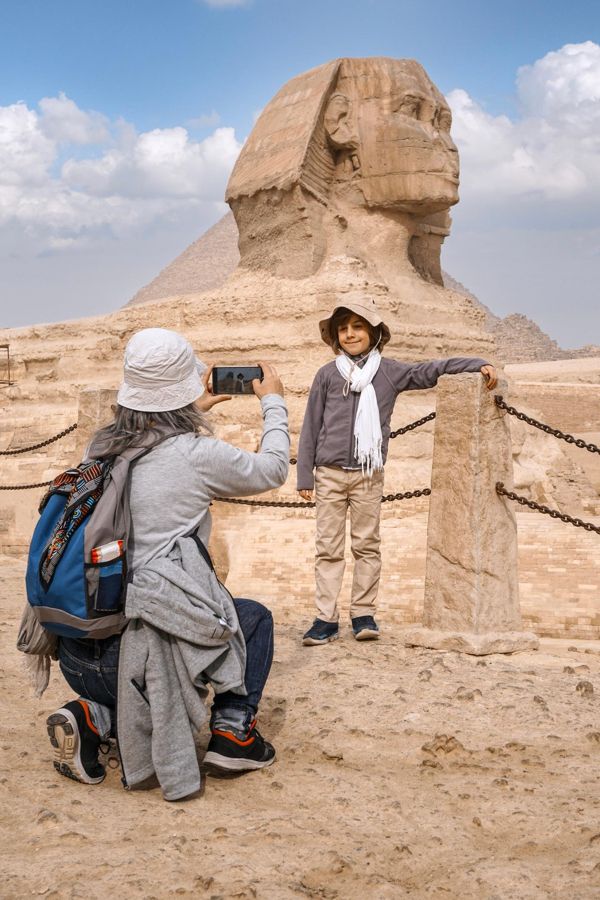
Half-day tour to the Pyramids of Giza and the Sphinx
- The preserved casing blocks on the north side are right along the walking route
- A licensed guide explains the dimensions on site, rather than just reciting them
- Plateau entry, German-speaking guide, and hotel pickup are included
- Free cancellation up to 24 hours before start
The Entrance Is a Break-In Hole
The interior is the biggest surprise for most visitors, in both directions.
First, the access. You do not enter the structure through the original entrance, but through a hole that someone knocked into it. Caliph al-Ma'mun had a tunnel driven into the north face in the 9th century AD, searching for treasure. He hit the existing passage system, and this break-in tunnel is still the way in today. The original entrance lies a few meters higher and significantly further east, and it was originally hidden behind the casing.
That the tunnel hit its target was partly luck, partly calculation. The ascending passage had been sealed after the burial with several multi-ton granite blocks that were lowered from above and wedged tightly. This barrier cannot be opened, only bypassed. Al-Ma'mun's men therefore drove their tunnel sideways past the seal through the softer limestone and hit the passage above the blocks. Those who enter today see the sealing blocks from the other side as they pass.
What Is Visible Inside – and What Is Not
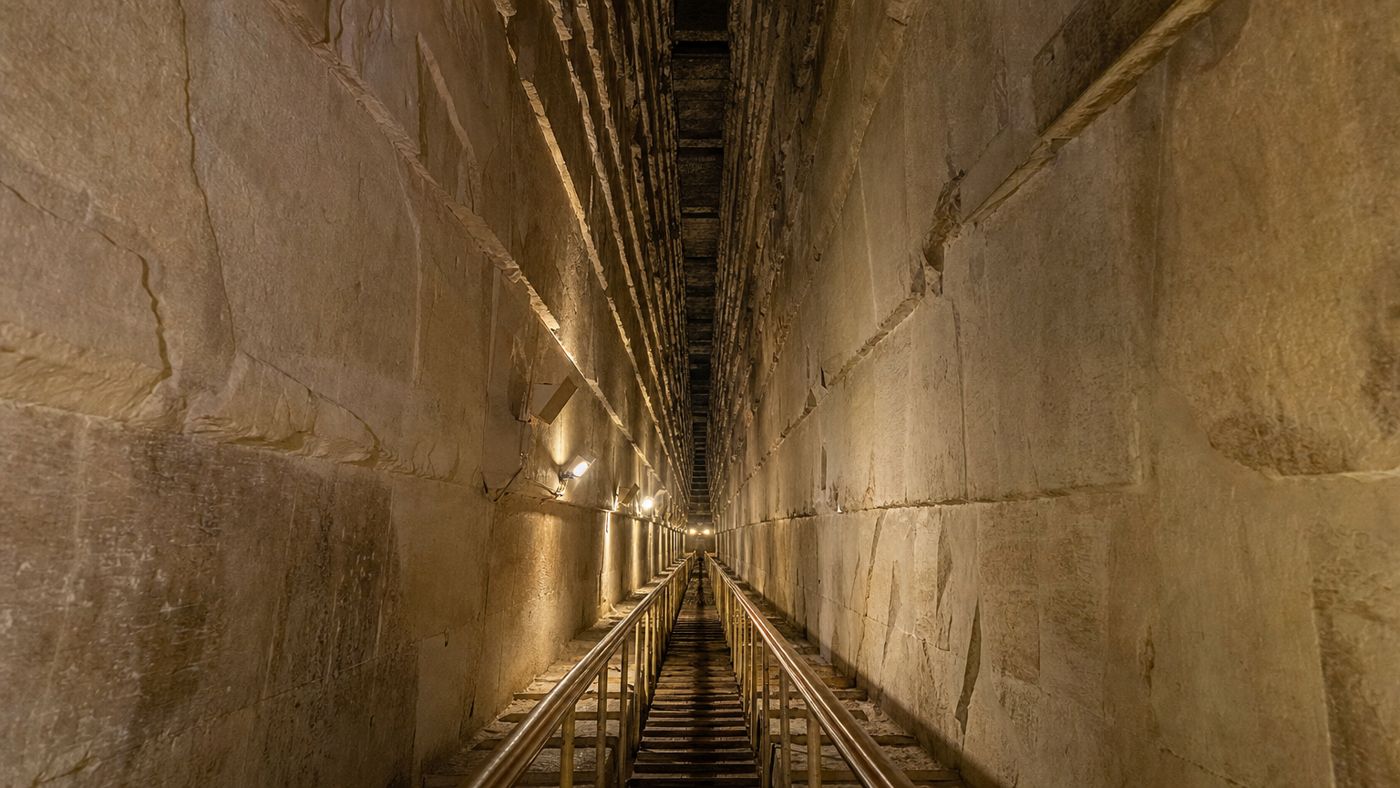
Inside, the route leads over three levels. A descending passage goes deep into the rock beneath the structure and ends in an unfinished chamber. An ascending passage, only about one meter high and nearly forty meters long, leads upward. There the space suddenly widens into the Grand Gallery, a shaft nearly nine meters high and almost forty-seven meters long, with a stepped corbelled ceiling. At the end lies the burial chamber, completely lined with granite, containing a single sarcophagus without a lid.
And now to the second surprise: there are no images. No wall paintings, no reliefs, no inscriptions, no grave goods. The rooms are bare. If you have the colorful burial chambers from documentaries about the Valley of the Kings in mind, you stand here before smooth stone. This is not a loss due to looting, but the state of the Old Kingdom: the decoration of royal burial chambers only came centuries later.
One detail nevertheless deserves mention because it has occupied the discussion for decades. From the burial chamber, two narrow shafts lead diagonally outward and reach the surface. From the second chamber below, two shafts also lead away, but they end in the masonry behind small stone slabs with metal fittings. Since the 1990s, they have been explored several times with specially built robots, most recently with a camera that could see around corners. Behind the first slab lies a short space and then a second slab. What lies beyond is unknown.
The individual rooms have their own stories, and they are too long for this page. There are separate pages for the burial chamber, the Grand Gallery, and the rock chamber underground.
What a Visit Inside Actually Means
- The Entry
Through the break-in tunnel on the north side, a few steps up, then immediately bent over.
- The Ascending Passage
About forty meters at about one meter in height, sloping upward, with cross battens on the floor. The most strenuous section.
- The Grand Gallery
The space suddenly becomes high. Walk upright, still ascending, handrail available.
- The Passage
Bent over again through a low chamber with granite blocks, then into the burial chamber.
- The Burial Chamber
Bare granite room with the sarcophagus. Warm, stuffy, usually crowded. Stay typically a few minutes.
- The Return
Same way back, against oncoming traffic. Allow about half an hour in total.
None of this is accessible. If you suffer from claustrophobia, back problems, or circulatory issues, it is advisable to skip the interior visit.

Guided day tour with option for interior visit
The number of interior tickets is limited daily and issued in two time slots. With this provider, the interior visit is available as an add-on.
What Lies Hidden in the New Voids?
Despite all that is known, the structure continues to pose puzzles, and measurable ones at that.
Since 2015, an international research project has been investigating the interior using muon radiography. Muons are produced when cosmic radiation hits the atmosphere; they penetrate rock and are slowed down to varying degrees depending on material density. Detectors in and around the structure register from which directions more muons arrive than expected, allowing conclusions to be drawn about voids without moving a single stone.
Two findings are confirmed. In 2017, a large void above the Grand Gallery was published, at least thirty meters long. In 2025, the confirmation of a passage behind the chevron stones on the north side followed, backed by three independent measurement methods. Both are in the specialist literature, not rumors.
What these spaces are, no one knows. The sober interpretations consider them construction-related: relieving structures, remnants of an abandoned construction phase, or voids to save weight. The spectacular interpretations suspect untouched chambers. For the spectacular ones, there is so far no evidence, and announcements of an imminent opening should be read for what they are: announcements.
Why not simply look? Because the structure is a protected monument and any drilling would be an irreversible intervention. The responsible authorities allow non-destructive methods, such as measurements, endoscopes through existing joints, and robots in existing shafts. To drill a hole into intact masonry to test a hypothesis is something else, and the restraint is not secrecy but the usual handling of an object of this significance.
What is more remarkable is the fundamental point. A structure that has been systematically measured for four hundred years still contains spaces that no one knew about. What that means for the completeness of our knowledge is the truly interesting question. Details on both finds are on the page about the hidden chambers.
The Pyramid Never Stood Alone
A common misunderstanding: the pyramid never stood alone. It was the main building of a vast complex, most of which is missing today.
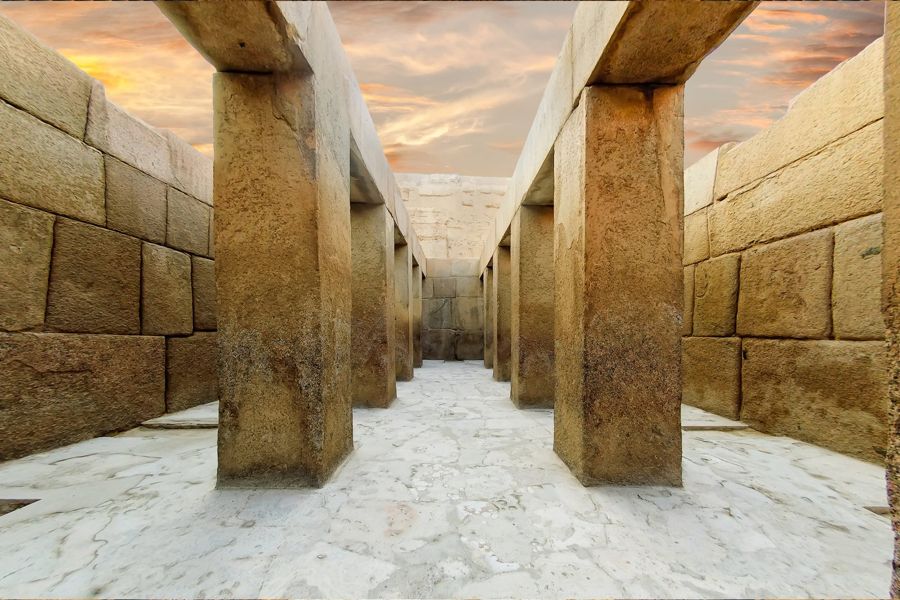
On the east side stood the mortuary temple, whose floor was made of black basalt. From there, a covered causeway led several hundred meters down into the valley to a second temple at the water. This valley temple now lies beneath modern buildings at the foot of the slope and has only been partially excavated. The causeway has disappeared except for remnants.
To the south and east stand smaller pyramids for queens and family members, along with a vast field of mastaba tombs for the court, laid out in strict rows like a city plan. Those who walk across the plateau and take these low stone boxes for foundations are walking through a cemetery of the highest administrative class.
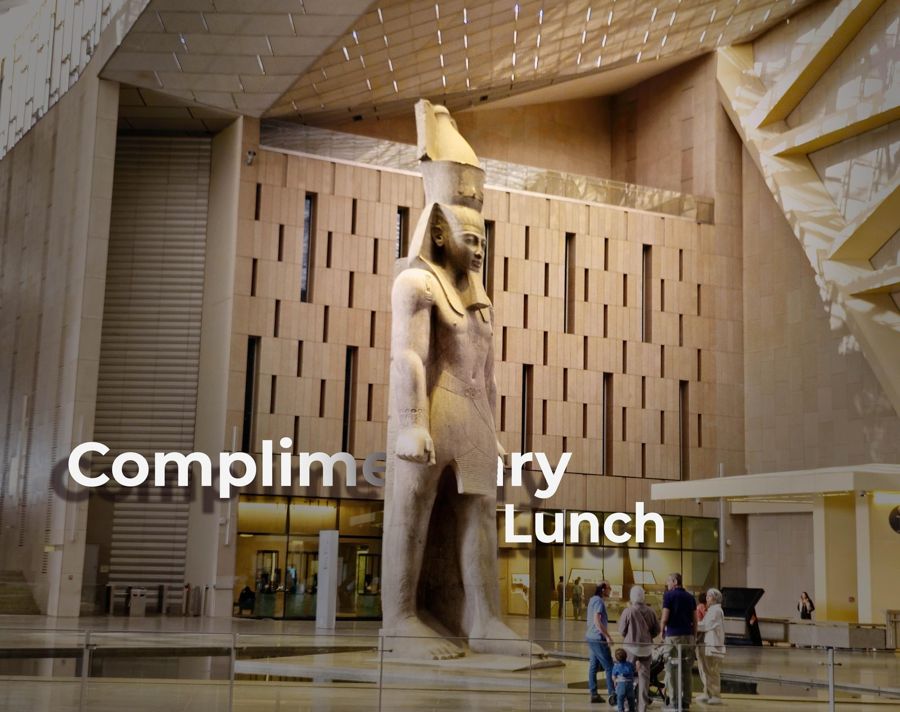
And then there are the boat pits. Seven pits belong to the complex; in two of them lay disassembled ships made of cedar wood. The first was found in 1954, assembled over years, and stood for decades in its own museum right next to the structure. That museum no longer exists. The ship was moved to the Grand Egyptian Museum in 2021; the second followed from late 2025 and is being assembled there in stages. The pits themselves have remained, empty but visible.
Among the queen's pyramids is also the strangest find of the entire complex. In 1925, an excavation team stumbled upon a vertical shaft east of the pyramid, filled with stones. At the bottom lay an untouched chamber with gilded furniture: a bed, a carrying chair, a canopy, along with jewelry and a container with entrails. The furnishings are attributed to the builder's mother. However, the sarcophagus in the chamber was sealed and empty. How this fits together has not been satisfactorily explained to this day.
For travelers, this is the most practically important change of recent years. Those who arrive expecting to see the boat at the plateau will be disappointed. It now stands a few kilometers away, in a new building, together with the rest of the collection.
The entire necropolis has been a UNESCO World Heritage Site since 1979, together with the pyramid fields of Saqqara and Dahshur. What is protected is therefore not a single structure but a landscape.
The Complex and Its Current State
What belonged to the original complex and what is still visible today.
| Component | Originally | Today |
|---|---|---|
| Pyramid | 146.6 m, smoothly cased, with capstone | 138.8 m, core visible, capstone missing |
| Casing | seamless skin of Tura limestone | remnants at the foot of the north side |
| Mortuary temple | east side, floor of basalt | foundation walls and floor slabs |
| Causeway | covered, several hundred meters | only remnants, course reconstructed |
| Valley temple | at the then harbor | under modern buildings, partially excavated |
| Queen's pyramids | three structures on the east side | preserved, significantly lower |
| Boat pits | seven, two with disassembled ships | pits visible, ships in museum |
- Originally
- 146.6 m, smoothly cased, with capstone
- Today
- 138.8 m, core visible, capstone missing
- Originally
- seamless skin of Tura limestone
- Today
- remnants at the foot of the north side
- Originally
- east side, floor of basalt
- Today
- foundation walls and floor slabs
- Originally
- covered, several hundred meters
- Today
- only remnants, course reconstructed
- Originally
- at the then harbor
- Today
- under modern buildings, partially excavated
- Originally
- three structures on the east side
- Today
- preserved, significantly lower
- Originally
- seven, two with disassembled ships
- Today
- pits visible, ships in museum
The whereabouts of the ships changed in 2021 and from late 2025. The former boat museum at the structure no longer exists.
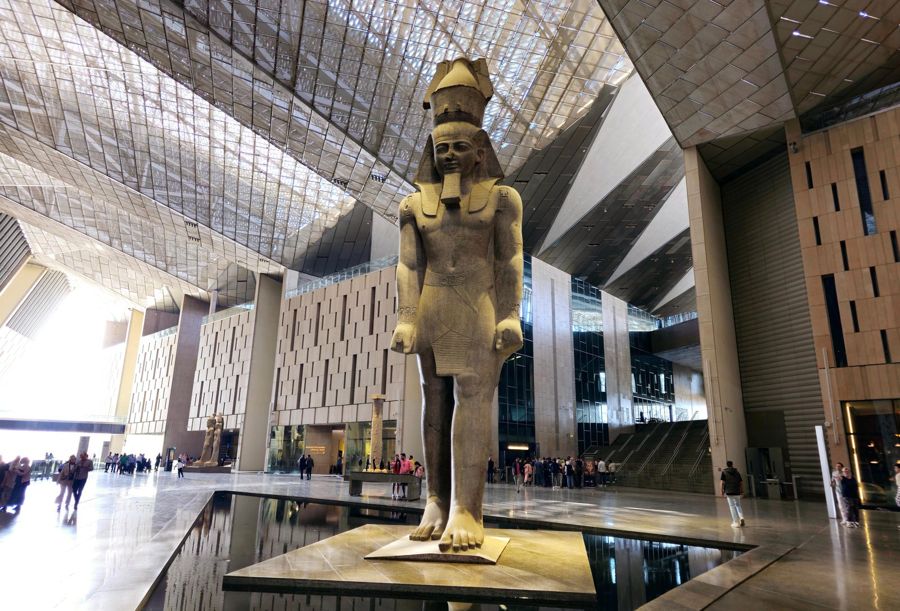
Day tour to the Grand Egyptian Museum and the plateau
- The boat from the boat pit is now in the museum, not at the structure
- Plateau and museum in one day, without organizing two trips yourself
- Entry fees, German-speaking guide, pickup, and lunch are included
- Free cancellation up to 24 hours before start
Access, Tickets, and the Best View
For the visit itself, a lot has changed since 2025, and outdated guidebooks regularly lead astray.
The main access is no longer at the old gate near the hotel in the village center, but at a new visitor center on the desert road in the southwest. Private cars and tour buses are no longer allowed on the site. If you come with a driver, you are dropped off at the gate and picked up there again. On the plateau itself, electric buses run between the main points, and their use is included in the entry fee.
The second gate at the Sphinx in the east is still open but has no ticket office. You can only enter there if you already have your ticket. That is the most common avoidable mishap during a visit.
For the structure itself, you need to make two decisions. The first concerns the time of day: in the morning it is cooler and the north side is favorably lit; in the late afternoon the shadows are better for photos, but it is hotter. The second concerns the interior. It is an additional ticket costing a multiple of the plateau price, the number is capped daily, and the route is narrow, warm, and without any decoration.
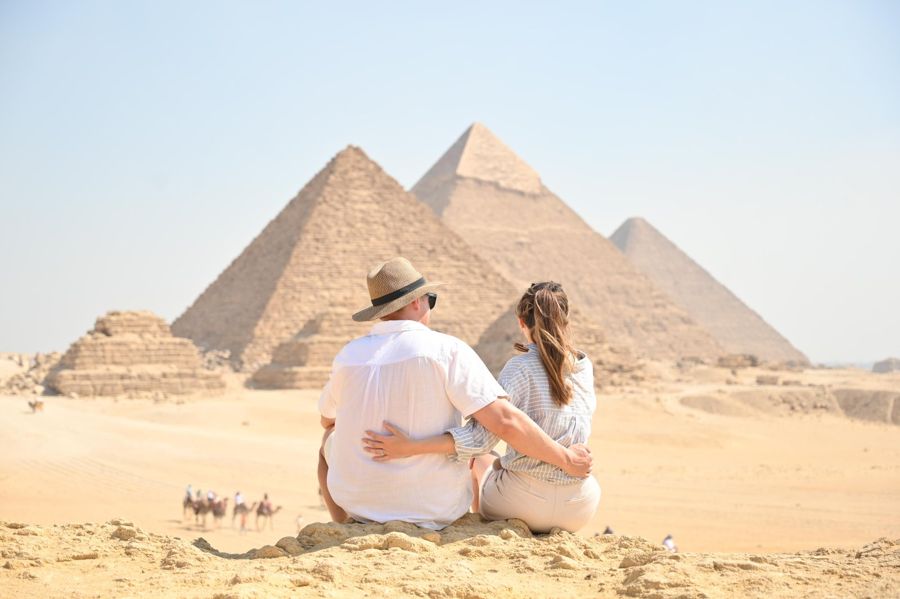
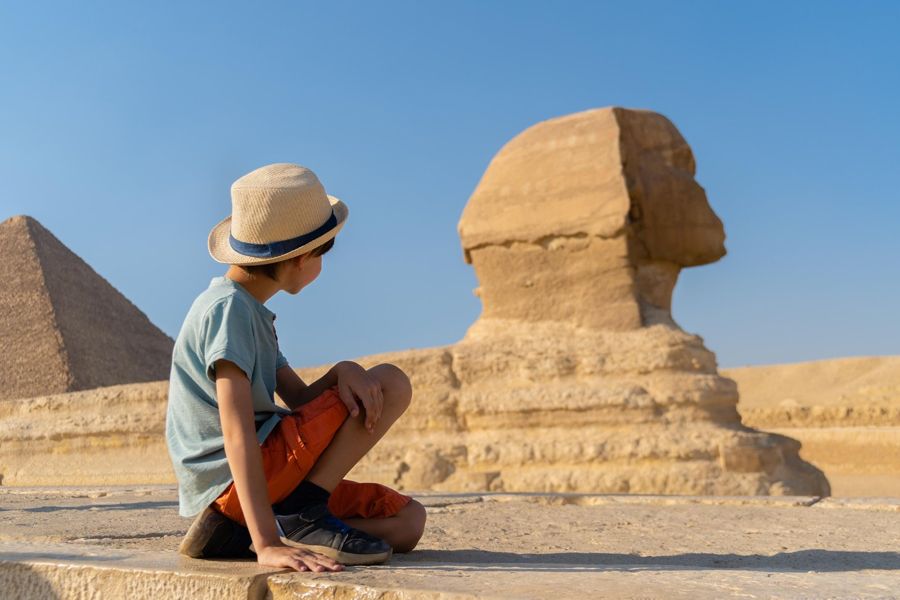
As for the question of where to best see the structure, a brief note: directly in front of it, the size is hard to grasp because the eye finds no reference point. The impression only emerges from a distance, when a person, a vehicle, or one of the secondary pyramids appears in the same frame. For that, there is a designated viewpoint in the southwest where all three structures appear in a row. It has its own page because the approach and the time of day play a bigger role there than at the structure itself.
The honest recommendation is therefore: book the interior if you want the experience of the space, the feeling of standing under six million tons of stone. Do not book it if you want to see something. Outside, there is considerably more to see.
What to Expect on the Plateau
A few practical points that are regularly underestimated on the plateau. There is almost no shade, and the distances between the structures are greater than they look. Sturdy shoes are advisable because the ground consists of sand, loose rubble, and stone steps. Bringing water is not a comfort but a necessity. And expect to be approached at the entrance and at the main points: camel and horse handlers, photo offers, souvenirs. A friendly but firm no and walking on is the most effective response.
One caveat should also be mentioned. Which pyramids are accessible from the inside changes. The administration closes interiors from time to time for restoration or conservation reasons, and this also affects the largest of the three structures. When it is closed, the other two pyramids are usually open and significantly cheaper, and the middle one has an unexpected strength: its passage system is simpler, the chamber lies in the rock rather than in the masonry, and it is usually considerably emptier. As a substitute, that is not a stopgap but for some the more pleasant visit.
Prices change frequently in Egypt and are set in Egyptian pounds; the euro amount fluctuates accordingly with the exchange rate. Current information is on the page about tickets and prices.
Frequently asked questions
What is the Pyramid of Khufu?
The tomb of King Khufu from the 4th Dynasty, built around 2560 BC, originally 146.6 meters high, the largest of the three structures on the plateau and the only surviving one of the seven ancient wonders of the world.
Can you go inside?
Yes, with a separate ticket in limited numbers. The route is narrow, ascending, and without decoration; the visit takes about half an hour.
Why does it look like a staircase?
Because the smooth outer casing is missing. It was removed over centuries and used as building material. What is visible today is the core masonry.
Is the king still inside?
No. The chamber was empty when it was first documented. The sarcophagus without a lid contained nothing.
Is the boat museum still on the plateau?
No. The first ship was moved to the Grand Egyptian Museum in 2021, the second from late 2025. The boat pits themselves are still visible.
How much time should I plan?
For the plateau with all three pyramids and the Sphinx, about three to four hours. With the interior visit, add half an hour plus waiting time.
Plateau entry as a QR code on your phone
There is no ticket office at the Sphinx gate. If you want to enter there, you need the ticket on your phone beforehand.