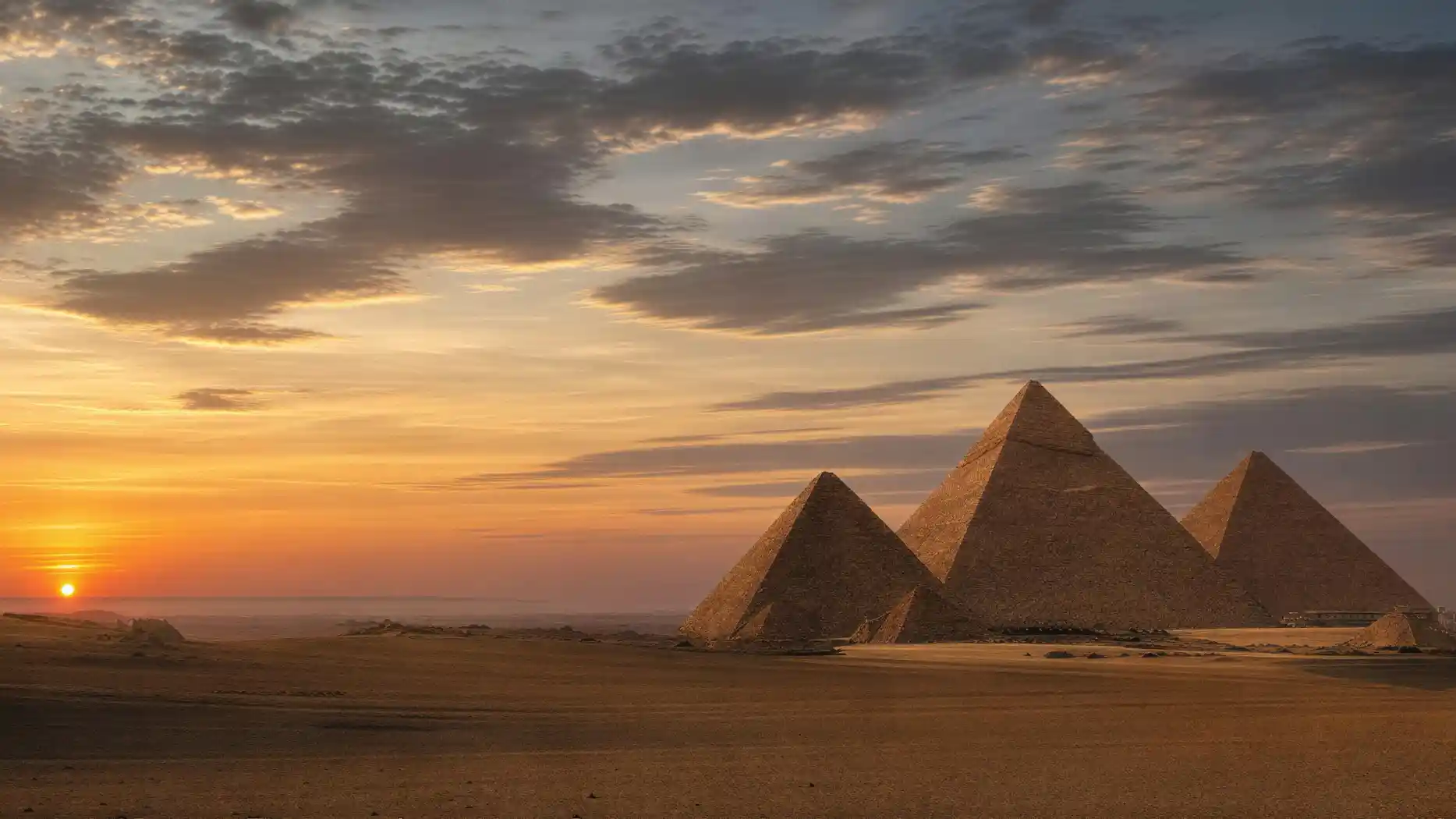
Standing before the Great Pyramid of Khufu today, you see something that was never meant to be visible. The roughly hewn, yellowish blocks stacked in steps were the building's interior. Over them lay a smooth, almost white skin of a completely different stone, and except for a few remnants, it has disappeared.
That is the first and most important point on this question: there is no single building material. Four different types of stone plus a binding agent were used, each from a different region, each for a different purpose, and the distances between these places of origin range from three hundred meters to eight hundred kilometers.
This distribution is neither coincidence nor convenience. It follows a logic that can still be traced today: what was needed in vast quantities came from nearby. What had to be beautiful came from the other side of the river. What had to be extremely durable came from the deep south and was transported across half the Nile. Where the building material of the Pyramids of Giza comes from therefore tells as much about the construction project as the dimensions of the finished structure.
This page is about the materials themselves: which stone sits where, how to recognize it, how heavy the individual blocks and the structures are overall, and which of these materials you can actually touch during a visit. Because one of them literally lies beneath your feet, yet is overlooked by almost everyone.
Five building materials, five places of origin
The distance a material had to travel reveals what it was used for.
| Material | Origin | Distance to the site | Purpose |
|---|---|---|---|
| Rough limestone | The plateau itself | a few hundred meters | Core masonry, by far the largest part of the mass |
| Fine white limestone | Tura, on the opposite east bank | about 15 kilometers across the river | The smooth outer casing |
| Granite | Aswan in the south | about 800 kilometers downstream | Burial chamber, relieving chambers, portcullis stones |
| Basalt | Widan el-Faras in the Faiyum | over 60 kilometers plus water route | Floor of the valley temple |
| Mortar made of gypsum and desert clay | The surroundings of the plateau | extracted and fired on site | Joints, leveling, sliding layer during placement |
- Origin
- The plateau itself
- Distance to the site
- a few hundred meters
- Purpose
- Core masonry, by far the largest part of the mass
- Origin
- Tura, on the opposite east bank
- Distance to the site
- about 15 kilometers across the river
- Purpose
- The smooth outer casing
- Origin
- Aswan in the south
- Distance to the site
- about 800 kilometers downstream
- Purpose
- Burial chamber, relieving chambers, portcullis stones
- Origin
- Widan el-Faras in the Faiyum
- Distance to the site
- over 60 kilometers plus water route
- Purpose
- Floor of the valley temple
- Origin
- The surroundings of the plateau
- Distance to the site
- extracted and fired on site
- Purpose
- Joints, leveling, sliding layer during placement
The core limestone makes up about ninety percent of the mass. The other four materials together determine the appearance and the statics.
The stone comes from the mountain itself
The stone that makes up the mountain comes from the mountain itself. The plateau is not a sand hill but a limestone ridge of the so-called Mokattam Formation, formed about forty million years ago at the bottom of a shallow, warm sea. Exactly this rock was quarried on site and stacked up right next door.
The main quarry lies in a horseshoe shape south of the Great Pyramid, only a few hundred meters from the construction site, and is still visible in the terrain today. Excavations by the Ancient Egypt Research Associates have identified it as the main supplier for the core masonry. The quarry of the Pyramids of Giza was therefore not a distant mine but a pit within sight.
The rock was almost ideal for this task. It splits cleanly along its bedding planes and is additionally crossed by vertical joints. A stonemason therefore did not have to saw the blocks out of a massive rock but could follow natural fracture lines and loosen the rest with wedges and copper chisels. This explains why the limestone of the Pyramids of Giza was available in such quantities despite simple tools.
The quarrying is still visible today in the cut edges. In several places south and southeast of the Great Pyramid, a low, unusually straight rock ledge runs through the terrain, and if you look closely, you can see the incisions along which individual blocks were separated. Some starts were never finished. They show the process mid-motion, similar to a workshop where someone put down the tool and never picked it up again.
If you estimate the size of the stone blocks of the Pyramids of Giza on site, you will be surprised how inconsistent they are. An average core block weighs about two and a half tons and measures roughly one to one and a half meters on each side. Individual pieces, however, weigh nine tons or more. The lowest layers are significantly thicker than the upper ones, and within a layer the blocks vary so much that the joints had to be compensated with smaller stones and mortar.
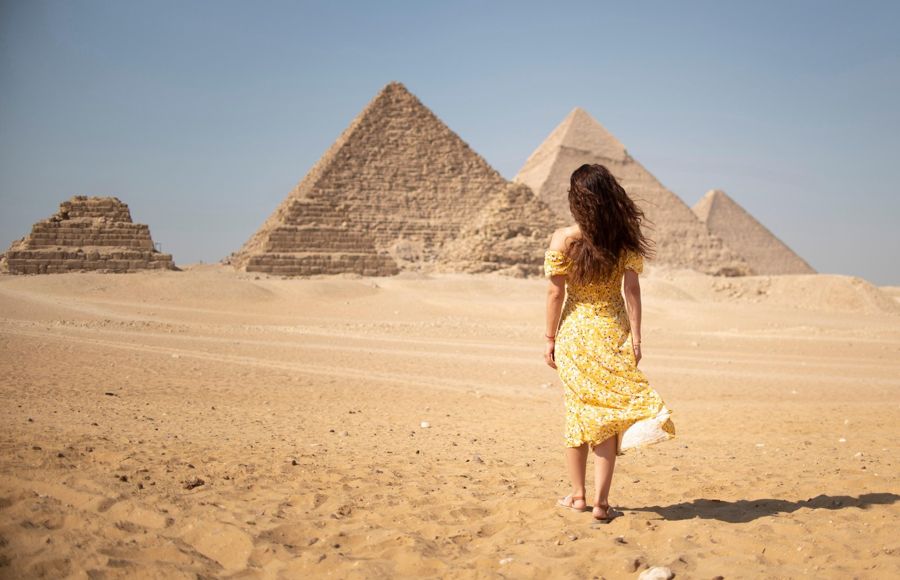
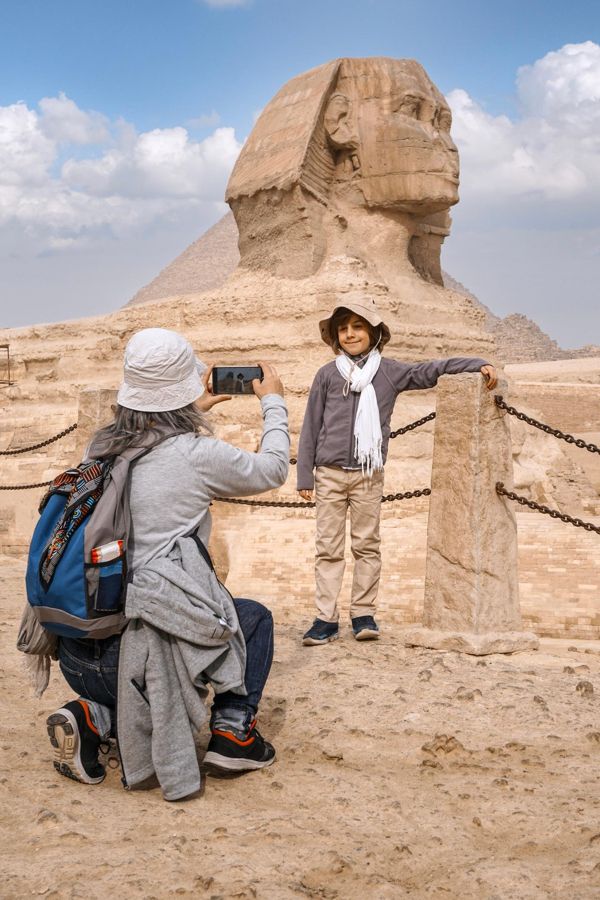
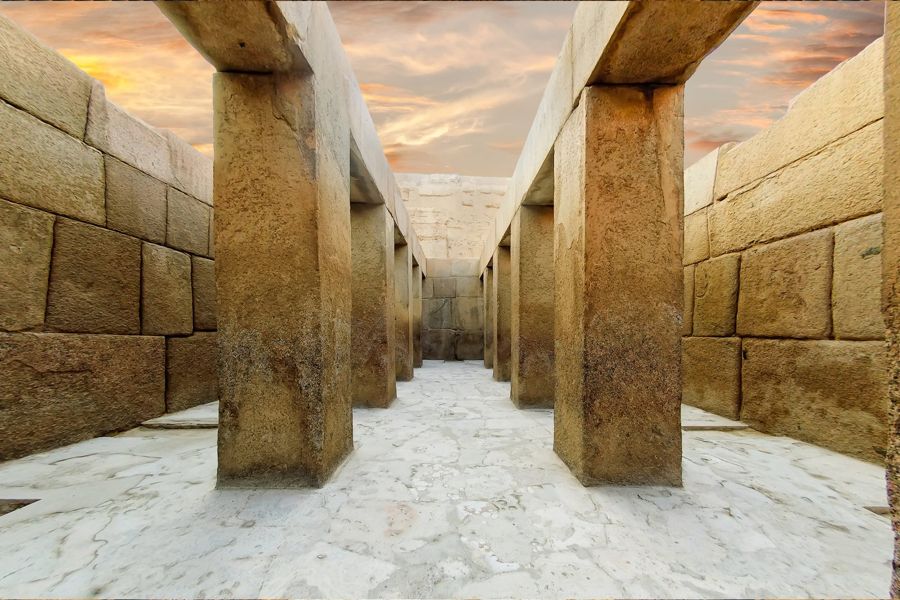
Half-day tour to the Pyramids of Giza and the Sphinx
- The old quarry, the remains of the casing, and the basalt floor are all on the tour route
- A licensed guide explains which stone sits where
- Plateau entry, German-speaking guide, and hotel pickup are included
- Free cancellation up to 24 hours before the start
The fossils in the stone
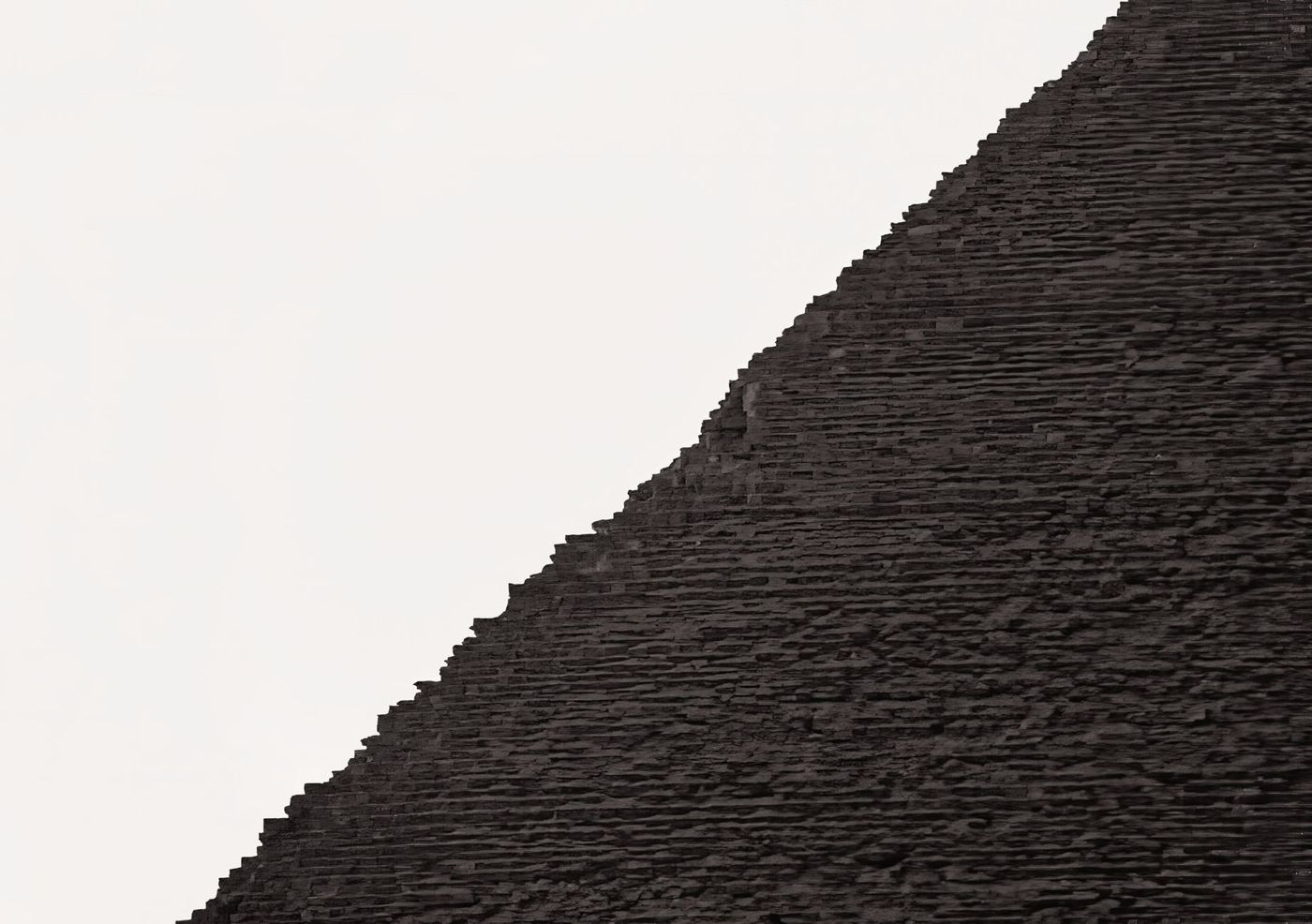
If you get very close to a pyramid flank, you will see small, flat discs in the stone that look like pressed lentils or worn coins. Some are barely a millimeter across, others reach the diameter of a two-euro coin.
They are fossils. Nummulites, single-celled marine organisms with a chambered calcareous shell, lived in unimaginable numbers in the warm shallow sea over what is now Egypt. Their name literally means small coin. The limestone blocks of the Great Pyramid of Khufu contain in places up to forty percent of these fossils, measured by rock volume. The building thus consists to a considerable extent of the skeletons of creatures that died forty million years before its construction.
These discs were already noticed in antiquity. The Greek geographer Strabo visited the plateau around the turn of the era, when the pyramids were already two and a half thousand years old, and was given an explanation on site: they were petrified lentils, remains of the workers' meals. Even then he considered this unlikely, and the modern interpretation of the fossils proves him right.
For visitors, this is the most accessible part of the entire material story. You need no equipment and no permission, just a look from thirty centimeters away at any block in the lower area. The fossils are everywhere.
Which material sits where
- Core masonry
- Casing, today almost completely missing
- Burial chamber and relieving chambers
- Portcullis stones in the passage
- Basalt floor of the valley temple
The percentages are rounded mass fractions and serve for size comparison, not for calculation.
The white limestone from Tura
The second limestone looked completely different. It came from the quarries of Tura on the opposite bank of the Nile, was fine-grained, almost white, and practically free of the fossils that run through the local stone. The original limestone casing of the Great Pyramid of Khufu was made of it: a closed, smoothed outer skin that gave the building a reflective surface.
The processing of these blocks is the true craftsmanship highlight of the entire complex. The joints between two casing stones are in places so narrow that a credit card does not fit through, and that with blocks weighing several tons that had to align exactly on an inclined surface. Today, standing before the rough stepped flank, you see none of that and correspondingly underestimate the precision of the construction.
Only remnants are preserved, and they are worth seeing. At the foot of the north side of the Great Pyramid of Khufu, a row of original casing blocks still lies in its original position. At the top of the middle pyramid sits a closed cap that survived because it was too high to be conveniently removed. And individual pieces are scattered across museums, including a casing stone in Edinburgh that came to Scotland in the 19th century.
Where the rest disappeared and who removed it is a separate and rather tangible story. It is told on the page about the casing stones.
Granite from Aswan, eight hundred kilometers downstream
The third material stands out because it was expensive. There is no granite in the vicinity of Cairo. The stone used comes from the quarries near Aswan, a good eight hundred kilometers upstream, and had to be transported down the entire Nile on barges. About eight thousand tons of it are in the Great Pyramid of Khufu.
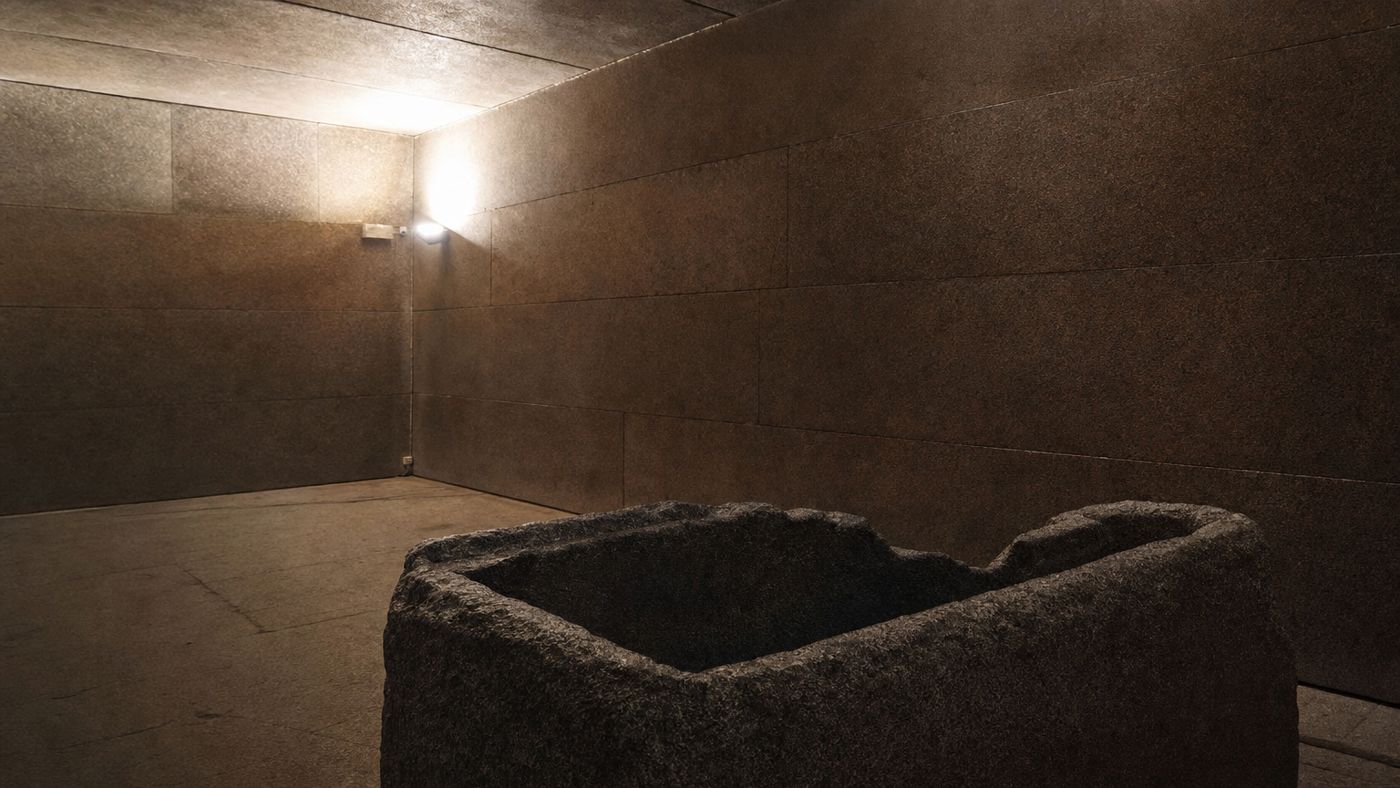
It was used where limestone would not have sufficed. The burial chamber is completely lined with granite, its ceiling consists of nine blocks, the heaviest of which reach into the range of fifty tons. Above it lie five further chambers whose only purpose is to divert the weight of the stone mass above. The portcullis stones that sealed the ascending passage after the burial are also made of granite.
The reason is primarily static. Granite bears loads under which limestone cracks, and precisely at the burial chamber the greatest mass presses down. Added to this is a second level: granite was the highest-ranking building material Egypt knew, dark red to gray speckled, extremely hard to work, and by its very origin a mark of royal reach. Whoever used it showed that they commanded the entire river.
How this stone was even worked is a separate question. Granite cannot be cut with copper tools; it is too hard for that. Instead, work was done with balls of dolerite, an even harder rock, with which the surface was crushed over hours, and for sawing and drilling, sand was used as an abrasive between tool and workpiece. The process is laborious but has been replicated in experiments and explains the tool marks visible on the blocks.
This is most evident at the third and smallest pyramid. Its lowest courses are not clad with limestone but with granite, and a large part of it remains unfinished. The supply was there, the time was not.
Plateau entry as a QR code on your phone
The quarry, the fossils, the casing remnants on the north side, and the basalt floor are all in the freely accessible area. The basic ticket is enough for that.
Mortar and basalt, the always missing
Two materials are missing from almost every list, although one was used in vast quantities and the other has the most spectacular transport story.
The first is mortar. About half a million tons of a mixture of burnt gypsum, desert clay, and limestone chips are in the Great Pyramid of Khufu. It did not hold the blocks together; for that it is far too soft. It served as a leveling layer between irregular surfaces and, when wet, as a sliding film on which a block weighing several tons could be moved the last centimeters with levers. Without this material, setting the blocks would have been much slower.
The second is basalt, and you will only find it if you know where to look. East of the Great Pyramid of Khufu, where the valley temple stood, black, hard-polished slabs lie in the ground. The rock comes from Widan el-Faras on the northern edge of the Faiyum Basin, more than sixty kilometers away and in the middle of the desert.
What is striking is the effort in relation to the result. Basalt was not needed for the pyramid itself but for the floor slabs of a temple only a few dozen meters on each side. For this comparatively small area, a quarry in the middle of the desert was opened, operated, and logistically connected. It is one of the clearest examples that in the Old Kingdom, material selection was not decided by the least effort but by the significance of the place.
To move it at all, a paved road of about eleven and a half kilometers in length was built from the quarry to the shore of the then lake. It is considered the oldest known paved road in the world. It was built not for the pyramid itself but for the floor of a temple next to it.
All five materials in one morning
Start at the north side of the Great Pyramid of Khufu at the preserved casing blocks, then go close to any flank and look for the nummulites in the core stone. The mortar sits in the same joints. East of that lies the black basalt floor of the valley temple, usually completely unnoticed. The granite is the only one for which you additionally have to go inside, or you can see it on the exterior at the base of the third pyramid.
The weight, and where the number comes from
That leaves the question of the total weight, and that is more difficult than it sounds. No one has weighed the blocks. The volume of the structure is known fairly precisely, the density of the limestone used is known, and from that it is calculated, with the cavities and joints slightly distorting the calculation.
The common estimate for the Great Pyramid of Khufu is just under six million tons. Of that, about five and a half million tons are limestone, half a million tons are mortar, and eight thousand tons are granite. For comparison: a fully loaded freight train weighs about two thousand tons. You would therefore need about three thousand of them to move the material of just one of these structures.
For the entire complex, this cannot simply be tripled. The middle pyramid has a slightly smaller volume than the large one, and the third hardly weighs in comparison: it does not even reach a tenth of the mass of its two neighbors. If you want a rough figure for the ensemble, twice the Great Pyramid of Khufu is closer to the truth than three times.
What these numbers above all show is a setting of priorities. Ninety percent of the mass was cheap and lay within sight. The effort went into the small proportions: into the skin that was seen and into the chamber where the king lay.
Frequently asked questions
What is the Great Pyramid of Khufu made of?
For the most part, it is made of rough limestone from the plateau itself, plus fine limestone from Tura for the outer casing, granite from Aswan for the burial chamber, and about half a million tons of mortar in the joints.
How much does the Great Pyramid of Khufu weigh?
The common estimate is just under six million tons. It was never weighed; the number is calculated from volume and rock density.
How much do the Pyramids of Giza weigh together?
Only the order of magnitude is reliable. The middle pyramid is slightly below the large one, and the third does not even reach a tenth of that. About twice the Great Pyramid of Khufu is the more realistic rough figure.
Are the pyramids made of sandstone?
No. Sandstone was used in Egypt mainly in the south, for example in the temples of Luxor. In Giza, limestone dominates, supplemented by granite and basalt.
Why do the stones look yellowish?
That is the color of the local limestone, additionally weathered and covered with desert dust. The original impression was different: a bright, closed surface.

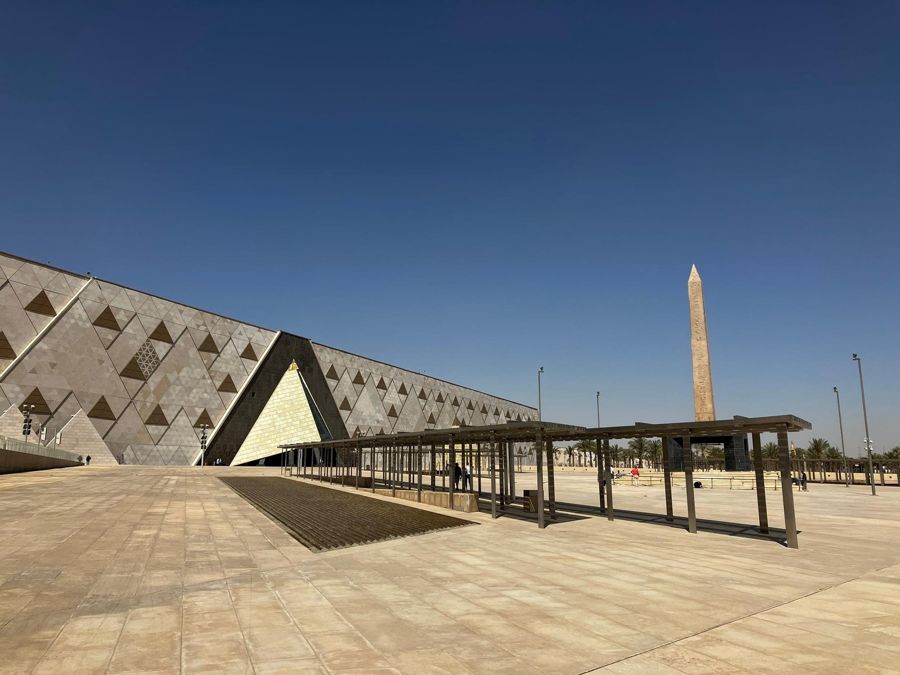
Private tour to the Grand Egyptian Museum and the Pyramids
- In the museum, you can see the objects that allow you to trace stone working in detail
- Privately guided, so there is time for questions about the rock instead of a fixed group rhythm
- Plateau entry, German-speaking guide, pickup, and lunch are included
- Free cancellation up to 24 hours before the start