
The usual answer is: around 2560 BC. It appears in reference works, on signs, and in every guidebook, and it is not wrong.
It is only something different from what most readers assume. It is not a read-off date and not a measurement result. It is the result of a chain of conclusions that rests on assumptions at several points, and this chain can be followed link by link.
That is not a relativization. In the end, a remarkably robust statement remains: the three great pyramids were built in the 26th century BC, within about eighty years, under three successive kings. This statement is supported by several independent methods and is not seriously disputed by research.
What cannot be stated precisely, however, is the exact year. And the reason for that is so unexpected that it deserves the rest of this page: the entire calculation depends, among other things, on how often cattle were counted in the Old Kingdom.
How long did Khufu rule? Four sources, four answers
Years of reign
The construction time of the Great Pyramid cannot be longer than the reign of its builder. How long that reign was is an open question.
Turin King List; Papyri from Wadi al-Jarf; Graffito in a chamber above the King's Chamber; Herodotus, Histories II; Manetho in later transmission
Egypt had no continuous year count
To understand how the date comes about, you have to take a detour. The ancient Egyptians did not have a continuous year count like ours.
There was no era from which years were counted, no year zero, no calendar that ran on across dynasties. Instead, dates were given according to the reign of the respective king: in the third year of Khufu, in the seventh year of Khafre. When a king died, the count started again at one.
For the administration, that was practical. For posterity, it is a problem, because such a date is only as good as the knowledge about when that king reigned and for how long. You get a relative sequence without gaps, but no absolute fixed point.
Egyptology therefore builds its chronology in two steps. First, the relative order: which king followed which, and how many years did each one rule? For this, king lists and administrative documents are used. Second, the anchoring: at which point can this chain be attached to our calendar? For this, astronomical data or scientific dating methods are needed.
For the anchoring, there is classically an astronomical path, and it deserves a brief explanation, because it plays a major role in older books. The Egyptian administrative calendar had 365 days without a leap day. It therefore drifted against the solar year by one day every four years, and only after about 1,460 years did both coincide again. If a text notes on which calendar day the star Sirius reappeared in the morning sky after its period of invisibility, one can calculate backwards in which section of this long cycle the document was created.
That is elegant and has carried Egyptology for a long time. It has three weaknesses, however. The observation depends on the geographical latitude of the observer, and where exactly the observation was made is usually not stated; a mix-up shifts the result by decades. Because the calendar drifts only one day every four years, each single observation fits four possible years. And above all: such dates are only available from the Middle Kingdom onward, not earlier.
For the pyramids of Giza, this path is therefore useless. The Old Kingdom lies before the first usable astronomical anchor. One has to calculate backwards from later epochs, and every uncertainty along the way travels with you.
Every error in the first step shifts everything that comes before it. And because the Old Kingdom is at the very beginning of the chain, all the uncertainties of all later epochs accumulate there.
A tattered papyrus in Turin
The most important source for the first step is a tattered piece of papyrus in Turin.
The Turin King List dates from the New Kingdom, more than a thousand years after the pyramids were built, and lists the rulers of Egypt with their reign lengths. It is the most complete preserved list of its kind. It is also badly damaged: the document was brought to Europe in fragments in the 19th century and further destroyed on the way, so that precisely the numbers that matter are missing in many places.
For Khufu, this papyrus gives about 23 years of reign. This number was long the basis of all calculations and is indirectly contained in the date 2560 BC.
There are also two other traditions that one should know because they are constantly cited. Manetho, an Egyptian priest of the Ptolemaic period, wrote a history of Egypt in Greek and gives Khufu 63 years. Herodotus, even earlier, gives 50. Both wrote more than two thousand years after the events, both survive only in quotations by later authors, and both contradict the archaeological findings in many places. As sources for the Old Kingdom they are of little use, but as evidence of what antiquity itself believed, they are very useful.
This leaves the calculation standing on a single serious leg: the 23 years from Turin. And precisely this leg has begun to wobble in recent years.


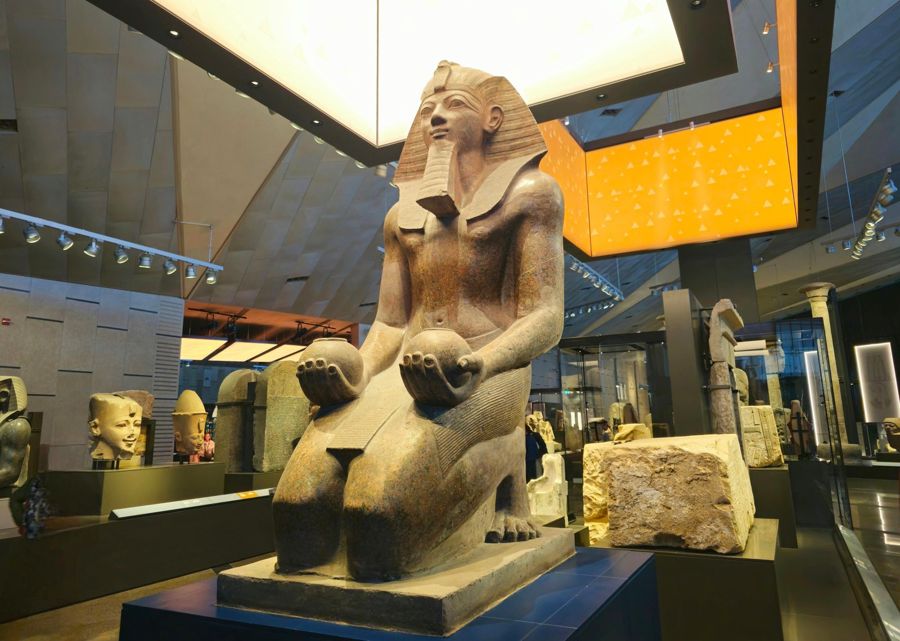
Full-day tour to the Grand Egyptian Museum, the pyramids, and the Sphinx
- The dated finds lie in the museum, the structures stand on the plateau
- Plateau entry, German-speaking guide, pickup, and lunch are included
- Seven to eight hours, without having to organize anything between two places yourself
- Free cancellation up to 24 hours in advance
The cattle count on which the chronology hangs
The reason is an administrative process that sounds more harmless than it is for chronology: the cattle count.
In the Old Kingdom, the livestock of the country was periodically recorded as a basis for taxes. Because this was a large, nationwide event, the administration used it for dating. Documents bear entries such as “year of the seventh count” or “year after the thirteenth count.” For the officials, this was unambiguous. For us, it can only be translated into reign years if we know the interval at which the count took place.
And that we do not know for certain. There are indications of an annual count and indications of a biennial one, and the practice seems to have changed over time. If the count was annual, the thirteenth count corresponds roughly to the thirteenth year of reign. If it was biennial, it corresponds to about the twenty-sixth.
This is the point where the chronology of the Old Kingdom diverges. The same inscription means one thing or double, depending on the assumption. For a single king, that makes a decade; over an entire dynasty, it adds up to centuries.
Compounding the difficulty, the practice apparently changed. For some reigns, the preserved counts suggest a biennial rhythm; for others, the intervals speak more for an annual survey; and for still others, the data is too thin for a statement. A uniform rule that could be applied to all kings does not exist. Each reign must be judged individually, and for most kings of the Old Kingdom, too few dated documents survive for that.
Specifically for Khufu: in the papyri from Wadi al-Jarf, there is a date in the year after the thirteenth count. With a biennial count, that gives at least 26 or 27 years of reign, thus clearly more than the 23 from Turin. In addition, there is a graffito from one of the chambers above the King's Chamber that mentions an even higher count. If this is also to be read as biennial, one would arrive at over thirty years.
Where the figures come from and what they are worth
Four types of sources with very different evidentiary value.
| Source | Created | What it provides | Reliability |
|---|---|---|---|
| Turin King List | New Kingdom, over 1,000 years later | Reign lengths in years | good, but fragmentarily preserved |
| Contemporary administrative texts | Time of construction itself | Dates according to cattle counts | highest, but in need of interpretation |
| Manetho and Herodotus | 2,000 years later, Greek | Reign lengths and anecdotes | low for the Old Kingdom |
| Radiocarbon dates | modern measurement | absolute time spans with error range | high within the framework, imprecise in the year |
- Created
- New Kingdom, over 1,000 years later
- What it provides
- Reign lengths in years
- Reliability
- good, but fragmentarily preserved
- Created
- Time of construction itself
- What it provides
- Dates according to cattle counts
- Reliability
- highest, but in need of interpretation
- Created
- 2,000 years later, Greek
- What it provides
- Reign lengths and anecdotes
- Reliability
- low for the Old Kingdom
- Created
- modern measurement
- What it provides
- absolute time spans with error range
- Reliability
- high within the framework, imprecise in the year
None of these sources suffices alone. The common date only emerges when they are compared against each other.
Why the radiocarbon dates are not sharper
The question remains why one does not simply anchor the chain scientifically and bypass the whole dispute.
One does do that, and it works, but not with the sharpness that many expect. Between 1984 and 1995, over 450 organic samples from structures of the Old and Middle Kingdoms were dated, mostly charcoal and plant remains from mortar. The results lay on average one hundred to two hundred years above the historically derived dates and scattered considerably. For the Great Pyramid alone, the individual values spread over a range of about four hundred years.
Part of that is explainable. Whoever burns old wood dates the wood, not the construction site. The experts involved, however, did not consider this old-wood effect itself a sufficient explanation, because it is unlikely that centuries-old material was burned throughout.
At this point, many ask why one does not simply count tree rings. Dendrochronology provides day-exact dates elsewhere by stringing together ring patterns of trees over millennia. In Egypt, that does not work. There are hardly any native trees with usable tree rings, because the climate does not force pronounced growth pauses, and the imported construction wood comes from Lebanon, where a continuous reference curve for this period is missing. Exactly the method that would answer the question in an afternoon is not available here. How difficult calibration in the Nile Valley is has been documented for decades by radiocarbon research in Oxford.
A much further step was taken by an approach presented in 2010 in the journal Science. Instead of arbitrary organic remains, only short-lived plant parts were dated, that is, material that grew and was consumed in the same year, and from contexts that can be assigned to a specific reign. Over two hundred such measurements were then fed into a statistical model that incorporated the transmitted reign lengths as an additional condition. The result of this work reduces the uncertainty in some places to under twenty years.
For the Old Kingdom, this approach yields values that tend to be somewhat older than the classical historical estimate. It thus confirms the order of magnitude and shifts the fine-tuning. That Egypt in the Nile Valley also shows a small systematic offset due to the growth period of the plants is another example of how many corrections are hidden in an apparently simple year.
The find of Wadi al-Jarf
The strongest anchor so far came from a find that no one had expected, and not in Giza, but about two hundred kilometers away on the Red Sea.
In 2013, a French-Egyptian team uncovered the oldest inscribed papyri of Egypt in old harbor galleries at Wadi al-Jarf. Among them is the duty log of an inspector named Merer. Over months, he noted how his crew brought limestone blocks from the quarries of Tura by boat to Giza, with dates, quantities, and destinations.
The value of this find for dating can hardly be overestimated. For the first time, a document exists that was written during the construction, was involved at the site, and itself bears a date. All other sources are either much later or carry no date.
At the same time, precisely this find shows where the limits lie. Its date is not “in year 26,” but “in the year after the thirteenth count.” Even the oldest and best document thus brings us only as far as we understand the counting method. It shifts the probable reign length of Khufu upward and confirms the epoch, but it does not provide a year in our calendar.
Incidentally, the papyri provide a picture of the operation that no king list reveals. Merer's crew comprised about two hundred men. They not only transported, but also worked on waterworks and were evidently deployed at several locations. The trips to Giza each took a few days, and there were several per month. From such details, one can extrapolate how many blocks a single team moved per year, and that gives a more realistic picture of the construction site than any total number.
This is how chronology works: a find improves the resolution at one point and thereby reveals which assumption still carries at another.
What the ground reveals about the order
The question remains why the order is so much more certain than the year. The answer lies in the ground.
The plateau is not a place where three structures stand independently side by side. They interlock. The causeway of Khafre and the Sphinx ditch are cut into areas where stones had previously been quarried for the older complex. Where one complex cuts into the quarry area of another, the sequence is unambiguous, entirely without a calendar. Such overlaps occur at several points on the plateau.
In addition, there are the cemeteries. East and west of the Great Pyramid lie entire streets of mastabas, laid out in planned rows, not grown organically. They were assigned to family members and high officials, and in them stand titles and names. When an official states in his tomb under which king he served, he links his tomb to a reign, and through the location of the tomb, that reign is in turn tied to the construction sequence of the pyramid next to it.
The structures themselves also carry clues. The Pyramid of Menkaure has a granite casing that was smoothed from bottom to top and breaks off in the middle of the work. Such unfinished states are chronological statements: here something ended with the death of a builder, and what came afterward looks different.
Finally, style helps. Statues, reliefs, and vessel forms change over generations in comprehensible steps. An expert can place a piece of the Old Kingdom in a sequence even without a name on it, much as furniture or cars can be assigned to a decade without a date being engraved.
From all this emerges a dense network of relative relationships. It reliably says what came before what and how many generations lie in between. It just does not say when. For the when, one needs the chain of king lists, reign lengths, and measurements, and that chain is exactly as strong as its weakest link allows.
The dating of Khufu's structure
Which number should you use, then, if you need one?
For most purposes, “around 2560 BC” is the right answer for the Great Pyramid, and “26th century BC” is the right answer for the entire complex. Both figures are professionally defensible, both are widespread in the literature, and both already carry the imprecision in the word “around.”
For the three structures individually, the common approximations are: the Great Pyramid around 2560 BC, the Pyramid of Khafre about a generation later, the Pyramid of Menkaure another generation after that. If you need a single number for the entire complex, for example for a caption, “25th to 26th century BC” is correct and requires no qualification.
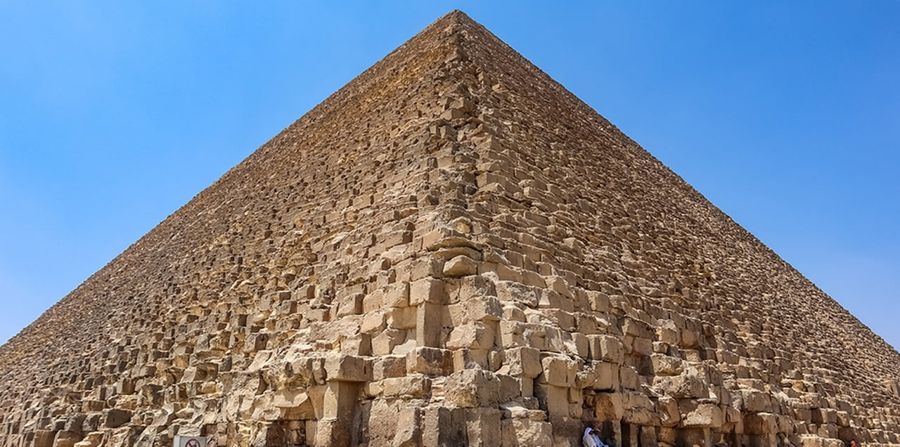
More important than the decimal place is the order, and that is secure. First the Great Pyramid, then the Pyramid of Khafre, then the significantly smaller Pyramid of Menkaure. The Sphinx belongs with high probability to the time of Khafre. The entire construction phase spans about three generations.
Caution is advised as soon as someone gives a year without “around,” especially if it sounds very precise. Figures like 2560 BC are roundings of a calculation with an error range of several decades. Whoever presents them as exact has either copied or does not understand what they are citing.
Practically, a look at the wording helps. Museum and excavation labels usually write “around” or give a range, such as 2600 to 2500 BC, and sometimes name the underlying chronology. Popular presentations omit both. When two sources differ by fifty or eighty years, they usually do not contradict each other, but follow different approaches. Only with deviations of several centuries does it pay to check the origin of the number.
And likewise caution with much older dates. Whoever dates the complex to ten or twelve thousand years must not only justify a different year, but explain why all administrative texts, king lists, workers' settlements, tombs, and over four hundred radiocarbon samples should point in the same wrong direction. No one has yet provided that explanation.
Private guided tour of the plateau, duration by arrangement
If you want to ask about the details, you are in bad hands in a group. Privately, the duration can be adapted to your own questions.
Frequently asked questions
When was the Great Pyramid built?
According to the common dating, around 2560 BC, during the reign of King Khufu. The figure has an error range of several decades.
Why do different books give different years?
Because they follow different chronologies. The differences arise mainly from the question of whether the ancient Egyptian cattle count took place annually or biennially.
Can the stones themselves be dated?
No. Radiocarbon dating works only on organic material. Therefore, the charcoal in the mortar is dated, not the limestone.
In what order were the three pyramids built?
Khufu, then Khafre, then Menkaure, within about eighty years under three successive kings.
We know the order better than the year
There is a sentence on this page that does all the work: we know the order better than the year.
That sounds like an admission and is in truth a rather strong statement. Egyptology can say who ruled after whom, which structure was built before which, which official served under which king, and in what order the chambers of a pyramid were planned. It can do this over centuries, supported by administrative writing, tombs, and building findings.
This order suffices for almost everything one wants to do with a date. It answers whether the Sphinx is older than the smallest pyramid, whether the workers' settlement belongs to the construction period, whether a tomb was built before or after the structure next to it. Only the one question that stands in the search field is not answered directly.
What it cannot do is pin the same chain to our calendar without inserting an assumption at one point. And that this assumption concerns precisely the frequency of a cattle count is the most beautiful detail of the whole matter. An administrative process from the third millennium BC decides which year stands on the sign in front of the pyramid today.
The next time you read 2560 BC somewhere, you now know what is in that number: a damaged king list from Turin, a duty log from the Red Sea, four hundred radiocarbon samples, a statistical model, and an open question about cattle.

Tour to the pyramids and the Museum of Egyptian Civilization
- Connects the structures with the finds from which their dating comes
- Plateau entry and pickup are included
- Three to eight hours, the scope can be adapted to the day
- Free cancellation up to 24 hours in advance