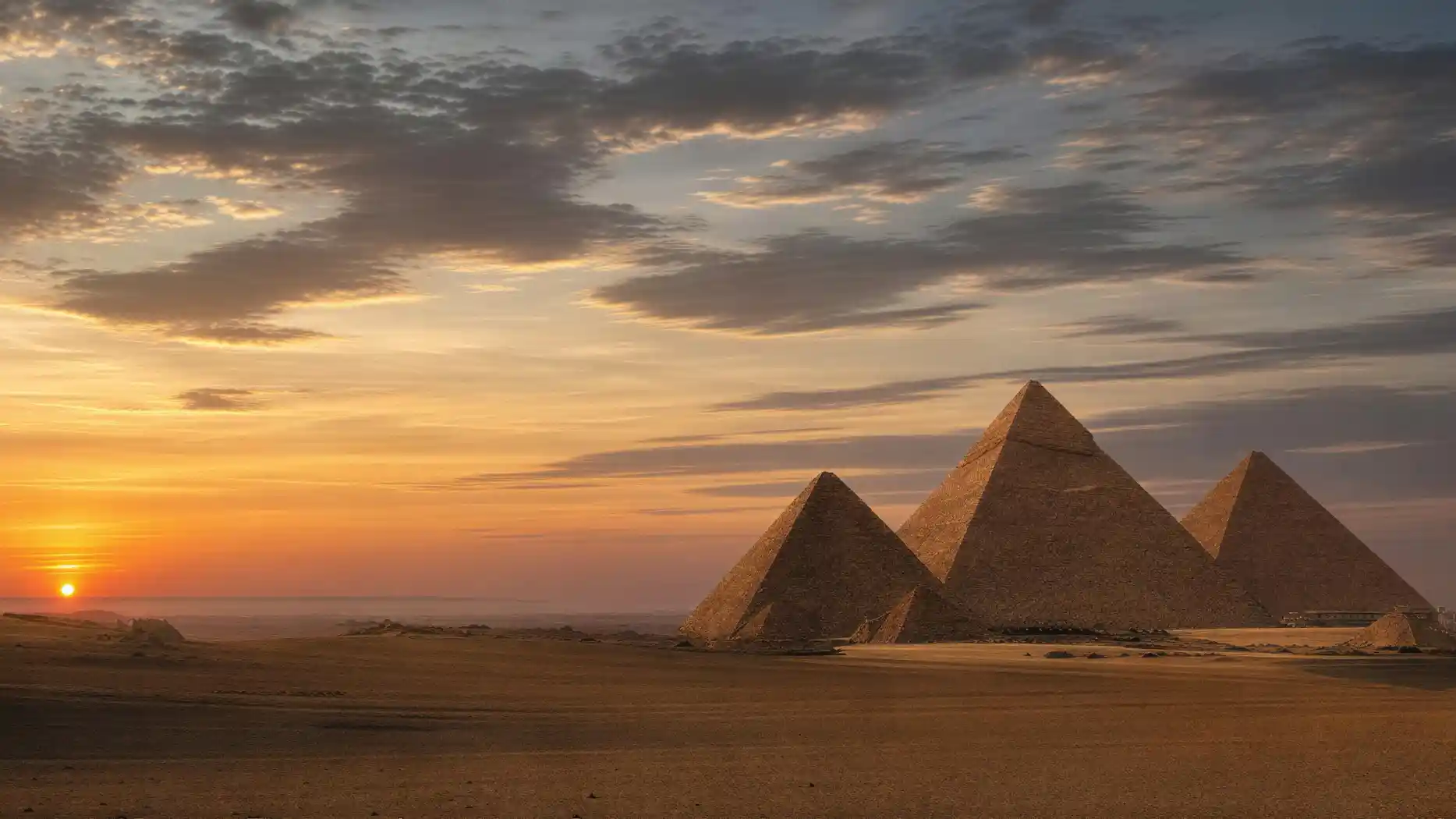
Most people carry a mental image when they think of the inside of a pyramid: painted walls, rows of hieroglyphs, golden grave goods in torchlight. That image comes from the Valley of the Kings, from tombs a thousand years younger.
In the pyramids of Giza, there is none of that. No wall paintings, no reliefs, no inscriptions in the accessible chambers. What you see is stone: polished limestone, red granite in the most important spot, nothing else. If you know this beforehand, you'll experience something impressive. If you don't, you'll come out disappointed and have paid a relatively high price for it.
That's exactly why the question of the interior is not a side issue but the most important decision you'll make for your visit. The plateau ticket gets you close to all three pyramids. Going inside costs extra, for the Great Pyramid of Khufu a multiple, and the number of tickets is capped.
What you get inside is something other than decoration, and for many it's more. You stand in a structure whose chambers have been in the same spot for four and a half thousand years, in passages so narrow that you touch the tool marks on the wall with your shoulder. The impression comes not from images but from scale, precision, and the sheer amount of rock above your head.
This page goes through the three interiors, describes the route through the Great Pyramid of Khufu as it actually happens, and at the end openly says for whom it's worth it and for whom it isn't.
Three pyramids, three very different interiors
Great Pyramid of Khufu
The most elaborate interior of the three. Great Gallery, King's Chamber in granite, plus two more chambers. The climb is the most strenuous.
- Good for
- Those who want to see the most famous interior of antiquity with their own eyes.
- Watch out
- Significantly more expensive than everything else on the plateau, strictly limited ticket numbers, often gone by midday.
Pyramid of Khafre
Simpler in design, one burial chamber cut into the bedrock, with a sarcophagus in the floor. The passages are less steep.
- Good for
- Those seeking the experience without the price and without the queue.
- Watch out
- Less spectacular than the Great Gallery. If you do both in one day, start here.
Pyramid of Menkaure
The smallest, but inside the most labyrinthine, with an antechamber, niches, and a chamber below ground level.
- Good for
- Those who've already been inside twice and fancy something unusual.
- Watch out
- Not always open. Ask on site before planning your route there.
The way in begins with a breach hole
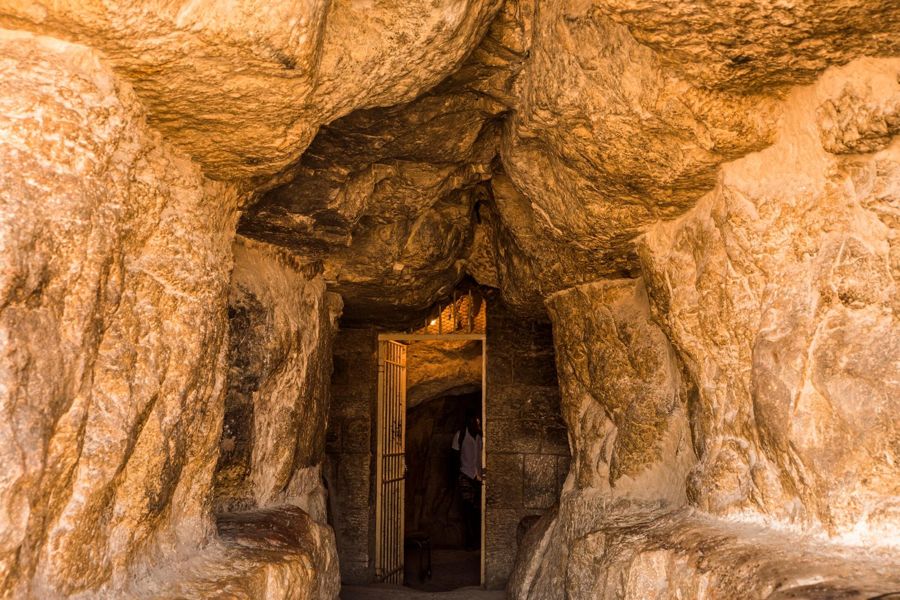
The way into the Great Pyramid of Khufu begins with a misunderstanding. The entrance you use is not the ancient one. It lies below and is a roughly broken hole.
It was made in the 9th century, under Caliph al-Ma'mun, whose men worked their way through the masonry in search of treasure. They hit the original passage system more or less by chance. The original entrance sits about ten meters higher and was hidden behind the smooth casing, so invisible from outside. When you see the inside of the Great Pyramid of Khufu today, you first walk through a medieval breach tunnel.
Then the actual construction begins. From the junction, a passage leads steeply down into the rock, to an unfinished chamber deep beneath the pyramid. This part is usually not open to visitors.
That the medieval tunnel diggers got up at all, they owe to a detour. The Ascending Passage had been sealed after the burial with three massive granite plugs that were pushed in from above and are stuck there. Granite can hardly be broken with the tools of that time. So al-Ma'mun's men hacked their way around it, through the softer limestone around, and met the passage again above the plugs. You still use this bypass tunnel today, and the plugs themselves lie to your right as you pass.
The Ascending Passage and the Great Gallery
Upwards, you go through the Ascending Passage, and that is the most physically uncomfortable part of the whole visit. It is about 39 meters long, about 1.20 meters high, and just over a meter wide, with an incline of about 26 degrees. You walk the entire distance bent over, on wooden planks with cross battens that give your feet grip. Oncoming visitors have to squeeze past sideways. If you have knee or back problems, you'll notice it here immediately.
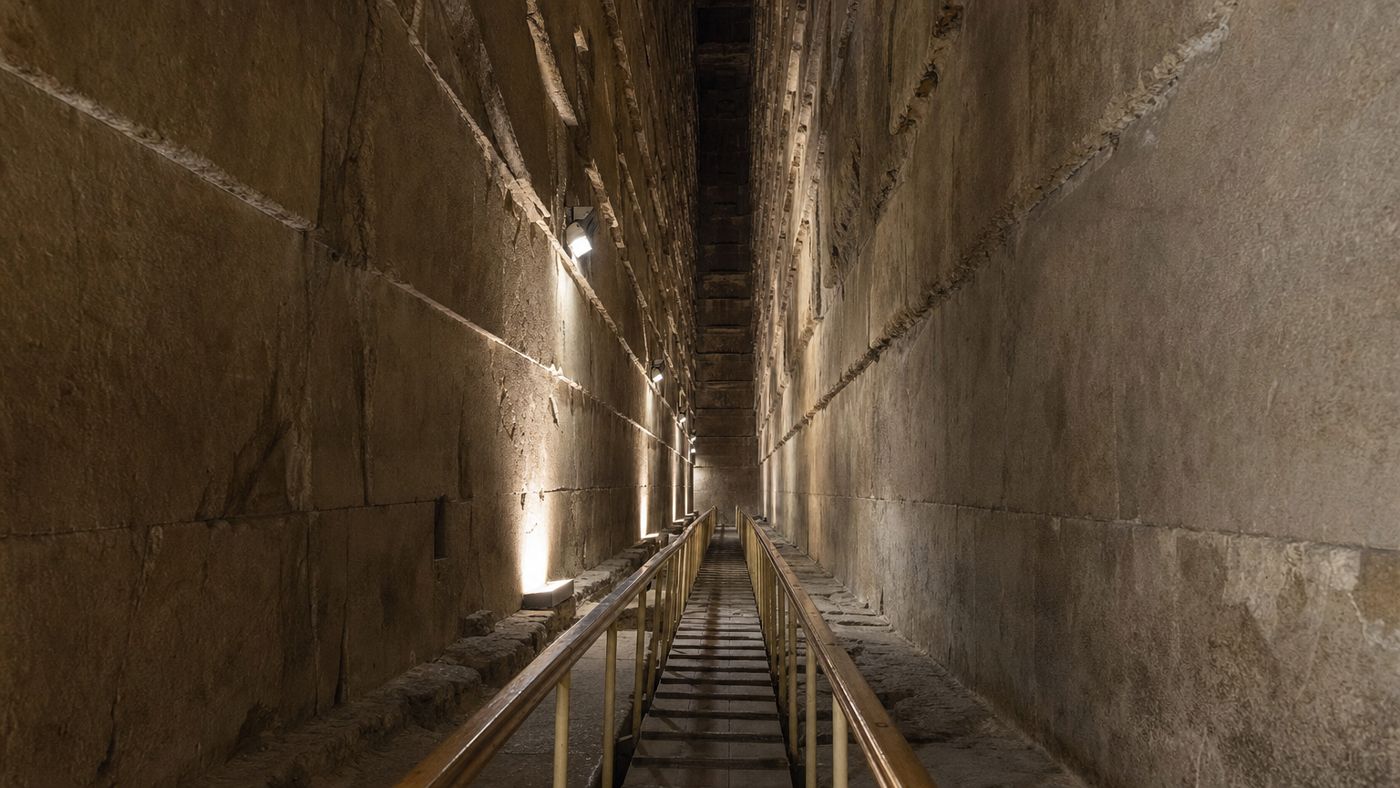
Then the space opens up, and this moment is the reason people come back. The Great Gallery is nearly 47 meters long and over eight and a half meters high, with just two meters width at the floor. The walls are built in corbelling technique: each course of stone projects a few centimeters inward over the one below, until the ceiling closes at the top into a narrow strip. It looks like an inverted, very precise funnel of polished limestone.
What the structure achieves here becomes clear only with the knowledge of why it looks like this. The gallery doesn't just support itself; it was probably also a work space and storage for the heavy granite blocks that were to seal the ascent at the end of construction.
The King's Chamber and its sarcophagus
At the upper end of the gallery, it gets tight again. A low passage with an antechamber leads into the most important room of the structure.
The King's Chamber is a sober rectangular room: just over ten and a half meters long, just over five meters wide, nearly six meters high, entirely of red granite from Aswan. The walls are smooth, tightly jointed, and completely unadorned. In the western half stands a sarcophagus of the same granite, without a lid, empty, damaged at one corner.
This sarcophagus is the most interesting object in the whole interior, and that's because of its dimensions. It is wider than the Ascending Passage through which it would have had to be carried. So it was already in place before the chamber and everything above it were finished. The construction went around it. That is one of the strongest pieces of evidence that the pyramid was planned as a tomb from the start and the chamber is not a later addition.
A detail that hardly anyone notices: the granite beams of the ceiling are cracked. You can see the cracks from below if you hold a flashlight on them. They probably date from the construction period or an early earthquake, and they were the reason for one of the most elaborate constructions of the whole structure.
Above the ceiling lie five so-called relieving chambers, hollow spaces stacked on top of each other that divert the weight of the stone masses above to the sides. They are not accessible. But it is precisely there that the only thing ever written in this structure stands: red markings of the work gangs, with names that mention King Khufu. They are construction site notes, not grave inscriptions, and they were never meant to be read.
For completeness: the famous coffin texts, Book of the Dead spells, and painted ceilings known from Egypt come later. At the time the Great Pyramid of Khufu was built, they simply didn't exist yet. The lack of decoration is therefore not a sign of poverty but a style of the time.
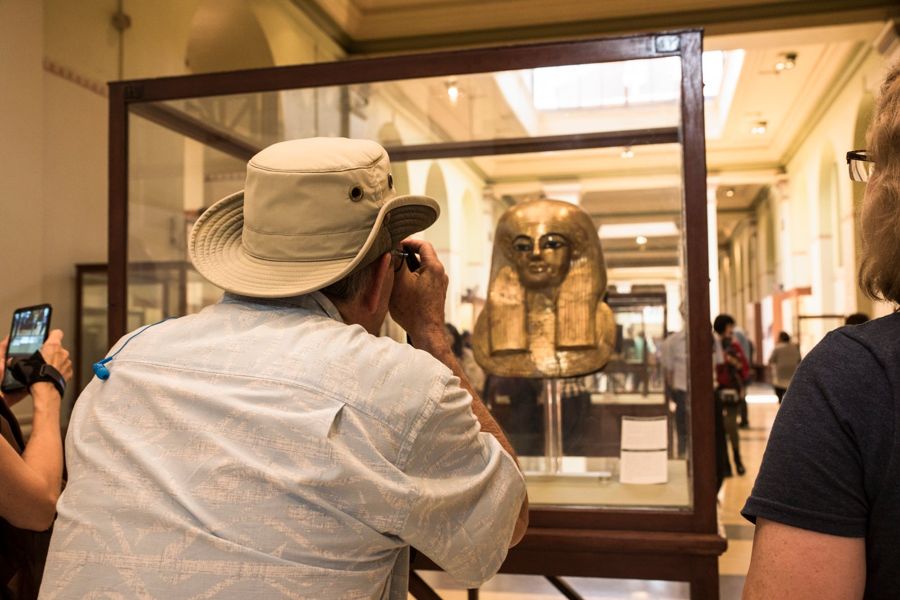
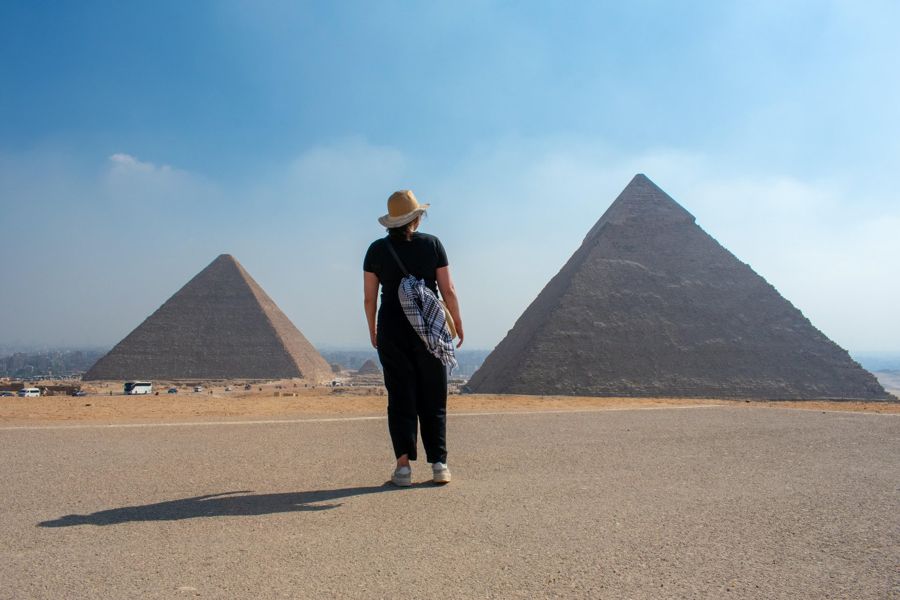
Full-day tour to pyramids, Egyptian Museum, and bazaar
- The interior ticket can be added as an add-on instead of organizing it separately
- Plateau entry, pickup, and lunch are included
- A guide explains before the climb what to look out for inside
- Free cancellation up to 24 hours before
The chambers of the Great Pyramid of Khufu in numbers
The dimensions explain why the route feels the way it feels.
| Chamber | Dimensions | Feature | Open to visitors |
|---|---|---|---|
| Ascending Passage | about 39 m long, about 1.20 m high | 26-degree incline, walk bent over | yes, the main route |
| Great Gallery | nearly 47 m long, over 8.5 m high | corbelled vault, only a narrow band at the top | yes |
| King's Chamber | 10.5 x 5.2 m, nearly 6 m high | red granite, empty sarcophagus without lid | yes |
| Chamber below | about 5.7 x 5.2 m | corbelled ceiling, without sarcophagus | usually no |
| Rock chamber | in the rock beneath the structure | unfinished, tool marks | usually no |
| Relieving chambers | five hollow spaces one above the other | the only inscriptions in the pyramid | no |
- Dimensions
- about 39 m long, about 1.20 m high
- Feature
- 26-degree incline, walk bent over
- Open to visitors
- yes, the main route
- Dimensions
- nearly 47 m long, over 8.5 m high
- Feature
- corbelled vault, only a narrow band at the top
- Open to visitors
- yes
- Dimensions
- 10.5 x 5.2 m, nearly 6 m high
- Feature
- red granite, empty sarcophagus without lid
- Open to visitors
- yes
- Dimensions
- about 5.7 x 5.2 m
- Feature
- corbelled ceiling, without sarcophagus
- Open to visitors
- usually no
- Dimensions
- in the rock beneath the structure
- Feature
- unfinished, tool marks
- Open to visitors
- usually no
- Dimensions
- five hollow spaces one above the other
- Feature
- the only inscriptions in the pyramid
- Open to visitors
- no
Which chambers are actually open changes. The information describes the normal case, not a promise.
The chambers that no one can explain
Below the King's Chamber lies a second room, traditionally called the Queen's Chamber. The name is wrong and comes from Arab visitors who interpreted it according to their own burial customs. A queen never lay there. What the room was for is unclear: a niche in the east wall suggests a statue, others think it was an abandoned first plan.
From this chamber and from the King's Chamber, narrow shafts lead diagonally outward. They are too narrow for people, about twenty centimeters square, and their angles point to star positions of the construction period. Since the 1990s, several robots have gone into them. They came across small stone slabs with embedded copper pins, behind them short cavities and further slabs. What that is, nobody knows.
At the very bottom, about thirty meters below the foundation, lies the rock chamber. It is the oldest part of the interior and was never finished. The floor is a jagged jumble of left rock and pits, and at the south wall a tunnel begins that simply stops after a few meters. Apparently the plan was changed twice during construction: first this chamber, then the middle one, finally the King's Chamber high up in the masonry. This part is usually closed to visitors, which is understandable given the air and condition.
Bigger is the find that made international headlines in 2017. Using muon tomography, a method that uses natural cosmic radiation like an X-ray machine, a void of at least thirty meters in length was detected above the Great Gallery. A second, smaller passage sits behind the stone beams on the north facade and was confirmed in 2025 by three independent measurement methods.
Both are explicitly not treasure finds. Whether they are structural voids that distribute loads, remnants of the construction process, or previously unknown chambers is open. No one has entered them, and you won't see them during your visit. You should know about them anyway, because it makes the walk through the gallery something different when you realize that just over twenty meters above your shoulder lies a room where no one has been since construction.
If you come across reports online about sealed doors and imminent revelations, pay attention to the source. What is reliable is what appears in a peer-reviewed journal with measurement data.
Who was inside before you
You are not the first visitor, and the list of your predecessors explains much of what you see inside.
After the burial, the pyramid was sealed and was meant to stay that way. When it was first opened and emptied is unknown, but it happened early, probably already in the Old Kingdom or the turbulent period after. When the medieval tunnel diggers arrived in the 9th century, there was long since nothing left.
The following centuries brought tourists, not researchers. Greeks, Romans, and Arab travelers came, marveled, and scratched their names into the stone. It became systematic only in the 19th century, and the transition was rough. The British officer Richard Vyse worked his way through the masonry with gunpowder in 1837 and found the upper relieving chambers above the King's Chamber.
There he came across what to this day is the only written evidence of who built this structure: red paint marks of work gangs, in which the name Khufu appears. Because Vyse was a rough man with ambition, it is occasionally claimed that he forged the marks. Against that speaks the obvious. The marks are also on block sides that faced upward or toward the wall during construction and that no one could have inscribed afterwards without dismantling the chamber. Comparable gang marks have since been found on other buildings of the same period, in the same script.
Only toward the end of the century did surveying come. Flinders Petrie produced a survey of the structure in the 1880s that remained authoritative for a century in its accuracy, and in doing so established how small the errors of the ancient builders actually are.
Since the 1990s, work has been done without hammers. First small robots went into the shafts, then muon detectors, radar, and ultrasound were added. The tools have changed, the question hasn't: what else is in this mountain of stone that no one knows.
Khafre and Menkaure from the inside
The other two pyramids are almost always overlooked, and that is a mistake, especially when the ticket for the Great Pyramid of Khufu is sold out.
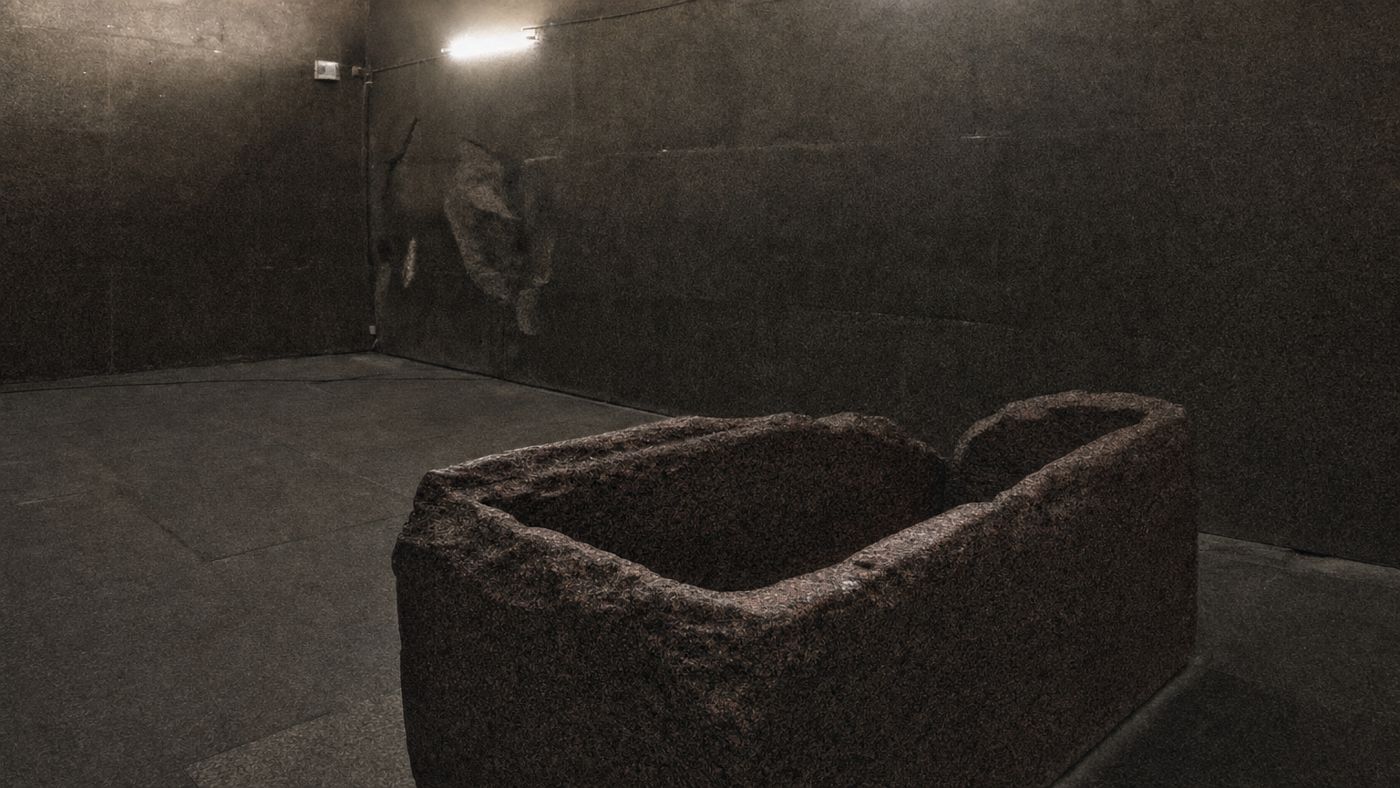
The Pyramid of Khafre has two entrances on the north side. The way in is shorter and less steep, the burial chamber lies deep down, partly cut into the bedrock, with a gabled ceiling of heavy limestone beams. The sarcophagus here is sunk into the floor, of polished granite, also empty.
On the south wall of this chamber stands an inscription that no Egyptian wrote. The Italian explorer Giovanni Belzoni opened the pyramid in March 1818 and left his name and date there in black paint. He was proud to have been the first. A few meters away is Arabic script that attests to a visitor around the year 1200. So Belzoni was a good six hundred years too late, which makes his inscription rather endearing.
The Pyramid of Menkaure is the smallest and inside the most idiosyncratic. Behind the descending passage lies a chamber with carved panels that imitate a palace facade, behind it an antechamber and deeper in the rock the actual burial chamber with a barrel vault.
From outside, something catches the eye about this pyramid that has to do with the interior: the lower courses are not of limestone but of granite, and many blocks are only roughly hewn. The casing was apparently smoothed from bottom to top and broken off in the middle of the work at the king's death. If you want to see what an unfinished pyramid looks like, you don't have to go into the desert, just walk around this structure.
Its sarcophagus is a story of its own. The British officer Richard Vyse had the pyramid opened with gunpowder in 1837, found a dark stone sarcophagus with palace facade decoration, and shipped it to London. The ship, the Beatrice, left Alexandria in September 1838, was last seen off Cartagena, and sank. The sarcophagus lies to this day somewhere in the Mediterranean.
Practically, that means: if you're already on the plateau and the expensive interior isn't available, you get a very similar basic feeling at Khafre for a fraction of the price. Narrow, dark, cool compared to outside, and very old.
Is the interior ticket for the Great Pyramid of Khufu worth it?
Pros
- The Great Gallery has no counterpart. Photos don't convey its effect.
- You stand in a room of Aswan granite that has sat unchanged in the same spot for four and a half thousand years.
- The route itself conveys the construction achievement better than any explanation from outside.
- If you're in Egypt once, you probably won't be back soon.
Cons
- There's nothing to see but stone. No painting, no finds, no lighting effects.
- The climb is bent over, hot, and stuffy, and unpleasant in oncoming traffic.
- The price is a multiple of the plateau ticket.
- With knee, back, or circulation problems and pronounced claustrophobia, it's not a good idea.
Three common ways to combine the plateau and an interior. The interior is regularly an add-on on guided tours, not part of the base price.
 Most booked
Entry only, organize everything yourself
- Plateau entry
- Guide
- Hotel pickup
- Lunch
- Pyramid interior
- Free cancellation up to 24 hours before
Those who want to buy the interior ticket on site themselves and stay flexible
 With Nile ride
Guided tour with felucca ride
- Plateau entry
- English-speaking guide
- Hotel pickup
- Pyramid interior as an add-on
- Free cancellation up to 24 hours before
Those who want to use the afternoon for something else
 Private, duration selectable
Private tour with selectable duration
- English-speaking guide
- Hotel pickup
- Lunch
- Pyramid interior as an add-on
- Free cancellation up to 24 hours before
Those who don't want to stand in oncoming traffic inside
Hot, narrow, and stuffy
A few things you should know before you go in, because they make the difference between a good and an unpleasant experience.
It's hot and stuffy. There's no real ventilation, and whatever air circulates has taken the same narrow passages as you. With many visitors at once, it quickly becomes oppressive. Take water with you and don't go straight from the climb onto the plateau into the midday sun.
Also expect a smell. In an unventilated passage through which hundreds of people climb daily, everything that people give off accumulates, and the walls give it back only slowly. That's not bad, but it surprises people who imagined the interior as reverent and sterile. Add to that the acoustics: the stone swallows nothing, every word and every step echoes up the gallery, and when it's full, it's loud. The quiet, solemn recordings you see online are made outside opening hours.
Dress accordingly. Shorts and a T-shirt are enough, sturdy shoes help on the planks. Large backpacks are cumbersome and often not allowed through the entrance, so take only the essentials.
Tickets, time slots, and oncoming traffic
The number of interior tickets is limited per day to a low three-digit number, distributed over fixed time slots. In price, this ticket is a good double the site entry, so noticeably above the normal entry. If you want to get in for sure, buy in advance via the official portal of the Ministry of Antiquities or book a tour where the add-on is taken care of.
What a time slot practically means surprises many: it's not an appointment but a period during which your ticket is valid. You queue at the entrance of the pyramid, and how long it takes depends on how many people have booked the same slot. At the beginning of a slot it's fuller than towards the end. If you're flexible, come in the second half and save yourself part of the wait.
Expect oncoming traffic. The Ascending Passage is not built for two people side by side, and when a group comes down while you're going up, you squeeze past each other. If you don't handle that well, be there in the first minutes after opening or choose the Pyramid of Khafre instead.
As for photography: the rules for cameras, tripods, and phones change, and they also change between structures. Ask at the entrance instead of relying on a guidebook. You'll get more out of the construction of the chambers anyway if you stand still for a while instead of looking through the display.
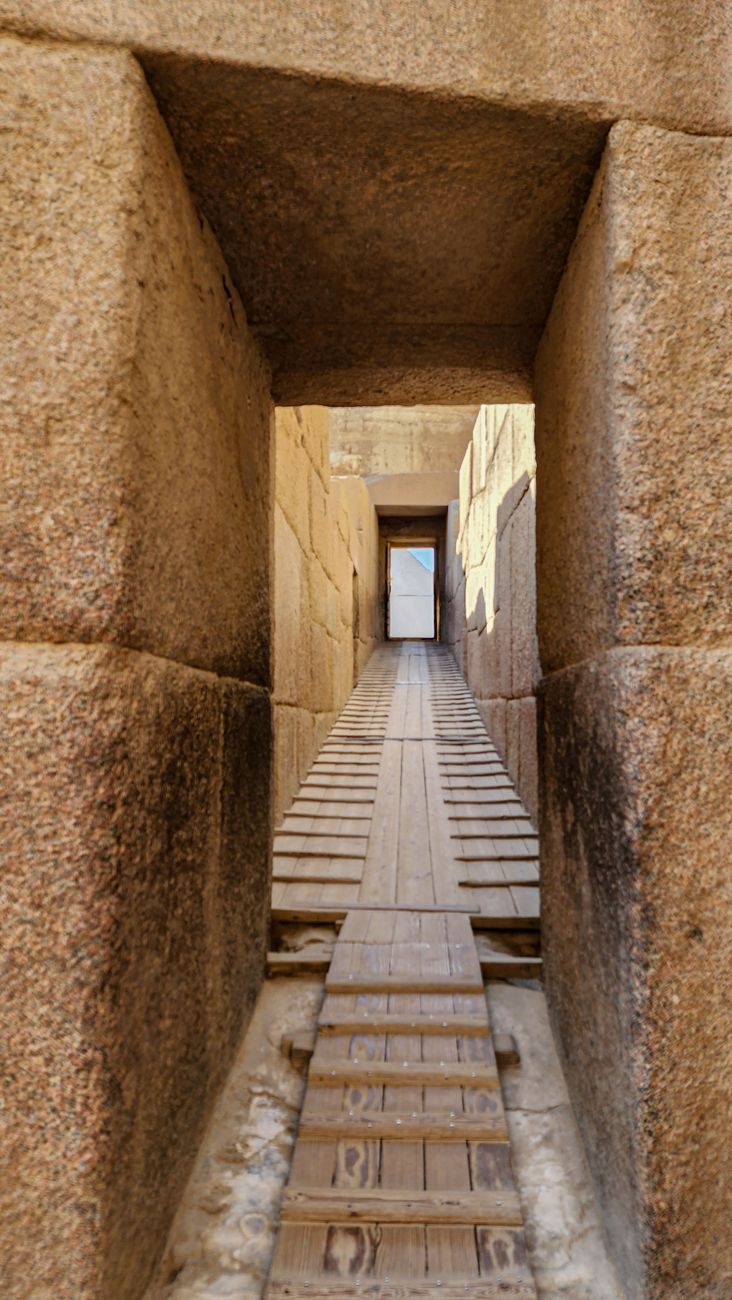
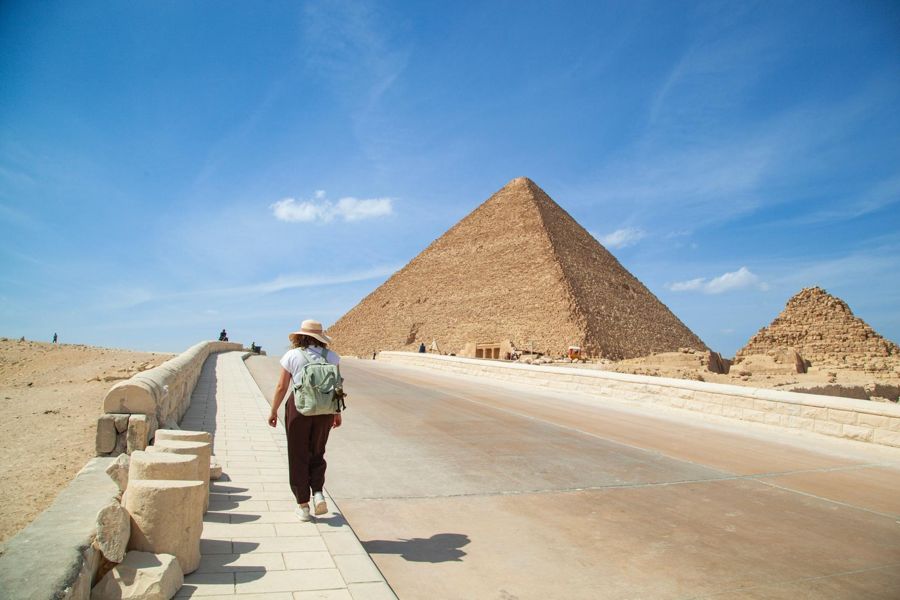
Short guided tour of the plateau with preferred entry
Three hours, on foot, without museum part. Fits when the interior is the actual goal and the rest of the day should stay free.
Frequently asked questions
What is inside the pyramids of Giza?
Passages and empty stone chambers. In the Great Pyramid of Khufu, the Great Gallery, the King's Chamber with an empty granite sarcophagus, and two other chambers. No wall paintings, no grave goods, no mummies.
Can you go inside all three pyramids?
Basically yes, each with its own ticket. Whether a particular pyramid is open changes, however, because the interiors are closed for maintenance and restoration.
How long does the visit inside take?
For the Great Pyramid of Khufu, realistically twenty to thirty minutes with ascent and descent, without waiting time at the entrance. With crowds, significantly longer.
Why are the chambers empty?
They were emptied already in antiquity. Everything preserved from the construction period comes from subsidiary structures and tombs around, not from the pyramids themselves.
The moment everyone describes
There is a moment that almost everyone who has been inside describes. It doesn't come in the King's Chamber but shortly before, when the bent-over climb ends and the Great Gallery opens up.
Until then, the pyramid was mainly narrow. Then you stand in a room that is narrow like a corridor and high like a three-story house, and above you seven courses of stone interlock so cleanly as if they were set yesterday. In that moment, without further explanation, you understand that people were at work here who knew exactly what they were doing.
If you want to do more than one interior, a sequence is worthwhile. Start with the Pyramid of Khafre. It's shorter, less steep, and costs little, and you'll reliably notice whether narrowness and heat are a problem for you. Only then the Great Pyramid of Khufu, with the knowledge of what you're getting into. The other way around, Khafre inevitably seems pale because the Great Gallery outshines everything that comes after. If you do both in one morning, plan a real break in the shade between the two climbs, because the strain adds up more than you think.
Whether it's worth the surcharge to you depends on whether you can do something with bare stone. If you want to see color and hieroglyphs, you're better off in the tomb of Meresankh on the same plateau, and that costs almost nothing. If, on the other hand, you want to know how four and a half thousand year old engineering feels from the inside, there is exactly one address for that.


Full-day tour to pyramids, Sphinx, and museum with female guide
- The whole day is planned, the interior can be added as an add-on
- Plateau entry, pickup, and lunch are included
- Over a thousand reviews, which speaks for reliable processes for interior appointments
- Free cancellation up to 24 hours before