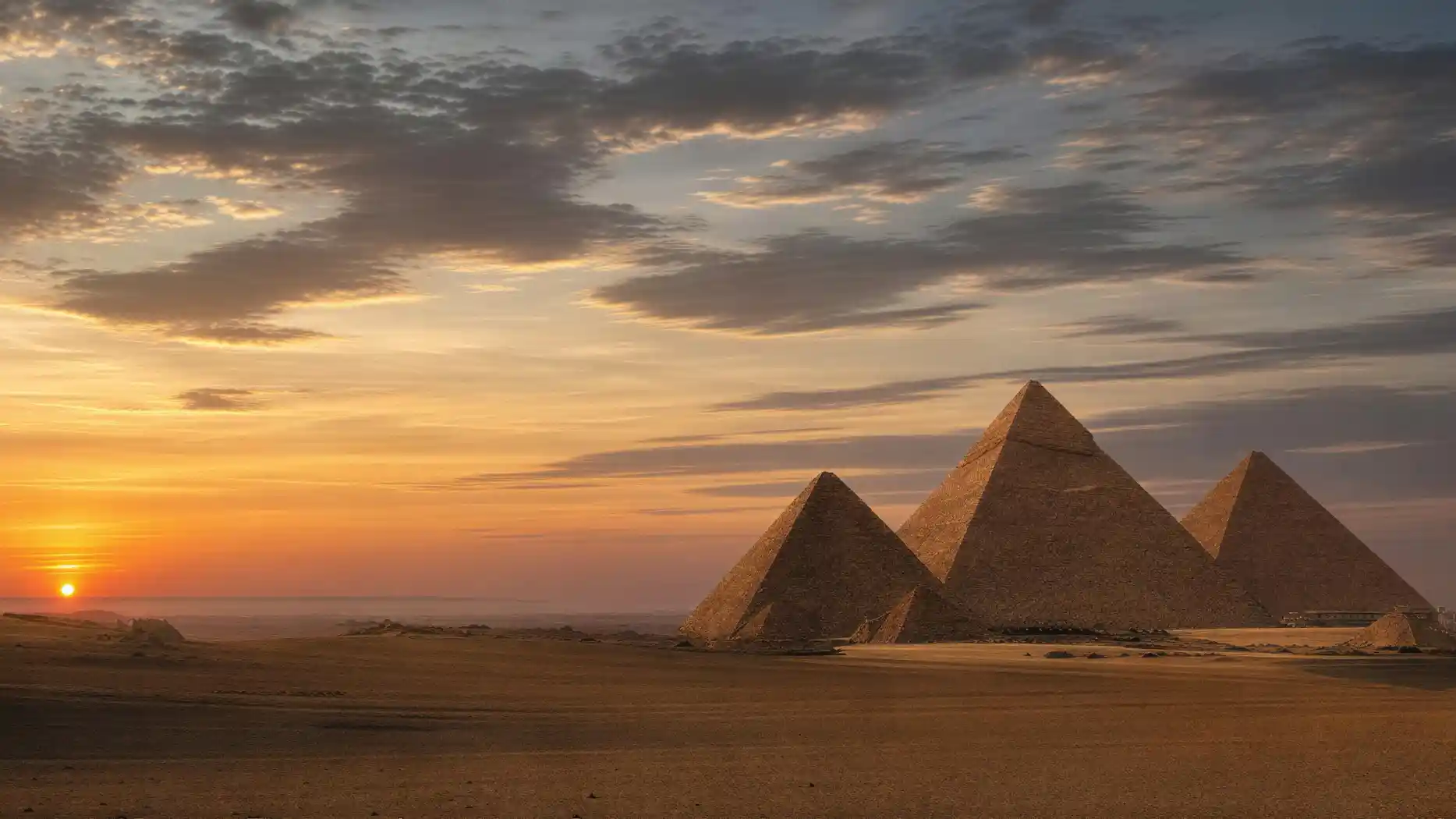
The Great Sphinx was not built. It was carved out.
That is the difference that explains everything else. The pyramids beside it are stacked from millions of individual blocks, layer upon layer, year after year. The Sphinx, by contrast, is a single piece of rock that was already there. The builders removed the limestone around it and left standing what was meant to remain. They worked from top to bottom and from outside in, and nothing could be corrected. A chisel stroke set too deep is final.
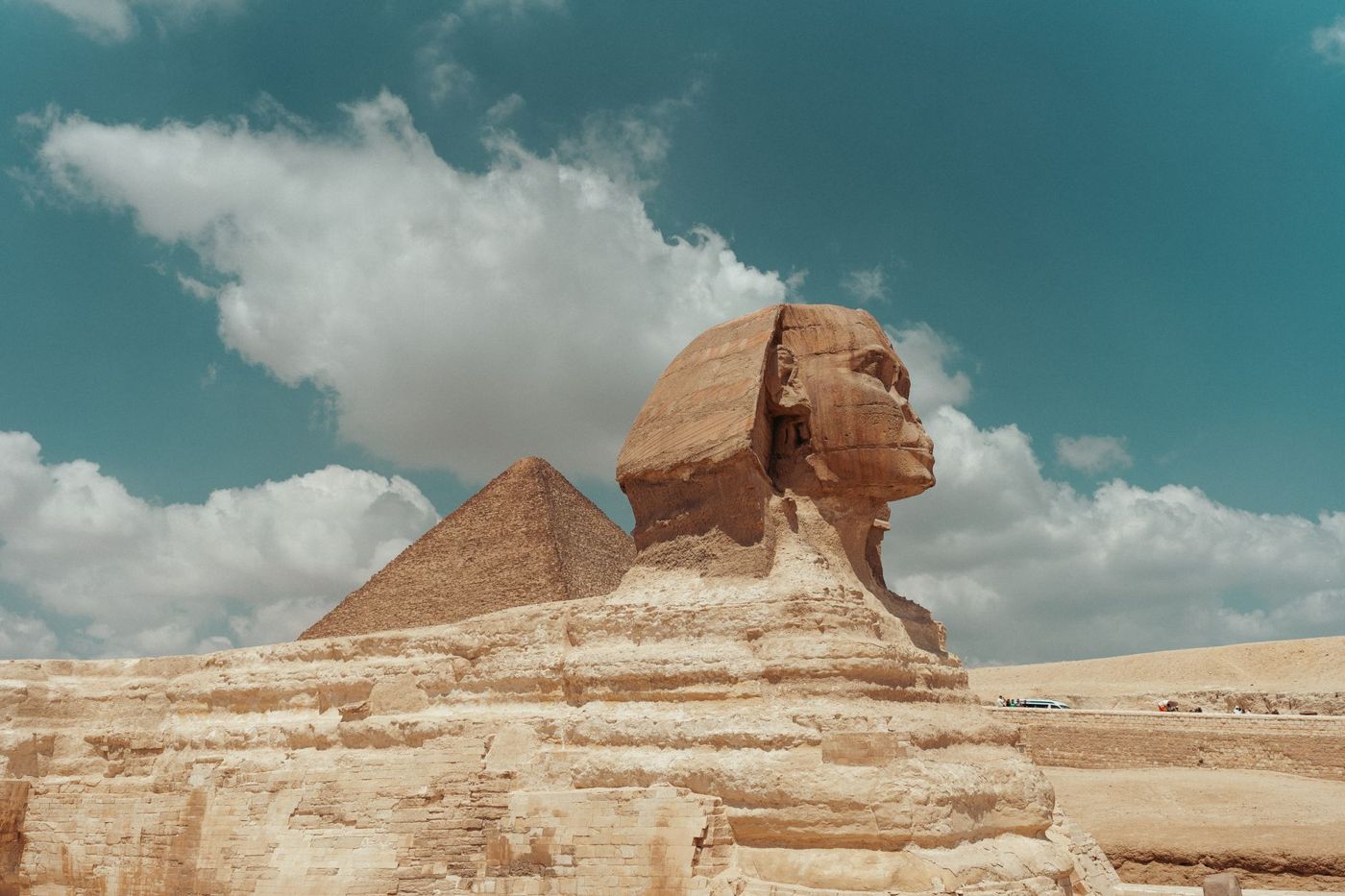
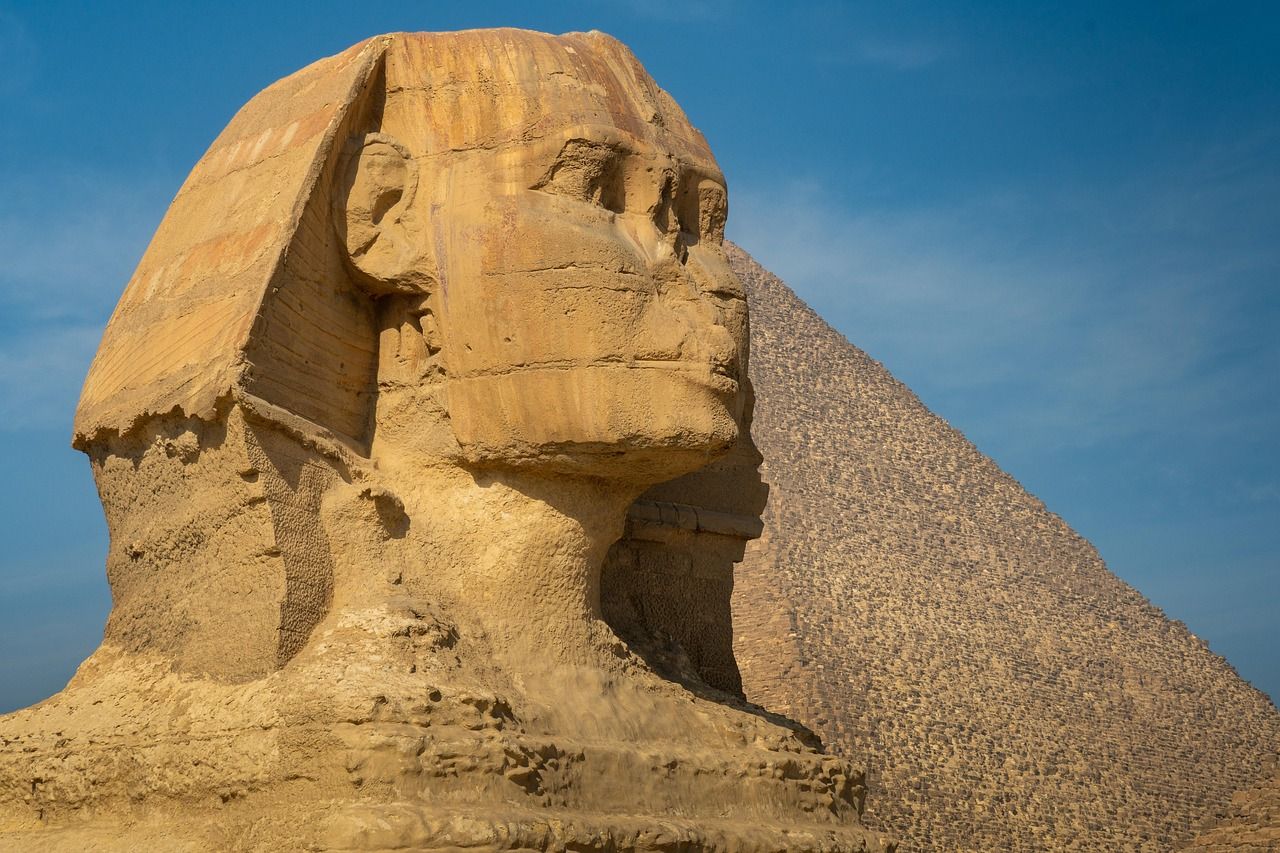
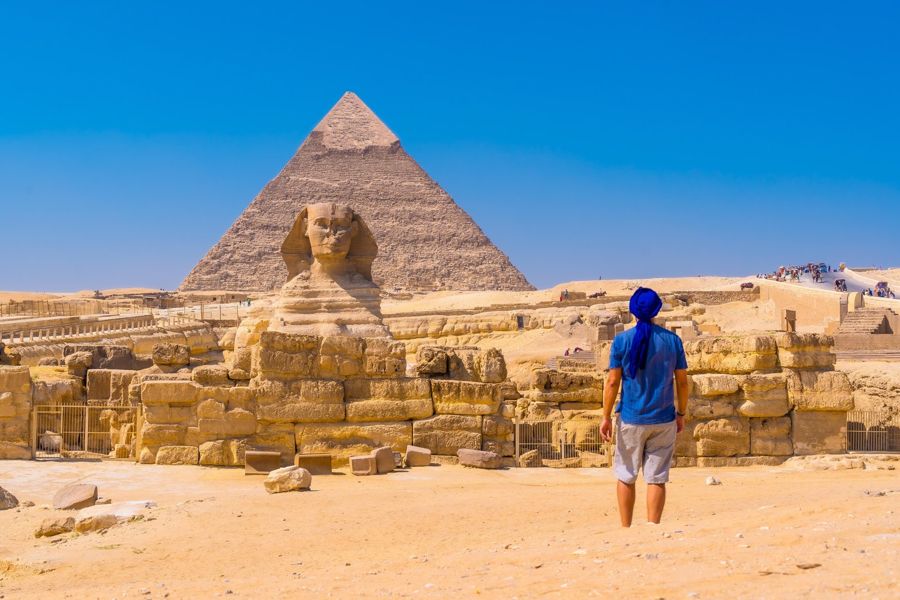
What remained is a recumbent lion figure with a human head, about 73 meters long from paw to tail and about 20 meters high. It does not lie on the plateau but in a pit that was created during the carving itself. Today, when you stand before it, you look down at it, not up.
This pit is also the reason for the second peculiarity: The Sphinx collects sand. Over millennia, the desert wind repeatedly filled the depression until only the head stuck out. That is exactly what saved it, because what lies in sand does not weather.
And something else is different from what most visitors expect. The Sphinx was not gray. It was painted in vivid colors, with a striped headdress and a braided ceremonial beard. What you see today is a worn-down remnant.
The Great Sphinx in Numbers
- Length
- about 73 m
- Height
- about 20 m
- Width at the hindquarters
- about 19 m
- Material
- natural limestone of the plateau
- Time of origin
- 4th Dynasty, around 2500 BC
- Most commonly attributed to
- Khafre, the builder of the middle pyramid
- Stela between the paws
- about 3.5 m high, erected around 1400 BC
The Sphinx Is Part of a Complex
To understand why the Sphinx lies where it lies, you have to see it as part of a complex, not as a single piece.
On the plateau, each great pyramid is accompanied by a chain of structures: at the bottom near the former riverbank a valley temple, from there a covered causeway up the slope, and at the top a mortuary temple on the east side of the pyramid. The Sphinx sits exactly in this chain, right next to the Valley Temple of Khafre and directly on its causeway.
The entire necropolis has been on the UNESCO World Heritage List since 1979, and within it the Sphinx is not a solitary monument but part of the protected ensemble. That is more than a formality: conservation measures on it are internationally monitored, and interventions must be documented.
The rock from which it is made was also no coincidence. It is a remnant left over from quarrying operations. Around it, material for the pyramids was quarried, and a hump of lower-quality stone that could not be used well was left standing. From this hump, the Sphinx was made.
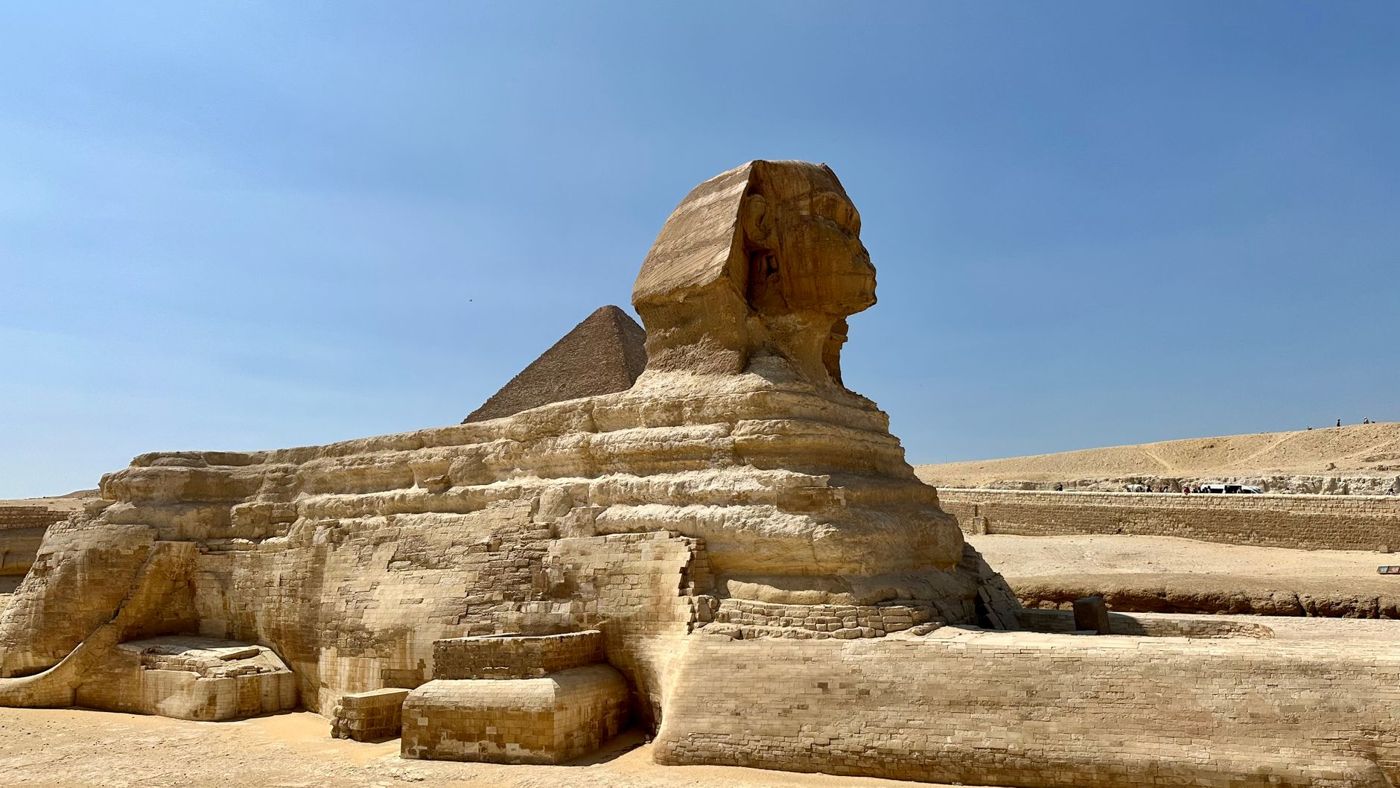
This also explains its condition. The limestone of the plateau is layered, and the layers vary in hardness. The head is made of harder material and is therefore comparatively well preserved. The body lies in softer layers that weather much faster. That is why the Sphinx looks like a creature with an intact face on a ravaged torso, and why the torso has been repaired again and again since antiquity.
How closely the Sphinx and the quarry are connected can be seen in the dimensions. The blocks cut from the pit weigh partly over two hundred tons, and today they are set in the walls of the temple in front of it. The Sphinx and its temple are thus literally the same material: what is missing here stands there.
Directly in front of the paws lie the remains of a temple of its own, made of massive limestone blocks from the same pit. It was never finished. Right next to it stands the Valley Temple of Khafre with polished granite pillars, and it is one of the most impressive and most overlooked structures on the entire plateau.
Who Had the Sphinx Built?
Who commissioned the Sphinx is the longest-debated question in Giza research, and it has not been definitively answered to this day.
The majority opinion is: Khafre, the second of the three great pyramid builders. The location speaks for this. The Sphinx lies in his complex area, directly on his causeway, in a pit whose stones were used in his valley temple. Also speaking for this is the stela of Thutmose, erected between the paws about a thousand years later, in which the name Khafre appears, albeit in a damaged context.
There is nevertheless dissent. Some experts consider the face stylistically divergent from the confirmed portraits of Khafre and instead suggest Khufu or his son Djedefre. Others point out that the layout of the Sphinx Temple and that of the Valley Temple conflict structurally, which could indicate different construction phases.
Arguing quite differently is a group outside professional Egyptology that, based on weathering traces, considers the Sphinx several thousand years older and attributes it to an unknown culture. This theory is largely rejected by geology and archaeology, among other reasons because such a culture would have left no settlement traces at such a well-studied site.
A recurring argument in this debate deserves a brief classification. Again and again, a stone tablet is cited that supposedly proves that Khufu already found the Sphinx. This tablet exists, but by language and orthography it dates from a period about two thousand years after Khufu. Such backdated texts are well known from Egypt: a temple justifies its claim by giving itself a very old prehistory. As a source for the Old Kingdom, it is not suitable.
Where research is genuinely uncertain, it says so. The cautious and at the same time honest formulation is: The Sphinx most likely dates from the 4th Dynasty and most likely belongs to Khafre. A datable building inscription that would settle the matter does not exist.


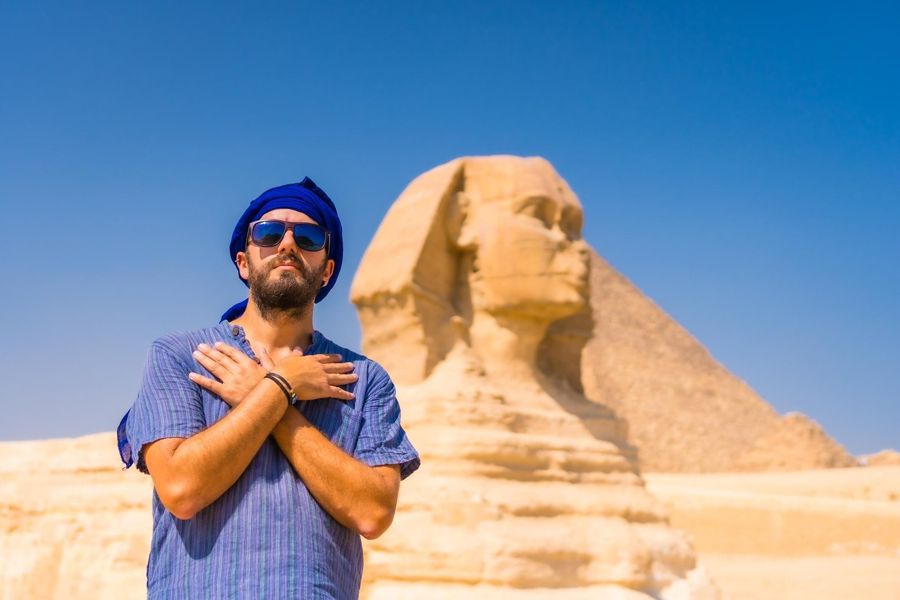
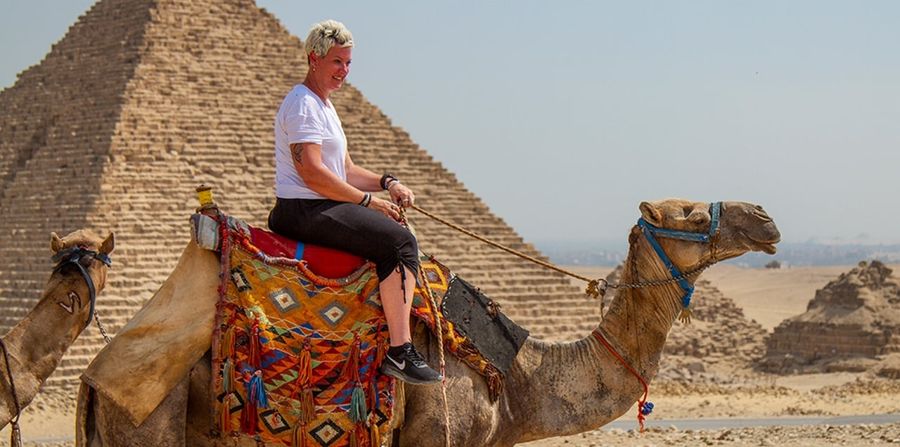
Private Tour over the Giza Plateau with Camel Ride and Lunch
- A private guide explains what is original at the Sphinx and what is repair work
- Four hours without group pace, with time for the valley temple next door
- Pickup and lunch are included
- Free cancellation up to 24 hours before
Nobody Knows Its Original Name
What often gets lost in this debate is a surprising gap: we do not know what the people who created it called it.
From the Old Kingdom, that is, from the time of its creation, not a single text is known that mentions the Sphinx. No name, no dedication inscription, no administrative note. For a structure of this size, that is remarkable, and it is one of the reasons why the attribution remains so difficult.
The name we know is about a thousand years younger. In the New Kingdom, the figure was venerated as Hor-em-achet, "Horus in the Horizon," later made into Harmachis by the Greeks. That is not a translation of an older name but a reinterpretation: a later era found a huge, half-buried statue, explained it as a sun god, and established a cult for it.
The word Sphinx itself is Greek and even younger. In Greek mythology, the Sphinx is female, winged, and poses deadly riddles. That has nothing to do with the Egyptian structure, except that the Greeks brought the term with them and applied it. In German, therefore, the masculine form has become established for the structure at Giza, while the Greek mythological figure remains feminine.
The stela itself is preserved and legible, and its text has been translated and commented on several times. It is thus one of the few sources that directly tell us what later Egyptians thought about this structure.
It is hard to imagine the extent of this gap. Four centuries after its construction, the Sphinx was already so deeply buried in sand and so far removed from memory that a prince could lie down beside it and take it for a deity appearing to him in a dream.
Look at me, gaze upon me, my son Thutmose. I am your father Hor-em-achet. The sand of the desert on which I lie has covered me. Turn to me, so that what I wish may come to pass.Paraphrased translation from the Dream Stela of Thutmose IV, around 1400 BC, erected between the paws of the Sphinx
The stela remains in place to this day. It is about three and a half meters high and made of granite.
The Sand Kept Coming Back
The stela is thus the oldest surviving request to clear a monument, and it describes a problem that has never stopped.
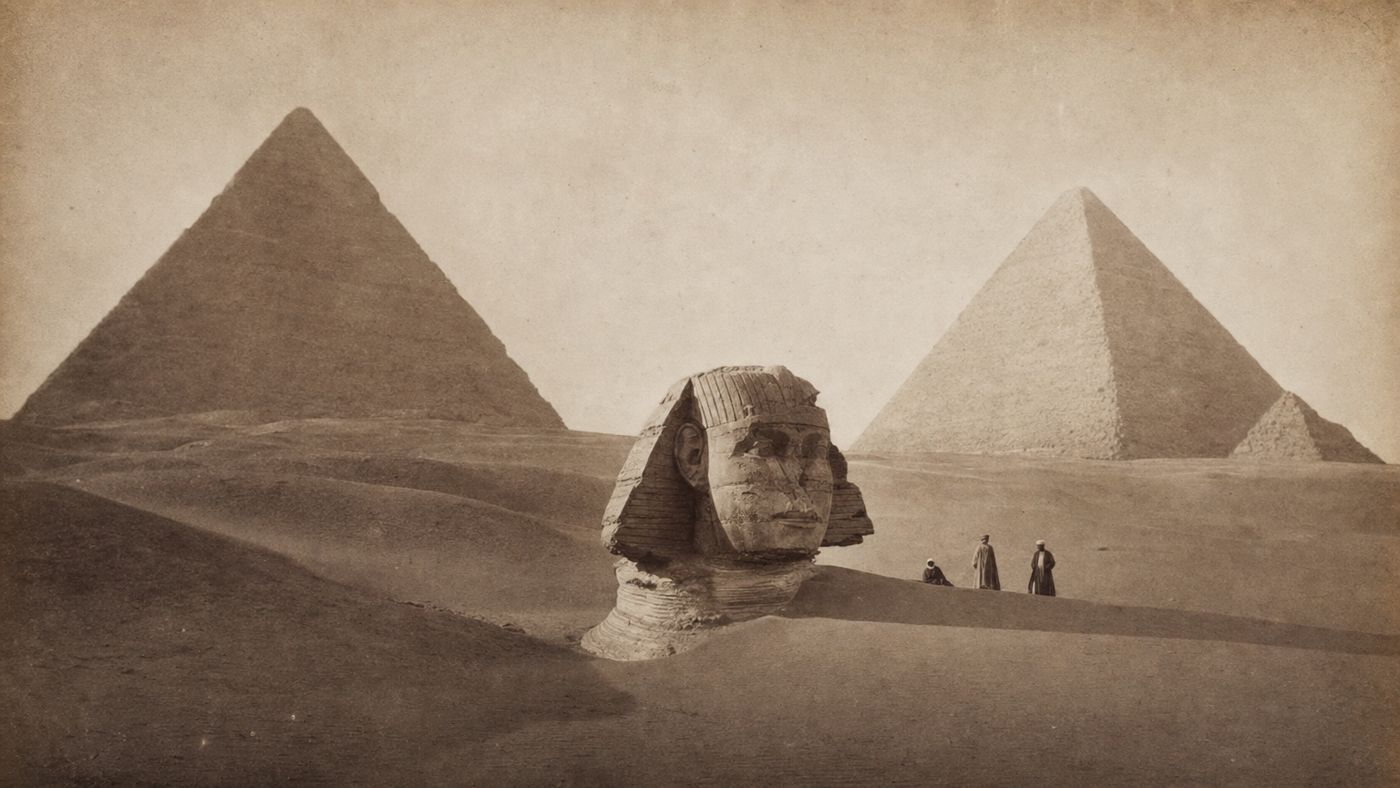
The sand kept coming back. After Thutmose, the Sphinx was uncovered again in Roman times and secured with an enclosure. Then it disappeared again. In drawings and early photographs of the 19th century, only the head and part of the back protrude from a smooth sand surface, while travelers in suits pose beside it.
The modern excavations stretched over more than a hundred years. The Italian excavator Giovanni Battista Caviglia began in 1817, reached the chest, and found fragments of the beard. Further campaigns followed. Only in 1925 and 1926 was the Sphinx completely freed from the sand and the pit around it cleared, so that the figure was visible in full length for the first time in centuries.
The price for this is often overlooked. As long as the body lay in the sand, it was protected from wind, moisture fluctuations, and salt crystallization. Since its exposure, it has weathered faster than in the two thousand years before. Conservation is therefore not a completed task but an ongoing operation, and research work on the Sphinx deals at least as much with salt and groundwater as with archaeology.
This Is How the Sphinx Originally Looked
How the Sphinx originally looked can be reconstructed better than the current appearance suggests. In protected recesses, especially on the ears and headdress, traces of paint have survived.
The face bore a strong red. For Egyptian depictions, that is no surprise, because male skin was conventionally rendered reddish-brown. The headdress, the so-called nemes, was striped in blue and yellow. Taken together, this yields an image that has little to do with today's sandy impression: a brightly painted figure in a bright, clad environment.
That these traces exist at all is both chance and geology. Paint survives only where neither wind nor sun nor sand reaches: in undercuts, in the folds of the headdress, behind the ears. Exactly there, examinations have found pigments. On the exposed surfaces, nothing has remained for millennia, and that is why the figure appears monochrome today. Reconstructions of the original appearance thus rely on a few square centimeters that happened to lie in the lee of the wind. That is little, but it is genuine, and it matches what is known about color conventions from contemporary statues and reliefs.
In addition, there was a beard. Not the beard of an old man, but the braided ceremonial beard that kings and gods wear in depictions and that was attached to the chin as an insignia. Whether it belonged from the beginning or was added only in the New Kingdom is disputed. What is certain is that it existed, because fragments of it exist. One part lies in the British Museum in London, another in Cairo.
And finally, a uraeus snake is missing from the forehead, the royal emblem. Its attachment traces are preserved. This detail also speaks for the fact that a king is depicted here, not an abstract hybrid creature.
If you put all this together, you get a structure that is hardly recognizable: red, blue, gold, with beard and forehead snake, in a pit with smooth walls, in front of it a temple of light blocks, behind it a pyramid clad in mirror-smooth casing. The current state is not the ruin of this image. It has become something else.
The Nose Is the Most Harmless Damage
What has taken its toll on the Sphinx is a long list, and the nose is not the most interesting entry on it.
It has been missing for centuries. Napoleon's soldiers were not the culprits, because drawings from before the French expedition already show the figure without a nose. The oldest known explanation comes from an Arab historian and names a man of the 14th century who is said to have destroyed it out of religious zeal. Whether that is true can no longer be verified.
More serious are the damages that nobody notices. The body consists of soft, salt-bearing limestone layers. When moisture rises, salt migrates to the surface, crystallizes there, and splits the stone from within. That is why the surface flakes off in scales. That is why groundwater is pumped away today and moisture is monitored.
Added to this is the location of the pit. It is a depression in which everything that comes from above collects: sand, dust, and in rare rainfalls also water. The Sphinx thus stands permanently in the most unfavorable position one could choose for a limestone monument, and this position cannot be changed structurally because it arose during the carving.
Even well-intentioned restorations have caused damage. In the 1980s, parts of the flanks were repaired with cement. Cement is harder and denser than the original limestone, it does not let moisture through, and it shifts the problem into the softer stone next to it, where it intensifies. Some of this work later had to be removed again. Today, work is done with adapted limestone and reversible materials, and everything is measured three-dimensionally in advance.
You can see the repairs very clearly from the terrace, by the way. The regular, light block layers on the flanks and on the paws are not ancient. Some date from the New Kingdom, some from Roman times, many from the 20th century. The Sphinx is thus also an object of study for three thousand years of monument preservation.
How Close You Can Actually Get
Standing between the paws is not possible. The Sphinx is fenced off, and you view it from an elevated terrace on the east side, at best from a few dozen meters away. That is the most common disappointment on the entire plateau, and it can be avoided by expecting it in advance. Also important: The Sphinx Gate in the east lies directly at the terrace but has no ticket counter. If you arrive there without a ticket, you cannot get in.
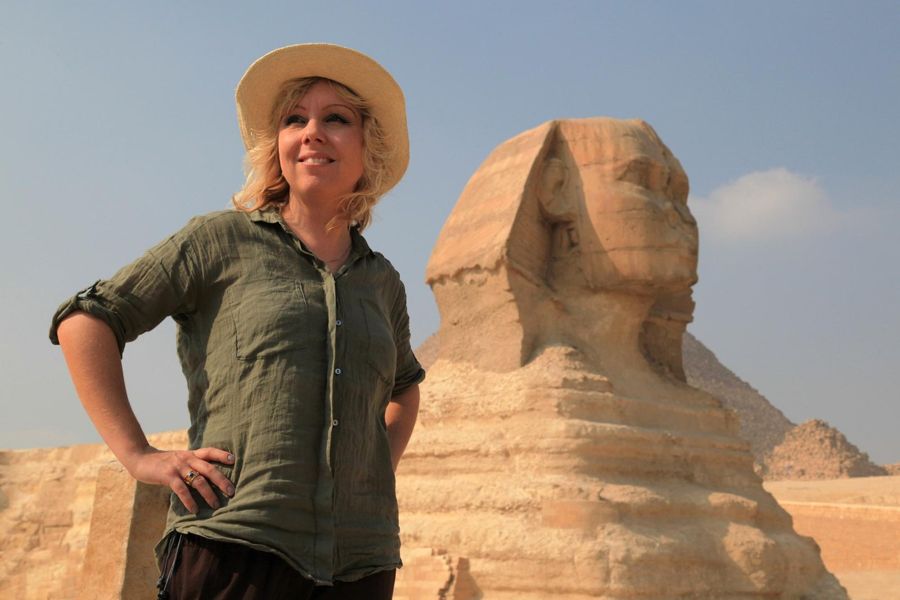
Plateau entry as a QR code on your phone
Exactly the case for which the Sphinx Gate has no counter: buy the ticket in advance, show the code at the entrance, and go in.
When You Should Be at the Sphinx
A visit to the Sphinx takes less time than most expect, and it is still doubly worthwhile if you choose the right time.
The terrace lies in the east, and the Sphinx faces east. That means: In the morning, the light comes from behind you and hits the face frontally, which is by far the best situation for photos. In the afternoon, the sun is behind it, the face lies in shadow, and the shot becomes flat. If you want the Pyramids of Giza and the Sphinx in one picture, you need the morning anyway, because the structures then line up cleanly.
Practically, that means: start early. The site opens around eight o'clock, and in the first hour the terrace is still empty. Later it becomes one of the busiest points on the plateau, because every group is funneled through here.
Ticket, Valley Temple, and Route
You should buy a ticket in advance via the official portal of the Ministry of Antiquities, especially if you want to come through the eastern gate.
Plan to include the Valley Temple as well. It lies right next door, is part of the regular admission, and is a different experience from the rest: narrow passages between man-high, polished granite pillars, cool and shady. From there, the path leads out onto the terrace, so you see the Sphinx first from below and then from the side.
About the route: The Sphinx lies at the eastern, lowest point of the site; the three pyramids lie above it to the west. Between them are a few hundred meters of rising, shadowless path. Since the plateau was redesigned, an electric shuttle runs there, and one of its stops is at the Sphinx. If you come from the main entrance in the southwest, you see the pyramids first and the Sphinx last. If you come through the eastern gate, it is exactly the other way around, and you then walk uphill. Both sequences work, but the second is significantly more strenuous in the midday heat, and that should be factored into your planning.
Allow a good half hour for the Sphinx itself if you are not taking photos, and considerably more if you are. The terrace is not large, and the favorable spots are quickly taken. If you add the Valley Temple, you should plan an hour for the whole area. That sounds little but is realistic: The Sphinx is a structure you look at, not one you walk through.
In the evening, there is also a sound and light show in which the Sphinx appears as narrator and the structures are illuminated. Opinions about it vary widely, and the reviews of the offered packages are inconsistent. If you are in Giza in the evening anyway, you can take it in. It is not a reason to extend your stay.
The Sphinx is practically never visited alone but is part of a plateau visit. The question is therefore less how you get to the Sphinx than how much time you plan in total.
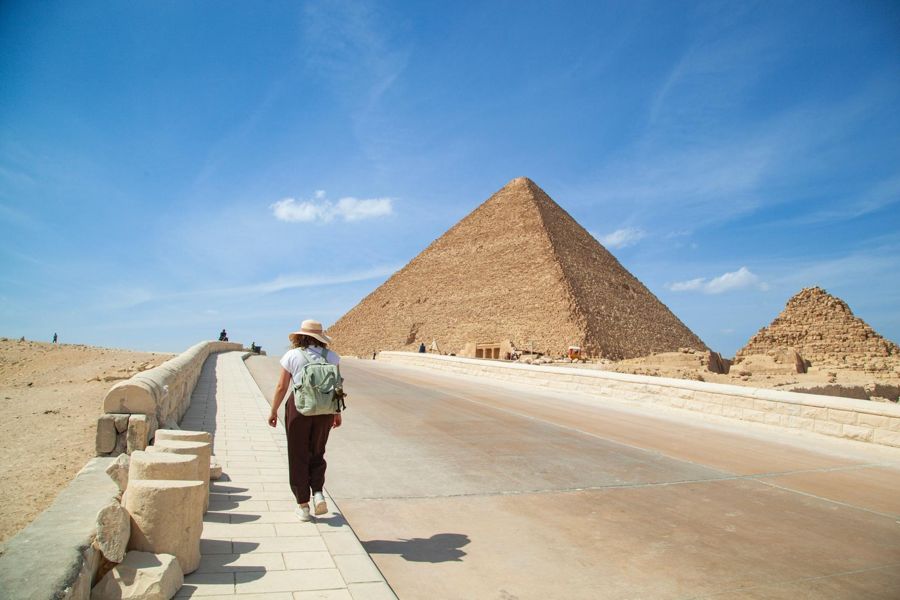 Start in Giza
Short and on Foot
- Plateau entry
- English-speaking guide
- Hotel pickup as an add-on
- Pyramid interior as an add-on
- Free cancellation up to 24 hours before
Those who want to see the Sphinx and the three pyramids and nothing else
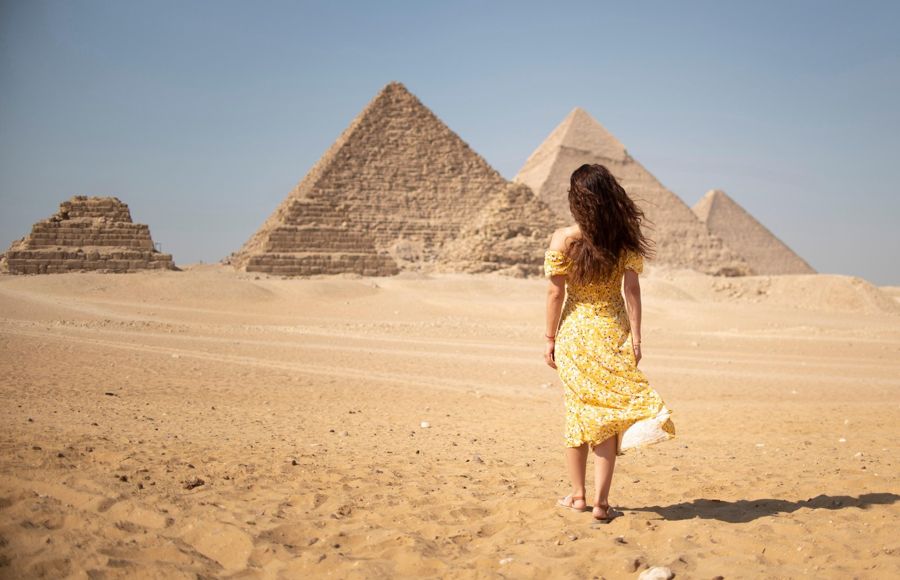 Most booked
Classic Half-Day Tour
- Plateau entry
- English-speaking guide
- Hotel pickup
- Lunch as an add-on
- Pyramid interior
- Free cancellation up to 24 hours before
For the first visit, by far the most booked option
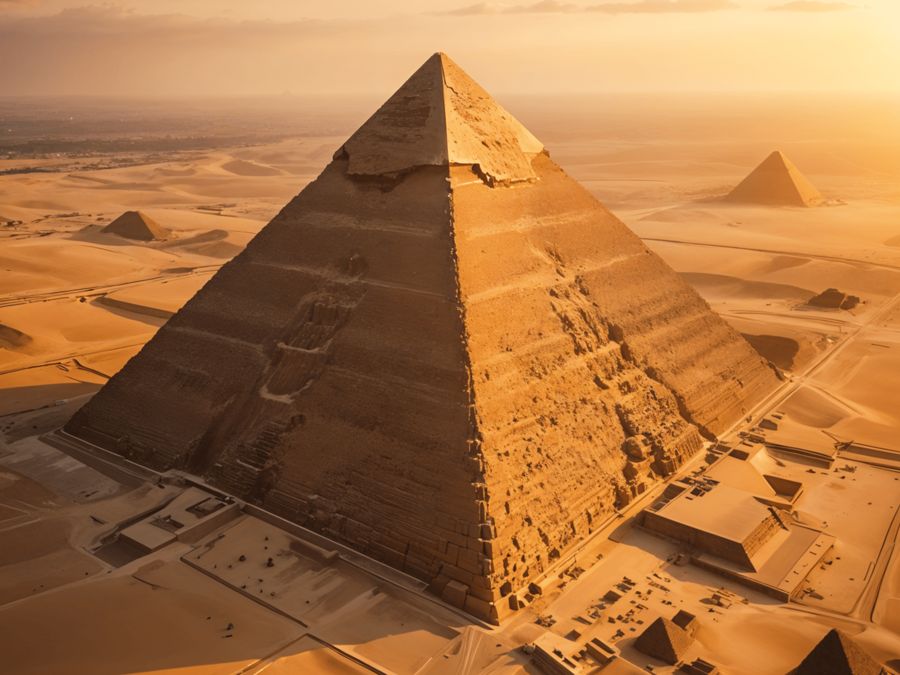 Best rated
Longer, with Selectable Scope
- Plateau entry
- English-speaking guide
- Hotel pickup
- Lunch
- Free cancellation up to 24 hours before
Those who also want to include the Valley Temple, the causeway, and the panoramic viewpoint
Frequently asked questions
How old is the Sphinx?
According to the current state of research, about 4,500 years old, created in the 4th Dynasty. Much older dates circulate but are not archaeologically proven.
Can you go between the paws?
No. The figure is fenced off and is viewed from a terrace. Access to the pit is only for specialists.
Where is the nose?
Unknown. It was already missing before Napoleon's Egyptian campaign, contrary to the widespread story. Fragments of the beard, however, exist in London and Cairo.
Are there chambers under the Sphinx?
There are several natural fissures and some old exploratory shafts, but no proven chamber complex. What appears in documentaries as a hall complex is not substantiated.
Why the Sphinx Is Considered Mysterious
The Sphinx has a reputation that does not actually belong to it. It is considered the enigmatic thing at Giza, the mysterious thing next to the pure engineering achievement of the pyramids.
In fact, it is the opposite. It is the part of the complex where you come closest to the people. A pyramid is perfect and impersonal, a mountain of geometry. The Sphinx is a face that someone cut from a leftover rock hump because that hump happened to be there and was good for nothing else. It has been damaged, repaired, reinterpreted, renamed, and buried several times.
Added to this is that it is the only part of the complex that you can look at without thinking of an achievement. In front of a pyramid, you involuntarily calculate: how many blocks, how many years, how many people. In front of the Sphinx, nobody calculates. You look into a face that looks back, and that is a completely different kind of encounter with a four-and-a-half-thousand-year-old object.
That is exactly why it is interesting. On it, you can read what a monument becomes over four and a half thousand years: tomb guardian, sun god, sand hill, curiosity for travelers, restoration problem, landmark of a modern state.
When you stand on the terrace and have a little time, pay attention not to the face but to the flanks. There you see stone layers from at least three millennia side by side, set by people who all wanted the same thing: that this thing would still be there when they were long gone. So far, it has worked.
Tour to the Pyramids and the Museum of Egyptian Civilization, duration selectable
- Combines the plateau with a museum housing finds from the area
- Plateau entry and pickup are included
- Three to eight hours, the scope can be adapted to the day
- Free cancellation up to 24 hours before