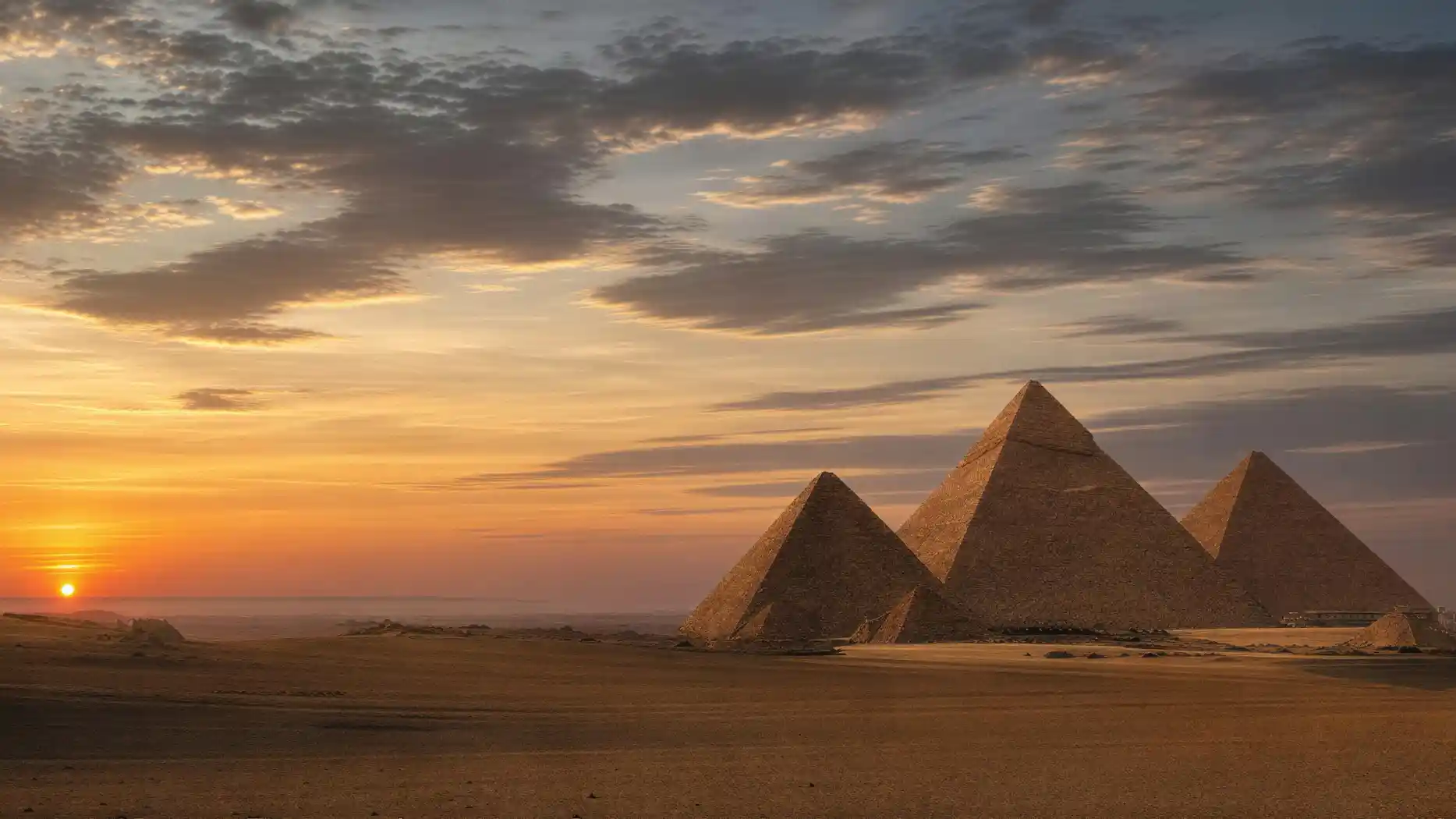
The short answer first, because that's why most people are here: The Great Pyramid of Khufu measures about 138.5 meters today. The Pyramid of Khafre comes in at about 136.4 meters, and the Pyramid of Menkaure at roughly 61 meters.
The height of the Great Pyramid, which in many German texts is written without a hyphen, is the only one of these three numbers that is actually disputed. These numbers are correct, and yet you'll constantly find different ones in books and online. There you'll see 146.6 meters, 143.5 meters, 65 meters. Both figures are correct; they just describe different points in time. The height of the pyramids of Giza is therefore not a single number but a number with a date attached.
The reason is simple: The pyramids have shrunk. Not sunk, not collapsed, but stripped away. What's missing is the smooth outer casing of fine limestone that once covered the entire structure and converged at a point at the top. Without it, the Great Pyramid loses a good eight meters.
If you need a number for school, a quiz, or a bet, you should specify which one you mean. The original height of 146.6 meters is the builders' number, calculated up to the peak that once existed. The 138.5 meters is the number a measuring device gives today when it stands on the plateau.
Interestingly, neither number is exact. The pyramid stands on slightly uneven bedrock, its edges are broken, and what counts as the top is a matter of definition. Different surveys therefore yield values that differ by a few decimeters. For everyday purposes, it's enough: just under 140 meters today, just under 147 back then.
A preliminary note on reliability: The measurements of the three structures are among the most thoroughly studied data in archaeology. The necropolis has been on the UNESCO World Heritage List since 1979, it has been the subject of systematic surveying for over two hundred years, and the numbers have been independently verified many times. If you read somewhere that the true height is being kept secret or has never been determined, that is simply false.
The rest of this page explains where the missing meters went, why the middle pyramid looks taller than the tallest one in almost every photo, and what 146 meters means compared to structures you know.
146.6 Meters in Comparison
meters above ground
Cologne Cathedral would have towered over the Great Pyramid, but only about four thousand years after its completion.
The Missing Meters Are Now in Cairo
The missing meters are no mystery. They are now in Cairo.
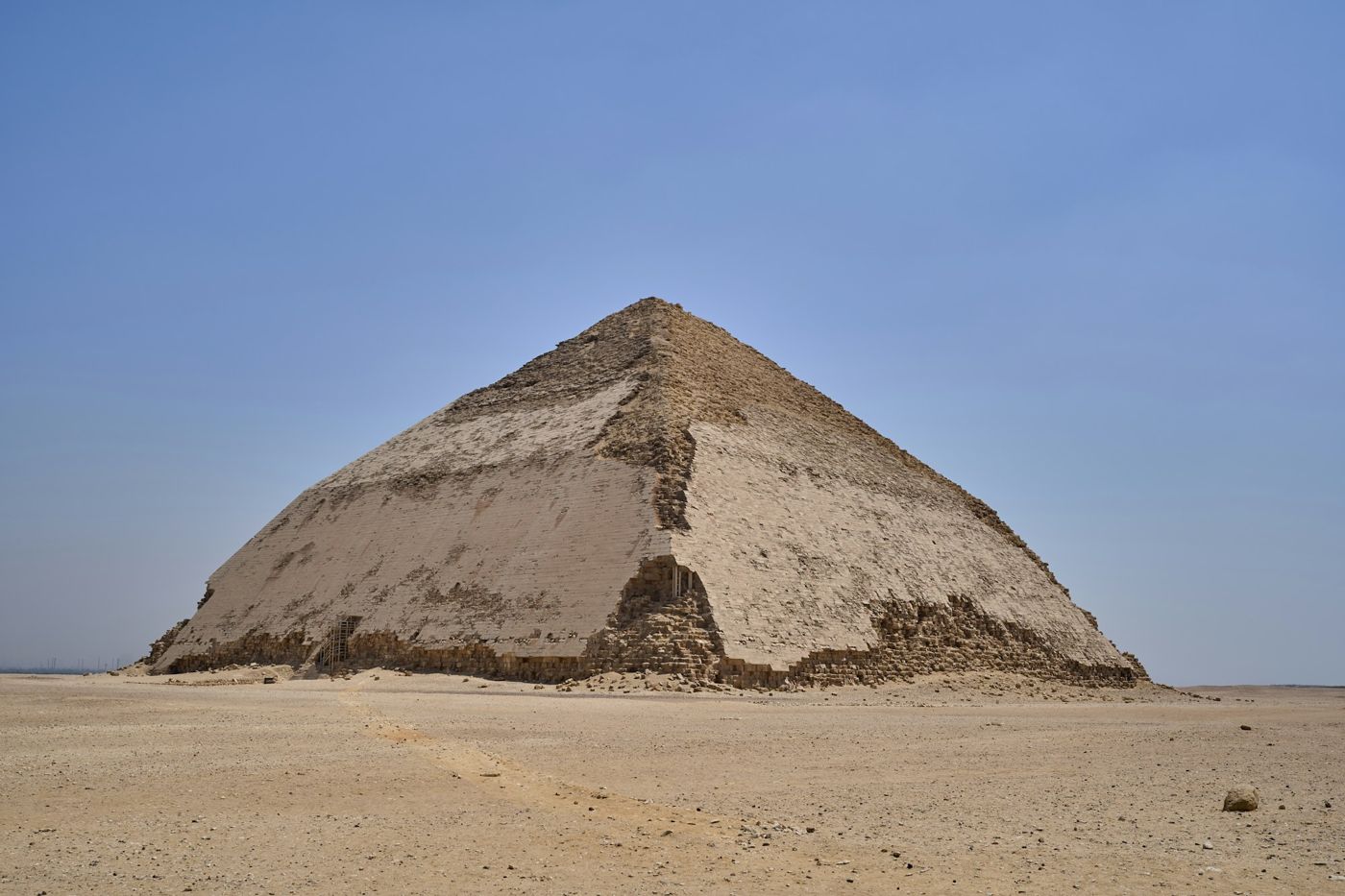
Originally, each of the three pyramids was clad in carefully cut white limestone from Tura. This layer was smooth, reflected light, and converged at a point at the top. What you see today is the core masonry underneath, which was never meant to be seen and therefore looks rough.
The casing was stripped away mainly in the Middle Ages. After a severe earthquake in the 14th century, large quantities of it were already lying on the ground, and a quarry with ready-cut material right at the city's doorstep was a gift for the builders of Cairo. The blocks went into mosques, palaces, and fortifications.
The trigger was a severe earthquake in 1303 that tore large parts of the casing from the flanks. Suddenly, at the gates of Cairo, there was a pile of ready-cut, high-quality building stones, and no one had to operate a quarry for them. What followed was not impulsive looting but decades of orderly removal. Buildings from that period in Cairo's old town contain material that originally lay on the plateau. If you read the description of the original structure and then stand before the pyramid today, you see the difference between a clad and an unclad building.
That is why the top of the Great Pyramid today is not a point but a flat surface. Depending on how you count, it measures about nine to ten meters square, roughly the area of a large living room. In historical photos, travelers in suits sit there and picnic.
Whether a true capstone, a so-called pyramidion, ever sat there is, by the way, not certain. For other pyramids, such capstones have been found, made of granite or limestone, some gilded. For the Great Pyramid, there is none. Reports from Roman times already describe the top as flattened. So both are possible: it was removed early, or it was never set.
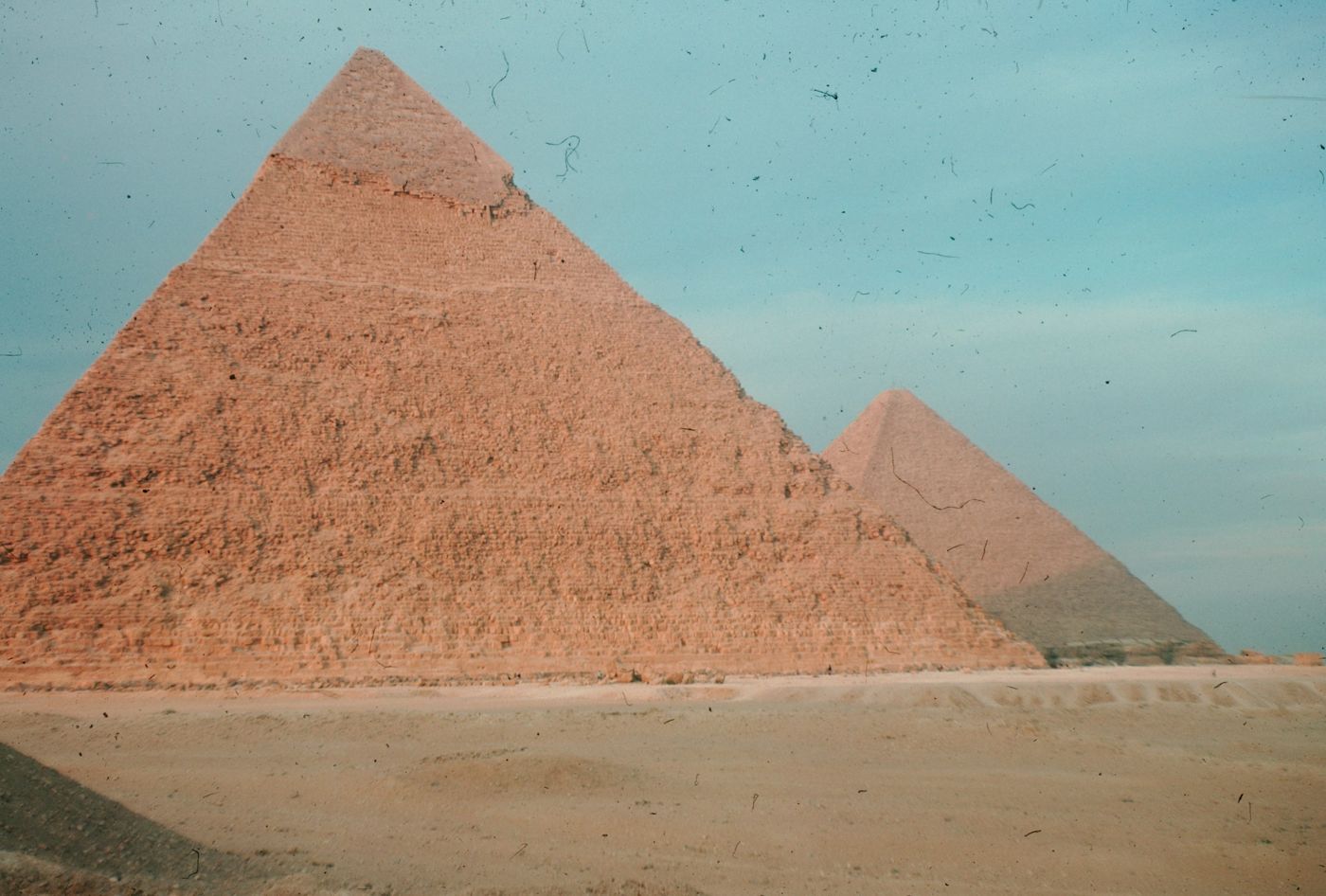
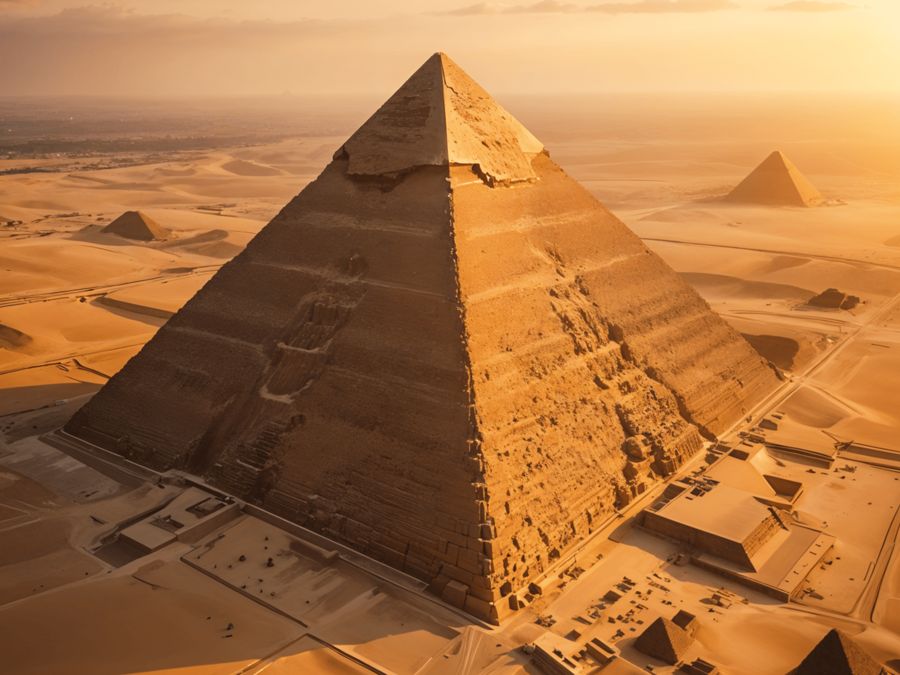
At the Pyramid of Khafre, the proof is still there. The topmost meters carry their original casing, a light, smooth cap on the otherwise rough structure. From below, it looks like a hat. In fact, you are seeing the only larger remnant of the original appearance of all three pyramids.
All Three Pyramids, Then and Now
The difference in the last column is the lost casing.
| Pyramid | Originally | Today | Base side | Inclination angle | Loss |
|---|---|---|---|---|---|
| Great Pyramid of Khufu | 146.6 m | about 138.5 m | 230.3 m | about 51.5 degrees | just over 8 m |
| Pyramid of Khafre | 143.5 m | about 136.4 m | 215.25 m | about 53 degrees | just over 7 m |
| Pyramid of Menkaure | 65 m | about 61 m | 102.2 m | about 51 degrees | about 4 m |
- Originally
- 146.6 m
- Today
- about 138.5 m
- Base side
- 230.3 m
- Inclination angle
- about 51.5 degrees
- Loss
- just over 8 m
- Originally
- 143.5 m
- Today
- about 136.4 m
- Base side
- 215.25 m
- Inclination angle
- about 53 degrees
- Loss
- just over 7 m
- Originally
- 65 m
- Today
- about 61 m
- Base side
- 102.2 m
- Inclination angle
- about 51 degrees
- Loss
- about 4 m
The values come from different surveys and vary by a few decimeters. The steeper angle of the Pyramid of Khafre is one of the reasons it looks taller.
Why the Middle Pyramid Looks Taller
And now to the thing that causes the most discussion on the plateau. Anyone looking at the group from the east or south is sure: The middle pyramid is the tallest. It isn't.
Four effects work together here, and each one alone would be noticeable.
The most important is the ground. The Pyramid of Khafre stands on bedrock that is about ten meters higher than that under the Great Pyramid. The plateau slopes down to the northeast, and the second pyramid was set higher up. Its peak therefore lies above that of its larger neighbor, even though the structure itself is lower. But a pyramid is measured from its own base, not above sea level.
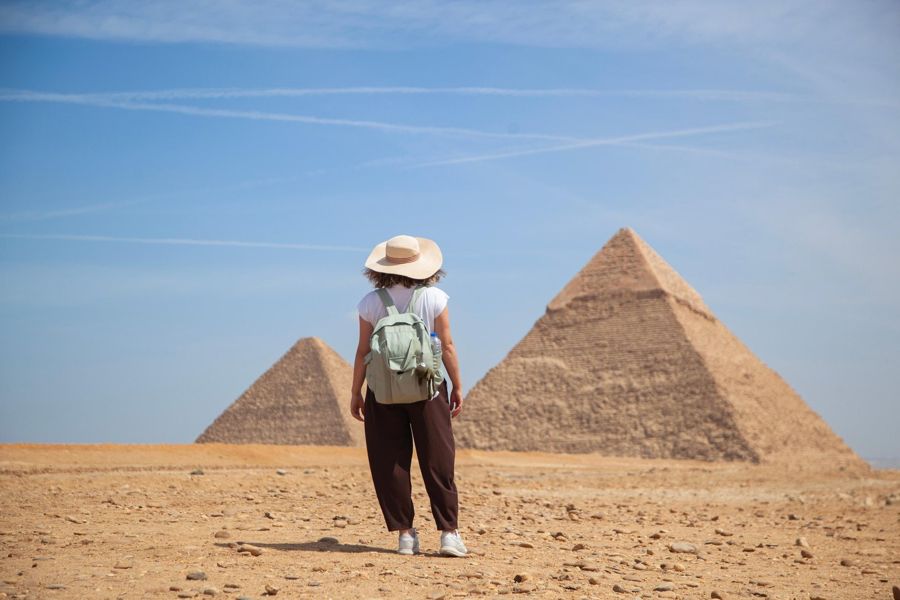
The second effect is the angle. Khafre rises at about 53 degrees, Khufu at about 51.5 degrees. One and a half degrees sounds like nothing, but it visibly changes the silhouette: The steeper pyramid seems more towering, the flatter one wider and more squat.
Third effect: the preserved cap. The light casing at the top draws the eye upward and gives the Pyramid of Khafre a clean finish, while the Great Pyramid ends frayed at the top. A structure with a clear peak looks taller than one that is ragged at the top.
And fourth, perspective. In most photos, including the famous ones, the photographer stands southwest at the panorama point. From there, the Pyramid of Khafre is closer to the camera than the Great Pyramid. Closer means bigger in the picture. This arrangement is so common that many people know the pyramids only in this order.
For photos, you can exploit or avoid this, depending on what you want. If you want the Pyramid of Khafre to look monumental, go to the southwest and let it stand in front. If you want to show the true proportions, look for a spot further east, roughly on the line connecting the two structures, and step back far enough that both bases are in the picture. Then the impression is correct, and the Great Pyramid gets the size it deserves. A wide-angle lens, by the way, strengthens the illusion; a slight telephoto reduces it.
Taken together, this creates one of the most persistent optical illusions in travel photography. If you want to test it on site: Stand between the two structures, at roughly equal distances, and look at the bases instead of the peaks.
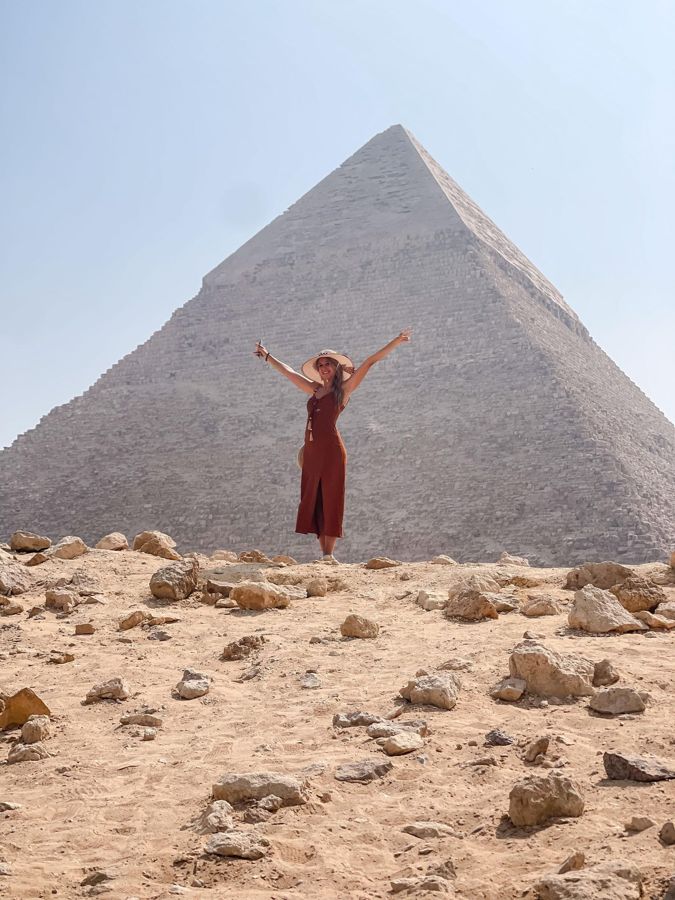
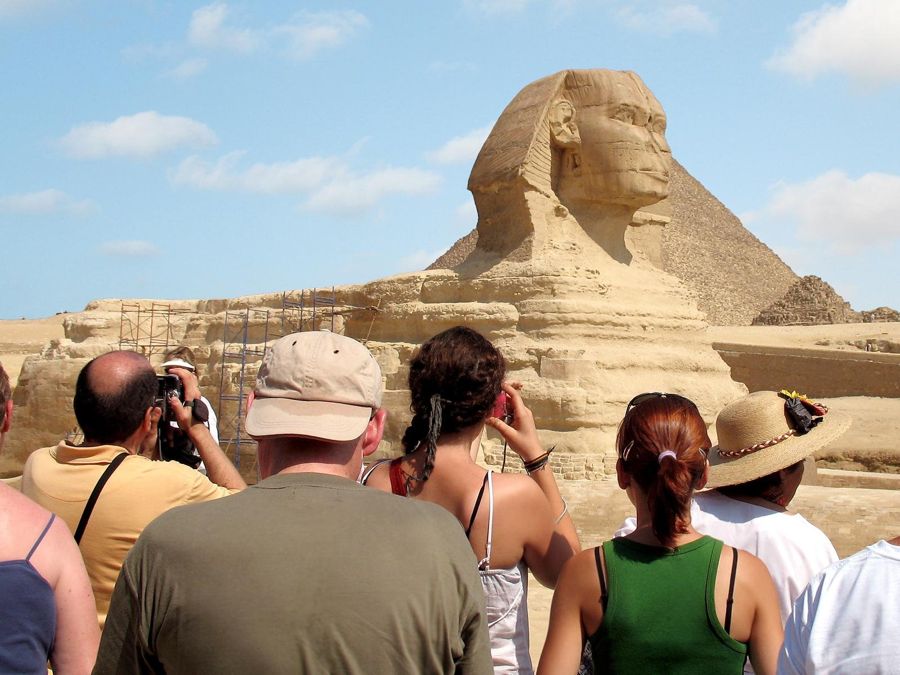
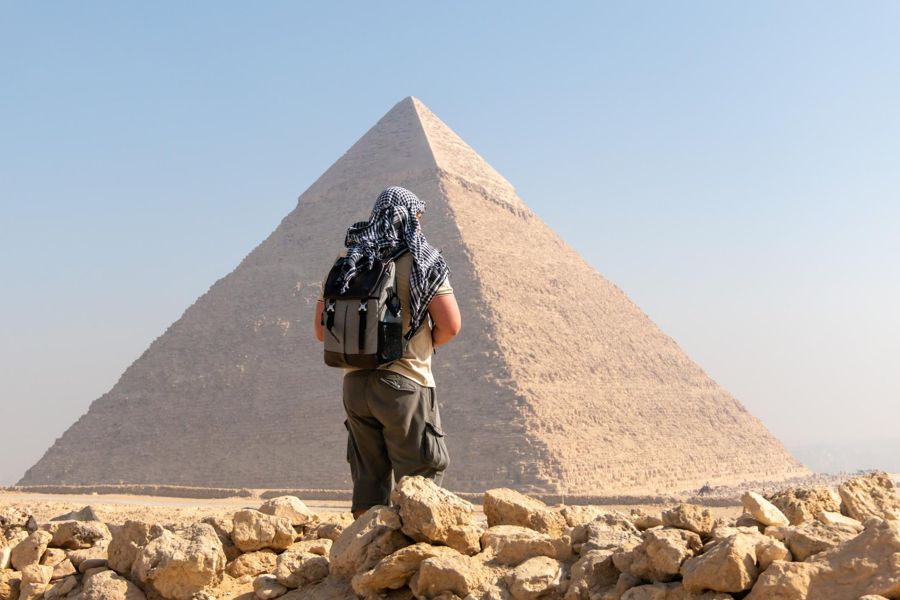
Short walking tour of the plateau with priority entry
- On foot instead of from the bus: The scale only becomes clear as you get closer
- Three hours, without the museum part, leaving time for the afternoon
- Plateau entry and a German-speaking guide are included
- Free cancellation up to 24 hours in advance
How Big Are the Pyramids When You Stand Before Them?
Numbers on a page are one thing. How big are the pyramids of Giza when you actually stand before them?
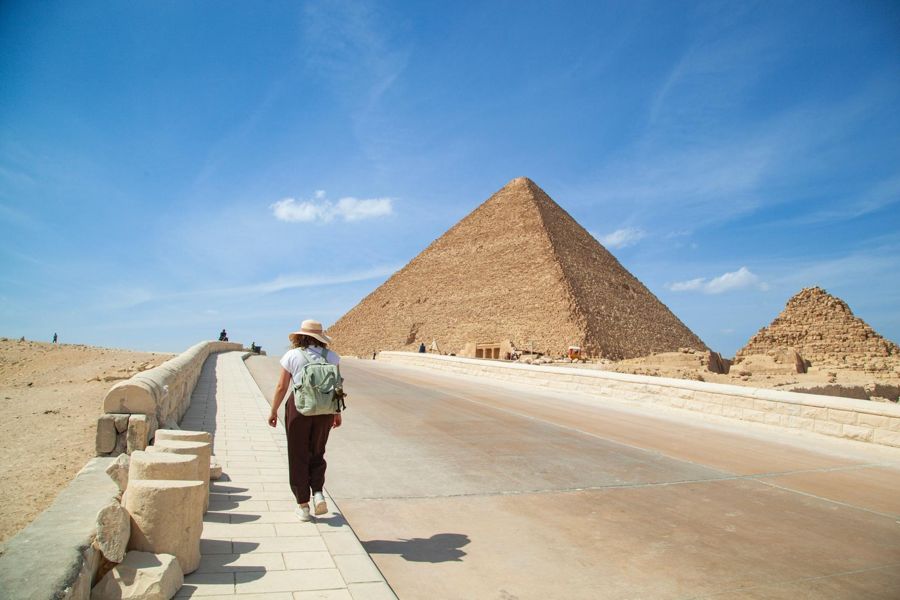
The honest finding is: first smaller than expected, then much bigger. That's because there's nothing in the surroundings for the eye to take measure of. No tree, no house, no vehicle near the structure. From two hundred meters away, a pyramid therefore looks like a clean geometric object without reference.
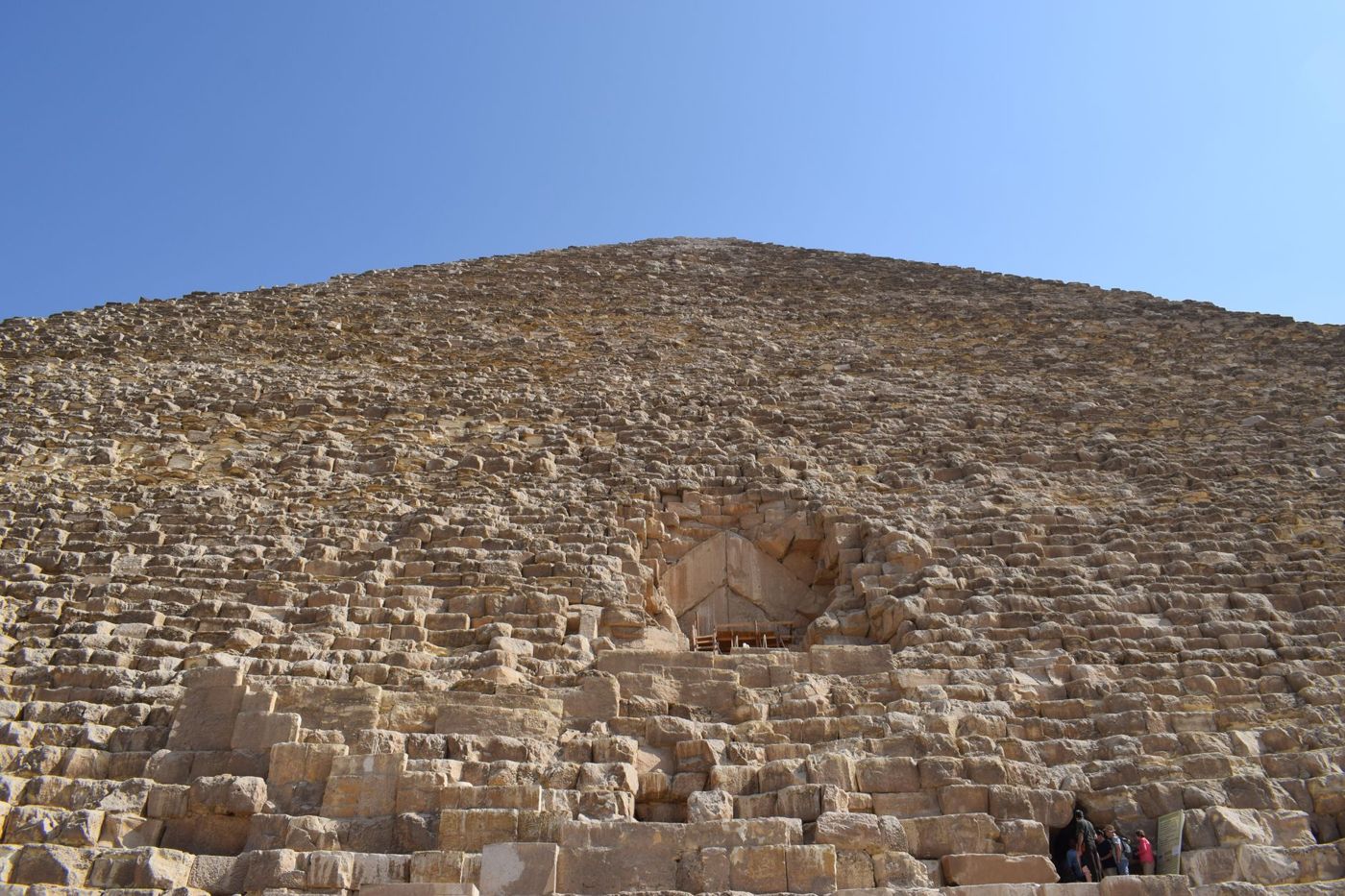
That changes as you approach, and abruptly. The lowest stone courses are the thickest. A block at the base often reaches an adult up to the chest, and the course above that too, and the one above that as well. As soon as you see a person at the base of the pyramid, the impression flips. The human becomes the scale and shrinks to the size of a detail.
A second effect comes when you walk around. One side is 230 meters long, and it takes a good twelve minutes to walk around the Great Pyramid at a normal pace, more in the sand. During that time, the view constantly changes, and the corners are the most interesting part because you can look along them up to the top.
The Trick to Grasping the Height
There is a trick to grasp the height after all. Find a spot on the north side where the sand has blown away and the lowest courses are exposed, and count the stone courses upward as far as you can. The Great Pyramid has about 200 of them. The lowest are a good one and a half meters high, and they get thinner toward the top. Twenty courses are about as high as a residential building, and you're not even at a tenth yet. This calculation works better than any comparison with a TV tower because you have the unit right in front of you and can touch it with your hand.
On the plateau, height is rarely experienced as height anyway, but as area. You stand at a wall that runs upward without you seeing the end. That's why many visitors report that photos had prepared them poorly: A photo shows a silhouette; on site, you stand at a slope of stone.
The height, by the way, has a consequence that is easy to overlook: reach. Because the plateau is elevated and the structures rise almost 140 meters above it, they are visible from large parts of Cairo's western urban area, from rooftop cafés, from the approach to the airport, from bridges over the Nile. Many travelers see their first pyramid not on the plateau but by chance between two high-rises while sitting in a taxi. In haze, however, they disappear completely, and haze is common in Cairo. If you want to see the silhouette from afar, your best chances are in winter after a rainy day.
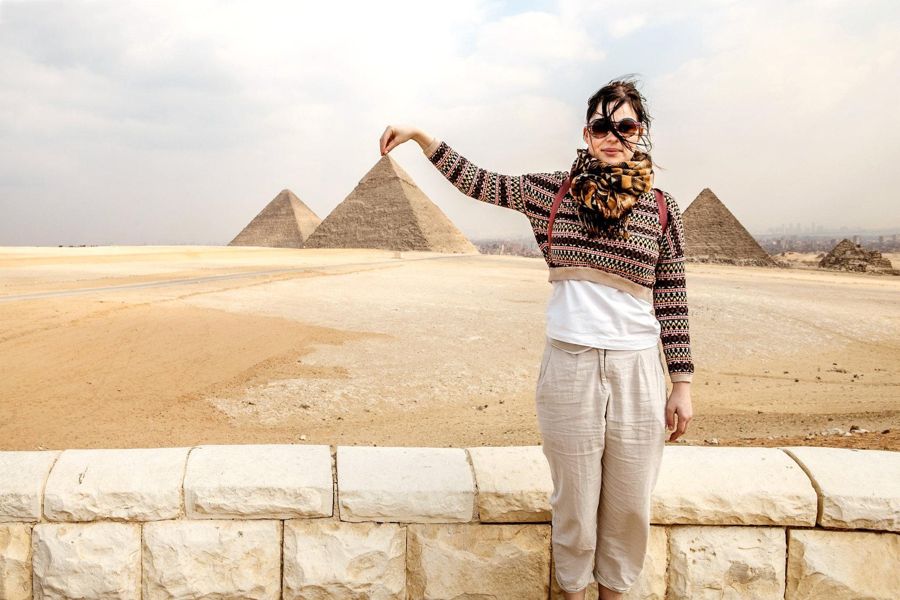
If you want to experience the height as a number, there is still a way. From the panorama point in the southwest, all three structures lie on one line of sight, and the staggering makes the size differences between Khufu, Khafre, and Menkaure truly visible for the first time.
Humanity's Height Record
- around 2560 BC
The Great Pyramid is completed at 146.6 meters and is thus the tallest structure in the world.
- 1311
The crossing tower of Lincoln Cathedral surpasses it. The record holds for about 3,800 years.
- 1548
Lincoln's tower collapses in a storm. For about three hundred years, the pyramids are again in the lead or on par with European church towers.
- 1880
Cologne Cathedral is completed after over six hundred years of construction, 157.38 meters.
- 1890
Ulm Minster reaches 161.53 meters and is the tallest church tower in the world.
- October 2025
The Sagrada Família in Barcelona takes over this title. Ulm held it for 135 years, the Great Pyramid for about 3,800.
How Do You Measure a Pyramid?
The question remains how you measure such a thing at all, and why reputable sources give slightly different numbers.
The basic problem is the base. A pyramid does not begin on a clean line but on a rocky plateau that was leveled but is not at the same height everywhere. Add to that sand that has been collecting at the edges for millennia and covers the corners. Where exactly the measurement starts is therefore a decision, not a given.
The second problem is the top. For the original height, you calculate to a point that no longer exists. You determine it from the inclination angle of the preserved faces and the base side, extend the edges mathematically upward, and see where they meet. If you set the angle a tenth of a degree differently, you get a different height.
The calculation itself is simpler than it sounds. The base side is measurable; it lies on the ground and is exposed in several places. The inclination angle can be determined from the preserved casing remnants and the slope of the core masonry. From half the base side and the angle, the height results via the tangent: 115.15 meters half base side, multiplied by the tangent of about 51.8 degrees, gives about 146.6 meters. If you calculate with 51.5 degrees instead, you end up at just over 144 meters. A third of a degree difference in the angle thus costs two and a half meters of height, and that is where most of the discrepancies between sources come from.
The benchmark for all later figures was set by Flinders Petrie in the 1880s. He surveyed the plateau over months with theodolites and measuring chains and set a standard of accuracy that Egyptology followed for a century. Modern methods, from laser scanning to satellite surveying, have confirmed his values in surprisingly many points and corrected a few.
Practically, that means for you: If one source writes 138.8 meters and another 138.5, they are not arguing. They just measured differently or rounded differently. Only when someone gives a number that deviates by several meters does it pay to take a second look at the source.
Why 146.6 Meters and Not a Round Number?
One question remains open with all these numbers, and it is the most interesting: Why 146.6 meters? Why not a round number?
The answer is that the height was not specified at all. What was specified was the inclination, and the height resulted from it.
Egyptian builders did not think in degrees of angle. They described a slope with a measure called the seked: How far does the surface recede horizontally while it rises by one cubit? The royal cubit was divided into seven palms, each palm into four fingers. A seked of five palms and two fingers means: for each cubit of height gain, the surface goes inward by five and a half palms.
Exactly this value is in the Great Pyramid. Five and a half palms correspond to an inclination of about 51.8 degrees, and that is exactly the angle the surveys deliver.
This calculation method is not handed down from the construction period itself but from later schoolbooks. The Rhind Papyrus in the British Museum contains a series of problems that practice exactly that: Given are base side and height, find the seked. Or vice versa, given are base side and seked, find the height. They are practice problems for aspiring officials, and they show that pyramid geometry in ancient Egypt was a craft with fixed rules, not a one-off stroke of genius.
Practically, that was a clever choice. An angle cannot be controlled on the construction site, but a ratio of palms to cubits can: You set a bevel and measure. Every stonemason could check on every block whether the slope was correct without knowing the overall plan.
And that explains the odd height. It is not a target value but the result of a chosen base side and a chosen seked. The builders determined how wide and how steep. How high, that was calculated.
The Smaller Pyramids on the Plateau
The three great pyramids are not the only ones on the plateau, and the smaller ones help explain the height relationships.
East of the Great Pyramid stand three noticeably smaller structures, the queen's pyramids. They each reach about thirty meters, sometimes less, and are heavily eroded today, so they look more like piles of stones. Next to a structure of 138 meters, they almost disappear, even though each one alone is a large tomb.
They are attributed to women from the closest circle of Khufu. For the northernmost, Hetepheres is considered the likely owner, the king's mother, whose grave goods were found in 1925 in a neighboring shaft and now lie in the museum. The other two are attributed to queens whose assignment is less certain. In addition, there is a fourth, very small pyramid at the southeast corner that was only recognized in the 1990s as a so-called cult pyramid. It was not a tomb but belonged to the religious program of the complex, and the fact that it was overlooked for so long says a lot about how much lies under the sand on this plateau.
The Pyramid of Menkaure also belongs in this consideration. At about 61 meters, it is less than half as high as its two neighbors, and in volume the difference is even more drastic because the building volume roughly develops with the third power of the height. It is therefore not a somewhat smaller third pyramid but a structure of a completely different order of magnitude.
Why that is so is one of the open questions of Egyptology. Explanations range from economic exhaustion after two giant structures, to a shorter reign, to a deliberate change in religious emphasis, away from building volume and toward temples and statues. None of them is proven.
If you count all the structures, you come to nine to eleven pyramids on the plateau, depending on how you count. The exact number depends on whether you count heavily destroyed cult pyramids.
Tour of the plateau with selectable duration, three to eight hours
The queen's pyramids, the causeway, and the panorama point lie off the usual three photo stops. That takes time, and here you can set it.
Frequently asked questions
How tall is the Great Pyramid?
Today about 138.5 meters, originally 146.6 meters. The difference is the missing outer casing.
Which of the three pyramids is the tallest?
The Great Pyramid, both then and now. The Pyramid of Khafre only looks taller because it stands on bedrock ten meters higher.
Was the Great Pyramid really the tallest structure in the world?
Yes, for about 3,800 years, until the tower of Lincoln Cathedral was completed in 1311.
Can you climb the pyramid to experience the height?
No. Climbing is forbidden and is punished. The steps are irregularly high and the edges are rounded, and there have been serious accidents.
What the Number 146.6 Doesn't Say
Height is the number most often asked about for these structures, and at the same time the one that explains the least.
146.6 meters says nothing about the fact that this height remained unattained for almost four thousand years, not because no one wanted to build higher, but because no one could. It also says nothing about the fact that the number is the result of a plan that was fixed before the first stone, because the inclination of a pyramid cannot be corrected later.
And above all, it says nothing about what the last meters must have felt like. At the very top, on a working surface of a few square meters, without a railing, with blocks that had to be brought up from below, in a land without a crane.
For context, once again the European perspective: The tallest church tower in Germany, Ulm Minster, towers over the original Great Pyramid by just under fifteen meters. It was built in stages between 1377 and 1890, that is, over a good five hundred years. The pyramid was built in about twenty.
If you want to remember a single number from this page, don't take 146.6. Take 3,800. That's how many years this structure stood at the top before another people on another continent surpassed it.

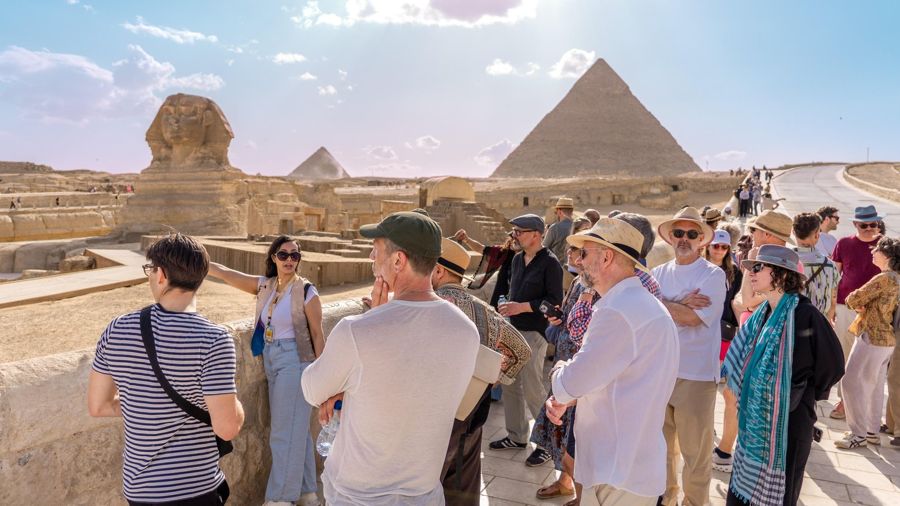
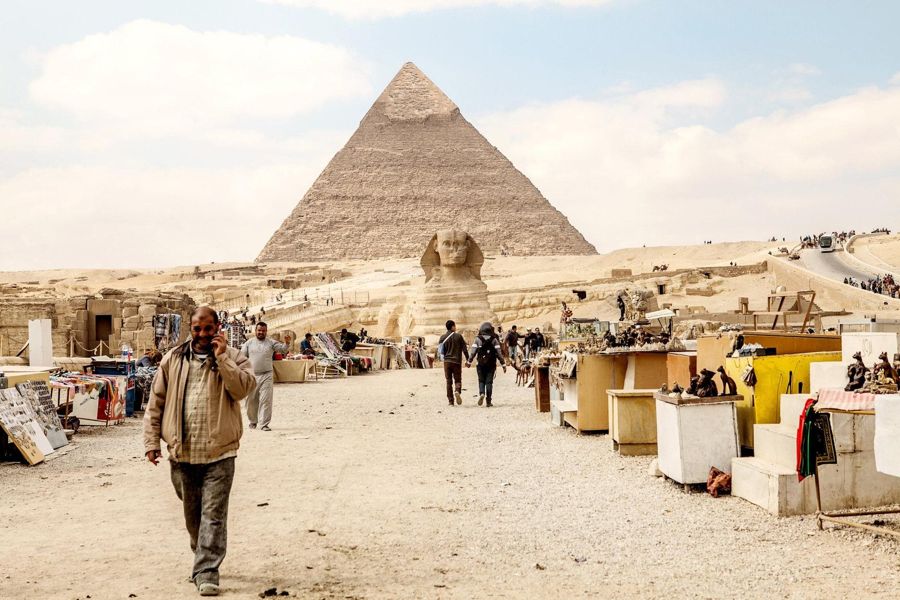
Half-day tour to the pyramids and Sphinx with a licensed guide
- Four hours, the classic format for a first visit
- Plateau entry, German-speaking guide, and pickup are included
- A guide leads to the viewpoints where the size relationships are correct
- Free cancellation up to 24 hours in advance