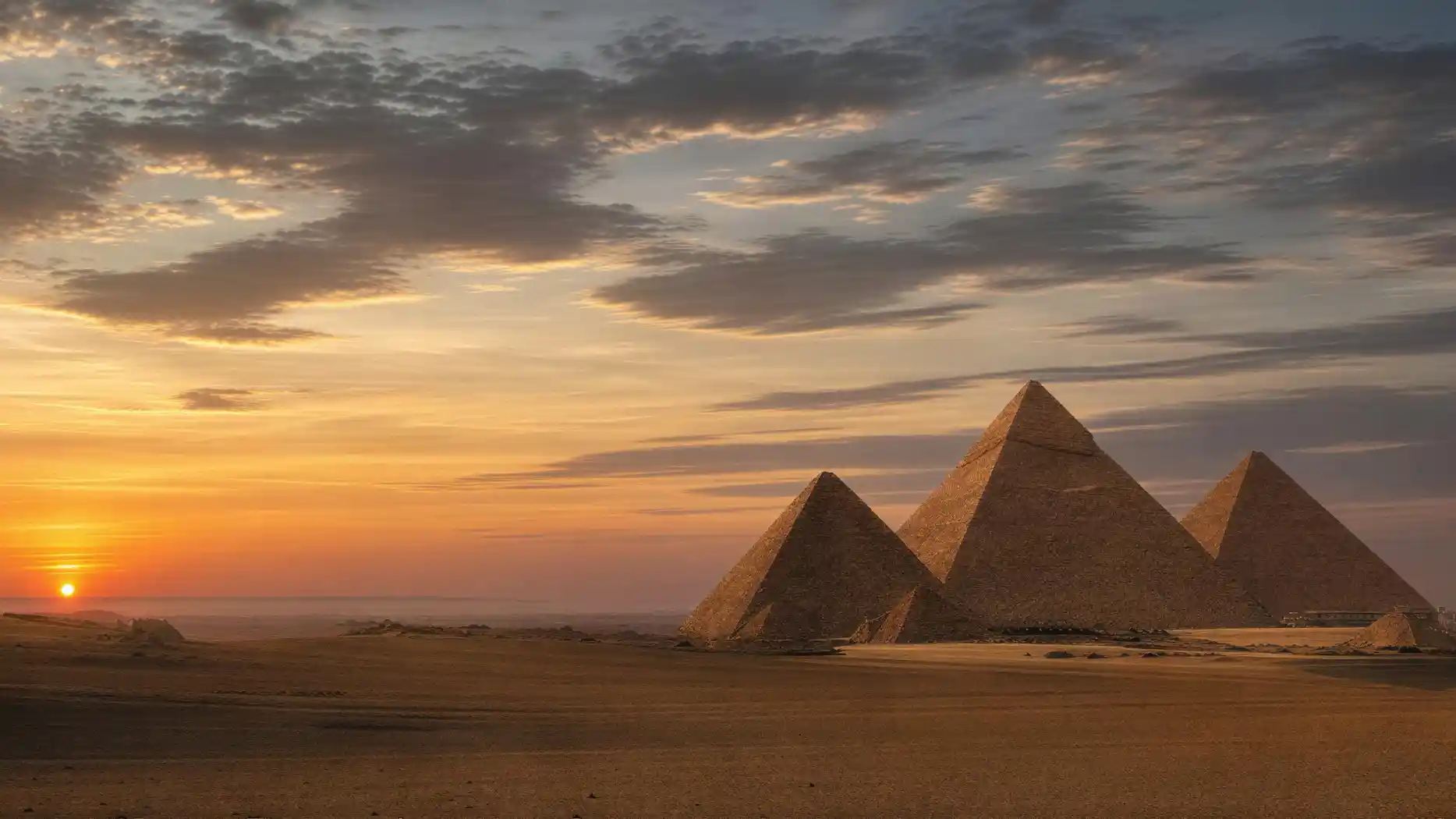
146.6 m high, 2.3 million blocks, 4,500 years old
The documented figures for the Great Pyramid of Khufu: base side 230.3 meters, inclination around 52 degrees, deviation from true north less than one-tenth of a degree.
Source: UNESCO World Heritage List
There is a reason why fact lists about Giza all look the same. They copy each other.
For decades, the same numbers have been circulating, including the false ones. The pyramid was built from two million blocks, or two and a half, or three. It is so heavy that modern cranes fail. You can see it from the moon. Hundreds of thousands of slaves worked on it for twenty years. Each of these statements appears in thousands of texts, and each is either wrong or so imprecise that it says nothing.
This page takes a different approach. It states where every number comes from and how certain it is. Some statements are extremely well-documented because they have been remeasured repeatedly for one hundred and forty years. Others are estimates that move within a range. And some very famous claims dissolve upon first questioning.
This is not nitpicking. For a structure around which so many stories revolve, distinguishing between measured, estimated, and claimed is the actual content. Knowing this allows you to recognize nonsense while reading, without needing to look it up.
A note in advance: You will not find round numbers here. Structures from the Old Kingdom were not planned in meters, but in cubits, and the conversion generates decimal places. Where a source cites smooth values, it has usually rounded them and failed to mention it.
The dimensions, and how certain they are
Let us begin with what is best documented: the dimensions.
The Great Pyramid of Khufu measures approximately 138.5 meters today. Originally, it was 146.6 meters. The difference is the removed outer casing, not settlement damage. One base side is 230.3 meters long. The four sides differ by less than twenty centimeters from each other, over a length of nearly a quarter kilometer.
The number of stone blocks is usually given as about 2.3 million. This number is a calculation, not a count: One takes the total volume, subtracts the natural bedrock core and the chambers, and divides by an assumed average volume per block. Depending on how large one assumes the bedrock core to be, one arrives at values between about 2 and 2.5 million. Anyone who gives you an exact number has not counted it.
The average block weight is around two and a half tons. The outliers are more interesting than the average: The granite beams above the King's Chamber weigh an estimated fifty to eighty tons each and lie at a height of about forty meters. They originate from Aswan, roughly 900 kilometers upstream.
Two further values appear constantly and are both calculated. The volume of the structure is around 2.6 million cubic meters, and the total mass is about six million tons. Both follow from the external dimensions and an assumed rock density, minus the voids, and both change as soon as someone sets the bedrock core differently. No one has weighed the pyramid.
Remarkably precise, however, are the corners. The four base angles deviate only by fractions of a degree from the right angle. For a structure that measures more than 325 meters diagonally and whose corners cannot be seen from the opposite end, this is the actual surveying achievement.
The construction time is given as approximately twenty years. This figure goes back to Herodotus, who wrote two thousand years after the construction, and it coincidentally fits well with the documented reign of Khufu. It is plausible, but it is not a measurement.
The Great Pyramid of Khufu at a glance
- Original height
- Height today
- Base side
- Inclination angle
- Stone blocks
- Granite beams
Dimensions based on surveys of the plateau repeated many times since Petrie
How old the pyramids really are
It gets more interesting when it comes to age, because the usual comparisons almost all miss the mark.
The Great Pyramid of Khufu was created around 2560 BC, i.e., around four and a half thousand years ago. This dating relies on several independent strands: the Egyptian king list, radiocarbon dates from mortar samples and construction site materials, and since 2013, the diary of the inspector Merer, which is explicitly dated to the 26th regnal year of Khufu.
At this point, it is worth looking at how secure the dating actually is, because this is where the difference between a number and a reliable number becomes particularly clear.
Between 1984 and 1995, over four hundred and fifty organic samples from structures of the Old and Middle Kingdoms were taken and measured independently in three laboratories. The material came predominantly from the mortar: During firing and mixing, charcoal and plant remains entered it, which can be dated. The result was uncomfortable. The values lay on average one hundred to two hundred years above the historically established reign data, and they varied strongly. Just for the Great Pyramid of Khufu, the individual data points distributed themselves over a span of around four hundred years.
This is usually explained by the old wood effect: Whoever burns centuries-old wood dates the wood, not the construction site. The participating researchers considered this explanation insufficient, however, because it is unlikely that consistently old material was burned.
Therefore, the honest formulation is: The Great Pyramid of Khufu dates from the middle of the third millennium BC, and the common figure of around 2560 BC is a well-founded convention, not a measurement with yearly precision.
The age comparisons that actually work
The comparison that really works goes like this: Cleopatra lived in the first century BC. Around 2,500 years lie between her and the construction of the Great Pyramid of Khufu. Around 2,000 years lie between her and the first moon landing. Cleopatra was temporally closer to the moon landing than to the structure, which was already considered an ancient sight during her lifetime.
A second comparison concerns the structure itself. It was the tallest in the world for around 3,800 years. It was not surpassed until 1311 by the spire of Lincoln Cathedral. For comparison: Only a little over seven hundred years have passed since this replacement. So the record held more than five times as long as it has been broken since then.
The case is different with the Sphinx, and this is one of the most honest pieces of information one can give about Giza. There is no datable construction inscription for it. From the Old Kingdom, i.e., from its presumed time of origin, no text is known at all that mentions it. The attribution to Khafre therefore relies on location: It lies in his complex area, on his causeway, in a pit whose blocks are built into his Valley Temple. This is a strong indicator, but it is just an indicator. Anyone who gives a year for the Sphinx is repeating a reasoned estimate.
And a third one, which anchors the magnitude in everyday life: When the last stones of the Great Pyramid of Khufu were set in Egypt, Stonehenge existed in its current form only just recently, writing was unknown in Central Europe, and about eighteen centuries were still to pass before the founding of Rome.
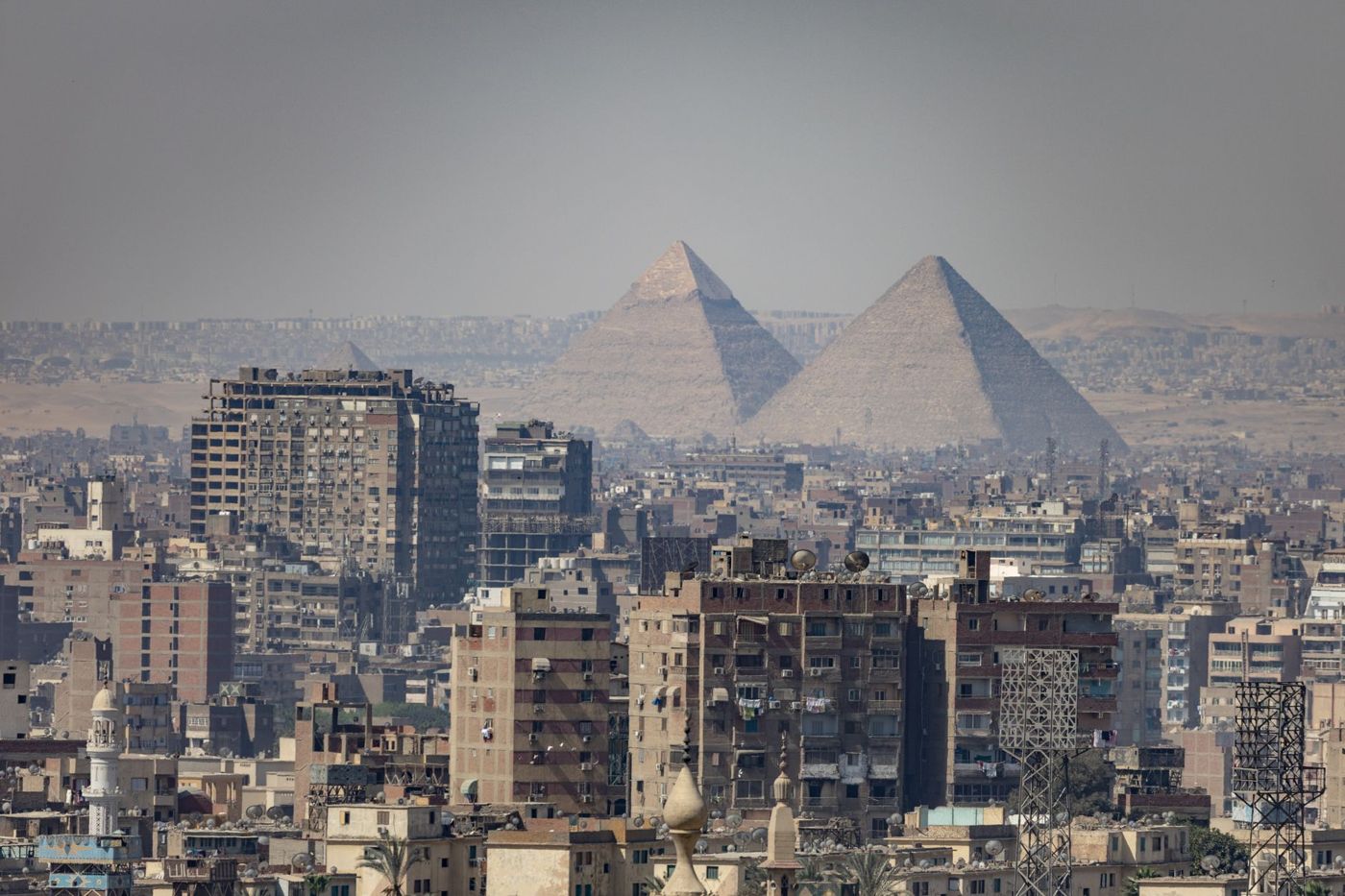
Not the size, but the precision
But the most impressive part is not the sizes, but the tolerances. Facts about the Great Pyramid of Khufu that truly astonish almost all concern precision.
The sides of the structure deviate by less than one-tenth of a degree from true geographic north. This was achieved without a magnetic compass, which did not exist then, presumably through the observation of stars. For comparison: One-tenth of a degree corresponds to a deviation of about forty centimeters over a length of 230 meters.
The base area lies almost exactly level. Over the entire extent, the deviation from horizontal is only a few centimeters. A procedure considered is a network of water-filled trenches, because water finds its own level.
The inclination was not defined in degrees, but as a ratio. The Egyptians used the seked: how far a surface recedes horizontally while rising by one cubit. The Great Pyramid of Khufu has a seked of five and a half handbreadths, which corresponds to around 51.8 degrees. This calculation is transmitted from exercise tasks on the Rhind Mathematical Papyrus in the British Museum. The curved height of the structure is therefore not a target value, but a result: The base side and inclination were set, the height fell out accordingly.
A caveat belongs here, because it is almost always missing. These tolerances apply to the foundation, the casing surfaces, and the granite chambers, i.e., the parts that were visible or load-bearing. The core masonry, which forms the exterior surface today, is worked considerably coarser: irregular block heights, wide joints, rubble filling in between. So whoever stands at the pyramid today and sees the coarse layers is not looking at negligence, but at a structural component that was never intended for view. The famous precision sat in the skin above it, and that is gone.
This precision is the reason why the structure attracts so much speculation. It is real, it has been remeasured, and it is explainable with the means of the time. Only the last part is often omitted in popular representations.
The pyramid has eight sides, not four
One detail brings both together, the precision and the legend formation: The Great Pyramid of Khufu does not have four sides, but eight.
Each of the four faces is slightly recessed inward in the middle, from the base to the tip. The depression is only about one meter on a side length of 230 meters. It cannot be seen from the ground. It becomes visible from the air when the sun is low and half of each face lies in shadow, the other in light.
This observation is usually attributed to an aerial photograph from 1940, taken by a British officer. And exactly here it becomes instructive: The attribution is not correct. Flinders Petrie had already surveyed and described the recess in the 1880s, and it is depicted in the plate work that emerged from Napoleon's Egyptian expedition, i.e., around 1800.
The process is typical. A real observation is packaged with a false discovery story because the story sounds better than the truth, and the packaging survives.
Why the faces are recessed is, incidentally, open. Proposed are a settlement effect, a conscious trick to stabilize the casing, and a pure side effect of the construction sequence. None of these explanations is proven.
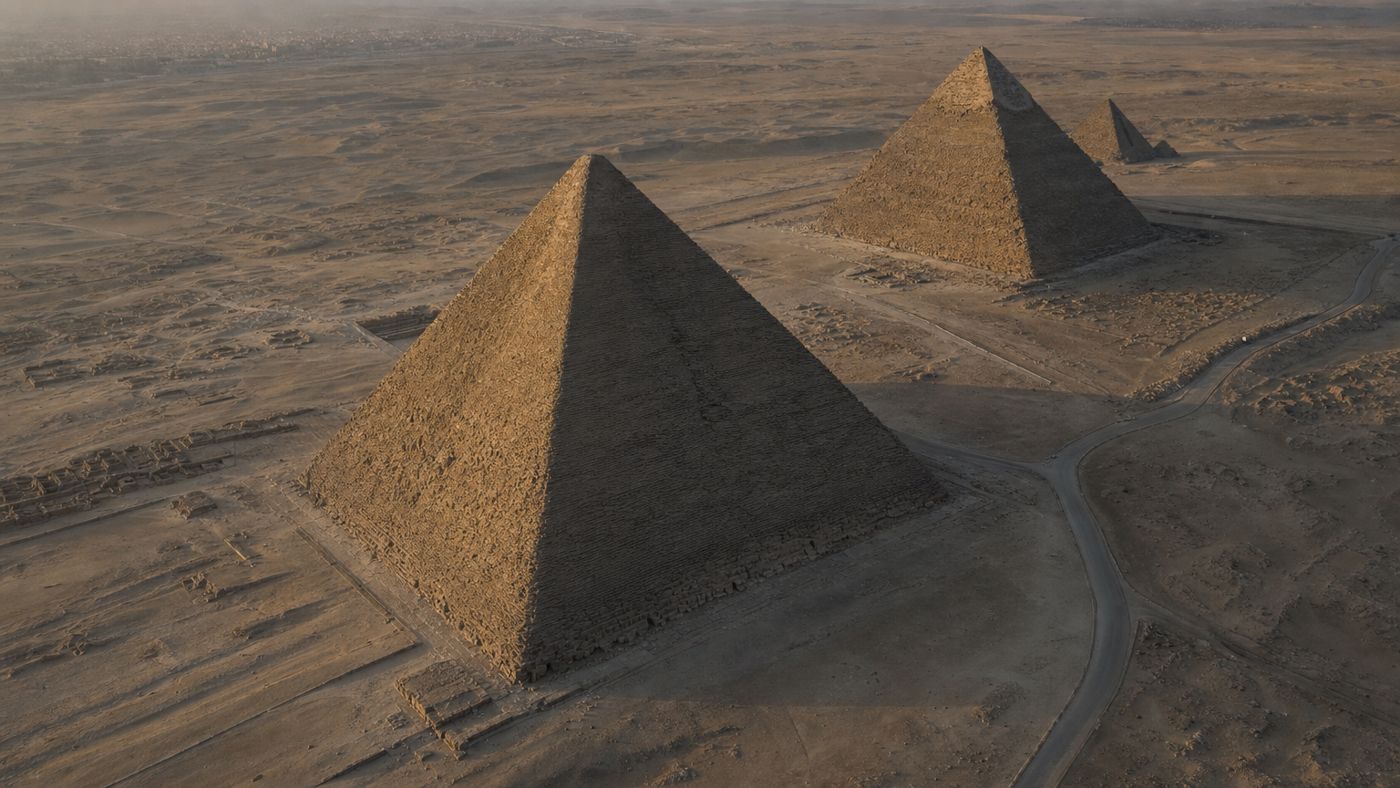
The four major structures in numerical comparison
The Sphinx is intentionally included in this table because it originated differently from everything next to it.
| Structure | Dimension | Built for | Special feature |
|---|---|---|---|
| Great Pyramid of Khufu | 146.6 m high, 230.3 m base side | Khufu | assembled, approx. 2.3 million blocks |
| Pyramid of Khafre | 143.5 m high, 215.25 m base side | Khafre | steeper, casing remnant at the top |
| Pyramid of Menkaure | 65 m high, 102.2 m base side | Menkaure | unfinished granite mantle in the base area |
| Great Sphinx | 73 m long, 20 m high | presumably Khafre | carved from the rock, not built |
- Dimension
- 146.6 m high, 230.3 m base side
- Built for
- Khufu
- Special feature
- assembled, approx. 2.3 million blocks
- Dimension
- 143.5 m high, 215.25 m base side
- Built for
- Khafre
- Special feature
- steeper, casing remnant at the top
- Dimension
- 65 m high, 102.2 m base side
- Built for
- Menkaure
- Special feature
- unfinished granite mantle in the base area
- Dimension
- 73 m long, 20 m high
- Built for
- presumably Khafre
- Special feature
- carved from the rock, not built
All heights are original values. Today, the pyramids are four to eight meters lower depending on the structure.
Who really built it, and how many
The picture regarding personnel has completely reversed in the last forty years, and the old version persists nevertheless.
They were not built by slaves. Southeast of the pyramid lies an excavated workers' village with sleeping galleries, bakeries on an industrial scale, breweries, stores, and an administration. Plus a cemetery, where the workers were buried in sight of their structure. In the skeletons, healed bone fractures are found that had been professionally splinted. The excavations at this settlement have been running since 1988.
The number of participants is often given as one hundred thousand. This also comes from Herodotus. The archaeologically supported estimates lie significantly below: a few thousand people permanently on site, plus larger contingents that arrived temporarily, and over the entire construction period, a total number in the order of twenty thousand.
The work was organized into named teams, which were divided into subunits and rotated. Their markings stand on blocks in the relieving chambers above the King's Chamber. They are the only inscriptions in the entire structure, and they were never intended to be read.
What this supply looked like can be read from the finds. In the bakeries stood clay bread molds that are considerably larger than anything known from residential houses of the same time. Baking was not for families, but for columns. Regarding the cattle bones, the quantity and age distribution speak for a systematic supply from the surrounding area. A construction site of this size is first a supply chain, and only afterwards a question of stones.
The teams, incidentally, bore their own names, which honored the king, and these names still stand on the blocks today. It is the only place where something like a signature appears on this structure, and it comes not from the patron, but from the workforce.
Since 2013, there has been a source that could hardly be better. In harbor galleries on the Red Sea, the oldest written papyri of Egypt were found, including the diary of an inspector named Merer. He noted over months how his team brought limestone blocks to Giza by boat, with dates and quantities. It is a work proof from the construction site itself.
Inside, there is nothing
The most persistent misconceptions circulate about the interior, and they can be resolved in one sentence: There is nothing there.
In the accessible rooms of the Great Pyramid of Khufu, there is no wall painting, no reliefs, and no hieroglyphs. This is not a loss due to plundering, but style of the time. The painted burial chambers, which everyone knows from Egypt, are around one thousand years younger and are located in the Valley of the Kings.
No mummy has ever been found in any of the three great pyramids. In the King's Chamber stands a granite sarcophagus, without lid, empty, damaged at one corner. It is wider than the passage through which it would have had to be brought in, so it stood there already before the chamber was finished.
Void spaces that no one has entered are documented instead. In 2017, muon tomography located a space of at least thirty meters in length above the Grand Gallery. A smaller corridor behind the north facade was confirmed in 2025 through three independent measurement procedures. What they are is open. Treasure chambers are not among them, and there are currently no proofs for sealed doors behind which something waits.
Two further architectural peculiarities are regularly overinterpreted. Narrow shafts lead diagonally outward from the King's Chamber and from the chamber below it, good twenty centimeters square. Their angles point to star positions of the construction time. Since the 1990s, several robots have entered them and encountered small stone plates with embedded copper pins, behind them short voids and further plates. What this is, nobody knows. That it is a door to a chamber is a supposition and not a finding.
Also documented and less known: The Nile once flowed much closer. In 2024, a buried river branch was proven, which ran along the entire belt of pyramids. The causeways of the pyramids end exactly at its former shore.
Five statements you find everywhere and which are incorrect
- False
The pyramids can be seen with the naked eye from the moon.
Even from low Earth orbit, they are only detectable under good conditions and with aids.
- False
Hundred thousand slaves built for twenty years.
The number comes from Herodotus, two thousand years after the construction. The workers were paid, fed, and honorably buried.
- Partially
You cannot slide a sheet of paper between the blocks.
This applies to the finest casing joints and the granite chambers, not to the coarse core masonry that one sees today.
- False
The eight sides of the pyramid were discovered from the air in 1940.
Petrie had already surveyed the recess in the 1880s; it was depicted around 1800.
- False
The solar barque of Khufu stands next to the pyramid.
The Boat Museum on the plateau no longer exists. The barque is in the Grand Egyptian Museum.
What changed on the plateau in 2025
Finally, the facts with the shortest shelf life, namely those concerning the current state. Here, almost everything is different from older representations since 2025.
The main entrance is no longer at the old gate near the Mena House, but at a new visitor center on the desert road to Fayyum. Private cars and tour buses are no longer allowed on the plateau. Instead, electric shuttle buses run as a ring line, the use of which is included in the admission ticket.
The Grand Egyptian Museum opened in November 2025 a few minutes away by car. Thus, the answer to a classic fact question has also changed: The solar barque of Khufu no longer stands on the plateau. The second barque has been assembled from around 1,650 wooden parts in front of the public since the end of 2025.
Caution is advised regarding visitor numbers. Figures in circulation differ by more than fivefold, depending on whether someone means Egypt's total tourist numbers, the visitors to the region, or the sold plateau tickets. Only the order of magnitude of a few million for the plateau itself is reliable. Anyone who reads a more precise number should check exactly what was counted.
The entire necropolis has been on the UNESCO World Heritage List since 1979, together with the pyramid fields of Abusir, Saqqara, and Dahshur. This is the only statement in this section that is not expected to change anytime soon.

Frequently asked questions
How many pyramids stand in Giza?
Depending on the counting method, nine to eleven. Three large ones, three queen's pyramids on the eastern edge, plus smaller cult and subsidiary pyramids, some of which are heavily destroyed.
How heavy is the Great Pyramid of Khufu overall?
The usual figures are around six million tons. This is an extrapolation from volume and rock density, not a weighing, and it fluctuates accordingly.
Why are the stones so uneven today?
Because the smooth outer casing is missing. What you see is the core masonry, which was never meant to be visible.
Has a treasure ever been found?
Not in the three great pyramids. The chambers were already empty in antiquity. Significant finds come from the surrounding graves and shafts.
Three types of statements, and how to distinguish them
If you take only one thing from this page, then preferably not a number, but a distinction.
At Giza, there are three types of statements. Measured: height, base side, angle, deviation from north. These are hard, checked multiple times, and change only in the last decimal place. Calculated: number of blocks, total weight, labor output per day. These depend on assumptions and move in ranges. And transmitted: construction time, number of workers, everything that comes from Herodotus. These are testimonies of a later time about an earlier one.
Almost every misleading fact list arises because these three types look the same when you write them down next to each other. A calculated block number gets the same authority as a measured edge length, and a statement from the fifth century BC stands next to a laser scan from 2020.
For practice, this means: Check at every striking statement first which type it belongs to. A number with many decimal places that is supposed to be transmitted from antiquity is a warning sign. Likewise a statement that matches a modern constant exactly, because with enough measurements and enough constants, you will always find some hit.
The structure does not need such enhancement. The documented numbers are sufficient. A grave whose sides deviate by less than one-tenth of a degree from true north, built without a compass, without a wheel for heavy loads, and without a pulley, is impressive enough without having to invent anything.