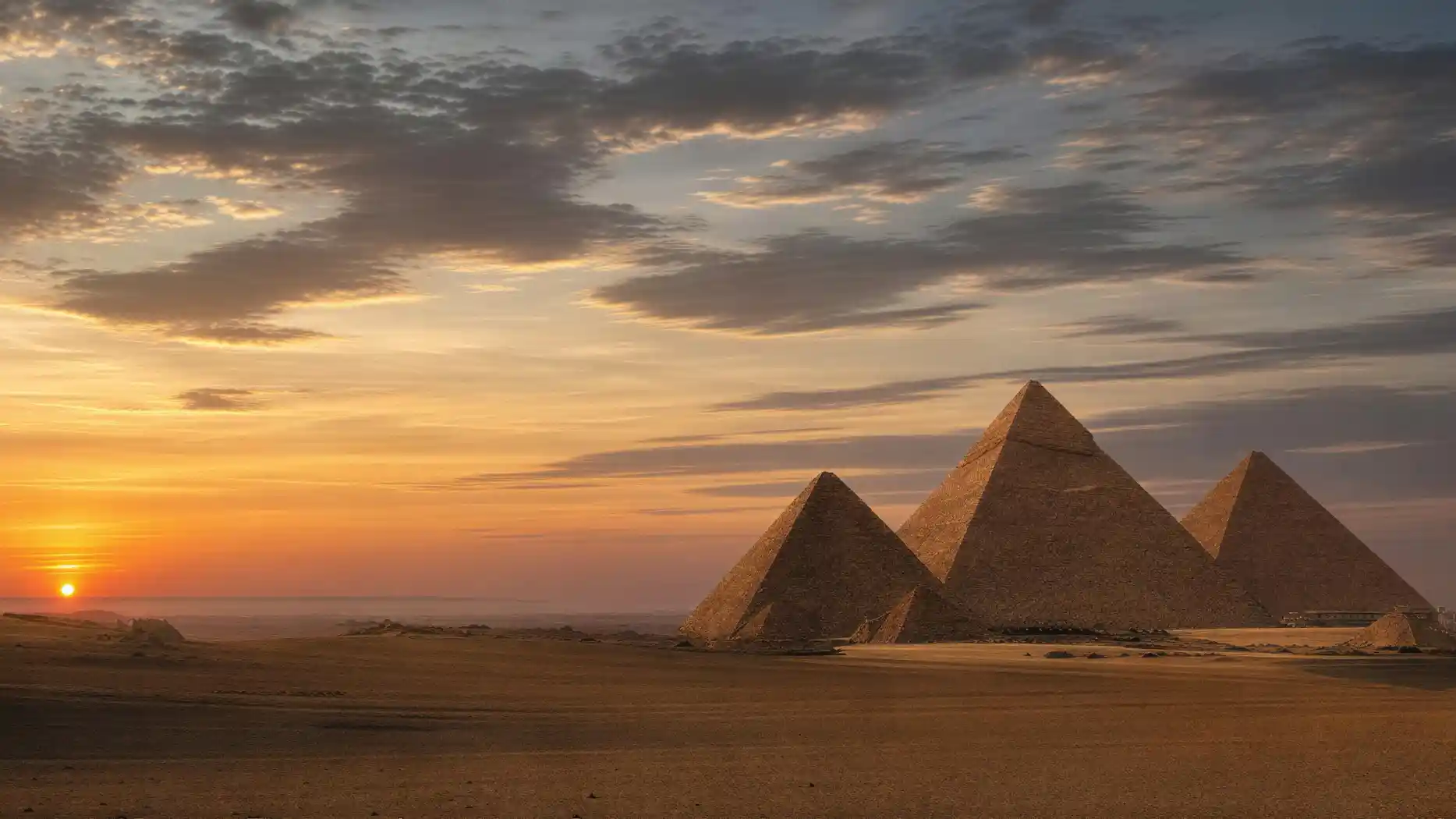
The standard answer is: as a tomb. It is correct, and it is unsatisfying because it doesn't address the real puzzle.
A tomb needs a space for a body. A chamber in the rock is enough for that, and that's exactly how kings were buried before this era and long after. No tomb needs two million stone blocks, a construction time of twenty years, and a structure whose usable area is less than a thousandth of its volume.
The purpose of the pyramids of Giza cannot therefore be answered with a single word. There are three levels that work together: a funerary one, a religious one, and a state one. Each explains a part, and all three together explain the structure.
So, in order: What was supposed to happen inside, what was the shape meant to signify, and what did the construction do to the land that built it?
First, the most important caveat. There are no texts from Giza itself that explain the purpose. The chambers are unadorned, there is no dedication inscription and no theological explanation. Everything said about the intention comes from later sources and is projected backward. That is well-founded, but it is a reconstruction.
The Function: A Complex of Five Parts
Let's start with the concrete. Why was the Great Pyramid of Khufu built, if you only look at the function?
It is the topmost part of a complex of five components that had a fixed sequence: a temple at the water, a covered causeway leading up, a temple on the east side, the pyramid itself, and a small subsidiary building on the south side. This sequence reflects a process. The dead king came over the river, was received below, led up, treated above, and finally buried.
Crucially, the complex continued to operate afterward. In the temple on the east side, cult was maintained for generations, with its own priesthood, its own supplies, and its own income from assigned lands. A pyramid complex was therefore not a closed construction site but a permanently operated institution.
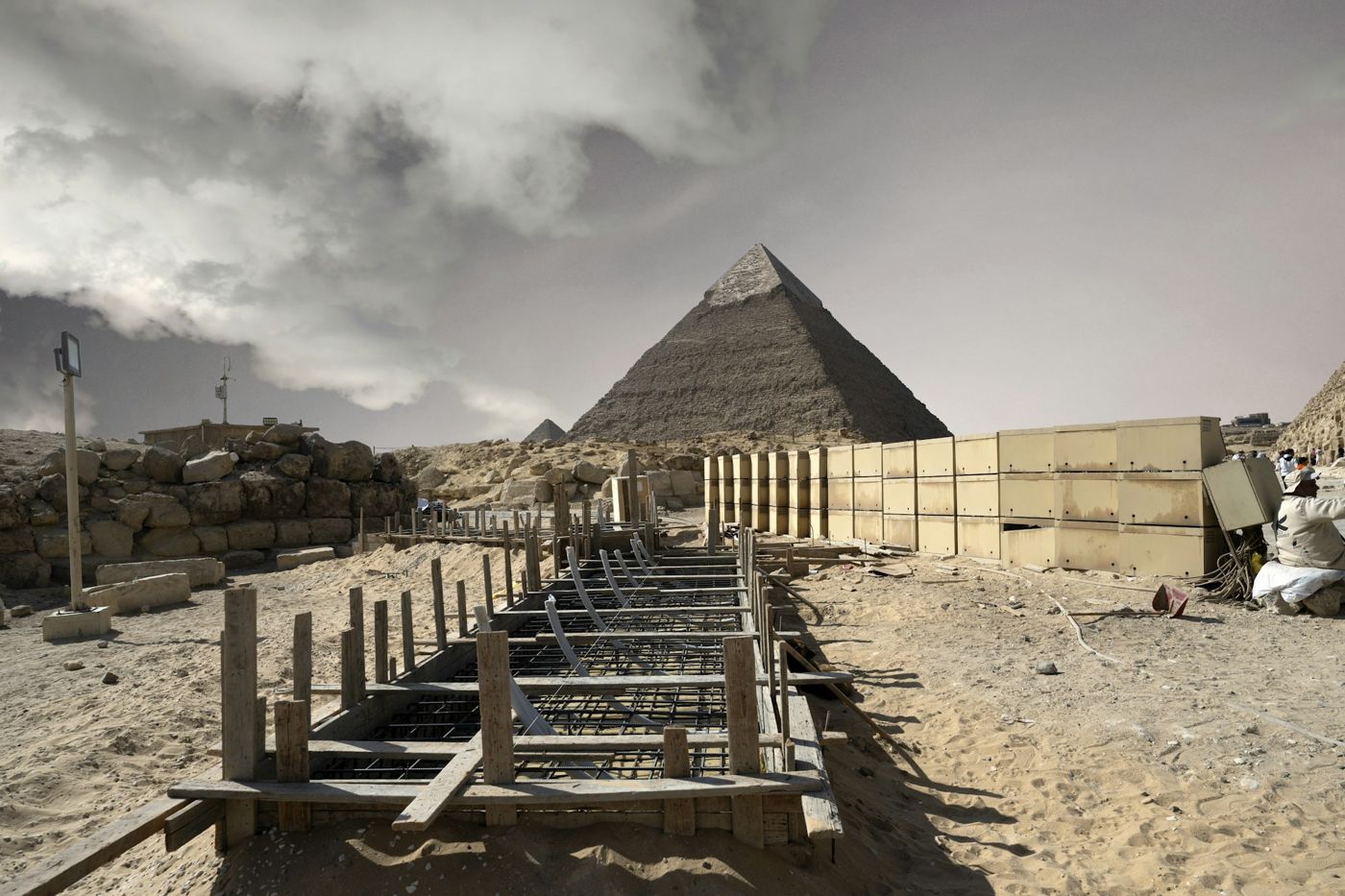
Remarkable is the ratio of effort to use. The temple, where something actually took place, is now a foundation wall. The structure, where nothing ever happened again after the burial, still stands. For the builders, this ranking would probably have been reversed: the cult was the living part of the complex, the pyramid was the sealed one.
The pyramid itself was the inaccessible part. After the burial, the passages were blocked with granite blocks weighing tons, and no one was ever supposed to enter again. This distinguishes it from a monument: a monument is entered and viewed, this structure was sealed.
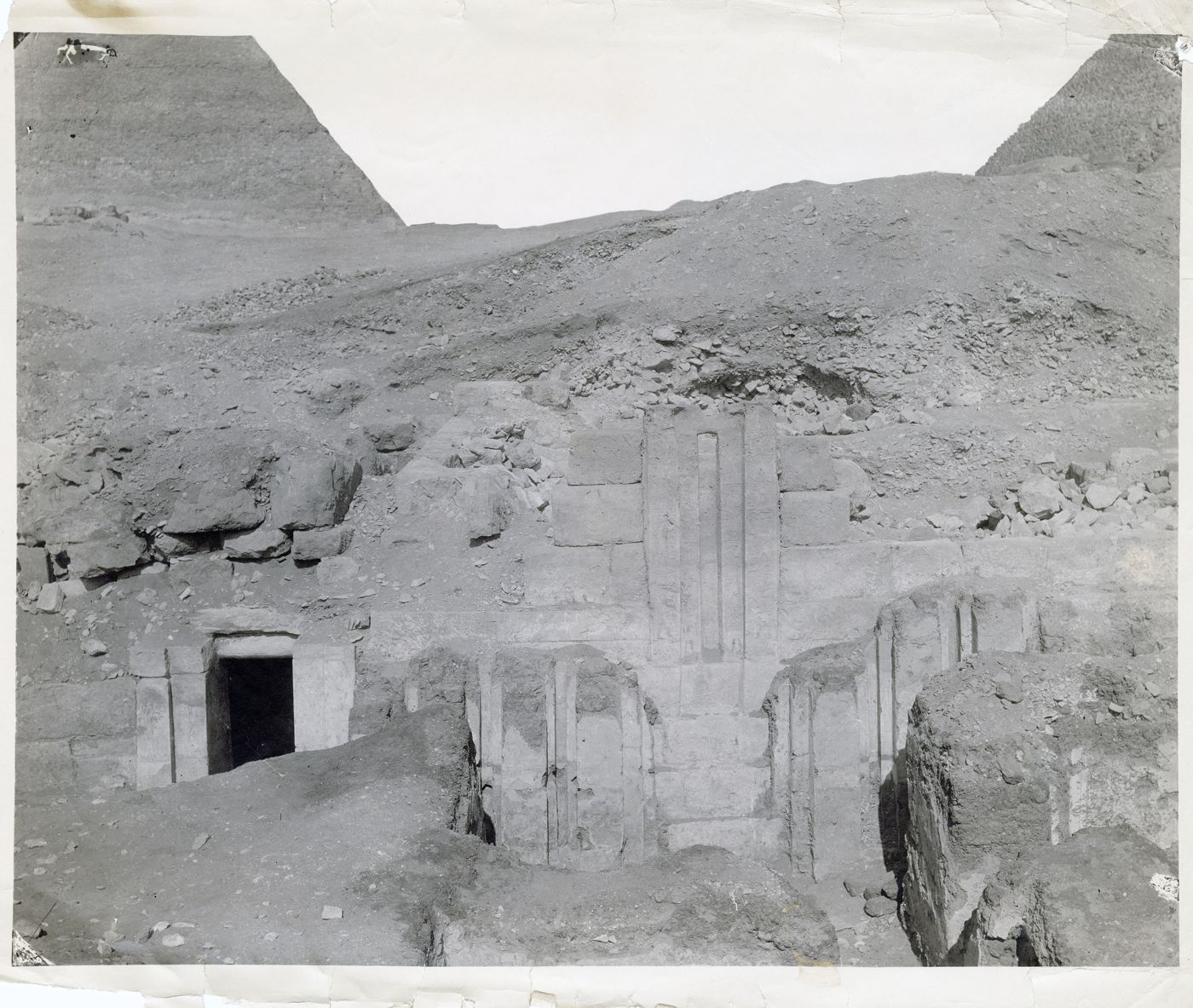
The excavation documentation of the complexes makes this structure comprehensible because it records all components in their context, not just the most conspicuous one.
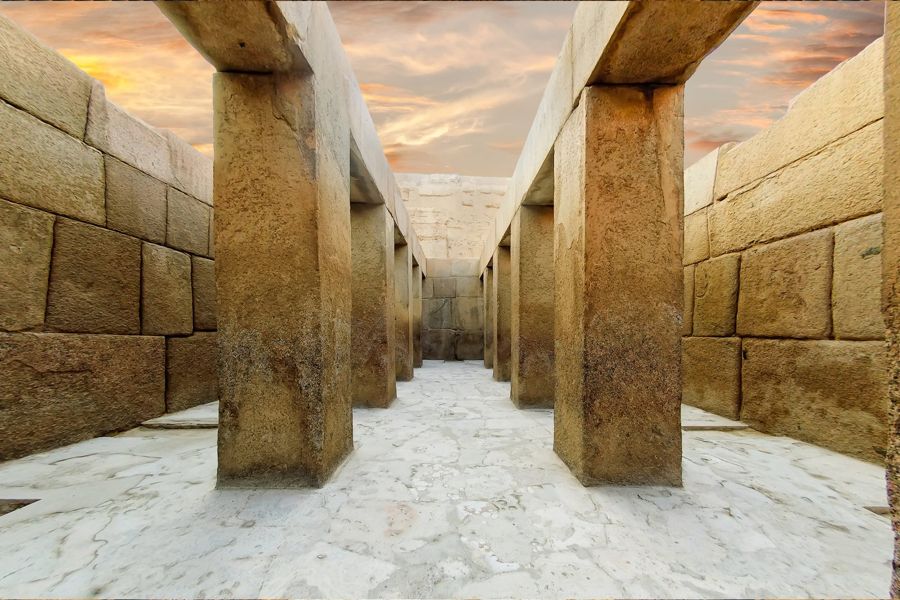
Half-Day Tour to the Pyramids of Giza and the Sphinx
- Mortuary temple, causeway, and valley temple are on the circuit and explain the purpose of the complex
- A licensed guide sorts out what is evidence and what is interpretation
- Plateau entry, German-speaking guide, and hotel pickup are included
- Free cancellation up to 24 hours before start
The Shape Itself Is a Statement
Now to the second level, and here the shape itself becomes a statement. The purpose of the Great Pyramid of Khufu is not exhausted by housing a corpse.
In the Egyptian creation myth, a hill rose from the primeval waters at the beginning, and on this hill life began. In the sun temple of Heliopolis stood a sacred stone on which, according to belief, the first sunbeam fell. This stone is considered the model for the pyramid shape, and the small capstones on pyramid tips bear the same name.
Add to that an image everyone knows without naming it. When sunbeams fall through a gap in the clouds, they form a slanted surface that widens downward: exactly the silhouette of a pyramid. A smoothed, brightly clad pyramid is thus a stone-built version of that sight, a sunbeam that has been frozen.
What that was good for is told in texts from later royal tombs. They contain spells intended to protect the dead king, transform him, and enable his ascent to heaven. The goal is not the preservation of the body but a transformation: from the dead emerges an effective being that continues to exist among the gods.
The color also belongs to the form. A finished pyramid was not sand-colored but clad in bright, smooth casing that reflected sunlight. From a distance, at low sun, the impression would have been corresponding: a glowing surface at the desert edge, visible for many kilometers from the inhabited valley. The effort for the outer casing, which came from a different quarry across the river, makes sense against this background.
These texts, however, are younger than Giza. In the chambers here, nothing of this is written, as the official description of the structure also notes. The religious interpretation is therefore inferred from the surroundings, not read from the structure.
Why This Shape
- Primeval Hill
- Sunbeam
- Pyramid
This compilation reflects the common interpretation. It is not attested from Giza itself but inferred from later texts and the sun cult.
The Construction Brought Forth the State
The third level is rarely told and is perhaps the most important: the construction helped bring forth the state that built it.
To erect a structure of this size, you need things that did not exist before. You must organize, house, feed, and pay tens of thousands of people. You must collect grain from the whole land, store it, and distribute it. You must operate quarries in Aswan and Tura, build ships, procure copper, maintain tools, and schedule supplies over years. And you must write all of it down, otherwise it doesn't work.
Exactly these structures have been excavated on the plateau. The excavations at the workers' settlement have uncovered bakeries on an industrial scale, storage yards, cattle pens, workshops, administrative buildings, and thousands of seal impressions with titles and responsibilities. This is not a construction site; this is a bureaucracy.
From this follows a reversal that surprises many. One tends to imagine a finished state that decides to build a pyramid. The other direction is more plausible: the project demanded an organization that did not yet exist, and in building this organization, the Egyptian central state emerged in the form it kept for two millennia.
This interpretation has another advantage: it explains why pyramid building on this scale stopped. Later kings built smaller, and after the Old Kingdom the building form as a royal tomb almost completely disappeared. If the project was primarily an instrument of state formation, it became superfluous once the state stood. A purely religious explanation would have to justify why belief waned, and for that, evidence is lacking.
In this reading, the pyramid is not only the goal of the effort but also its byproduct. What remained was not just a structure but an administration that had learned to coordinate an entire country.
Three Levels of Purpose
Burial and Cult
The complex is a tomb with a permanently operated cult facility in front of it.
- Good for
- Explains the layout, the sequence of components, and the blocking stones.
- Watch out
- Does not explain the size. For a burial, a rock chamber suffices.
Religious Symbol
The shape depicts the primeval hill and the sunbeam and makes the king's ascent permanently visible.
- Good for
- Explains the form, orientation, casing, and the effort on the outer skin.
- Watch out
- Not attested from Giza itself but inferred from later texts.
State Mega-Project
The construction forced an organization that did not exist before and thereby created administration and cohesion.
- Good for
- Explains the duration, resource use, and finds in the workers' settlement.
- Watch out
- As the sole explanation, too functional. No one builds for twenty years for administrative reasons.
Plateau entry as a QR code on your phone
The remains of the mortuary temple, causeway, and valley temple are in the regular ticket area, mostly unmarked and often crowded.
What the Structure Certainly Was Not
What the structure was not is also part of the answer, because it is searched for almost as often.
What was the Great Pyramid of Khufu certainly not used for? Not as a granary. This interpretation, widespread in the European Middle Ages, fails because there is no significant interior space: the ratio of void to mass is below one thousandth. A granary into which nothing fits is none.
Not as a power plant. This idea presupposes components and materials that are not present there, and it explains neither the blocking stones nor the sarcophagus nor the surrounding necropolis.
Not as an observatory in the modern sense. The alignment to the north is precise and was achieved astronomically, but that is a construction achievement, not an operational purpose. A structure that is sealed after completion is not suitable for observation.
And not as a structure of unknown authorship. The construction sequence, the settlement, the tools, the tombs of those involved, and the markings of the work gangs in the relieving chambers all belong to the same era and to the same patrons.
The pattern behind these interpretations is always the same: they explain a single feature and ignore the rest of the complex. Anyone who looks only at the pyramid can read much into it. Anyone who includes the temple, causeway, boat pits, necropolis, and settlement in their thinking can no longer do so.
Four Common Claims About Purpose
- False
The pyramids were granaries.
The usable interior space is less than one thousandth of the building volume. The interpretation dates from the European Middle Ages.
- True
The pyramids were tombs.
Sarcophagus, blocking stones, mortuary temple, and the classification in a series of royal tombs prove this.
- Partially
The shape is purely statically motivated.
A pyramid is stable, but the shape was also a symbol. Step pyramids and bent forms show that there was searching and deciding.
- False
The pyramids served astronomical observation.
The alignment was done astronomically, but the structure was sealed after burial and was not intended for operation.
What the Pyramids Stand For
What do the pyramids of Giza stand for when you take all three levels together?
Most of all, for the attempt to make a transition permanent. The death of a king was, in this conception, not an end but a change, and this change was to succeed, be secured, and be repeatable forever. The structure is the architectural form of this intention: designed to be indestructible, aligned with the sun, with a cult operation in front that renewed the process annually.
That the calculation did not work out is part of the story. The chambers were plundered, the cult ended, the casing disappeared into other buildings, and the name of the builder was only fragmentarily known even in antiquity. What remained is precisely what was least intended: the mass.
For the builders, that would probably have been no consolation. For us, it is the reason we can talk about it at all.
And perhaps that is the most honest answer to the question of why. Built for an afterlife in the religious sense. Achieved was an afterlife in the literal sense: the structure still stands, and the culture that produced it has been gone for two thousand years.
Frequently asked questions
For whom was the Great Pyramid of Khufu built?
For King Khufu, who commissioned it and was to be buried in it. The three small subsidiary pyramids on the east side belonged to members of the royal family.
Were the pyramids really tombs?
Yes. Sarcophagus, blocking stones, mortuary temple, and the classification in a long series of royal tombs prove this unequivocally.
Why so big then?
Because the size itself was part of the statement. The shape depicts the primeval hill and the sunbeam, and the effort demonstrated the reach of the kingship.
Why are there no inscriptions inside?
Because the decoration of royal burial chambers only emerged centuries later. The religious texts come from later pyramids.
Was anyone found in it?
No. The chambers were empty at the first documented opening. When they were cleared out is unknown.

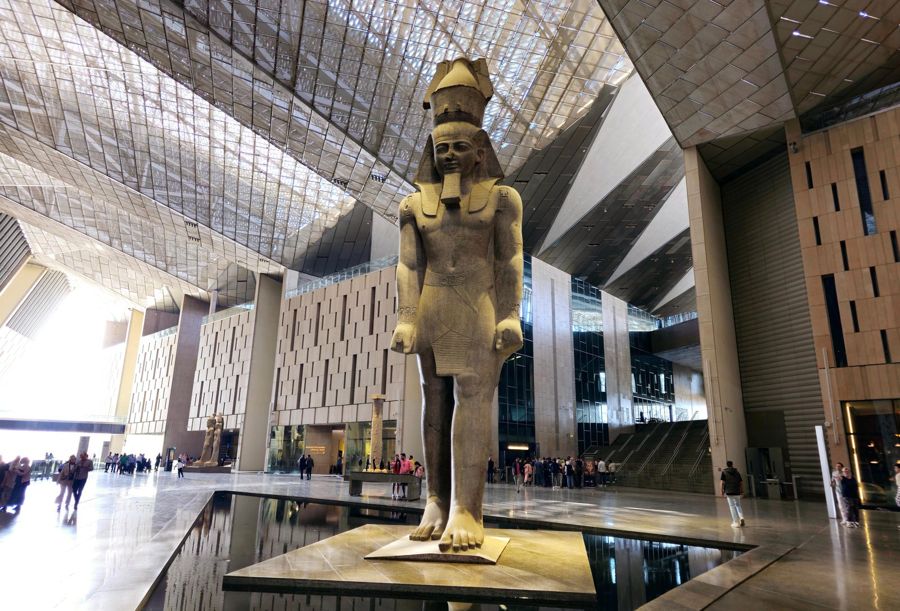
Day Tour to the Grand Egyptian Museum and the Plateau
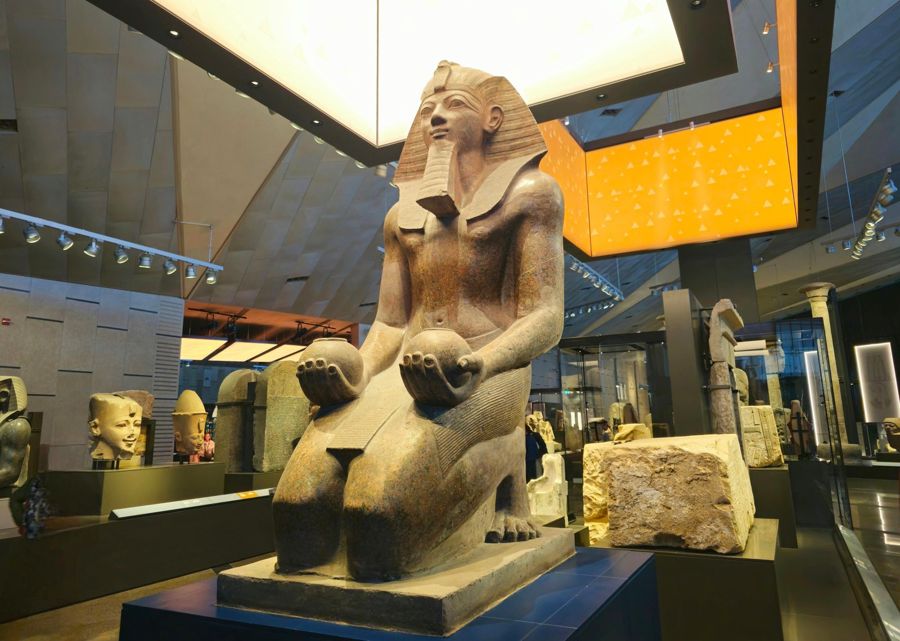
- The museum houses the burial equipment from which the purpose of the complexes can be inferred
- Plateau and museum in one day, without organizing two trips yourself
- Entry fees, German-speaking guide, pickup, and lunch are included
- Free cancellation up to 24 hours before start