
Around four and a half thousand years. That is the answer, it appears in every reference work, and it is well supported within the limits of what can be determined.
More precisely, it is calculated as follows: The largest of the three pyramids is considered to have been completed around 2560 BC. That amounts to about 4,580 years to the present day. Because the dating itself carries an uncertainty of a few decades, the round figure of 4,500 years is the more honest one.
The age of the Pyramids of Giza is therefore not a measured quantity like height, but a derived value. There is no date on the structure. What exists are king lists, administrative notes, excavation findings, and scientific measurements, and from their interplay a time period emerges.
One must also distinguish between the age of the structures and the age of the site. Burials took place on the rocky ridge even before pyramid construction, and use in the surrounding area goes back further. If you ask how old the site is, you get a larger number than when asking about the structures. This page is about the structures.
Remarkable is how robust this time period is. For about a hundred years, the dating has shifted by decades, not centuries, and none of the major upheavals in archaeology has fundamentally changed that. If you read somewhere a figure of a completely different magnitude, say ten thousand years, then you are not reading newer research but a different kind of claim.
A small note on the calculation, because it explains why sources differ by one or two years. Between the year 1 BC and the year 1 AD there is no year zero. If you simply add 2560 and 2026, you get 4,586 and miss by one year. Such one-year differences are meaningless for a dating with decades of uncertainty, but they appear in reference works and irritate.
This page explains where the number comes from, why a scientific method systematically yields something different, and how a span of this length can be imagined at all. That is the real difficulty: four and a half thousand years is a number that no one feels.
The age of the three structures
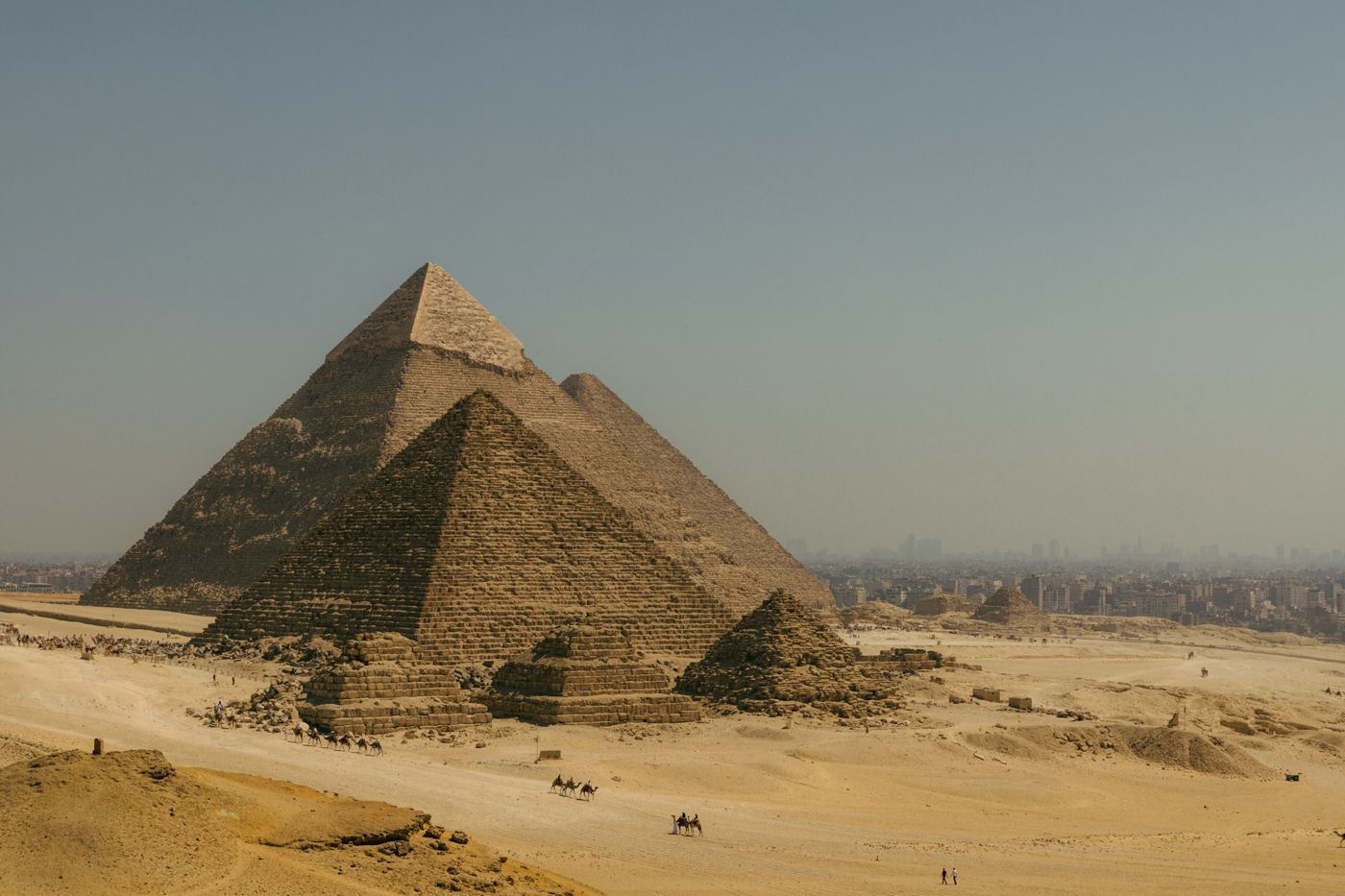
The three great pyramids were built successively under three kings. Between the first and the last lie around eighty years.
| Structure | Completion, common dating | Age in 2026 |
|---|---|---|
| The Great Pyramid of Khufu | around 2560 BC | around 4,580 years |
| Pyramid of Khafre | around 2530 BC | around 4,550 years |
| Pyramid of Menkaure | around 2500 BC | around 4,520 years |
| Great Sphinx | around 2500 BC | around 4,520 years |
- Completion, common dating
- around 2560 BC
- Age in 2026
- around 4,580 years
- Completion, common dating
- around 2530 BC
- Age in 2026
- around 4,550 years
- Completion, common dating
- around 2500 BC
- Age in 2026
- around 4,520 years
- Completion, common dating
- around 2500 BC
- Age in 2026
- around 4,520 years
All figures carry an uncertainty of several decades. The sequence of structures, however, is certain because it results from the construction sequence in the terrain.
Where the date comes from
How do we know this at all? The basis is a method that initially has nothing to do with science.
Egypt kept king lists for over three millennia. Rulers and their regnal years were recorded continuously, partly on papyrus, partly on stone. From these lists, one can calculate backwards: If you know how long each king ruled and in what order, a framework emerges. The question of how old the Great Pyramid of Khufu is thus becomes initially a bookkeeping question.
This framework has two weaknesses. First, the lists are incomplete and partly damaged; sections are missing precisely for the early dynasties. Second, there were times when several rulers reigned simultaneously, which leads to double counting when adding up.
The most important of these lists are well known. A papyrus in Turin lists rulers and regnal years over centuries and is the most important single source for the early dynasties, but its condition is lamentable: It disintegrated into hundreds of fragments during transport to the museum, and it has been pieced together ever since. In addition, there is a history of Egypt written in the third century BC, which itself is only preserved in quotes by later authors. Both sources contradict each other in places, and both are indispensable.
The framework is therefore anchored to astronomical events. Egyptian texts occasionally note the heliacal rising of certain stars, and such events can be calculated backwards. This gives the relative sequence an absolute reference point.
For Giza, the excavation findings add to this. The three complexes overlap in the terrain, so their construction sequence is secure, and the surrounding officials' graves can be assigned to the respective kings via titles and names. The excavation documentation from over a hundred years makes this network comprehensible.
How reliable this framework is became clear when papyri were found in 2013 at a harbor site on the Red Sea. Among them is the duty log of an inspector that explicitly mentions the 27th regnal year of the builder of the largest pyramid and records deliveries to the plateau. A find of this kind could have shaken the chronology. Instead, it confirmed it and also refined it, because it shows that construction was still ongoing in the 27th year.
The result is a dating with an uncertainty of decades. For an event from four and a half thousand years ago, that is remarkably precise.
What the radiocarbon dates say
Now to the science, and here it gets interesting because it delivers a different result than the king lists.
Mortar was used during construction, and embedded in this mortar are charcoal, straw, and reeds. Such material can be dated using the radiocarbon method. In two major campaigns, in 1984 and 1995, samples were taken from the structures themselves and measured.
The result was unexpected. The measurements from 1984 averaged 374 years older than the historical chronology led to expect. The 1995 campaign came to a deviation of a hundred to two hundred years, also in the direction of older.
Briefly to the method, because it makes the deviation understandable. Living organisms constantly take in carbon from the environment, including a small proportion of a radioactive variant. With death, uptake stops, and the radioactive portion decays at a known rate. From the remaining portion, one can calculate how long ago death occurred. This is supplemented by calibration curves derived from tree rings and other archives, because the proportion in the atmosphere has fluctuated over millennia. The evaluation of the campaigns at the plateau describes this work in detail.
The old-wood effect explains the deviation
This sounds like a contradiction, but it is well explained, and the explanation is called the old-wood effect. Radiocarbon does not date the time of use, but the time when an organism stopped taking in carbon, that is, the death of the tree. Wood was scarce in Egypt and was reused over generations. Whoever burns a centuries-old beam to mix mortar produces charcoal that dates correspondingly older than the construction site.
In addition, it is proven that the builders reused older material, partly out of frugality, partly possibly to deliberately create a connection to their predecessors. The age of the Great Pyramid of Khufu is therefore systematically overestimated by such measurements, in one direction.
A fundamental limitation belongs here: Stone cannot be dated with this method. Limestone contains carbon, but from a sea of forty million years ago, far beyond the range of the method. Only organic material that got into the construction can be dated. So if you ask how old a particular block is, you are asking something that cannot be answered with this method. What is measured is always the mortar, never the stone.
What is important is the conclusion drawn from this. The measurements have confirmed the historical classification, not refuted it: The structure belongs precisely to the era that Egyptology assumes. The scatter comes from the material, not from an error in the chronology.


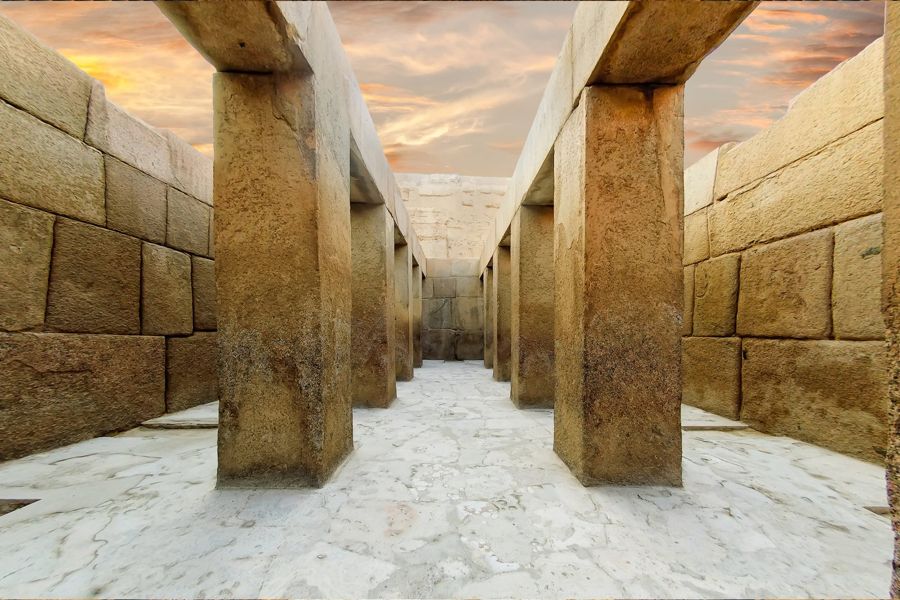
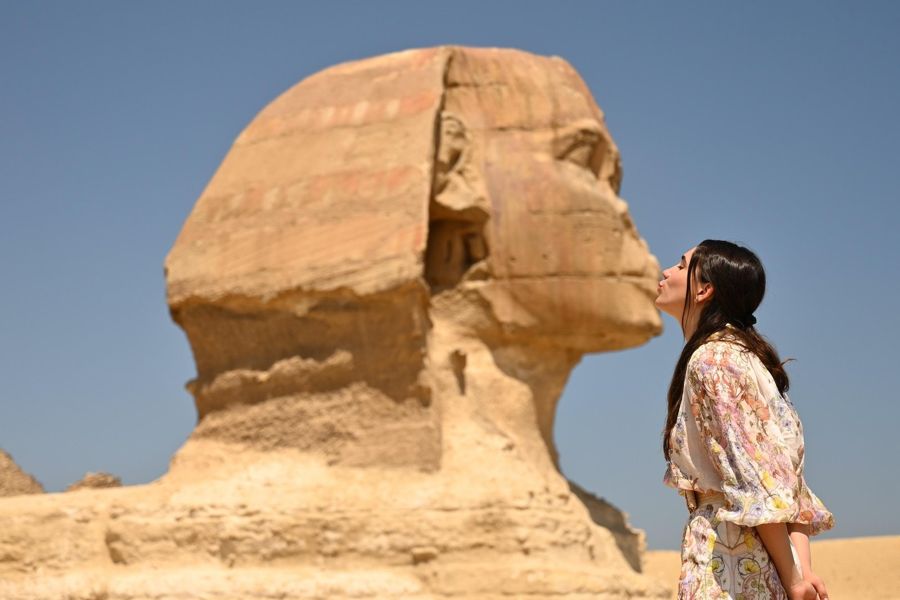

Half-day tour to the Pyramids of Giza and the Sphinx
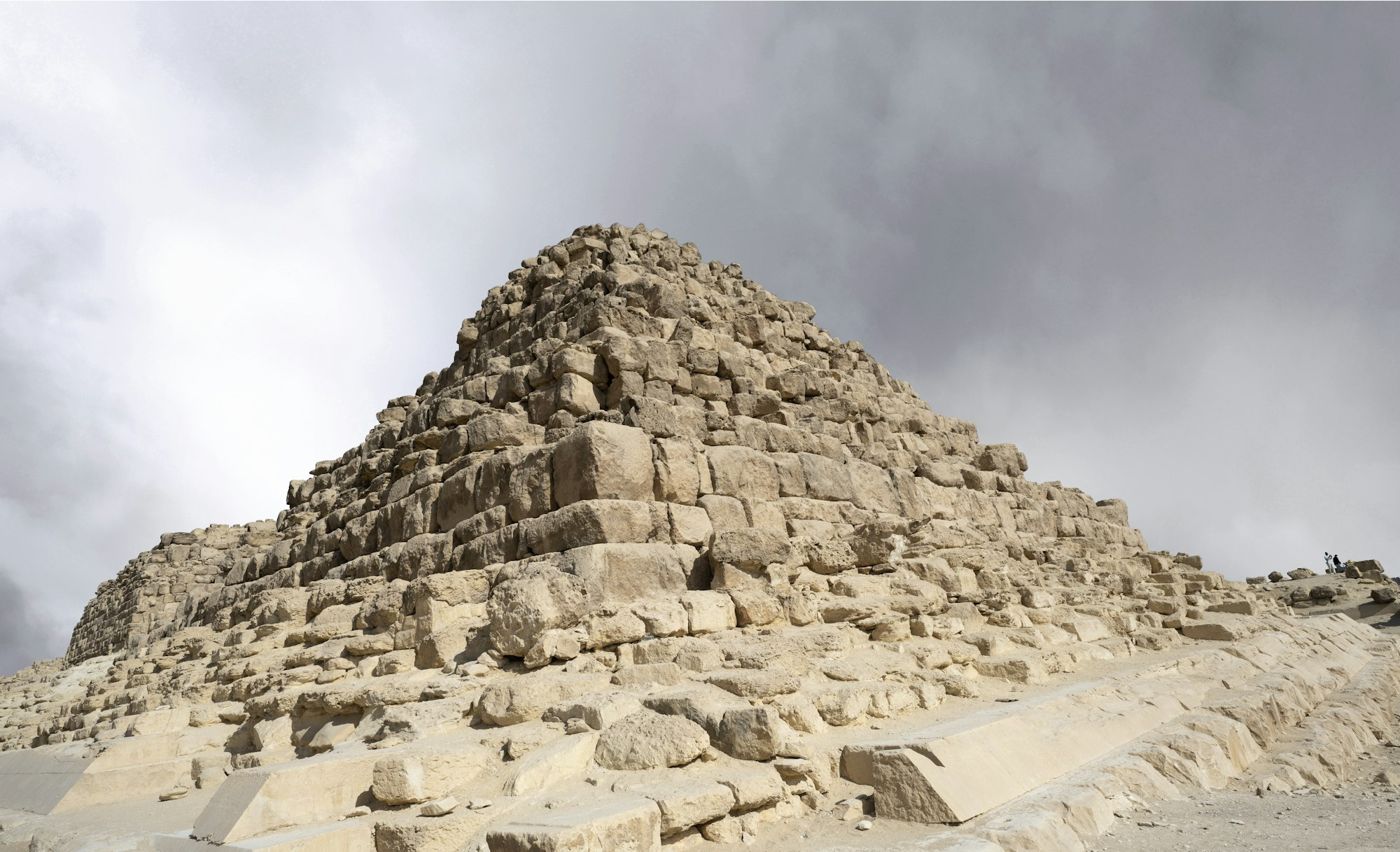
- The construction sequence of the three complexes is directly visible on site
- A licensed guide classifies the dating instead of just giving a year
- Plateau entrance, German-speaking guide, and hotel pickup are included
- Free cancellation up to 24 hours before start
Four and a half thousand years cannot be imagined
And now the real problem: Four and a half thousand years cannot be imagined. The number is too large, and it has no relation to anything a person experiences.
The usual trick is a comparison, and the best one goes like this. Cleopatra, the last ruler of independent Egypt, lived in the first century BC. From her perspective, the pyramids were then around two and a half thousand years old. From our perspective, Cleopatra is about two thousand years away. So the pyramids were older for Cleopatra than Cleopatra is for us.
This can be extended. When the Romans took over Egypt, the structures were already ancient sights with tourism. When Herodotus described them, the time of construction was about two thousand years past, and he had to rely on priests' stories, just as we rely on medieval chronicles.
Even more revealing is the view of Egypt itself. The ancient Egyptian civilization lasted about three thousand years, from the first kings to the Roman conquest. The Pyramids of Giza were built in the first sixth of this span. For the Egyptian priests with whom Herodotus spoke, the pyramid building lay further back than for us the fall of the Western Roman Empire. The idea of a uniform ancient Egypt is therefore wrong: Between the pyramid builders and Tutankhamun lie more years than not between Tutankhamun and us, but also far more than a thousand.
A second approach goes through generations. If you calculate with twenty-five years per generation, between the construction and today lie around one hundred and eighty generations. That is a number that still cannot be imagined, but at least it is countable.
Another approach makes the ratios spatial. Imagine the time since completion as a distance of four and a half meters, one year per millimeter. The Colosseum then stands at two meters, Cologne Cathedral at one, the invention of the steam engine at twenty-five centimeters, and your own lifespan is a segment of a few centimeters at the very end. The entire time from which we possess photographs measures less than two centimeters.
And a third approach via everyday life: In the time that has passed since completion, writing was reinvented several times, the wheel spread, bronze gave way to iron, iron to steel, and in the last two percent of this span everything we call technology arose. The structure stood there the whole time.
Age in comparison
Age in years, rounded
The bars show how unusually far this structure stands out from the rest of the monument landscape. Almost everything we consider old is younger than half of it.
Rounded values according to common dating, for size comparison.
Plateau entrance as a QR code on your phone
The structures themselves and the surrounding burial fields are in the regular ticket area. For the interior, a separate ticket is added on site.
The overlaps that no one expects
The best way to grasp it is through overlaps, that is, things that existed simultaneously and belong for us to completely different eras.
The most striking example is mammoths. On the mainland, they died out at the end of the last Ice Age, but on an island in the Arctic Ocean, a small population survived much longer, by current knowledge until about 1650 BC. So when the largest pyramid was completed, there were still mammoths, and they continued to exist for almost a thousand years after that.
Similar is true for cultures. While building was under way in Giza, a city culture with sewage systems and standardized bricks flourished in the Indus Valley, administration and writing had been running in Mesopotamia for centuries, and the palace period began on Crete. The Old Kingdom was therefore not an isolated special case, but part of a world in which large organizations emerged simultaneously in several places.
Two images that never go together in the mind thus belong to the same era: a completed pyramid with a smooth white outer casing and a herd of mammoths. That is not a curiosity, but the accurate idea.
The comparison works the other way as well
The comparison works just as well in the other direction. The man found in the Alpine ice, whom we consider the epitome of prehistory, died around 3300 BC, thus about seven hundred and fifty years before the completion of the largest pyramid. He is therefore older than the structure, but not by ages, but by less than what lies between us and the Middle Ages. If you place both images side by side, a glacier man with a copper axe and a completed pyramid, you see two points of the same epoch.
Further overlaps in the same direction: The great stone circle of Stonehenge was built at roughly the same time as the pyramids. Writing was already centuries old in Egypt and Mesopotamia, not yet invented in China and Central America. And in Northern Europe, people lived in wooden and clay buildings at this time, while in Giza a structure of six million tons of stone was being built.
One last comparison that turns the direction around. From the completion of the largest pyramid to the birth of Cleopatra passed about two and a half thousand years. In the same span, projected from us into the future, would lie the year 4500. Whatever of our structures still stands then would have the same relation to us as the pyramids have to Cleopatra.
Whoever places this side by side understands better why the complex was considered extraordinary already in antiquity. It was not only technically, but also temporally: a structure that outlived the culture that produced it, and then survived another two millennia of history.
The claims of a much higher age
Remains the question of claims that cite a far higher age, because whoever searches for the age comes across them.
The most widespread concerns not the pyramids but the Sphinx. It is based on the weathering pattern of the figure and concludes from it heavy rain, which has not occurred in this area for millennia. From this, an age of nine thousand years or more is derived. The professional world does not share this interpretation because the weathering pattern can be explained by the rock layers and salt weathering. On this portal, there is a separate page on this.
For the pyramids themselves, such claims are rarer, and they run into a concrete problem. A structure of this size does not arise in a vacuum. It requires quarries, tools, a settlement, storage, administration, and a cemetery for those involved. All this has been excavated at the plateau, and all of it dates to the same era. Whoever wants to make the structures five thousand years older must also make the bakeries, the granaries, and the graves older, and for that there is no evidence.
Why such claims still gain traction has little to do with Egypt. A very high age turns a well-researched structure into a riddle and a known culture into an unknown one. That is narratively attractive, and it has the extra appeal of putting established science in the wrong. Against this stands an unspectacular finding: a culture that gradually learned to build ever larger stone structures, and that left behind failures that can be visited.
In addition, there is the construction sequence. The three complexes overlap, their order is readable in the terrain, and they fit into a developmental series of Egyptian pyramids that leads from step pyramids over failed intermediate forms to the perfected form. This series has a beginning and an end, and Giza sits at a specific place in it.
Methodologically, the burden of proof does not lie with the professional world. The common dating rests on king lists, astronomical anchoring, excavation findings, construction sequence, settlement finds, and scientific measurements that support each other. Whoever wants to replace it must shake not just one of these pillars, but all of them, and with evidence instead of interpretations. So far, that has not happened.
The entire necropolis has been protected as a World Heritage Site since 1979, together with the older pyramid fields of Sakkara and Dahshur. This designation is not an administrative act, but follows precisely this developmental series.


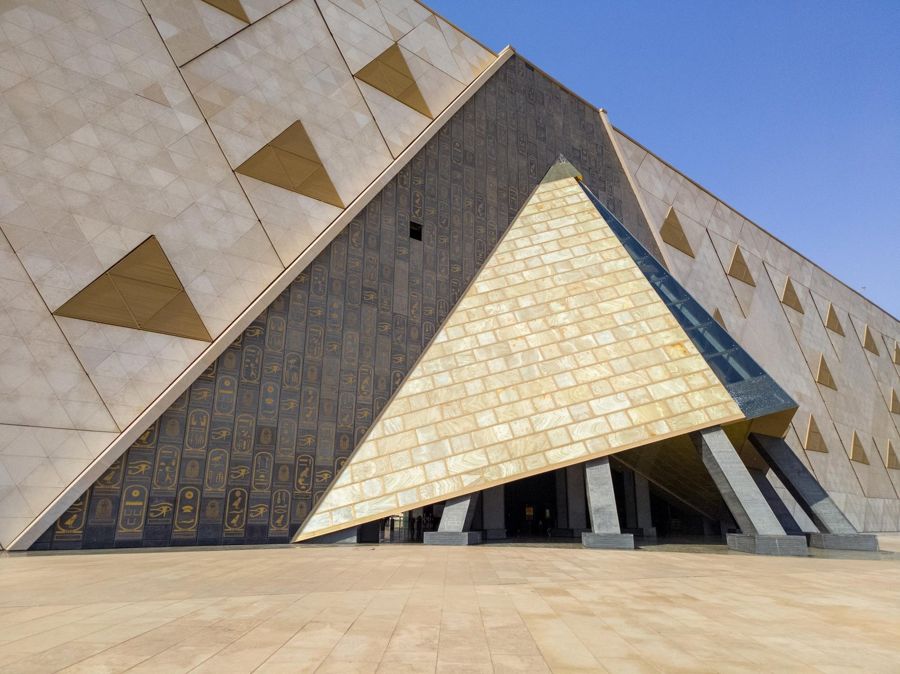
Day tour to the Grand Egyptian Museum and the plateau
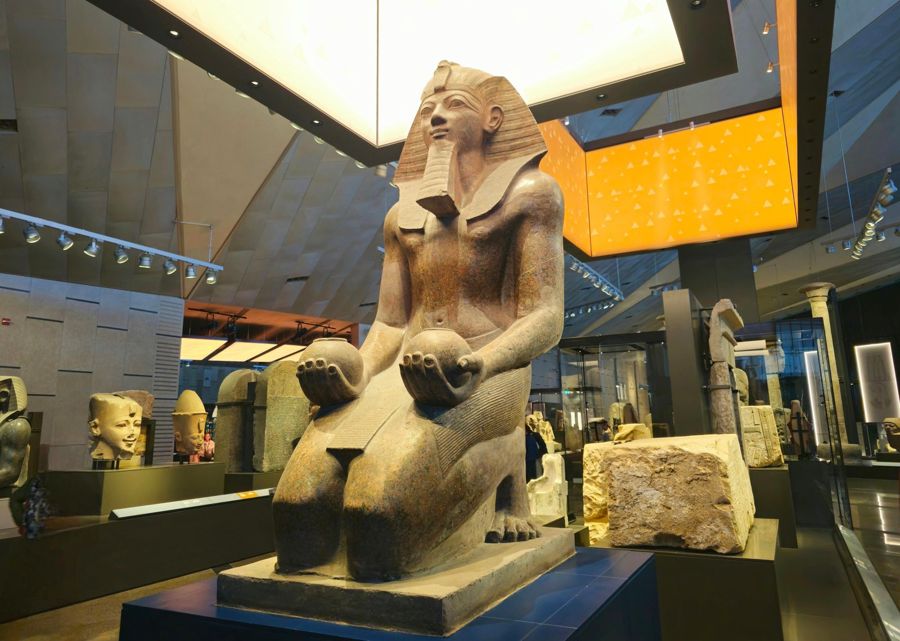
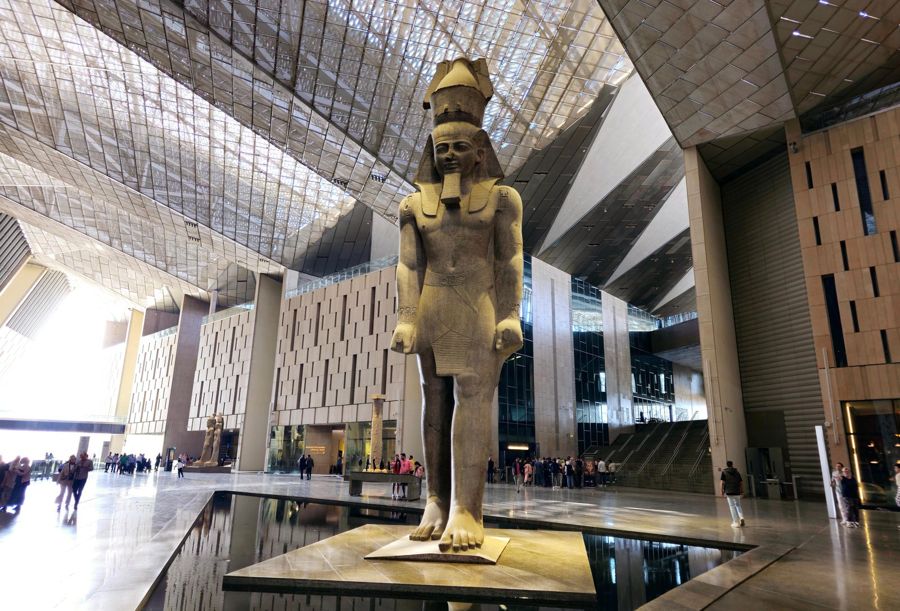
- In the museum lie the dated finds on which the chronology is built
- Plateau and museum in one day, without organizing two routes yourself
- Entrances, German-speaking guide, pickup, and lunch are included
- Free cancellation up to 24 hours before start
How far is that from you?
Default 25 years per generation.
With a birth year of 1985 and 25 years per generation, that is about 182 generations and about 111 of your lifespans so far.
Not the age, the visibility
In conclusion, a classification that makes the age truly remarkable: The pyramids are not extraordinary because they are old, but because they have remained visible for so long.
There are older structures. In Anatolia, there are complexes several thousand years older, and in Europe there are stone tombs that precede the pyramids in time. Only they were covered, forgotten, or unknown for long stretches. They were excavated, not handed down.
The pyramids, on the other hand, were never gone. There is no point in the last four and a half thousand years when no one knew they stand there. Egyptians, Persians, Greeks, Romans, Arabs, Ottomans, and Europeans have seen, described, plundered, measured, and marveled at them. They are the only structure of this magnitude with an uninterrupted observation history.
The observation history is itself a source
This observation history is itself a source. Greek travelers described the casing when it was still complete. Arab scholars of the Middle Ages measured the structures and noted states that no longer exist today. European travelers of the 17th and 18th centuries drew what has since been removed. From these reports, the decay over two thousand years can be traced, and that is possible with hardly any other structure in the world.
This also explains why the dating is so stable. A structure that has been described since antiquity has a dense source base, and every new method is tested against this base rather than against a blank page.
This continuity also has an unpleasant side. A structure that was never forgotten was also never protected. The casing was removed because it was accessible, the chambers were plundered because they were known, and the stones went into buildings in the surrounding area. What stands today owes its preservation not to care, but to sheer mass: It was too large to be completely cleared away.
And it explains the effect on site. For trip planning, this means little; for the visit itself, a lot. It is worth stopping once and thinking the thought to the end: This structure was already a monument when the people we call antiquity visited it. It has outlived every rule that ever administered it, and it will almost certainly outlive ours as well.
Whoever stands before it sees not just an old building, but one that was already old for people who have themselves been dead for two thousand years. That is the part that no year number conveys.
Frequently asked questions
How many years ago were the pyramids built?
The largest was completed around 2560 BC, that is, about 4,580 years ago. The other two followed in the subsequent eighty years.
How precise is this figure?
The uncertainty lies in the range of decades, not centuries. Therefore, the rounded figure of 4,500 years is the more honest one.
Why does the radiocarbon method say something different?
It dates the death of the wood, not the construction. Because old wood was reused, the measurements systematically come out too old, by a hundred to several hundred years.
Are they the oldest structures in the world?
No. There are significantly older complexes. What is rather unique is that the pyramids never fell into oblivion and remained continuously visible.
What about the claims of 10,000 years?
They mostly concern the Sphinx and are based on its weathering pattern. The professional world explains this from the rock layers and salt weathering.
How old was the complex at the time of Cleopatra?
Around two and a half thousand years. The pyramids were thus older for her than she is for us.
Private tour to the Grand Egyptian Museum and the pyramids
Privately guided, so there is time for questions about chronology instead of a fixed group rhythm. Entrances and lunch are included.