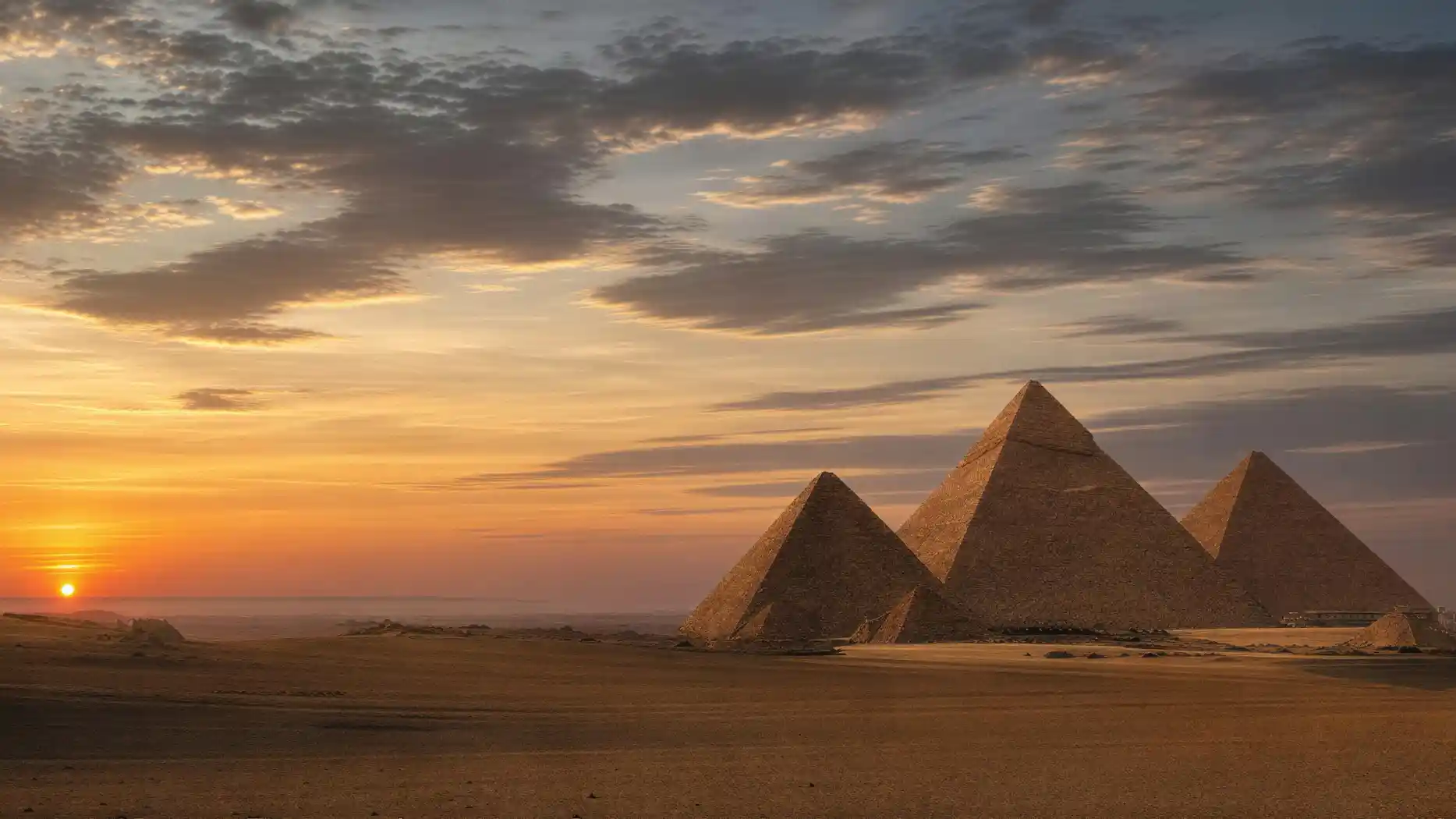
If you're searching for Tiësto at the Pyramids of Giza, you're looking for something that actually exists. Since 2023, the site has become a stage, and one of the most sought-after in the industry.
This is new. Concerts at the foot of the monuments used to happen occasionally, mostly classical and mostly state-organized. What has changed since the plateau's renovation is the system: the operator explicitly profits from renting out the site, and in recent years, this has developed into a small series of international events, predominantly electronic and mostly during the winter half-year.
For travelers, this is both appealing and unreliable. Appealing because a night against this backdrop is truly hard to beat. Unreliable because an announced event on the plateau isn't the same as one that takes place, and there's a very well-known precedent for that.
First, a sense of scale: this isn't an ongoing series with a schedule, but a handful of dates per year, announced weeks to months in advance, and almost always in the winter half-year when outdoor nights are bearable at all. If you travel in summer, you'll most likely miss such an evening.
This page lists what has taken place, explains who decides on such evenings, and says what to watch out for when buying tickets.
What Has Been Played on the Plateau
Only confirmed dates. The list is deliberately incomplete because smaller events are rarely reported beyond the region.
| Date | Who | Note |
|---|---|---|
| May 2023 | Carl Cox | Considered the start of the series |
| July 28, 2023 | Travis Scott | Canceled two days before; tickets were gone in minutes |
| April 19, 2024 | Keinemusik | The collective around Adam Port, &ME, and Rampa |
| October 10, 2025 | Anyma | Ten hours, from 5 PM to 3 AM |
| December 2025 | Black Coffee | Part of the winter program |
| December 19, 2025 | Tiësto | Announced as a three-hour set |
| April 2026 | Zamna Egypt | Two nights, festival format |
- Who
- Carl Cox
- Note
- Considered the start of the series
- Who
- Travis Scott
- Note
- Canceled two days before; tickets were gone in minutes
- Who
- Keinemusik
- Note
- The collective around Adam Port, &ME, and Rampa
- Who
- Anyma
- Note
- Ten hours, from 5 PM to 3 AM
- Who
- Black Coffee
- Note
- Part of the winter program
- Who
- Tiësto
- Note
- Announced as a three-hour set
- Who
- Zamna Egypt
- Note
- Two nights, festival format
The performance by Anyma at the Pyramids of Giza and the evening with Keinemusik at the Pyramids of Giza can be found as recordings online; Black Coffee at the Pyramids of Giza was part of the same winter program as Tiësto's set.
It's Not a Rave
A rave at the Pyramids of Giza in the literal sense isn't one. What takes place there are approved, organized large-scale events with seating or barriers, fences, security checks, and fixed times—not spontaneous parties in the desert.
The procedure is always similar. An organizer rents an area on the site, usually in the area south of the monuments, where there's enough space for the stage, technology, and audience. The operator of the visitor business earns from this rental, and the state from the day-to-day ticket sales. Setup takes days, as does teardown, and during that time, the affected area is restricted for normal visits.
For day visitors, this is the most noticeable side effect. If you come in the days before a major event, you'll find trucks, scaffolding, and fenced-off areas in the south of the site, precisely in the area where the viewpoint with a view of all three monuments is located. This isn't announced, and nothing about it appears when buying a regular entry ticket.
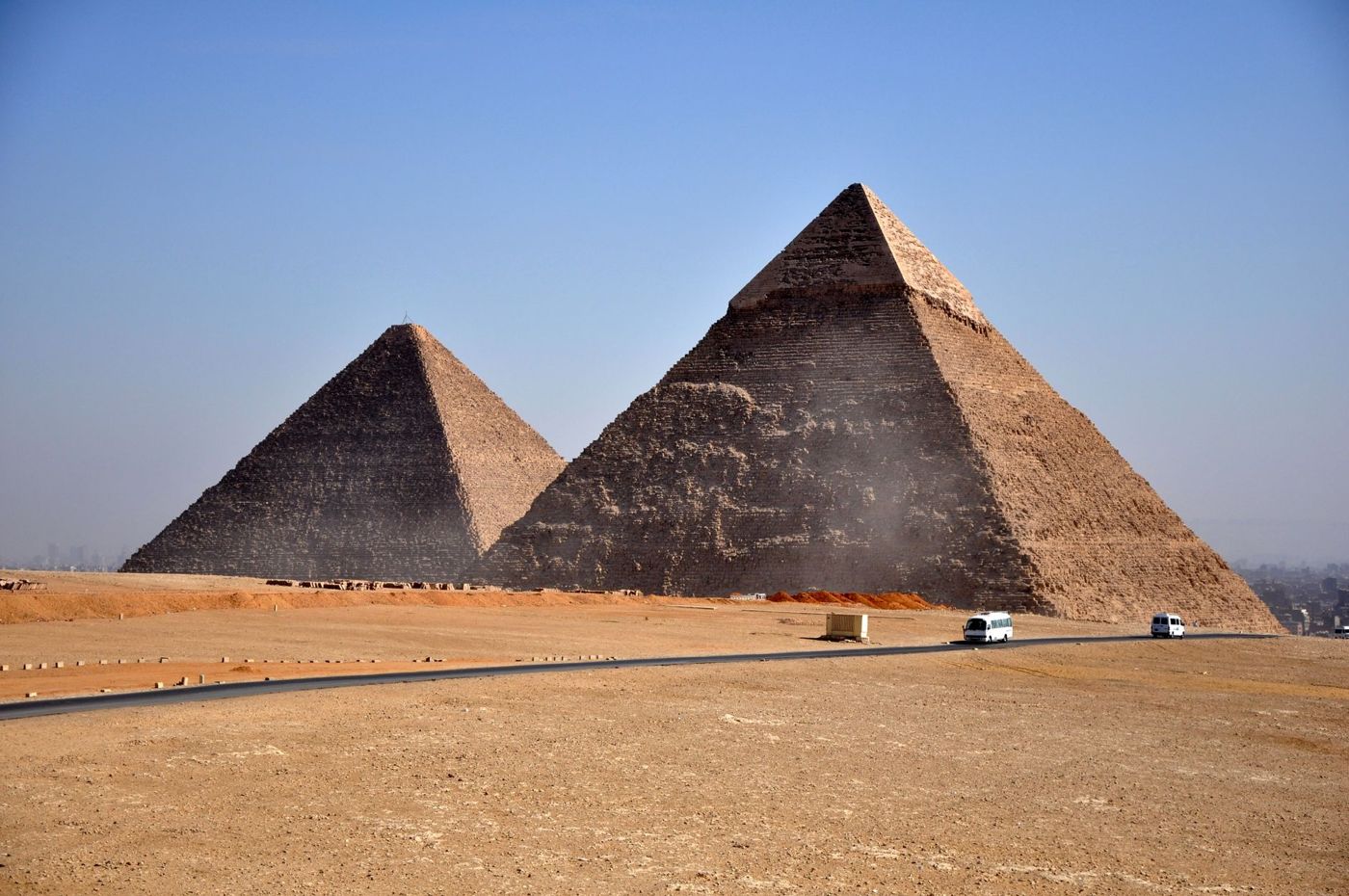
The backdrop is used differently than you might expect. The monuments aren't behind the stage but are illuminated and integrated into the light show. If you watch recordings of such evenings, you'll usually see a pyramid in changing colors, and that's exactly the point where opinions diverge.
The permit isn't issued by the operator but by another body, and that's the most important sentence on this page.
Accommodation within walking distance of the event site. When things end at 3 AM, the distance to your lodging decides the whole evening. Three places that cover this:
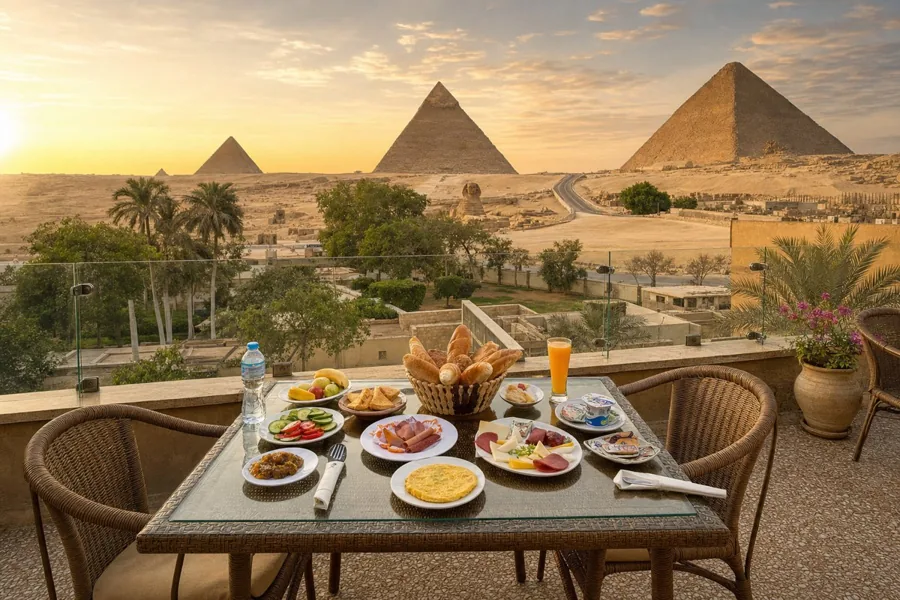 At the Sphinx
Giza Pyramids View Inn
- Good breakfast
- Airport shuttle
- Two restaurants
- 24-hour reception
- Free Wi-Fi
For those who want to see the Sphinx from their breakfast chair
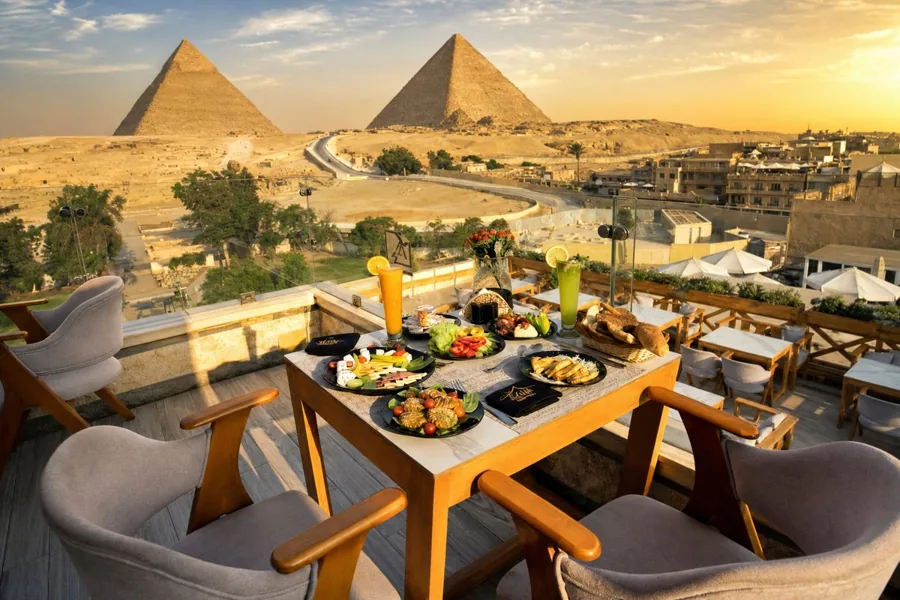 Most reviewed
Great Pyramid Inn
- Fabulous breakfast
- Rooftop terrace restaurant
- Bar
- Airport shuttle
- 24-hour reception
Most who want to stay in the neighborhood
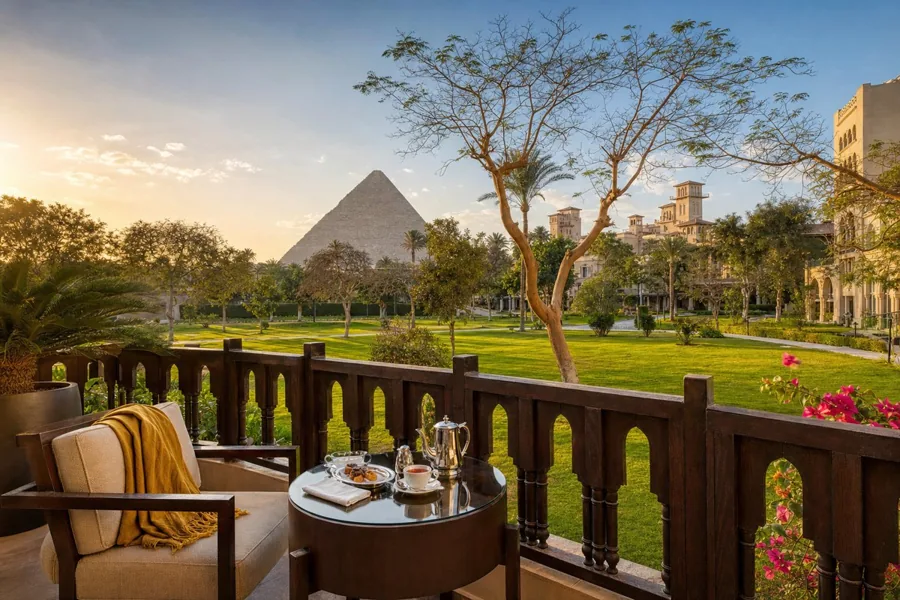 Garden & pool
Marriott Mena House
- Excellent breakfast
- Outdoor pool
- Spa and wellness center
- Three restaurants
- Fitness center
For those who want space, garden, and pool instead of a rooftop terrace
An Announcement Isn't a Commitment
Public performances in Egypt require a permit from the musicians' professional association, and it can refuse or withdraw it, even after tickets have been sold. So don't buy flights that only exist because of such an evening, check the cancellation conditions of the tickets, and expect a cancellation until shortly before the date.
The Travis Scott Case
How serious this is can be seen in the most famous case. For July 28, 2023, a performance by Travis Scott at the plateau was announced, tickets sold out within minutes, and two days before, the event was canceled. The organizer cited the elaborate production that couldn't be realized in the desert. Previously, the musicians' professional association had refused the permit, stating that the music wasn't in line with the country's cultural values.
This professional association isn't a formality. It decides on performance permits across the country, has banned entire genres in the past, and has also excluded well-known Arab artists from performing. So anyone buying a ticket for a party at the Pyramids of Giza is buying a ticket with reservations, regardless of how prominent the name on the poster is.
The framework for this has become tighter in recent years. Parliament approved a law change giving professional associations enforcement rights against performances they consider substandard. Supporters see this as quality assurance; critics from the cultural scene see it as an expansion of state control over what can be played publicly. For travel planning, the political assessment is secondary. What matters is that the decision about an evening doesn't lie with the organizer or the antiquities authority.
Practically, this doesn't mean you should skip it. The 2023 cancellation is the only spectacular case, and the series since then has held up. It means you plan such an evening as a bonus, not as the reason for the trip, and that you buy tickets where a refund process is regulated.
How Such an Evening Goes
If you go, you should know how such an evening practically unfolds, because it has little to do with a club visit.
The times are long. The evening with Anyma ran from 5 PM to 3 AM, and Zamna's festival format at the Pyramids of Giza was scheduled for two nights from 6 PM to 3 AM. So you're standing on sand for ten hours, and the majority of that is after sunset.
Then there's the cold, which is regularly underestimated. In Giza, the difference between day and night is around ten degrees year-round; in the winter half-year, that means single-digit temperatures around midnight, plus wind over open ground. The clothing that was right at 6 PM is wrong at 2 AM.
Getting Back, Cold, and Money
The second point is the way back. At 3 AM, several thousand people are at the same exit at once, and the public transport network isn't running at that time. If you don't have accommodation within walking distance or a pre-arranged pickup, you'll be negotiating a fare in the middle of the night, and that's the worst bargaining position this place has to offer.
A fourth point concerns money. Tickets for these evenings are marketed internationally and priced in dollars or euros, and they're many times what an evening in Cairo usually costs. If you're making the trip anyway, you'll factor that differently than someone traveling specifically for it. Additionally, for multi-day formats, there's accommodation and transport for several nights, because after 3 AM, you won't sensibly drive across the city.
A word about something that's on no announcement: sound carries far over open ground. Residents of the neighborhood east of the fence hear such evenings into the early morning hours without having bought a ticket. That's part of the balance sheet of such a date, even if it doesn't affect the guests themselves.
And a third point, less obvious: From the event site, you see the illuminated monuments, but you don't visit them. The ticket isn't an entry ticket to the plateau, and a tour isn't part of the evening.
The question remains whether all this is a good idea, and there are two opinions, both worth taking seriously.
In favor is the money and visibility. A DJ set at the Pyramids of Giza reaches an audience that classical cultural advertising wouldn't reach, and recordings of such evenings are seen millions of times. For a country where tourism is a significant economic factor, that's an argument. And the rental income flows into an operation that has visibly improved the site in recent years.
Against it is the thing itself. A World Heritage site isn't a venue, and the responsible international committee regularly addresses in its conservation reports what happens around the monuments. Structures, vehicles, vibration, and lighting rigs are no small matter at a 4,500-year-old monument, and there's no publicly accessible study on what such evenings do or don't do to the fabric.
What's particularly striking is what's missing. The World Heritage Committee's conservation reports deal extensively with construction projects around the site, with roads, a footpath project, and a railway line. There's significantly less on large events on the site itself, and a publicly accessible study on vibration, sound, or lighting at the monuments doesn't currently exist. If you're looking for a solid answer on the damage question, you won't find one, and that absence is itself a finding.
This page doesn't decide that. It notes that both are true: the evenings take place, they're approved, and the question of their compatibility with the protection of the site is open.

Private transfer around the clock from Cairo and Giza
Such evenings end between 2 and 4 AM, and that's exactly when the return trip becomes a problem. This provider explicitly advertises 24/7 availability, which makes the difference between a booked ride and a negotiation in the dark. Free cancellation.
Frequently asked questions
Do such events take place regularly?
Several times a year since 2023, mostly in the winter half-year. There's no fixed series with a schedule.
When is the next one?
Dates are usually announced a few weeks to months in advance. Dates are announced with a few weeks to months of lead time and are subject to the approval of the musicians' professional association.
Where do you get tickets?
Through the respective organizer, not the antiquities authority. Pay attention to the cancellation conditions, as permits can be withdrawn.
Can an announced event be canceled?
Yes. In 2023, a sold-out performance was canceled two days before, after the musicians' professional association refused the permit.
Do you see the pyramids during the event?
Yes, illuminated and integrated into the light show. However, a tour of the site isn't included; the ticket doesn't replace an entry ticket.
What should you wear?
Something warm in addition. There's a difference of about ten degrees between day and night, and the majority of the evening is after sunset.