Currency and prices in Giza can be summed up in one sentence: you pay in Egyptian pounds, and if you pay in another currency, you pay extra.
This applies to admission, drinks, taxis, and tips. Euros and dollars are accepted in some places, but at a rate set by the person accepting them, and you get change in pounds. That's not fraud, just a bad deal, and it can be avoided by exchanging or withdrawing beforehand.
More important than this rule, however, is a development that has made much of what older travel guides say about money obsolete. In 2024, Egypt floated its exchange rate, and a piece of advice that appeared in every forum for years has disappeared.
This page therefore first explains this change, then the question of what a price quoted in dollars tells you about an offer, and finally how to judge whether a price is fair without fixed numbers. The question of card versus cash is covered on a separate page.
What happened to the pound
- 2016
First float of the exchange rate. Until then, the rate was a single-digit number per US dollar.
- 2022 and 2023
Several devaluations, with the official rate kept stable for longer periods in between. In parallel, a black market emerges with a rate significantly higher.
- Early 2024
The official rate is around thirty-one pounds per dollar, while the black market offers nearly twice as many pounds.
- March 2024
The central bank floats the currency. The pound loses more than a third of its value, the rate jumps to around fifty pounds per dollar, and the gap to the black market largely disappears.
- Since then
The rate moves with the market. Inflation in the country remains high, causing prices in pounds to keep rising.
Two consequences of the float
For travelers, this float of the exchange rate has two consequences, both more important than any number.
The first concerns a piece of advice you can safely forget. For years, the saying was: don't exchange money at the bank, because you get significantly more pounds elsewhere. That was true as long as the official rate was artificially maintained and the parallel market offered almost twice as much. Since the float, this gap has disappeared. If someone offers to exchange money on the street today, you won't get a better rate – you'll get a legal risk, often bad notes, and occasionally shortchanging. You should check the rate on the day of your trip yourself; it has moved strongly in recent years.
The second consequence is less pleasant and rarely stated openly: Egypt has become cheaper for you, but life has become more expensive for the people there. The devaluation has reduced purchasing power in the country, and inflation has at times been in the double digits. That is why tipping matters more here than in Central Europe, and it is also why prices for tourists have risen noticeably in recent years.
A third point concerns the shelf life of price information. When a currency loses more than half its external value within two years and inflation is in the double digits, concrete amounts in a travel guide become worthless after a few months and misleading after a year. That is exactly why this page lists no specific prices. What remains are ratios, and those stay valid much longer.
If you understand these two points, you can navigate most price discussions on the ground without memorizing a table.
What a price in dollars tells you
Now to the observation from the title of this page: a price quoted in dollars says something about the offer.
There are legitimate cases. The visa on arrival is charged in foreign currency, and internationally marketed services such as tours or hotels are often priced in dollars or euros because their customers are international. A price tag in dollars is therefore not a warning sign in itself.
It becomes revealing when the service is actually local. If a driver, a shopkeeper, or a camel guide quotes a price in dollars, they do so for two reasons: they assume you think in that currency, and they can set a higher amount more easily than they would dare in pounds. The conversion almost never works in your favor.
The same applies to change. If a price is quoted in dollars and you pay in dollars, you often receive change in pounds – at a rate set by the seller. If you pay in pounds, you skip this intermediate step entirely, and that is where the saving lies, not in haggling.
The simple countermeasure is to conduct the conversation in pounds and pay in pounds. That puts you in the local price structure rather than one built for tourists. It's not about haggling; it's simply about returning to the local currency.
The official admission fee, by the way, is not affected: it is set in pounds and listed in the ministry's price list, even if that list may be older than the latest adjustments.
How to recognize a fair price
The question remains, and it decides everything on the ground: how do you know if a price is fair when this page gives no numbers?
The most useful benchmark is not an amount but a ratio. The entrance fee to the site is set by the state and can be looked up in the price list; it is the only price of your day that nobody negotiates. Use it as an anchor. A coffee, a bottle of water, or a short taxi ride costs significantly less; a guided day tour costs significantly more. If someone quotes you a small item at a price in the range of the entrance fee, something is wrong.
It helps that this anchor is public. The entrance fee is in an official list, it is the same for all foreign visitors, and nobody can tell you it's different today. That is more orientation than you get at many destinations, and it costs nothing to check the amount before your trip.
The second benchmark is the location. Inside the fence, prices are higher than outside; directly at the gate, they are higher than two streets away. That is true everywhere in the world, and here it is particularly pronounced. If you buy water before entering, you pay a fraction.
The third is the way you are addressed. A price quoted unsolicited, before you have asked for anything, is rarely the price a local would pay. The price level shifts with the exchange rate faster than any figure on this page could stay current.
The final benchmark is your own composure. For the amounts typically involved here, the annoyance over a bad deal is out of proportion to the sum. If you know the rough ratios, you may occasionally overpay a little and still have a good day.
The biggest item in your travel budget. For admission, the amounts are negligible; the cost of a Giza trip is determined by your accommodation, and there the range between a simple pension and a house with a view is the widest. Three places that cover that range:
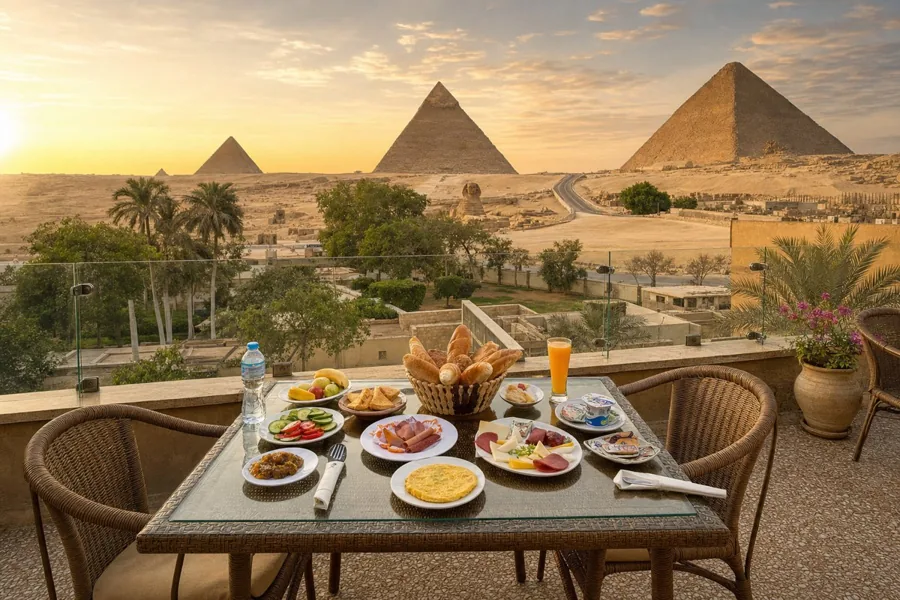 At the Sphinx
Giza Pyramids View Inn
- Good breakfast
- Airport shuttle
- Two restaurants
- 24-hour reception
- Free Wi-Fi
For those who want to see the Sphinx from their breakfast chair
 Most reviewed
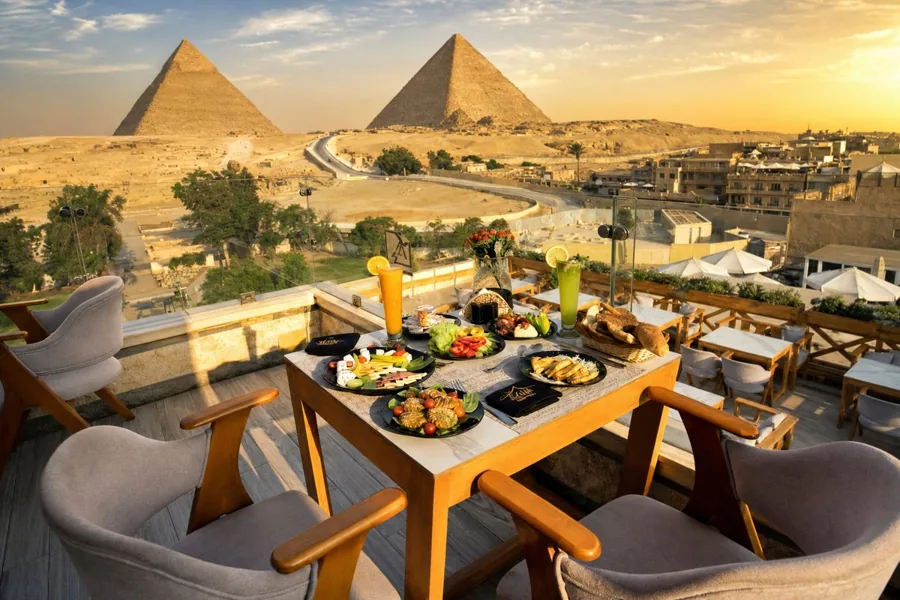
Great Pyramid Inn
- Fabulous breakfast
- Rooftop terrace restaurant
- Bar
- Airport shuttle
- 24-hour reception
Most who want to stay in the neighborhood
 Garden & pool
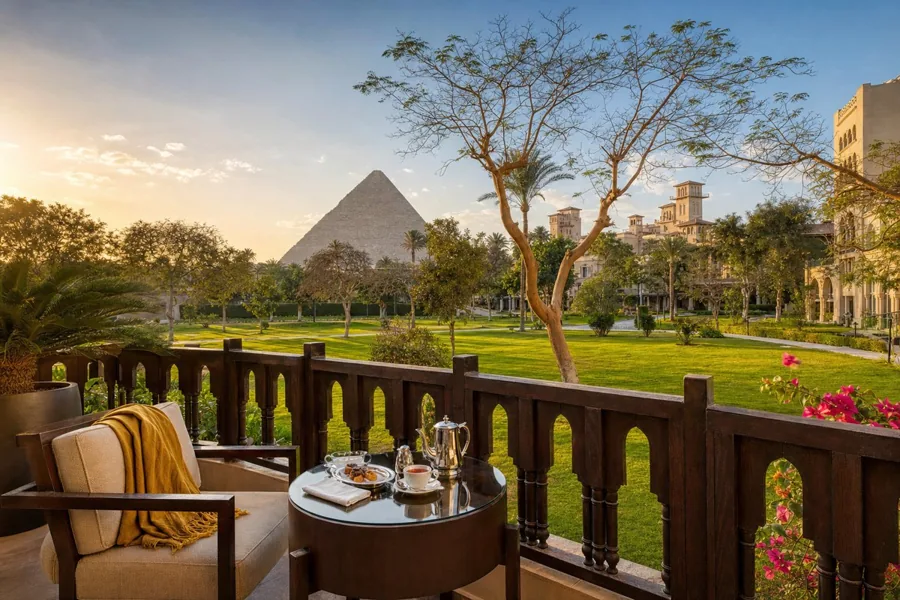
Marriott Mena House
- Excellent breakfast
- Outdoor pool
- Spa and wellness center
- Three restaurants
- Fitness center
For those who want space, garden, and pool instead of a rooftop terrace
Frequently asked questions
What currency should I pay in?
In Egyptian pounds. Euros and dollars are accepted in some places, but at a rate you cannot negotiate, and you get change in pounds.
Is it worth exchanging money on the street?
No, not anymore. Since the rate was floated in 2024, the old gap to the black market has disappeared. What remains is the risk and the shortchanging.
What does a price in dollars mean?
For internationally marketed services, nothing special. For a local service, it usually means a higher amount is set than would be asked in pounds.
How can I tell if a price is fair?
Use the state-set entrance fee as an anchor, consider the location of the purchase, and note whether you asked for the price or it was quoted to you unsolicited.
Has Egypt become cheaper for travelers?
In euros, yes, due to the devaluation. Within the country, prices have risen sharply at the same time, which means the opposite for the local population.
Where is the best place to exchange money?
At a bank, at the airport, or at an ATM. Ask for small notes, as you will need them most in daily life.