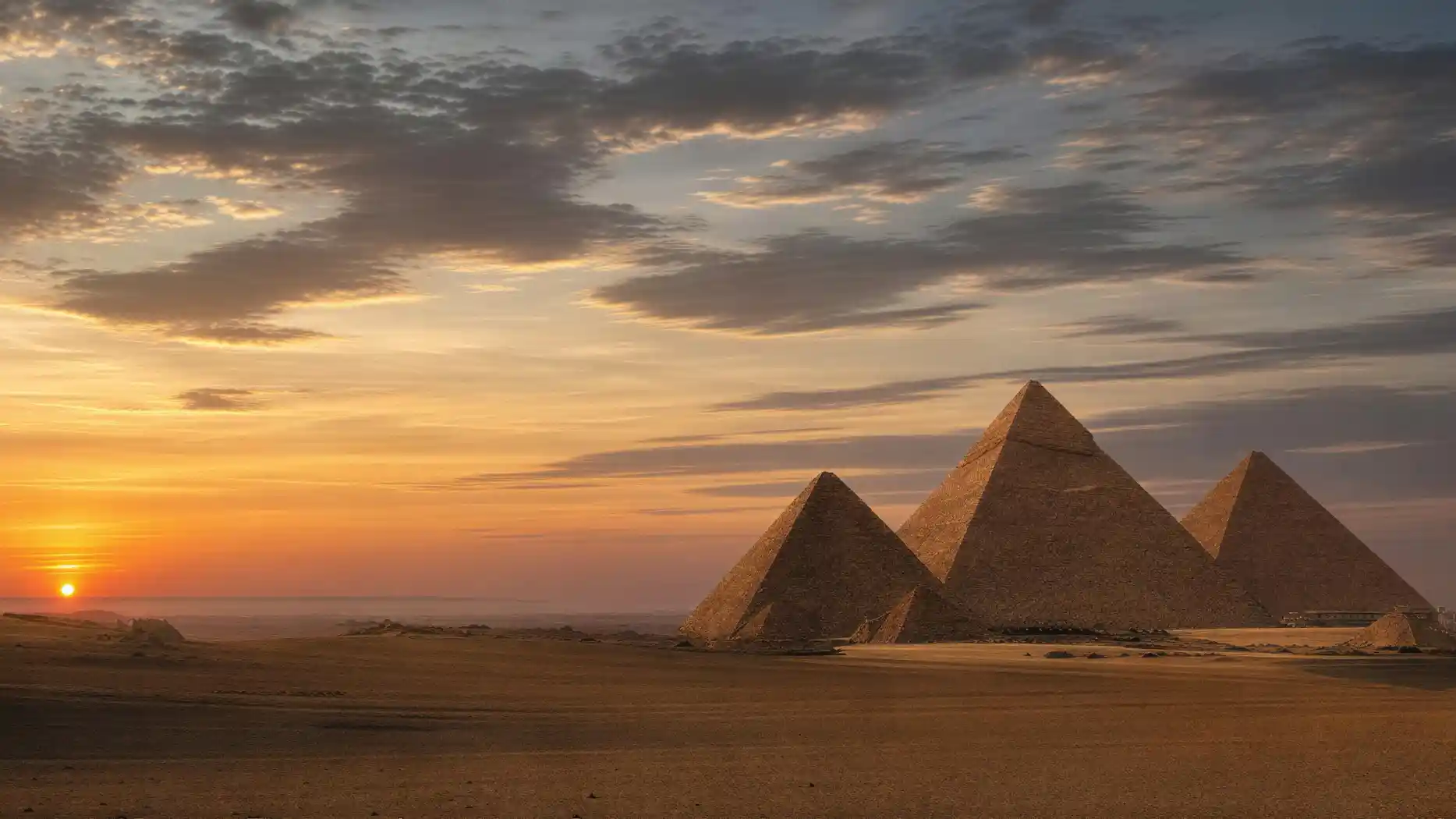
A Grand Egyptian Museum in Giza was announced for decades. Since November 2025, it actually stands there, about two kilometers from the plateau, and since November 2025 it has been fully open. For anyone visiting the pyramids, it is no longer an afterthought but a decision.
The reason is simple: what is missing on the site is here. The structures outside are empty. They were already cleared in antiquity, and what excavations later found is now in museums. The plateau shows architecture, the museum shows the contents. Only together do they form a complete picture.
This works in both directions. Those who visit the museum first and then the site see something different outside: they know how a burial chamber was furnished and can imagine the empty space filled. Conversely, those coming from the site recognize the scale in the museum. Both orders work, and those who have the choice should decide deliberately rather than based on opening hours.
The distance is also new. Until 2025, the path to the most famous pieces led across Cairo to a building on Tahrir Square. Today, the collection lies two kilometers from the structures it came from, and that is the real break with a hundred years of visiting routine.
This page covers the building first, then the collection, and finally the question of how both fit into a day at the plateau. The order follows what people actually search for, and that is unusual for this building: after the name itself, the exterior is the most searched topic, far more than the interior. People want to see the building first, then the collection.
The building in numbers
- Distance to the plateau
- about two kilometers
- Site area
- 500,000 m²
- Exhibition space
- about 81,000 m²
- Collection
- over 100,000 objects
- Tutankhamun Gallery
- 7,500 m², over 5,600 pieces
- Fully opened
- November 1, 2025
The building and its facade
The exterior of the Grand Egyptian Museum is the second most common reason people search for this building, and that is not a whim. The structure is unusual, and for a comprehensible reason.
It was designed by the Irish firm Heneghan Peng, which won an international competition in 2002 with over 1,500 entries from 82 countries. What emerged is not a building with a view, but a building made of views: the form derives from the sightlines to the three pyramids. The house is organized along axes pointing to the three structures, follows the contours of the desert terrain, and remains deliberately lower than the pyramids on the horizon.
This becomes visible on the facade facing the desert. It consists of translucent alabaster from local quarries, set in a pattern of interlocking triangles. During the day, this wall filters the light; at night, it glows from within. The triangular geometry is not decoration but the same figure that defines the entire building: a slanted wedge, divided by lines that point to the structures.
For visitors, this has a practical consequence. From the outside, you cannot tell how large the building is because it lies flat in the landscape. The scale only becomes clear inside, and that is exactly what the design aims for.
Photographically, the facade is most interesting in the late afternoon, when the low light brings out the triangular structure, and after dark, when the alabaster glows from inside. At noon, it looks flat because the perpendicular light erases the relief effect. The same effect also strips the structures on the plateau of their texture around midday.
That the construction took so long is not visible from the outside, yet it is part of the building's history. Between the allocation of the site and the full opening lie more than three decades, during which Egypt's political situation fundamentally changed twice. The timeline further down makes this comprehensible.
Full-day tour to the plateau, the museum, and the Sphinx
- Solves the actual problem: two destinations with separate tickets in one day
- Seven to eight hours with a German-speaking guide and hotel pickup
- Includes entry to the site and lunch
- Free cancellation up to 24 hours before
The hall, the staircase, and the Tutankhamun galleries
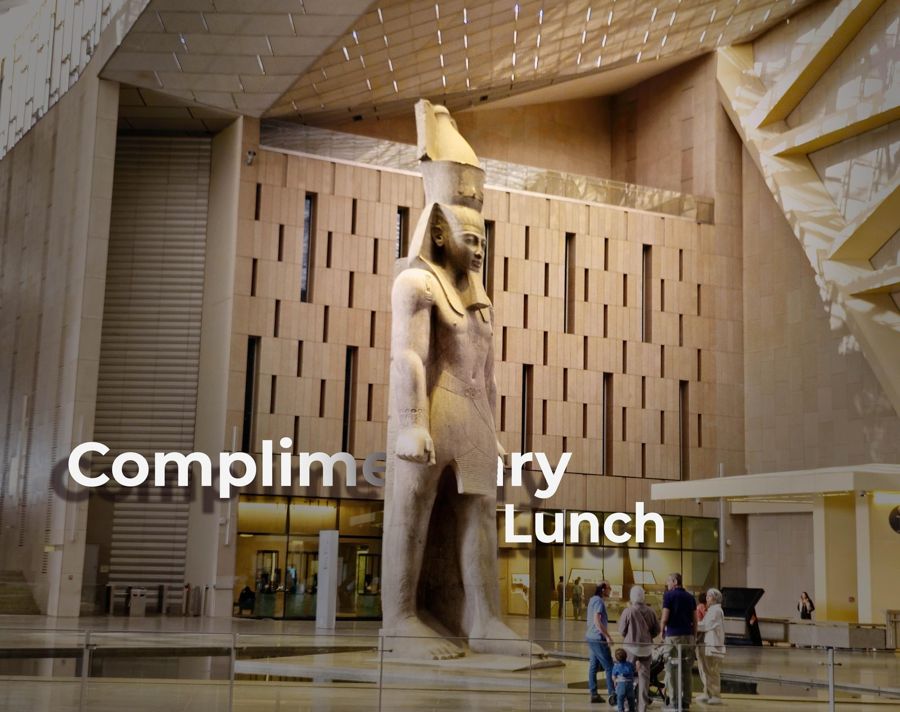
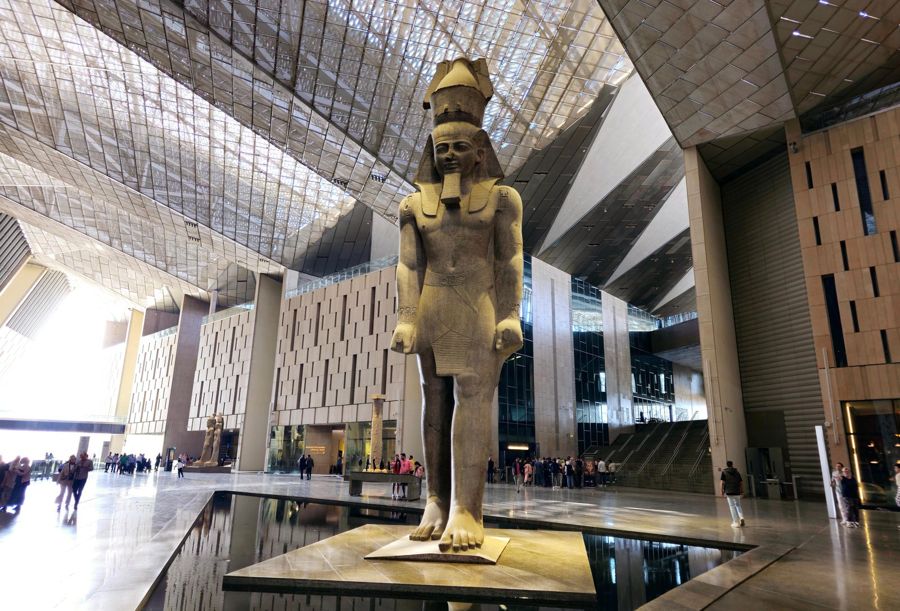
The interior of the Grand Egyptian Museum begins with a hall spanning six stories, in which stands a statue of Ramses II over three thousand years old, illuminated by diffused daylight from above. From there, a broad staircase leads upward, lined with statues, columns, and sarcophagi, and it ends at a floor-to-ceiling glass wall with a view of the pyramids. The path through the building is thus itself a staging: you ascend through history and emerge at the original.
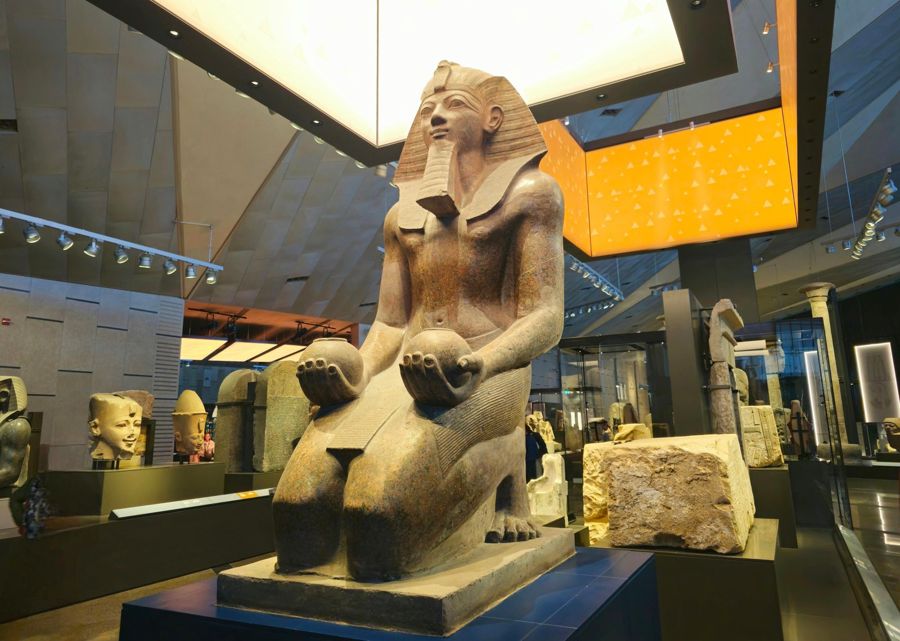
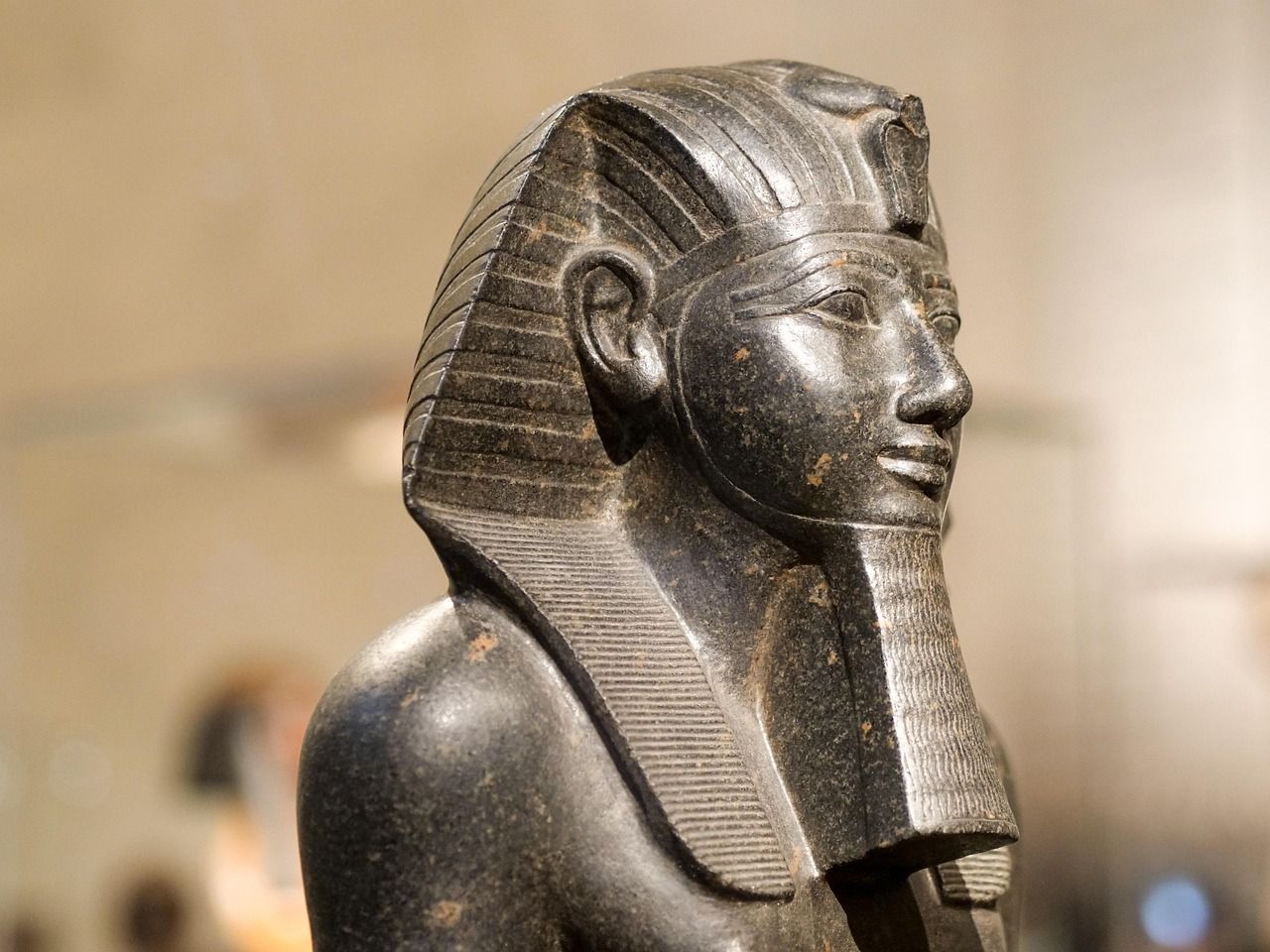
The actual reason for the crowds, however, lies in two galleries further up. There, for the first time, the complete burial equipment of Tutankhamun is on display, covering 7,500 square meters with over 5,600 pieces. Until the opening, only a fraction of it had ever been shown publicly; more than three thousand objects had never been exhibited at all.
That is a remarkable number. The discovery of the tomb lies over a hundred years back, it is the most famous archaeological find of the modern era, and yet the public knew only part of it until recently. Those who have the golden mask in mind will see here for the first time what else lay beside it: furniture, weapons, chariots, clothing, everyday items.
This completeness has a side effect that becomes apparent during the tour: much of it does not look like a treasure chamber at all. Between gilded shrines stand folding stools, baskets, sandals, and storage jars. It is precisely these things that turn a collection of precious objects into the household goods of a person, and they are the reason a visit is worthwhile even for someone who already knows the famous pieces from pictures.
Around them lie twelve galleries, arranged by era and theme, from prehistory to the Roman period. In total, the building holds over one hundred thousand objects, and a considerable portion of them is on display. In addition, there is the Solar Boat of Khufu, which was brought here from the plateau in 2021.
For the second boat, the process itself can currently be observed. It was transferred from its pit on the plateau at the end of 2025, in about 1,650 individual parts, and will be reassembled over years. The work is visible to visitors, which is rare in a museum: you do not see the finished object but the restoration through which it comes into being.
A quarter century until the opening
- 1992
The site next to the plateau is designated for a new museum.
- 2002
International competition with over 1,500 entries from 82 countries; the firm Heneghan Peng wins.
- from 2005
Construction begins. The work stretches over two decades, interrupted by political and economic upheavals.
- 2021
The first Solar Boat of Khufu is transferred from the plateau to the new building.
- October 2024
Partial opening with twelve halls; the Tutankhamun galleries remain closed.
- November 1, 2025
Full opening with a state ceremony; public access a few days later.
- November 16, 2025
After overcrowding, fixed entry time slots are introduced.
Can it be combined with a day at the plateau?
The question that matters for trip planning remains: how does a museum at the Pyramids of Giza fit with a day at the plateau?
Not as easily as the distance suggests. The building requires time, at least three to four hours for the main galleries, and thus about as long as the site itself. Anyone who wants both in one day should plan a full day of nine to ten hours, not an afternoon detour.
In addition, there is a regulation that rules out spontaneous decisions. After the rush of the first weeks, when 27,000 people came in one day and the museum closed early, fixed entry time slots apply. The ticket must be booked in advance for a specific slot. Currently offered are: 9, 11, 13, 15, 17, and 19 o'clock, each as a two-hour window. Admission is separate and has nothing to do with the plateau ticket; it is noticeably higher than the site entry fee.
From this, the order follows by itself. The site closes in the late afternoon, the museum stays open longer. So: plateau in the morning, museum in the afternoon, and the booked slot determines when you need to be done outside.
One confusion should be avoided. The older Egyptian Museum on Tahrir Square in the city center still exists, and it has not been emptied. What moved were specific collections, not the entire country's collection. The old building retains its own focus and, above all, a completely different character: narrow halls, an order grown over decades, display cases from an earlier museum era. Those who visit both see not just two collections but two ideas of how to display antiquities, and for some, the older one is the more interesting.
Those with two days should separate them. Both destinations lie side by side, so no extra travel is needed, and the difference between seeing and ticking off is particularly great at this place. A contemporary report on the opening cites 24,000 square meters for the permanent exhibition alone. No one walks through that on the side.

Private car with a local driver in Cairo and Giza
Two kilometers sound like a walk and are not: a highway lies between, and vehicles are not allowed on the plateau. A car for the day solves exactly this leg, including the waiting time while you are inside. Free cancellation, instant confirmation.
Frequently asked questions
Is the museum included in the pyramid entry ticket?
No. It has its own admission and its own booking system. The two tickets have nothing to do with each other.
Do you need to book in advance?
Yes. Since mid-November 2025, a fixed time slot applies, which must be booked in advance.
How much time do you need there?
At least three to four hours for the main galleries. Those who want to see the Tutankhamun galleries at leisure should plan more.
What is the most important thing in the building?
The complete burial equipment of Tutankhamun. Over three thousand of these pieces had never been publicly shown before the opening.
Is the Solar Boat there?
Yes, the first boat was brought here from the plateau in 2021. The former boat museum on the site no longer exists.
Is the building itself worth seeing?
Yes. The facade of translucent alabaster and the staircase with a view of the pyramids are attractions in their own right.