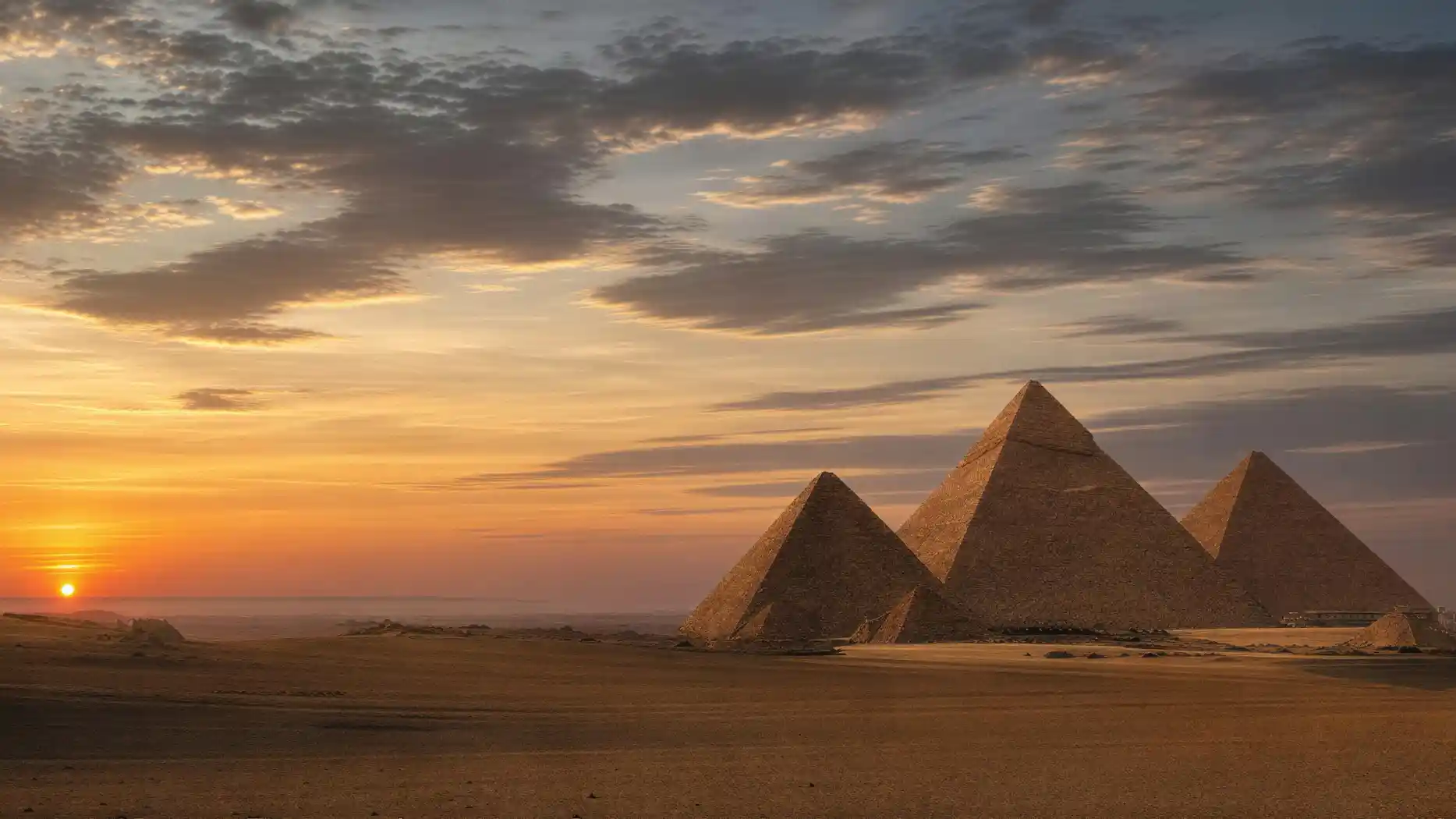
The standard answer is: about twenty years. It appears in encyclopedias, on signs, and in practically every account, and it is probably roughly correct.
What is remarkable is what it is based on. There is no Egyptian source that gives a construction time. No foundation stone, no dedication inscription, no administrative note with start and end dates. The number comes from a Greek historian who wrote two thousand years after the events and relied on stories told by Egyptian priests.
Nevertheless, it persists, and not just for convenience. It fits several independent constraints, and no better number has yet gained acceptance. That is a weaker basis than most people assume, and a stronger one than it initially sounds.
This page shows where the twenty years come from, what calculations are usually made with them, and where these calculations make a crucial mistake. For the most famous of them, one block every two minutes, mixes two completely different transport chains together.
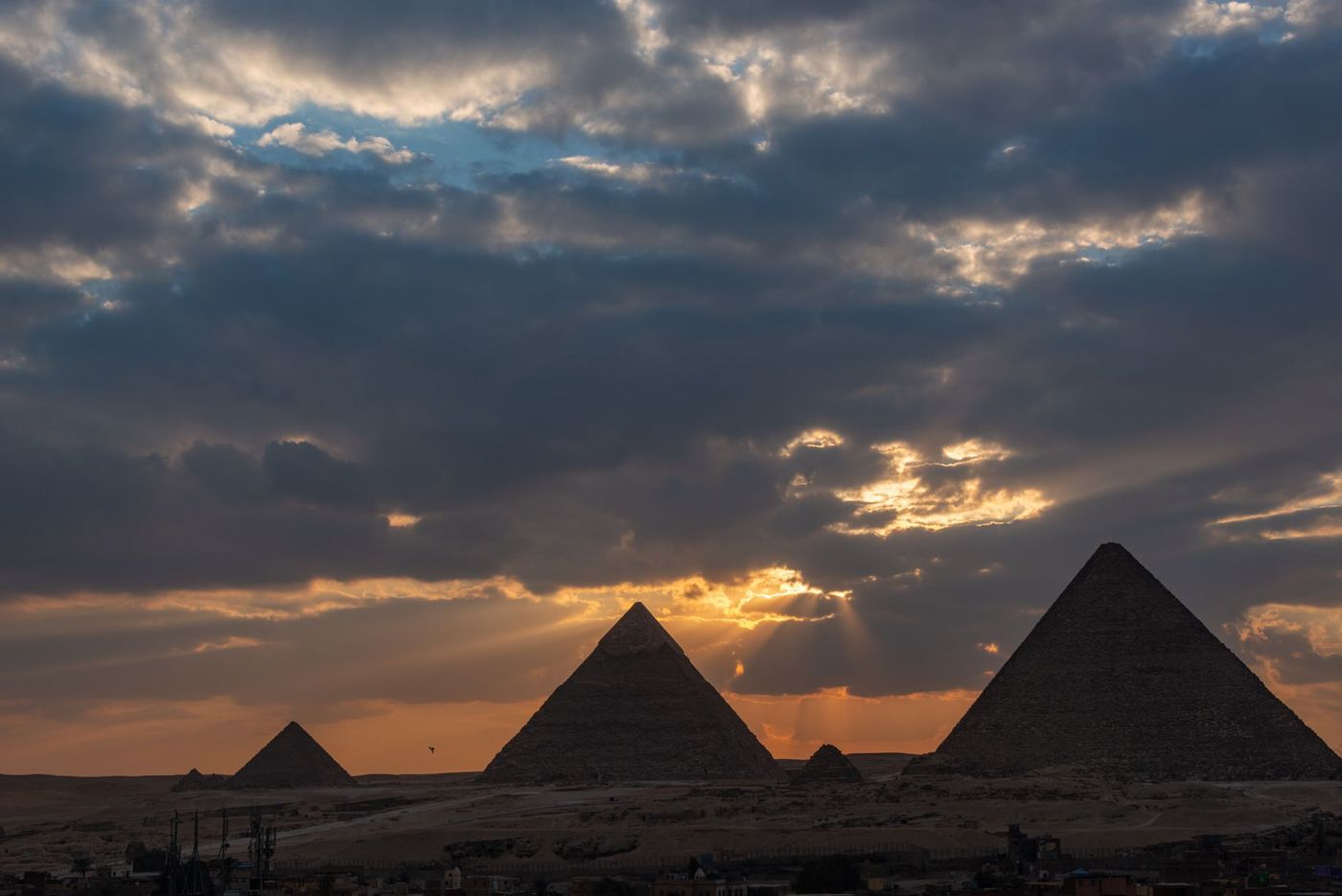
First, a clarification that makes many things easier. When talking about construction time, almost all figures refer to the Great Pyramid of Khufu alone. The three great pyramids of Giza were built successively under three different kings, and between the first and the last structure there are roughly eighty years. So there is no common construction time for the whole complex, but three separate projects that overlapped at the edges.
And another important point: construction time is not a measured quantity, but an estimate. There is no document that records it, and no method that reads it directly from the stone. What exists are constraints. From them emerges a corridor, and the twenty years lie roughly in the middle of that corridor.
Where the Twenty Years Come From
The source for the twenty years is Herodotus, and it is worth reading exactly what he writes.
In his second book, he reports that the construction took twenty years, that one hundred thousand men worked in shifts of three months, and that an additional ten years were needed for the causeway and the preparatory work. So strictly speaking, he gives thirty years for the entire project and twenty for the structure itself.
Of these figures, one is certainly wrong. One hundred thousand people at the same time is ruled out by the archaeological evidence; the settlement on site was designed for a few thousand. The number is probably an exaggeration, as is common in ancient historiography, or a figure for the total number of all those ever involved.
The shift duration of three months, on the other hand, seems astonishingly credible today, because it corresponds exactly to the length of the Nile flood, during which the farming population was not needed in the fields. So Herodotus passed on a real mechanism, even if he missed the scale.
As for the construction time itself, there is no comparable counter-argument. It stands because nothing speaks against it.
Nevertheless, one should be clear about how this information reached Herodotus. He traveled through Egypt in the fifth century BC and had priests tell him what was in their traditions. Between the construction and this conversation lie about two thousand years, roughly the distance that separates us today from the Roman era. What he wrote down is therefore not a source from the time of construction, but a very late report about a very old memory.
The fact that the number twenty survived while the names of the builders were lost says something about the nature of this tradition. Round numbers survive better than details. It is therefore quite possible that twenty years was never an exact figure, but from the beginning a phrase for a very long construction project.
It Couldn't Take Longer Than the King Reigned
There is a hard upper limit, and it comes from a completely different direction: a king could not build longer than he reigned.
A pyramid was a tomb. It had to be finished when its owner died, and after his death it was at best hastily completed. The construction time is thus linked to the reign length, and for Khufu the surviving figures range from just over twenty to well over thirty years, depending on how one reads a particular administrative record.
This gives a window instead of a number. Twenty years is compatible with any of these readings; thirty only with the longer one. Whoever estimates the construction time upwards must also assume a longer reign, and both assumptions depend on the same uncertain basis.
From this coupling follows something else that is rarely mentioned. The construction must have begun early in the reign, practically immediately after the king took the throne. A king who waited ten years risked ending up in an unfinished tomb, and exactly this case is documented for other pyramids.
The construction time was therefore not a schedule that was set up, but a race against a deadline whose date no one knew.
This deadline also explains why certain parts were built so early. The underground chamber and the lowest courses were finished first, and several experts suspect that the tomb complex was replanned in stages: first a grave deep in the rock, then a chamber in the masonry, finally the present chamber high up. Each of these changes makes sense if a king realizes that he has more time than initially thought.
Conversely, this means: the finished pyramid is not necessarily the original plan. It is what was possible within the available time, and the available time was the only variable that no one could control.
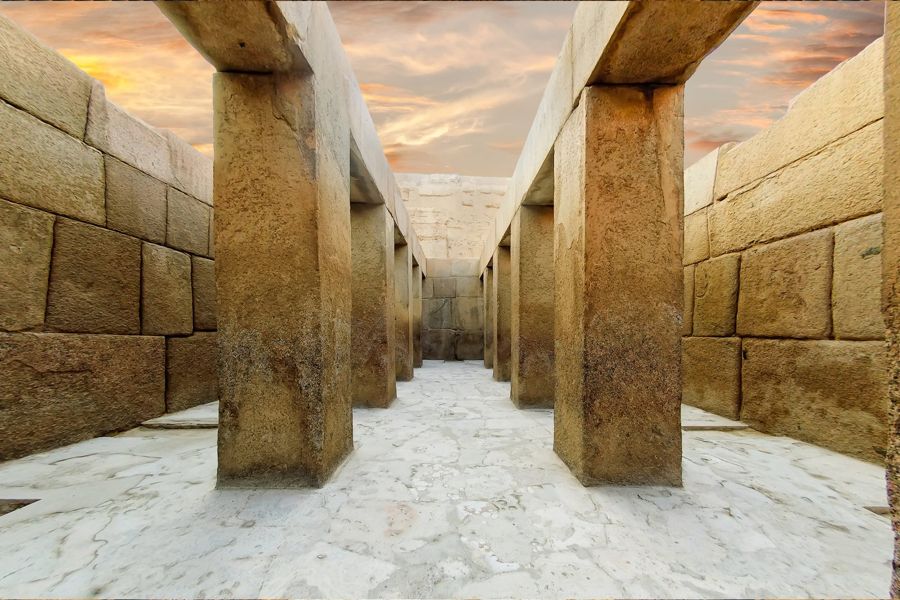

Half-Day Tour to the Pyramids of Giza and the Sphinx
- The quarries on the plateau are open and explain the short transport route
- A licensed guide shows where the core masonry ends and the casing began
- Plateau entry, German-speaking guide, and pickup are included
- Free cancellation up to 24 hours before
What a Construction Time Includes
- before the first stone
Site selection, surveying, setting the ground plan and slope. No possibility of correction later.
- first phase
Leveling the rock, establishing the quarries, building ramps, harbor basins, and canals.
- in parallel
Construction of the workers' settlement with bakeries, storage facilities, and accommodation.
- main phase
Stacking the core masonry, layer by layer, with the greatest material throughput.
- towards the end
Setting the granite chambers, sealing the passages, casing from top to bottom.
- afterwards
Mortuary temple, causeway, valley temple, boat pits, and subsidiary pyramids.
- unlimited
The funerary cult, for which the complex was operated and staffed.
The Calculation with 2.3 Million Blocks
The most famous calculation on this topic goes like this, and it appears in every other documentary.
One takes about 2.3 million stone blocks and distributes them over twenty years. That gives about 315 blocks per day, if one calculates without a break. With a ten-hour working day, that is just over thirty blocks per hour, i.e., roughly one block every two minutes, for two decades.
This number is arithmetically correct and is also used as a starting point in current specialist literature, for example in a study on counterweight systems at the construction site from 2025. It is the reason why many people find the construction time implausible, and it is also the reason why some conclude that there must have been an unknown technique.
Before doing that, it is worth looking at what is actually being counted in this calculation. One block every two minutes does not mean that a block was moved every two minutes. It means that on average one reached its final place every two minutes, spread over a construction site with a side length of several hundred meters, where many teams worked simultaneously.
With twenty teams working in parallel, that corresponds to one block per team every forty minutes. That is no longer a superhuman achievement, but a question of organization.
In addition, the blocks are very unevenly distributed. The lowest courses are the thickest and contain by far the largest part of the mass; towards the top, the stones become smaller and the courses thinner. About half of the total volume is in the lowest fifth of the height. The material throughput was therefore enormous at the beginning and then steadily decreased, while at the same time the transport routes upwards became longer and more difficult.
Whoever distributes the blocks evenly over twenty years is therefore not describing a single real week on this construction site. The average is arithmetically correct and describes a construction process that never existed.
How Long Would You Need?
The default setting with 2.3 million blocks, twenty teams, and 365 days gives approximately the traditional twenty years.
The Mistake in Almost All These Calculations
Now to the mistake that almost all these calculations contain, and it is not a rounding problem, but a logical one.
The number of 2.3 million blocks describes the entire structure. The idea that all this material was brought in via the Nile, on the other hand, is wrong. About ninety percent of the mass consists of coarse limestone from quarries a few hundred meters south of the construction site. This material never had to be loaded onto a boat, it was not dependent on the water level, and it could be moved all year round.
Only two materials came by water: the fine white limestone for the outer casing, from Tura on the other side of the Nile, and the granite for the chambers, from Aswan. Together, these are a small proportion in terms of quantity and logistically the real problem, because they depended on ships, water levels, and seasons.
Thus, two completely different chains run side by side. One is a mass transport over short distances, uniform and year-round. The other is a special logistics operation over hundreds of kilometers, seasonal and weather-dependent.
Whoever squeezes both into a single number gets a calculation that is correct for neither. And that is exactly what happens when one distributes 2.3 million blocks evenly over twenty years.
The difference has tangible consequences for the construction process. Core masonry could be brought forward, stacked, and if necessary stored temporarily; it came from nearby and was available in any quantity. Casing, on the other hand, had to be there in the right order and at the right time, because it was set from top to bottom and the delivery was tied to water levels. A missed flood meant a lost year for this one material.
That is why the question of construction time is at its core a question about the casing. The shell was a problem of quantity. The outer skin was a problem of deadlines, and deadlines are what construction projects fail on.
What the Diary of Merer Reveals
How the second chain actually worked, we have known quite precisely since 2013, and the numbers are soberingly concrete.
The service record of Inspector Merer, found in harbor galleries at the Red Sea, documents a period of about five months in the 27th year of Khufu's reign. Merer led a crew of about two hundred men who brought limestone blocks from the quarries of Tura to Giza, over a distance of roughly fifteen to twenty kilometers.
The rhythm can be read from his entries. About every ten days, the crew completed two to three round trips. The loaded journey took two days, the empty return one. Per month, that gives on the order of two hundred blocks, transported by a single crew.
Crucial is the period covered by the service record: from the flood season to early spring, i.e., about July to November. Exactly in these months the transport of heavy loads took place, because the river was high then and reached closer to the construction site. The evaluation of these records shows an operation that followed the water level and not a construction schedule.
For the construction time, this means: the casing could only be delivered during part of the year. The core masonry, on the other hand, continued to grow.
Remarkable about Merer's records is also how casual they sound. He notes trips, loads, and stays in a tone that shows no sign of an exceptional state. It reads like a logbook, not like the report of a century project. That is exactly why these texts are so valuable: they show the construction as routine operation.
And they date themselves. The entries name the 27th year of Khufu's reign, and at that time casing material was still being delivered. Whoever estimates the reign at just over twenty years thus gets a problem, because in the 27th year construction was obviously still going on. The records therefore speak more for the longer reading of the reign and thus for a construction project that stretched over more than twenty years.
Two Transport Chains, Two Schedules
The usual calculation treats both as one. They worked completely differently.
| Core masonry | Casing and granite | |
|---|---|---|
| Share of the mass | about ninety percent | small share |
| Origin | Quarries on the plateau | Tura and Aswan |
| Distance | a few hundred meters | 15 to 900 kilometers |
| Means of transport | Sledges over land | Barges on the river |
| Temporal constraint | possible all year round | tied to high water level |
| Bottleneck | Workforce | Ships, season, water level |
- Core masonry
- about ninety percent
- Casing and granite
- small share
- Core masonry
- Quarries on the plateau
- Casing and granite
- Tura and Aswan
- Core masonry
- a few hundred meters
- Casing and granite
- 15 to 900 kilometers
- Core masonry
- Sledges over land
- Casing and granite
- Barges on the river
- Core masonry
- possible all year round
- Casing and granite
- tied to high water level
- Core masonry
- Workforce
- Casing and granite
- Ships, season, water level
The information on delivery frequency comes from the service record of Merer and concerns exclusively the right column.
The Years Before the First Block
What does not appear in any of these calculations is the time before the first block, and it was considerable.
Before construction could begin, the rock had to be leveled, to an accuracy in the centimeter range over an area of more than five hectares. The alignment to the north had to be measured, without a compass and without the possibility of correcting later. The quarries had to be developed, ramps built, harbor basins dug, and canals excavated.
In parallel, the infrastructure for the people was created: accommodation, bakeries on an industrial scale, breweries, storage facilities, workshops, an administration. The excavations at this settlement show a complex that itself represents a major construction project.
Herodotus reckons ten years for this preparatory work, in addition to the twenty for the pyramid. Whether the number is correct is open, but the order of magnitude is plausible. When one gives the construction time of a pyramid, one almost always means only the main phase and leaves out preparation and finishing work.
More honest would therefore be a formulation that distinguishes between the two: about twenty years for the structure, and an overall project that ran considerably longer.
The same applies to the end. With the last casing stone, the complex was not finished, but only the main building. After that came the mortuary temple in the east, the causeway down into the valley, the valley temple at the water, the subsidiary pyramids for the queens, and the pits for the disassembled boats. Each of these structures was in itself a larger project than what many cultures have ever built.
When you stand on the plateau today, you therefore see a section. Remains of the causeway are preserved, of the valley temple under today's development almost nothing, and the subsidiary pyramids look like footnotes next to their neighbor. But the construction time applies to the entire work, not just the silhouette that one photographs.
What the Neighboring Pyramids Reveal About Time Pressure
A look at the neighboring structures shows what happened when the calculation did not work out.
The Pyramid of Menkaure, the third and smallest in Giza, has a base area made of granite whose blocks are only roughly dressed. The smoothing was apparently carried out from bottom to top and was broken off in the middle of the work. The builder died before the casing was finished, and what happened afterwards was only enough for a conclusion, not a completion.
The same pattern is found elsewhere. Several pyramids of the Old Kingdom remained unfinished, some were not continued at all after a change of reign. That is the best existing evidence that the construction time was actually tied to a person and not to a building program.
For the Great Pyramid of Khufu, this means conversely: it was finished. Casing, chambers, sealing stones, everything executed. Whoever estimates a construction time must therefore assume a duration that fit into a reign and in which there was additionally buffer for delays.
That is a stronger argument for twenty years than any calculation with blocks per minute. Not because twenty years are proven, but because the structure is complete and the reign was not unlimited.
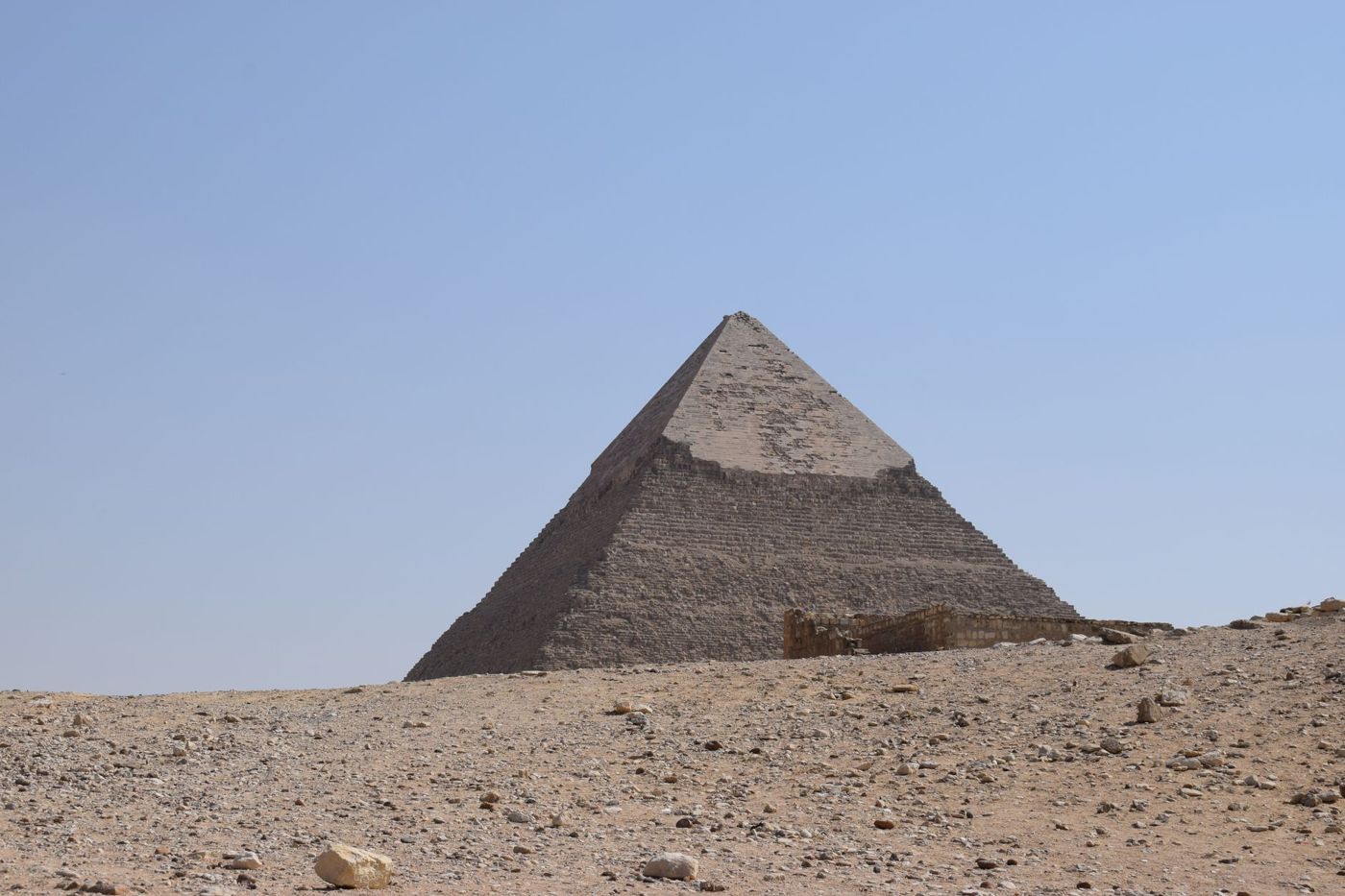
The middle pyramid adds another hint to the picture. At its top, a remnant of the original casing sits to this day, and below it is almost completely missing. The reason lies not in the construction time, but in the later use as a quarry: what was easy to reach was removed, what sat high up remained. Construction time questions and preservation questions are often confused here.
This is useful for classification. Missing casing does not automatically mean unfinished, and rough stone does not automatically mean abandoned. Only when tool marks end in the middle of a surface, as at the base of the third pyramid, is there actually a break-off.
Plateau entry as QR code on your phone
The unfinished granite casing and the quarry edges are in the freely accessible area. The basic ticket is sufficient for both.
How Research Today Deals with the Question
How today's research deals with the question differs significantly from the popular presentation.
In the specialist literature, the construction time is rarely the topic. What is discussed are methods, material flows, and work organization, and the twenty years run along as a working assumption because they fit the constraints. No one seriously tries to prove them, and no one considers them refuted.
Practical experiments have nevertheless changed the discussion. Replication experiments with contemporary tools show how long individual steps actually take, and they thus provide lower limits: cutting a block from the rock, dressing it, moving it over a certain distance. These figures are more reliable than any extrapolation from the total volume, because they are measured and not derived.
What they show is unspectacular and important: no single work step is impossible with the means of the time. The bottleneck was never an unknown technique, but the quantity and the coordination.
The fact that the entire necropolis has been under protection as a World Heritage site since 1979 has, by the way, a practical influence on this research: experiments on the original are excluded, which is why replicas take place next to the site.
A second development is currently shifting the question. New studies on the course of a long-silted Nile branch show that the water reached much closer to the plateau during the construction period than today and that its level fluctuated significantly over the centuries. A high level considerably shortened the land route for the heavy deliveries, a low one lengthened it.
Thus, the construction time becomes a quantity that also depended on the climate. A series of dry years could slow down the delivery of casing stone without anything going wrong at the construction site itself. This dependency is not included in any of the popular calculations, and it is probably the most important uncertainty factor of all.
Frequently asked questions
Where does the figure of twenty years come from?
From Herodotus, who wrote two thousand years after the construction. There is no Egyptian source with start and end dates.
Is the number therefore worthless?
No. It fits the traditional reign length, the size of the workers' settlement, and the delivery frequency documented in the service record of Merer. Nothing has contradicted it so far.
Was construction carried out all year round?
On the core masonry, presumably yes, because the material came from the plateau itself. The transport of casing and granite was tied to high water levels and only ran during part of the year.
Does the preparation count?
Not in the usual figure. Leveling, alignment, quarries, and the workers' settlement came before, and Herodotus reckons another ten years for that.
The Short Answer, and the Reliable One
If someone asks how long the construction of the Great Pyramid of Khufu took, the best answer is therefore two-part.
For the structure itself: about twenty years, a figure from a second-hand source that fits all known constraints and to which nothing contradicts. For the entire project including preparation, temples, causeway, and subsidiary structures: considerably longer, probably most of a reign.
The more interesting part of the answer, however, is not the number, but what it presupposes. Twenty years of uninterrupted construction activity mean twenty harvests in which enough surplus was produced to feed tens of thousands. They mean an administration that functioned for two decades, across changes of personnel. And they mean that in these twenty years nothing major went wrong: no famine, no coup, no lost border.
That is the actual achievement, and it is not in any calculation with blocks per minute. A structure of this size is less a technical than a political result.
And perhaps that is the reason why the question of construction time is asked so persistently. It sounds technical, and the answer is about statecraft.
Anyone who wants to see this for themselves on site has it easier than it sounds. The quarries south of the Great Pyramid of Khufu are open, the quarry edges are visible in the rock, and the short distance to the construction site becomes immediately understandable. Then the look at the base of the third pyramid, where the work breaks off in the middle of the stone. Between these two points lies the whole story: unlimited material on one side, limited time on the other.
The twenty years are ultimately not a measurement, but the best available estimate. It comes from a second-hand source, it fits everything else we know, and it will probably not change significantly. What changes is our picture of what actually had to be organized in these twenty years.


Full-Day Tour to the Grand Egyptian Museum, the Pyramids, and the Sphinx
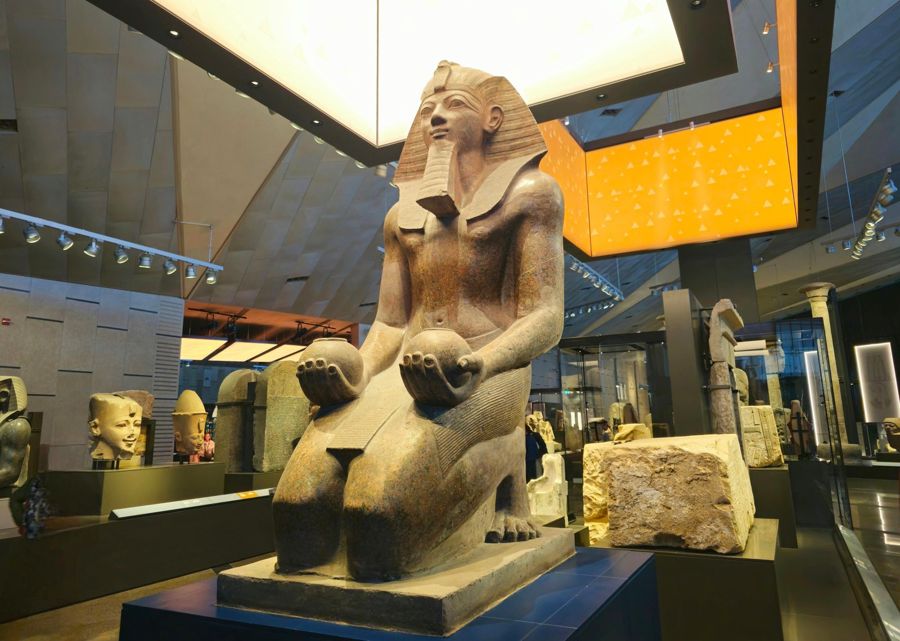
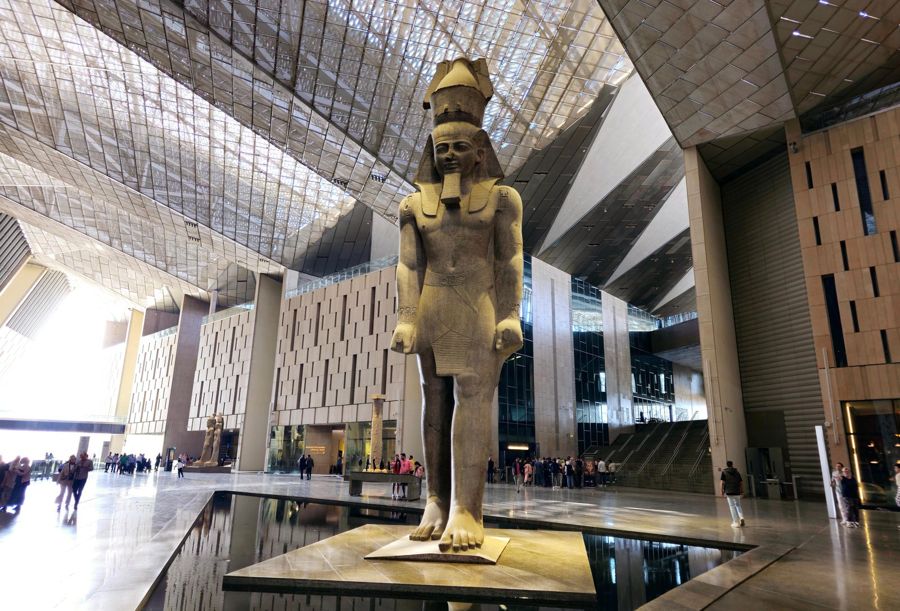
- The museum houses the finds from which the construction processes were reconstructed
- Plateau and museum in one day, without organizing two trips yourself
- Entry fees, German-speaking guide, pickup, and lunch are included
- Free cancellation up to 24 hours before