
There are two completely different trips sold under the same name, and the price difference between them is significant.
Typically, a Nile cruise from Cairo means: the trip starts in Cairo, you see the plateau and the museum, then a domestic flight takes you to Luxor, where you board the ship. The ship then sails between Luxor and Aswan. It never passes the pyramids, because it travels six hundred kilometers further south.
In exceptional cases, the same name means something else: the ship actually departs from Cairo and sails the entire route. These trips exist but are rare, last two weeks, and cost accordingly.
If you search for pyramids and Nile cruise together, you'll almost always get the first option. That's not a scam and not a bad trip. It's just different from what the name promises, and if you know the difference beforehand, you'll book the trip you actually wanted.
Same three words, two different products
The standard: flight in between
Two to three nights in Cairo with the plateau, then a domestic flight to Luxor, board the ship, sail between Luxor and Aswan. Five to ten days in total.
- Good for
- Almost everyone. This is the format you'll find in nearly every catalog, and it works well.
- Watch out
- The ship never passes the pyramids. The plateau visit is a separate day trip by bus with a guide, like for any other visitor.
The exception: the ship really sails
Departure from the Cairo area, then upstream through Middle Egypt to Aswan. Twelve to fifteen days, few ships, few departure dates per year.
- Good for
- Those who want to see Middle Egypt. Tell el-Amarna and the monasteries near Sohag are not on any other route.
- Watch out
- Significantly more expensive, requires more time, and departure dates are scarce. Landings there are subject to restrictions.
The standard, and why it looks that way
A Nile cruise with Cairo and the pyramids is usually not a contradiction, but a combination of two trips that have nothing to do with each other geographically.
The reason is geography. The navigable stretch lies between Luxor and Aswan, about two hundred kilometers in the south of the country. Between Cairo and Luxor, there are another six hundred fifty kilometers of river that hardly any cruise ship covers. A domestic flight covers this distance in about an hour; a ship would need days and would have little to show along the way.
So the typical itinerary looks like this: you land in Cairo, see the plateau and the Grand Egyptian Museum, fly south, board the ship in Luxor, sail upstream with the usual stops, and fly back from Aswan or return to Cairo.
In practice, this is even a good order. Since the Grand Egyptian Museum opened a few minutes' drive from the plateau, the Cairo part can be done in two full days without rushing: one day for the plateau site, one morning for the museum, and in the evening you're already on the plane south.
What you don't get is a view of the pyramids from the water. That doesn't exist on any route, because the river runs several kilometers east of the plateau, with the city in between.
Three variants of the standard, sorted by duration. All three start in Cairo, all include a German-speaking guide, and all have the ship between Luxor and Aswan. The difference lies in the number of days and what's already included in the price.
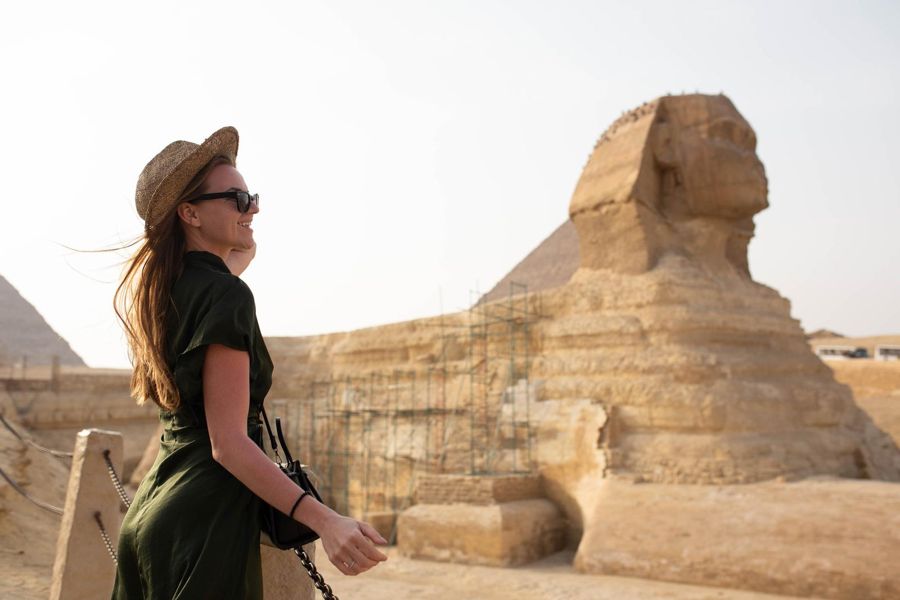 Most booked
Five days with cruise and balloon ride
- Plateau entry
- English-speaking guide
- Hotel pickup
- Free cancellation up to 24 hours before
Those with little time who still want to see both
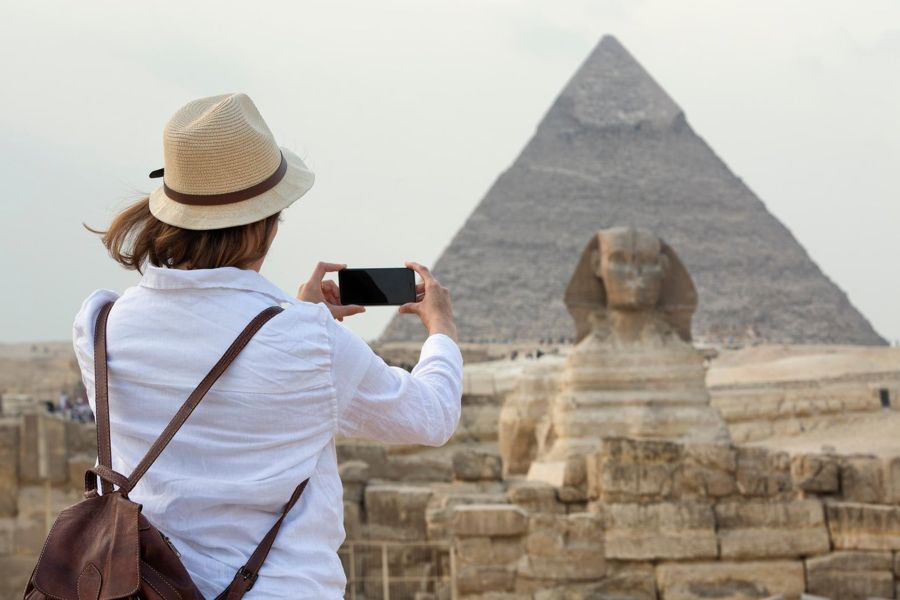 Plateau included
Eight days: Cairo, Luxor, and Aswan
- Plateau entry
- English-speaking guide
- Hotel pickup
- Lunch
- Free cancellation up to 24 hours before
The standard case: eight to ten days of vacation and the wish not to rush
 Private
Nine days, private tour
- Plateau entry
- English-speaking guide
- Hotel pickup
- Free cancellation up to 24 hours before
Those who want to set their own pace and book for two to four people
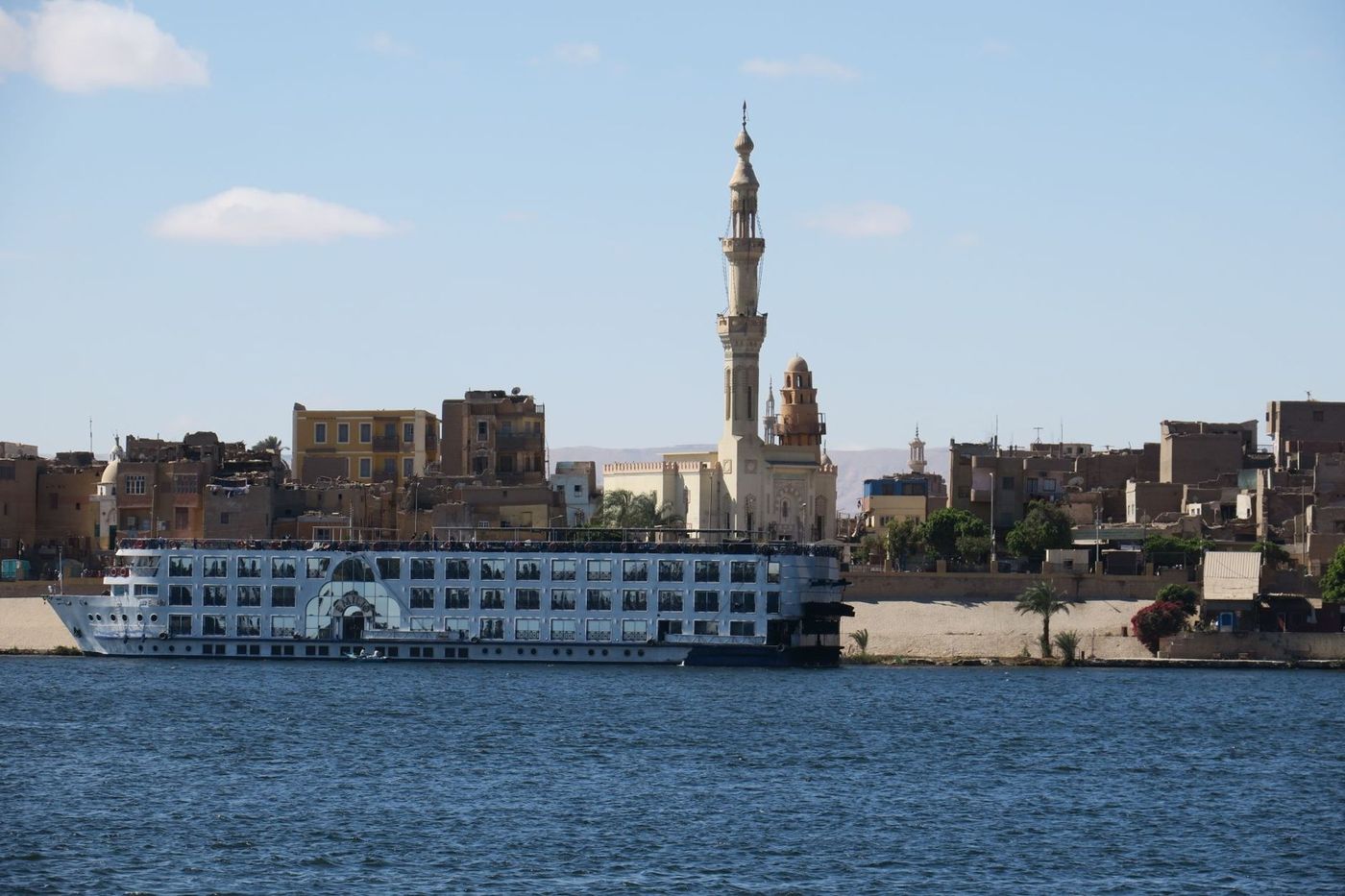
The ships that actually sail the route
A Nile cruise from Cairo to Aswan as a continuous ship journey does exist, and it's the reason the phrase is in circulation at all.
For the 2026 season, a few ships sail the long route, including units with names from the Old Kingdom, offered by German-speaking river cruise operators. The programs last twelve to fifteen days and are sold as Nile cruises between Luxor and Cairo or as grand voyages to Aswan.
What makes this route different is Middle Egypt. There lie places that simply don't appear on the short route: Tell el-Amarna, the capital that Akhenaten had built in the middle of the desert and that was abandoned after his death, plus the early Christian monasteries near Sohag. If you're interested in the period between the Old Kingdom and Luxor, you'll only find it here.
The reason for its rarity is concrete and verifiable. At several landing sites in Middle Egypt, shore excursions are only possible with permission from the local police and accompanied by guards. That's not a warning but a requirement, and it explains why the number of ships and dates remains limited.
In the south, the route ends at Aswan. From there, it's not far to the Nubian monuments that were rescued and relocated in the 1960s before the rising water. Most programs add this side trip, by flight or bus.
And there begins a third product that hardly anyone knows before stumbling upon it: the cruise on Lake Nasser. Behind the dam, there's no longer a river but a reservoir about five hundred fifty kilometers long, reaching into Sudan. A few ships operate there between the dam and Abu Simbel, with stops at the relocated temples of Kalabsha, Wadi es-Sebua, and Amada. Three to four nights are typical.
That's not a Nile cruise, even if it's sold as one. It's a different body of water, a different type of ship, and a much quieter program, because only a handful of ships sail the lake. If you don't want to check off the Nubian temples as a day trip but see them at leisure, this is the answer.
Seven, ten, or fourteen days
The three lengths that actually appear in offers, and what each covers. The right column names the point where the shorter variant becomes noticeably tight.
| Duration | What fits in | The ship sails | Where it gets tight |
|---|---|---|---|
| Seven days | Two nights in Cairo with plateau and museum, then three to four nights on board | Luxor to Aswan | Cairo. Two nights leave no buffer for traffic. |
| Ten days | Three nights in Cairo, seven nights on the ship, usually with Abu Simbel | Luxor to Aswan and back | Nothing essential. This is the length where the math works out. |
| Fourteen days | Cairo, the full river route through Middle Egypt, Aswan, often a week at the sea | Cairo to Aswan | The price and the dates. Both are the limiting factor, not the time. |
- What fits in
- Two nights in Cairo with plateau and museum, then three to four nights on board
- The ship sails
- Luxor to Aswan
- Where it gets tight
- Cairo. Two nights leave no buffer for traffic.
- What fits in
- Three nights in Cairo, seven nights on the ship, usually with Abu Simbel
- The ship sails
- Luxor to Aswan and back
- Where it gets tight
- Nothing essential. This is the length where the math works out.
- What fits in
- Cairo, the full river route through Middle Egypt, Aswan, often a week at the sea
- The ship sails
- Cairo to Aswan
- Where it gets tight
- The price and the dates. Both are the limiting factor, not the time.
A 7-day Nile cruise from Cairo is therefore almost always the flight variant, while a 14-day Nile cruise from Cairo can be the continuous ship journey. At ten days, both occur, and that's where a close look at the program pays off. If you compare 10-day Nile cruises from Cairo, you should first check whether a domestic flight is in the itinerary.
What kind of ship, and what a day on board looks like
On the short route, two very different types of ships operate, and the difference determines your trip more than the stars in the brochure.
The usual Nile ship is a motor vessel with three to five decks, usually around fifty to eighty cabins, a sun deck with a small pool, restaurant, and evening entertainment. It runs on a fixed schedule, and because many of these ships operate between Luxor and Aswan, they often lie side by side in rows of two or three at the landing stages. You then go ashore through the neighboring ship, and the view from your cabin is of its windows rather than the river. That's normal and not mentioned in any catalog.
The alternative is the dahabiya, a sailing ship with usually six to twelve cabins, the opposite of everything else sold as Nile cruise ships. It sails slower, stops at places where the big ships can't dock, and rarely lies next to anyone in the evening. It costs significantly more, has no evening entertainment, and is the right choice for travelers who prefer exactly that.
The daily routine is similar on both. Early in the morning, you go ashore to a temple, because the heat is still bearable in the morning; then the ship continues while you eat on board and the riverbank passes by. The afternoon usually belongs to the ship, the evening to a second temple or the mooring. If you expect a tightly packed schedule, you'll be surprised how much time is spent on the water, and that's exactly the appeal for most.
When to go, and the thing about swimming
The season is more clearly defined on the river than at the plateau, because a ship becomes hardly bearable in high summer.
From October to April, temperatures in Upper Egypt are in a range where temple visits in the morning are comfortable. December to February is the most pleasant time and also the most expensive and crowded. May to September is hot, in Aswan significantly hotter than in Cairo, but prices and availability are noticeably better.
If you're looking for a Nile cruise with Cairo and swimming, you're actually planning three trips in a row: the city, the river, and the sea. That works because Hurghada is reachable from Luxor in a few hours by land, and many programs offer exactly this sequence. However, it extends the trip to two weeks, and the beach part is the only one that can be shortened without loss. What travelers report about such programs and how reliable these Nile cruise experiences are is a separate question. If you go the opposite way and book a Nile cruise and beach all-inclusive as a ready-made package, you get exactly these two weeks, but without Cairo. If you don't have that much time, you'll find the short form under trips to Cairo: three to four nights in the city, without a ship and without a domestic flight.
One observation about the order that rarely gets mentioned: it's worth putting Cairo at the beginning, not at the end. The plateau is the program point with the biggest crowds and the tightest time window in the morning, and if you do it after ten days of travel, you'll be tired and usually there at the wrong time of day.
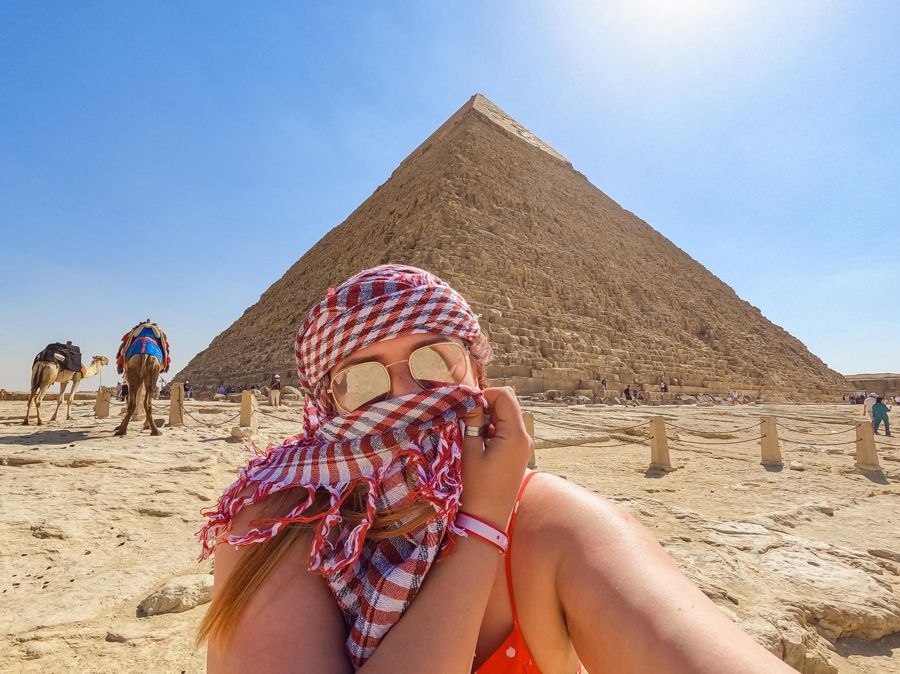
Six days all-inclusive with Nile cruise
The format for ten vacation days without a beach segment: Cairo with plateau entrance, then domestic flight and ship, German-speaking guide, pickup, and meals included. Of the offers mentioned here, this one has the best rating, though also the smallest number of reviews. Free cancellation up to 24 hours before.
How to recognize an offer before booking
When you compare Cairo and Nile cruise offers side by side, you quickly compare prices that include different things. Four points decide, and all four are in the program if you know what to look for.
First, the domestic flight. If it's in the itinerary, it's the flight variant, and the ship sails Luxor to Aswan. If it's not there and the trip still lasts two weeks, the ship sails the route itself.
Second, the entrance to the site. It's surprisingly often not included, even though the plateau visit is in the program. That's permissible and not hidden, it's just in small print.
Third, the language of the guide. German-speaking is more common for Nile programs than for day tours, but not a given, and it can't be changed afterward.
Fourth, the direction. Upstream from Luxor to Aswan and downstream back are not the same program: the stops are different, and the number of nights on board often differs by one, without the price reflecting it.
Frequently asked questions
Can you see the pyramids from the ship?
No, on no route. The river runs several kilometers east of the plateau, and the city is in between. The plateau visit is a separate day on land in every program.
Does a ship really sail from Cairo to Aswan?
Yes, but few. For 2026, individual German-speaking river cruise operators offer the long route, with programs of twelve to fifteen days. The standard remains the short route with a domestic flight.
Why do so few ships sail the whole route?
At several landing sites in Middle Egypt, shore excursions are only possible with permission from the local police and accompanied by guards. That limits the number of ships and dates.
How many days do you need at minimum?
Seven, if both Cairo and the ship should be included. With ten days, the math works without rushing, because then you have three nights for Cairo instead of two.
When is the best time for the cruise?
October to April. December and January are the most pleasant and also the most expensive. From May to September, it gets very hot in Upper Egypt, but prices and availability are better.