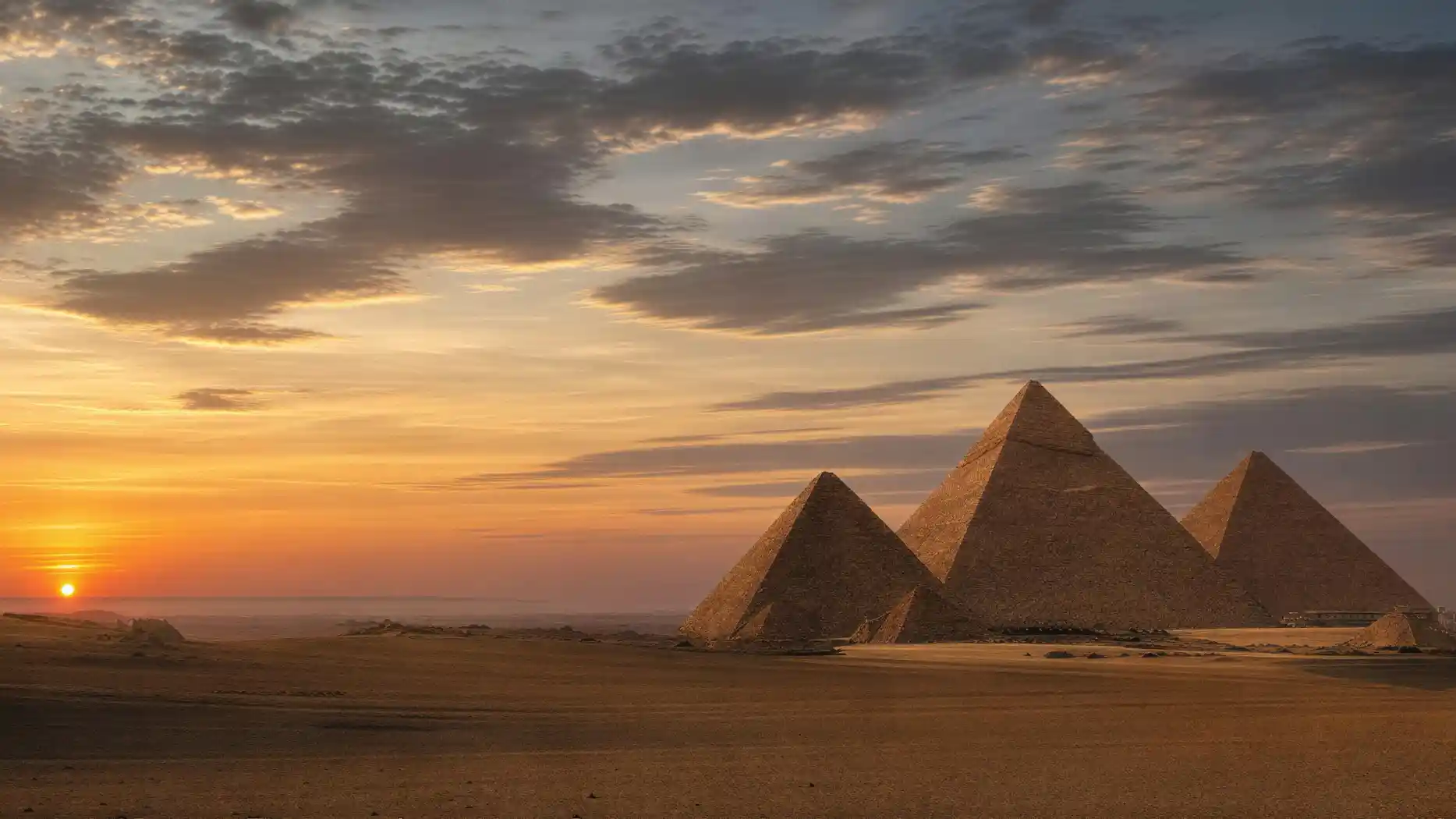
Two point three million stone blocks, about twenty years of construction. Divide one by the other and you get a number that is hard to believe: about 315 blocks every single day. At ten working hours, that would be one block arriving, fitting, and being placed every two minutes.
The calculation is rough. But it shows better than any description what this is really about. Not a mystery, but logistics on a scale that no one else mastered four and a half thousand years ago.
For context, the weights: An average block weighs about two and a half tons, as much as a large SUV. The granite beams above the King's Chamber weigh an estimated fifty to eighty tons, and they lie at a height of over forty meters. They did not come from the plateau. They came from Aswan, about 900 kilometers upstream.
Much of this is well documented today. Where the stones came from, what they were cut with, how they were moved, how the foundation was aligned: there are quarries, tool marks, settlements, tombs, and even administrative records. One question remains open, and it is precisely the one everyone asks first. How did the blocks get to the top?
Because this last gap is so conspicuous, everyone has been filling it on their own for centuries. The range goes from serious engineering models to aliens. The difference between the two lies not in the confidence of the explanation, but in whether there are traces in the ground.
This page therefore separates cleanly: first the certain, step by step, then the ramp question with what speaks for and against each model.
The Process in Six Steps
- Choose the site
Solid rock as a foundation, quarries within reach, a Nile branch close enough for heavy loads. All three conditions at once are rare.
- Align to the north
The sides are aligned to true north without a compass, presumably by observing stars. The deviation is less than one-tenth of a degree.
- Level the rock
The base is leveled, probably using water-filled trenches as a level. Over a side length of more than 230 meters, the deviation from horizontal remains within a few centimeters.
- Quarry and dress
Copper chisels with quartz sand as an abrasive, wooden wedges for splitting, dolerite pounders for hard stone. Rough at the quarry, fine at the construction site.
- Transport
Sledges over dampened sand on land, barges on water. The waterway carries the heavy loads.
- Place and face
Layer by layer upward. The smooth outer casing comes last and is smoothed from the top down.
Leveling and Aligning: The First Two Steps
The first two steps determine everything else, and they are the part that visitors on site most easily overlook.
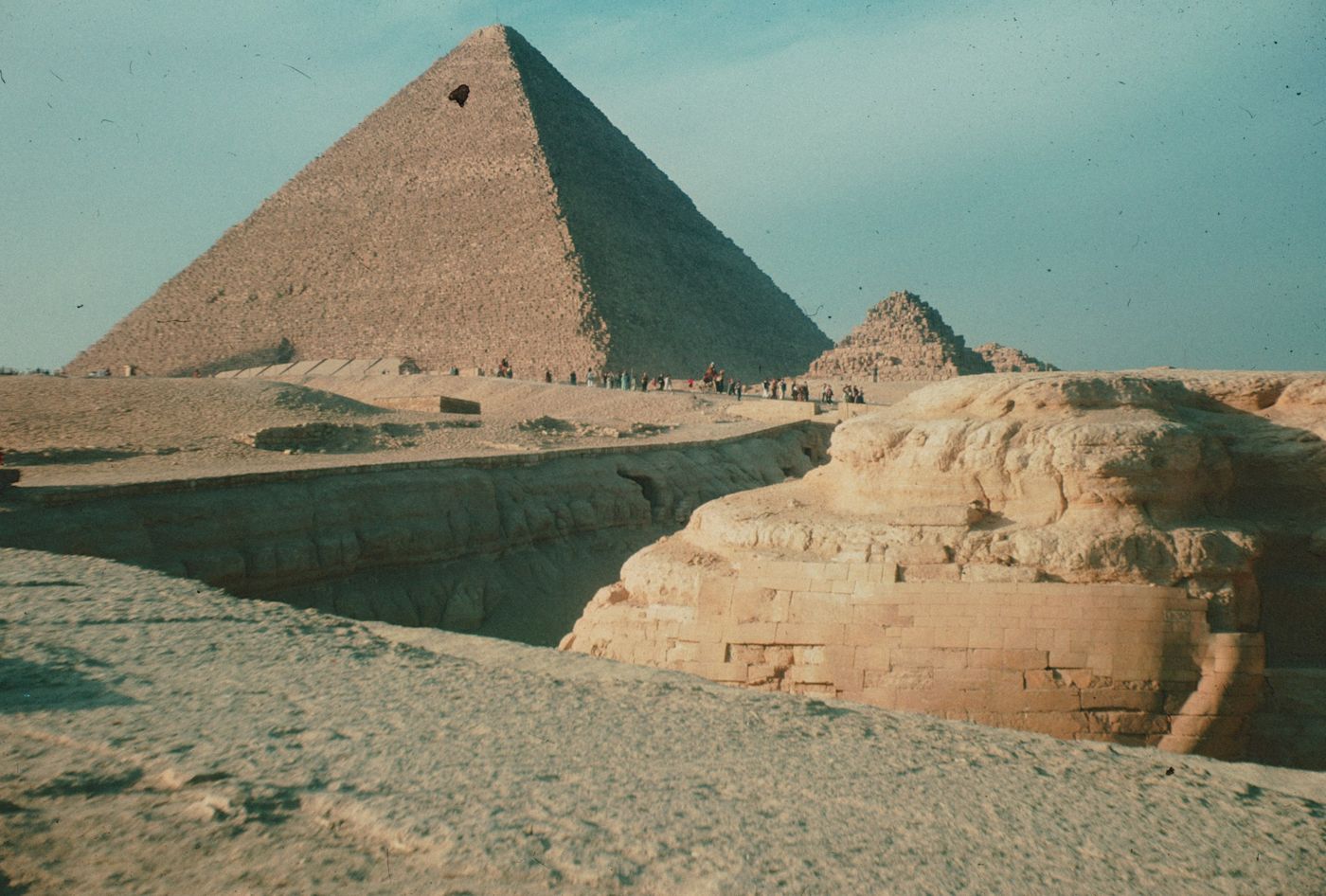
The rock beneath the Great Pyramid of Khufu is not a flat field. The builders left a natural rock core in the middle of the base and built around it, saving millions of blocks. How large this core is, no one knows exactly, because it lies beneath the masonry.
Around it, the ground was leveled with a precision that would be respectable even with modern equipment. The common explanation: A network of shallow trenches was laid out, water was let in, and the water level was marked on the trench walls. Water finds its own level. Then the rock was cut down to the mark, the trenches were filled in, and you had a level surface.
The alignment to the north is the second achievement. Without a magnetic compass, which did not exist then, the sky remains. The common models work with the rising and setting point of a star or with the shadow of a vertical staff during the day. Both work in experiments and provide accuracies in the right order of magnitude. Which method was actually used is not decided.
Why align so precisely to the north at all? The answer lies in belief, not technology. In the north are the circumpolar stars, which never set. They were considered the imperishable ones, and the dead king was to join them. A slightly skewed pyramid would have been statically completely unproblematic. Theologically, it would have been a problem.
Consistent with this, measurements were also taken inside. From the King's Chamber and the chamber below, narrow shafts lead diagonally outward, their angles pointing to star positions of the construction period. Whether they were intended as air shafts, as paths for the soul, or both, is debated. That their angles are intentional is hardly disputed by anyone.
One detail suggests that the Egyptians learned: The deviations of the great pyramids from true north slowly shift in one direction over the decades. This fits a method that depends on a star whose position shifts over time.
Not Every Stone Is the Same Stone
Not every stone on a pyramid is the same stone, and that is the key to understanding the construction site.
The bulk of the structure, about ninety percent, consists of rough limestone from quarries directly on the plateau. These blocks never had to be moved over water. You can still see the quarry edges south of the Great Pyramid, with right-angled channels in the rock from which the blocks were cut out.
The smooth outer casing, on the other hand, was made of fine white limestone from Tura, on the other side of the Nile. The granite for the King's Chamber, for the relieving chambers above it, and for the portcullis stones came from Aswan. Basalt for the floor of the mortuary temple was brought from the Fayyum. The construction site thus sourced from four directions, and only the cheapest material was right at the doorstep.
When it comes to tools, it becomes unspectacular, and that is exactly the point. Limestone is soft enough for copper. The workers cut channels into the rock with copper chisels, drove wooden wedges into them, and soaked them until the swelling wood split the block. Where finer work was needed, quartz sand helped as an abrasive, because sand is harder than limestone and harder than copper.
How long does such a thing take? Experiments with reconstructed copper tools land at a few days for an average limestone block for a small crew. That sounds like little output, but with enough parallel working teams, it yields exactly the daily rate that the construction time requires. The bottleneck was never the cutting. The bottleneck was the moving.
Granite is another league. For that, dolerite balls were used, fist-sized to head-sized pounding stones made of a rock harder than granite. This does not cut, but crushes: You pound the surface over weeks into grit. It is not a secret technique, but a very patient one.
On the granite sarcophagus in the King's Chamber, saw marks are visible, fine parallel grooves. Toothless copper saws, guided with sand as a cutting agent, leave exactly such marks. Nevertheless, they regularly appear as evidence for unknown machines. Those who know the reconstruction experiments see in them rather evidence of endurance.


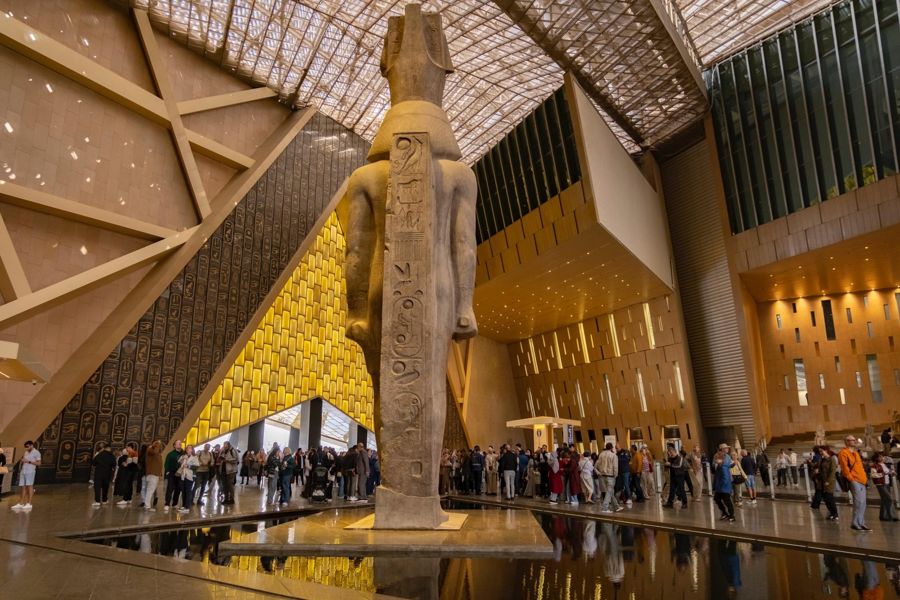
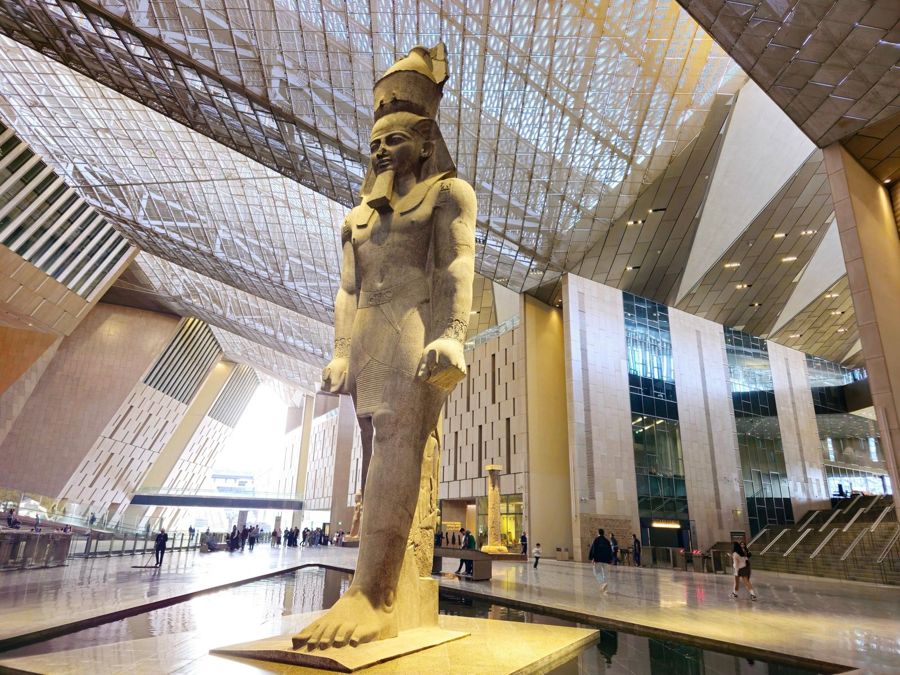

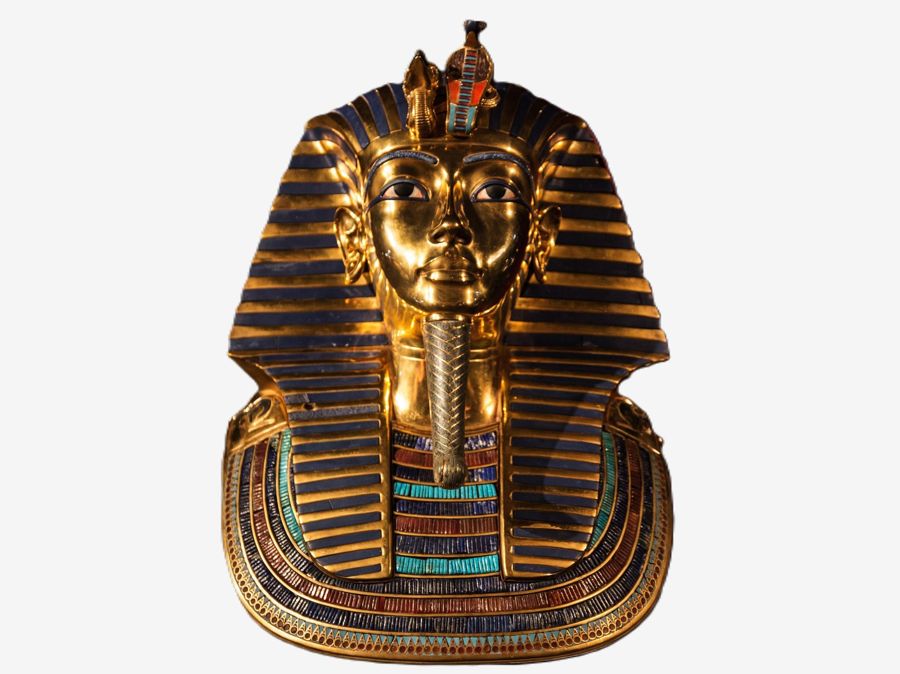
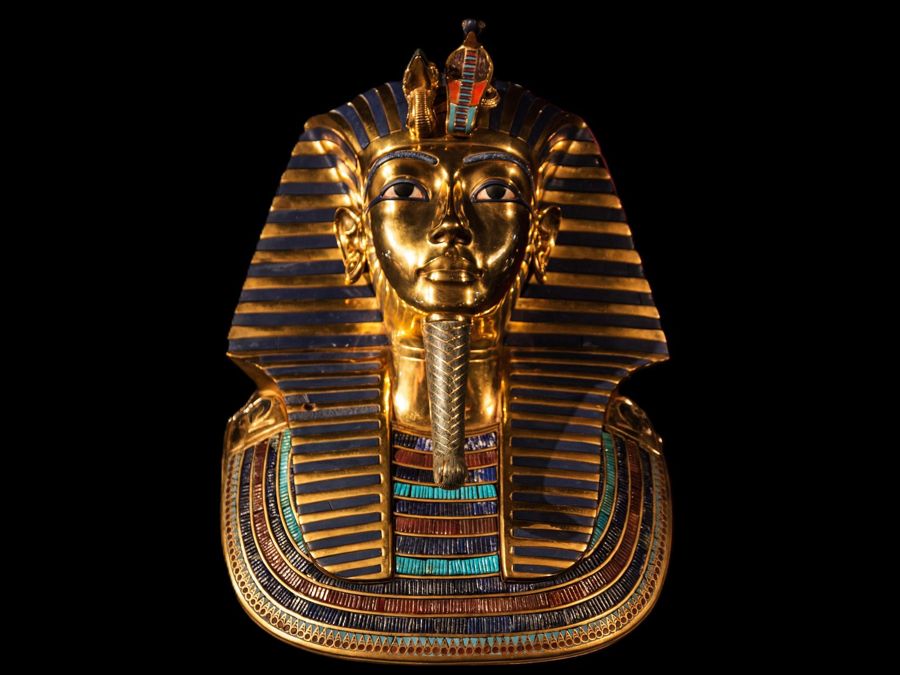
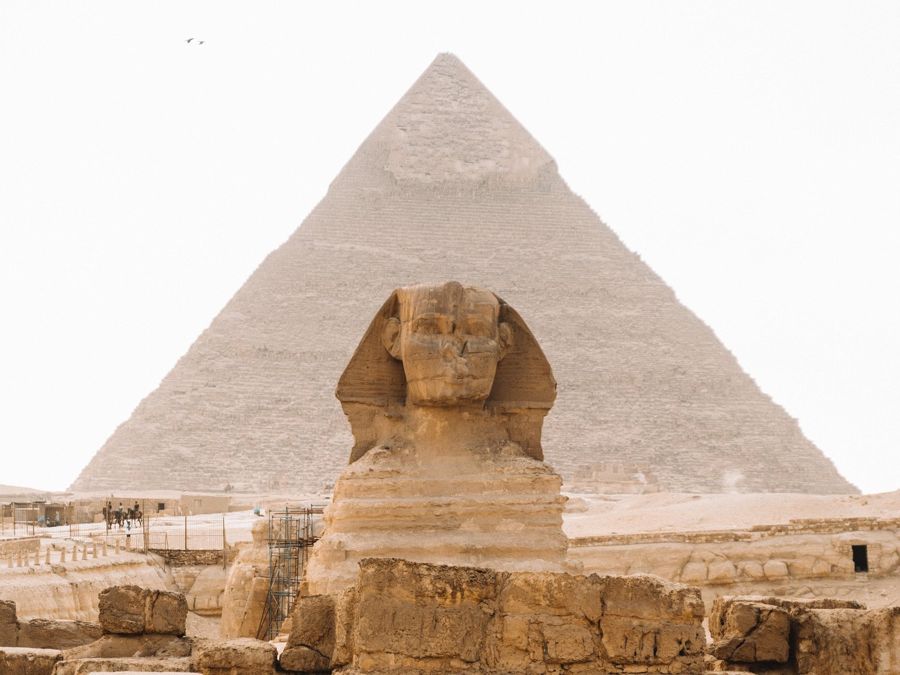
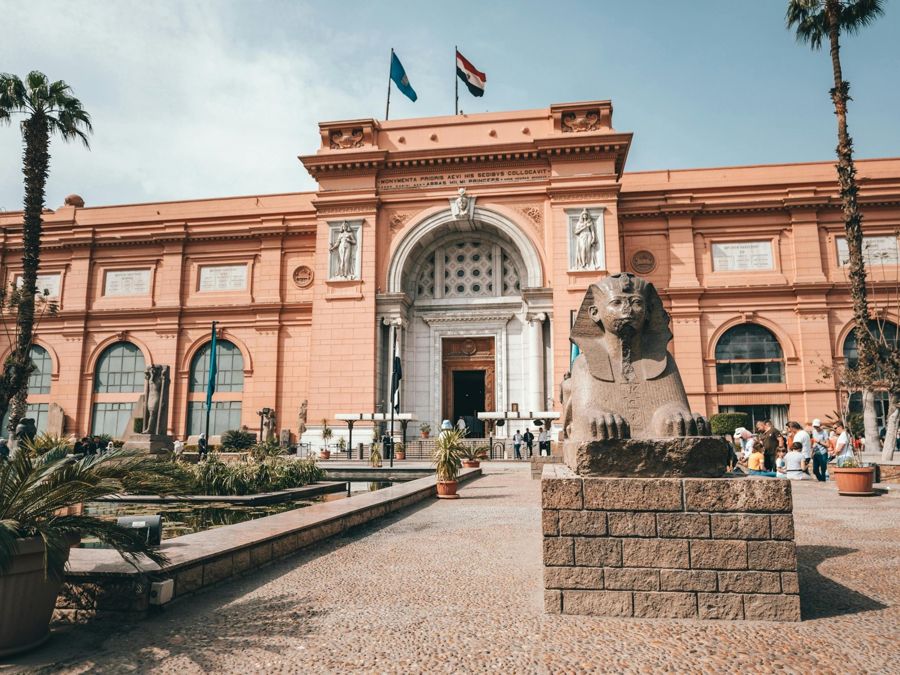
Full-day tour to the pyramids, Sphinx, and Egyptian Museum with female guide
- The Grand Gallery and the relieving chambers show the construction from the inside; the interior ticket can be booked as an add-on
- A licensed guide explains what is actually visible at the construction site
- Plateau entry, pickup, and lunch are included
- Free cancellation up to 24 hours before
Where the Stone Came From
Four materials, four distances, four transport problems.
| Material | Origin | Distance | Used for | Route |
|---|---|---|---|---|
| Limestone, rough | Quarries on the plateau | a few hundred meters | Core masonry, the largest part of the mass | Sledges over land |
| Limestone, fine | Tura, east bank of the Nile | about 15 kilometers | Outer casing | Barge over the river |
| Granite | Aswan | about 900 kilometers | King's Chamber, relieving chambers, portcullis stones | Barge downstream |
| Basalt | Fayyum | about 60 kilometers | Floor of the mortuary temple | Barge and sledge |
- Origin
- Quarries on the plateau
- Distance
- a few hundred meters
- Used for
- Core masonry, the largest part of the mass
- Route
- Sledges over land
- Origin
- Tura, east bank of the Nile
- Distance
- about 15 kilometers
- Used for
- Outer casing
- Route
- Barge over the river
- Origin
- Aswan
- Distance
- about 900 kilometers
- Used for
- King's Chamber, relieving chambers, portcullis stones
- Route
- Barge downstream
- Origin
- Fayyum
- Distance
- about 60 kilometers
- Used for
- Floor of the mortuary temple
- Route
- Barge and sledge
The distances are straight-line or river distances and serve for orientation, not navigation.
Wet Sand Halves the Crew
Over land, the blocks moved on wooden sledges. That sounds like the most laborious solution, but it is actually a pretty good one. A wall painting from the tomb of Djehutihotep shows a column pulling a large statue on a sledge, and at the front stands a man pouring liquid in front of the runners. For a long time, this was thought to be a ritual gesture. Physical experiments have shown that properly dampened sand roughly halves the pulling resistance. Water bridges form between the grains, the sand becomes firmer and no longer piles up in front of the runner. Too much water worsens the result again; the range is a few percent moisture. So the man with the jug in the wall painting is not making a gesture. He is halving the crew.
The Buried Nile Branch
The heavy loads, however, did not come over land, but over water, and here the most interesting piece has been added in recent years.
In 2024, a team led by Eman Ghoneim evaluated radar satellite data and drill cores and proved a buried Nile branch that once ran along the entire pyramid belt, from Giza to Lisht. The researchers named it Ahramat, after the Arabic word for pyramids. A crucial detail: The pyramid causeways, those covered ramps between the valley temple and the structure, run across the course of this branch and end exactly at its former bank. The evidence published in Communications Earth and Environment thus explains not only the transport, but also why the pyramids stand where they stand. The river later migrated east and silted up, partly as a result of a major dry phase.
What the operation on this water looked like has been known fairly precisely since 2013. In harbor galleries at the Red Sea, a French-Egyptian team led by Pierre Tallet found the oldest written papyri of Egypt, including the work log of an inspector named Merer. Over months, he noted how his crew of about two hundred men brought limestone blocks from Tura by boat to Giza, several trips per month, with names, dates, and quantities. It is the work record of a shift on the largest construction site of antiquity, written in the 26th regnal year of Khufu.
This fits with what was found at the foot of the plateau. In front of the valley temples lay harbor basins into which barges could sail. The river itself did not reach the construction site, but a canal brought the cargo right up to the slope. From there, it went up the causeway. This causeway is therefore not a pure processional street, but first and foremost a transport axis, and it was probably built early because it was needed throughout the entire construction period.
The Ramp Question Remains Open
So the blocks are at the foot of the construction site. Now begins the part on which experts still disagree today.
Only the framework is clear. There were no pulleys, no wheel in the sense of a transport vehicle for such loads, no winches with gears. There were ramps, levers, ropes, sledges, and very many people. Everything else is model building, and the competing models differ considerably.
An important find from 2018 has shifted the discussion. In the alabaster quarry of Hatnub in Middle Egypt, a team from Liverpool and the French institute in Cairo exposed a ramp system: a central ramp, flanked on left and right by stairs with numerous post holes. With ropes running around these posts, sledges could be pulled up slopes of twenty percent or more, because the posts act as deflection points and the pulling crew can work downhill. The excavators date the site via inscriptions to the time of Khufu.
That is important, but it is not proof for Giza. Hatnub is far away and is a quarry, not a pyramid. The find shows that steep ramps with post technique were part of the repertoire of the time. It does not show that exactly this was done at the Great Pyramid. This distinction is almost always lost in popular accounts.
Alongside the ramps, a second proposal is on the table that does without large earthworks entirely. Already Herodotus reports that the Egyptians lifted the blocks from step to step with wooden lifting devices. Experiments show that a block of two and a half tons can indeed be raised step by step with levers, inserted layers of beams, and a few men. For the uppermost layers, this is the most plausible method. For the lower ones, where almost the entire mass is, it would be unbearably slow.
Anyone who deals with the construction technique of the pyramids ultimately runs into the same problem: Ramps consist of rubble and clay, and rubble is cleared away when it is no longer needed. At the foot of the Great Pyramid, no large ramp is preserved. Whether that means it did not exist, or only that it was thoroughly disposed of, is exactly the point of contention.
Three Ramp Models and What Speaks Against Each
The straight ramp
A single ramp from one side that grows with the structure.
Pros
Simple, well documented for smaller structures, and remains of such ramps have actually been found at other pyramids.
Cons
At a slope usable for sledges, it would have to be more than a kilometer long and contain more material at the end than the pyramid itself.
The wrapping ramp
A narrow ramp that spirals around the growing structure on the outside.
Pros
Needs far less material and remains short at every height.
Cons
It covers the corners, and exactly those are needed to continuously control alignment and inclination during construction. For heavy sledges, the curves are also uncomfortably tight.
The internal ramp
A spiral passage within the masonry itself, proposed by the French architect Jean-Pierre Houdin.
Pros
Explains some structural anomalies and has not been refuted by the density measurements so far.
Cons
Such a passage has never been found. The cavities detected since 2017 are in the wrong place for a continuous spiral.
Cast Blocks and Aliens
If you search the internet for this topic, you quickly land on explanations that sound considerably more spectacular. Two of them are so widespread that they deserve an answer.
The first comes from the French materials scientist Joseph Davidovits and is the more serious one. It claims that the blocks were not cut, but cast in place, from a kind of limestone concrete. That would solve transport and dressing in one stroke. Several findings speak against this. Petrographic examinations find in the blocks the structure and chemical characteristics of natural limestone, not those of an alkali-bound artificial stone. Above all, the material contains hundreds of thousands of marine fossils, and they are distributed as they are in natural rock, not as in a mixed mass. In addition, there is a very practical problem: Casting requires molds. The blocks have greatly varying dimensions, wood was scarce in Egypt, and such a mold has never been found.
The second explanation needs aliens or a lost high culture. It has a difficulty that is hard to argue away. We have the quarries, the tool marks, the workers' settlement, their bakeries, their tombs, their crew names on the blocks, and a work log with delivery dates. Nothing is missing of what a human large construction site leaves behind. What is missing is a single preserved ramp.
An open detail question is not a hole into which any claim fits. It is an open detail question.
Who Really Built the Pyramids
The question of how depends on a second one that was long answered incorrectly: Who did it.
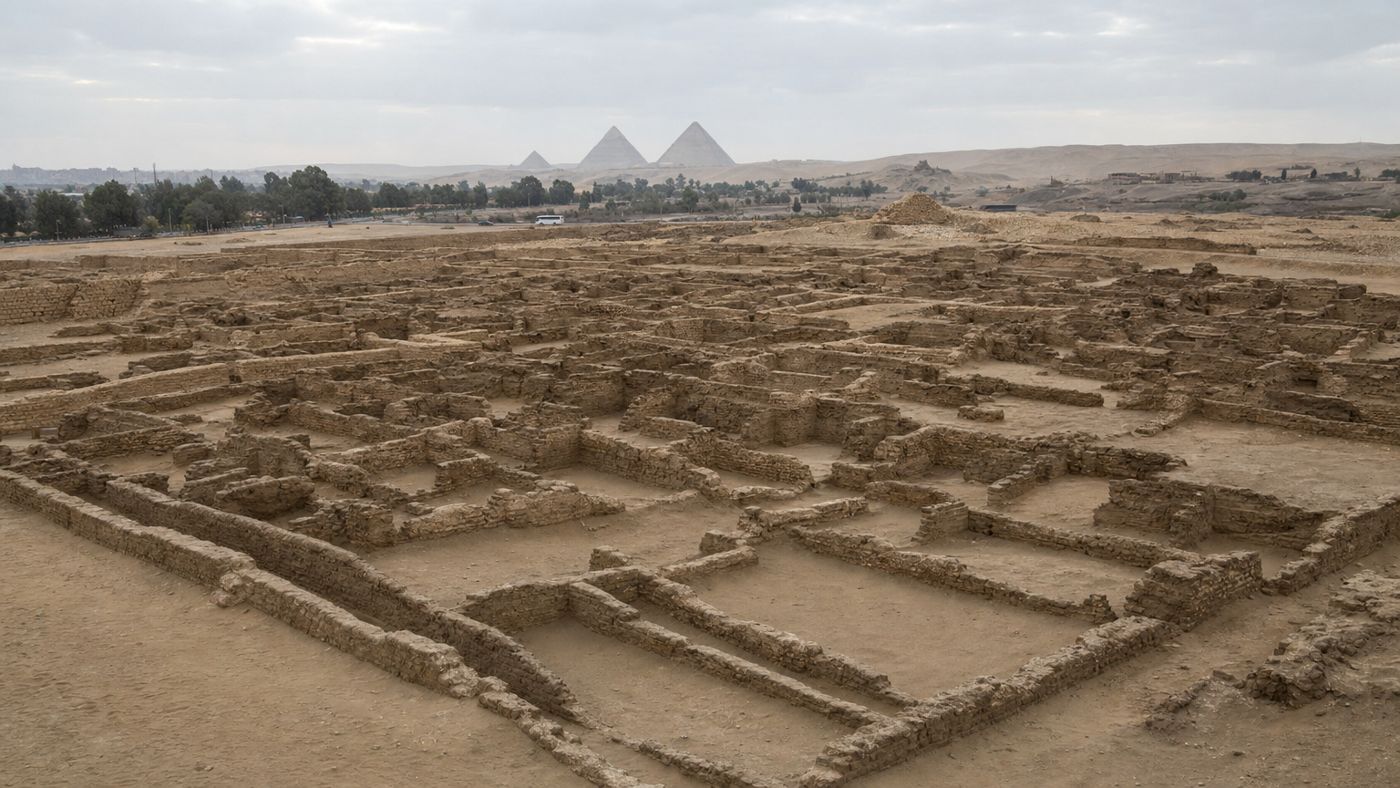
Southeast of the pyramids lies an excavated settlement, Heit el-Ghurab, systematically studied since 1988. What came to light there is not a camp, but a city for a time: sleeping galleries, bakeries on an industrial scale, breweries, granaries, an administration that kept accounts of cattle and grain deliveries, and workshops. In addition, a cemetery where workers were buried within sight of their structure. In the skeletons, healed bone fractures are found that had been professionally splinted.
One detail from the excavations makes the scale tangible. In the bakeries stood clay bread molds that are significantly larger than anything known from residential houses of the same period. Here, bread was not baked for families, but for columns. The same applies to the cattle bones: Quantity and age distribution speak for a planned supply from the hinterland, not for self-sufficiency on site. Whoever operates a construction site of this size first operates a supply chain for calories.
The numbers derived from this should be read with caution. The excavations of the Ancient Egypt Research Associates assume a permanent workforce on the order of a few thousand people on site, supplemented by far larger contingents that arrived temporarily. The classic estimate of twenty thousand participants refers to the total number over the entire construction, not the people who stood on the site at the same time.
It was organized in named crews. On blocks in the relieving chambers of the Great Pyramid are markings of work gangs, with names that celebrate the king. Such groups were divided into subunits, rotated, and were fed and paid. The construction of the pyramids of Giza was thus less a forced project than a massive, seasonally timed state employment that pulled the rest of the economy along.
Whether the workers came voluntarily is another question. A service obligation to the king was normal, and one did not negotiate about it. But forced labor under overseers with whips, as in the film, has nothing to do with the archaeological evidence.
What Really Remains Open
So what really remains open?
Not the material, not the tools, not the transport, not the organization. Open is the geometry of the last meters: the exact shape of the ramps, the sequence in which work was done, and the question of how one still sets millimeter-precise at 140 meters height when the space for pulling runs out.
That is considerably less mysterious than it sounds, and at the same time a real problem. The upper layers of the Great Pyramid make up only a small part of the volume, but they are the most uncomfortable part of the construction site. Anyone who puts forward a comprehensive theory must explain what happened at the very top, and there no ramp that still makes sense helps.
This becomes concrete in the dimensions. The uppermost meters of height contain only a tiny part of the volume, but there the working area has shrunk to a few square meters. A ramp leading up there would have to be either absurdly long or too steep for sledges. Both fit poorly with everything else known about pulling technique.
It is conceivable that several methods were combined: an external ramp for the lower, massive layers, levers and short platforms for the upper ones. So far, this cannot be proven.
This honesty is not a flaw. A structure that has been openly accessible for four and a half thousand years and still carries an open question at its center is more interesting than one that would be completely explained.
Half-day tour over the plateau with licensed guide
Quarries, causeway, and quarry edges lie openly visible and are overlooked by most visitors. A guide shows where to look.
Frequently asked questions
How was the Great Pyramid of Khufu built?
From local limestone for the core, fine limestone from Tura for the casing, and granite from Aswan for the chambers. Everything was moved with sledges, ropes, and boats, and lifted via ramps. Which exact ramp form was used is not clarified.
How many people worked on it?
Simultaneously on site probably a few thousand, over the entire construction period considerably more. The often cited twenty thousand refers to the total number, not to a daily workforce.
Are there construction plans from the time?
Architectural drawings for Giza are not preserved. What exists are administrative documents such as the work log of Merer, as well as work sketches and markings at other structures.
Why is this not simply known exactly?
Because ramps consist of rubble and rubble is cleared away. What remains is the structure, not the construction site around it.
What You Can See of It on the Plateau
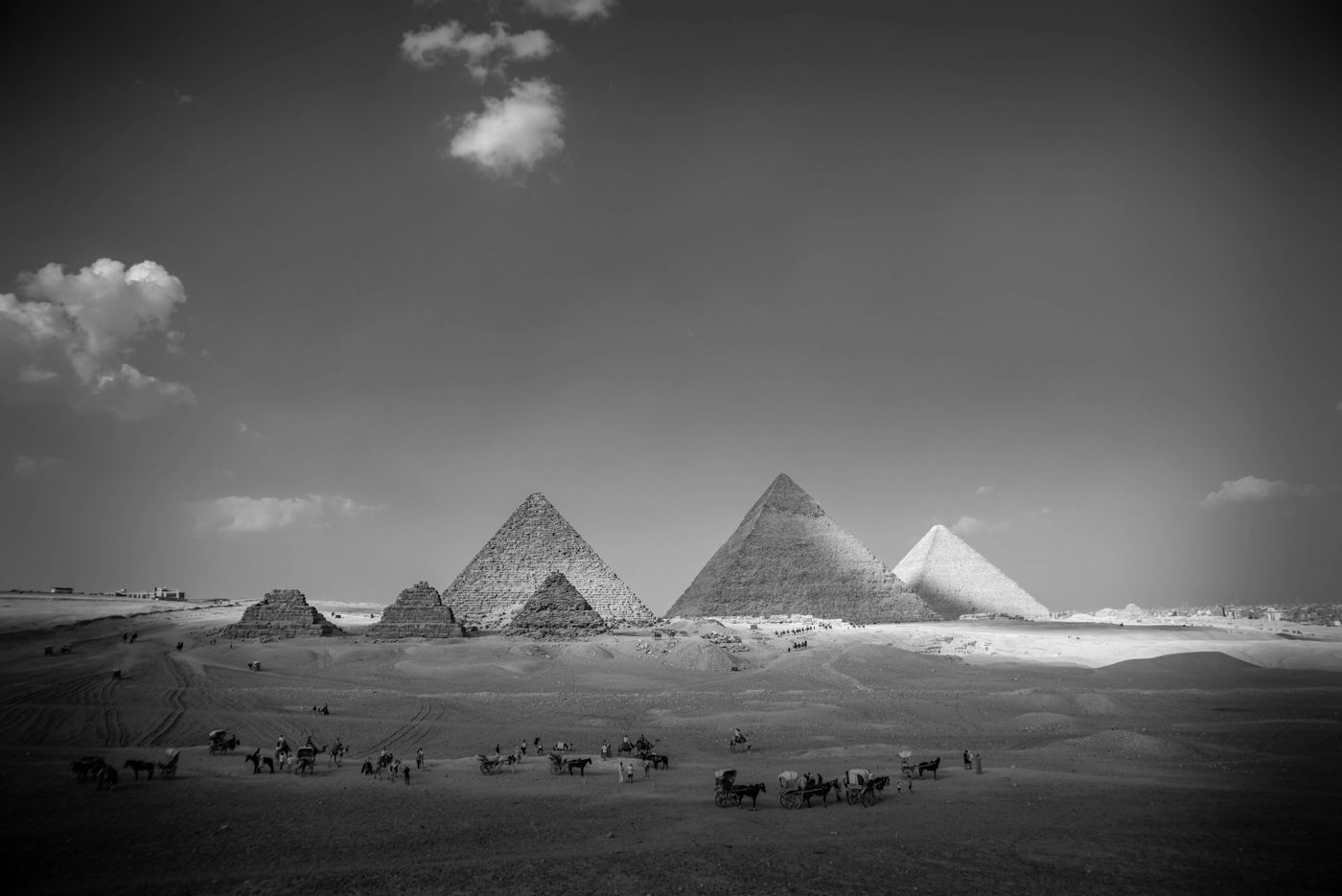
If you stand on the plateau today, you see more of all this than you expect. The quarry edges in the rock are visible. The causeway of Khafre still traces the line between the valley temple and the pyramid, and this line, according to current research, points to a riverbank that no longer exists. On the Pyramid of Khafre, a remnant of the smooth casing sticks to the top, showing how the whole thing once looked.
Four places are especially worth a look. The quarry edges south of the Great Pyramid, where the rock is cut away in clean right angles and you can still count the size of the blocks removed. The empty boat pits, which show how seriously the waterway was taken. The relieving chambers above the King's Chamber, whose construction only becomes clear from the inside. And the difference in height in the rock itself, which explains why the middle pyramid appears larger than the largest.
None of this is written on a sign.
It is worth looking for these things instead of just photographing the three big triangles. The construction site is still there. It has just been cleaned up, more thoroughly than any other construction site in history.
Tour over the Giza Plateau with selectable scope, three to eight hours
- The duration depends on how much you actually want to see
- Plateau entry and pickup are included
- Enough time for causeway, valley temple, and the quarries, not just for photo stops
- Free cancellation up to 24 hours before