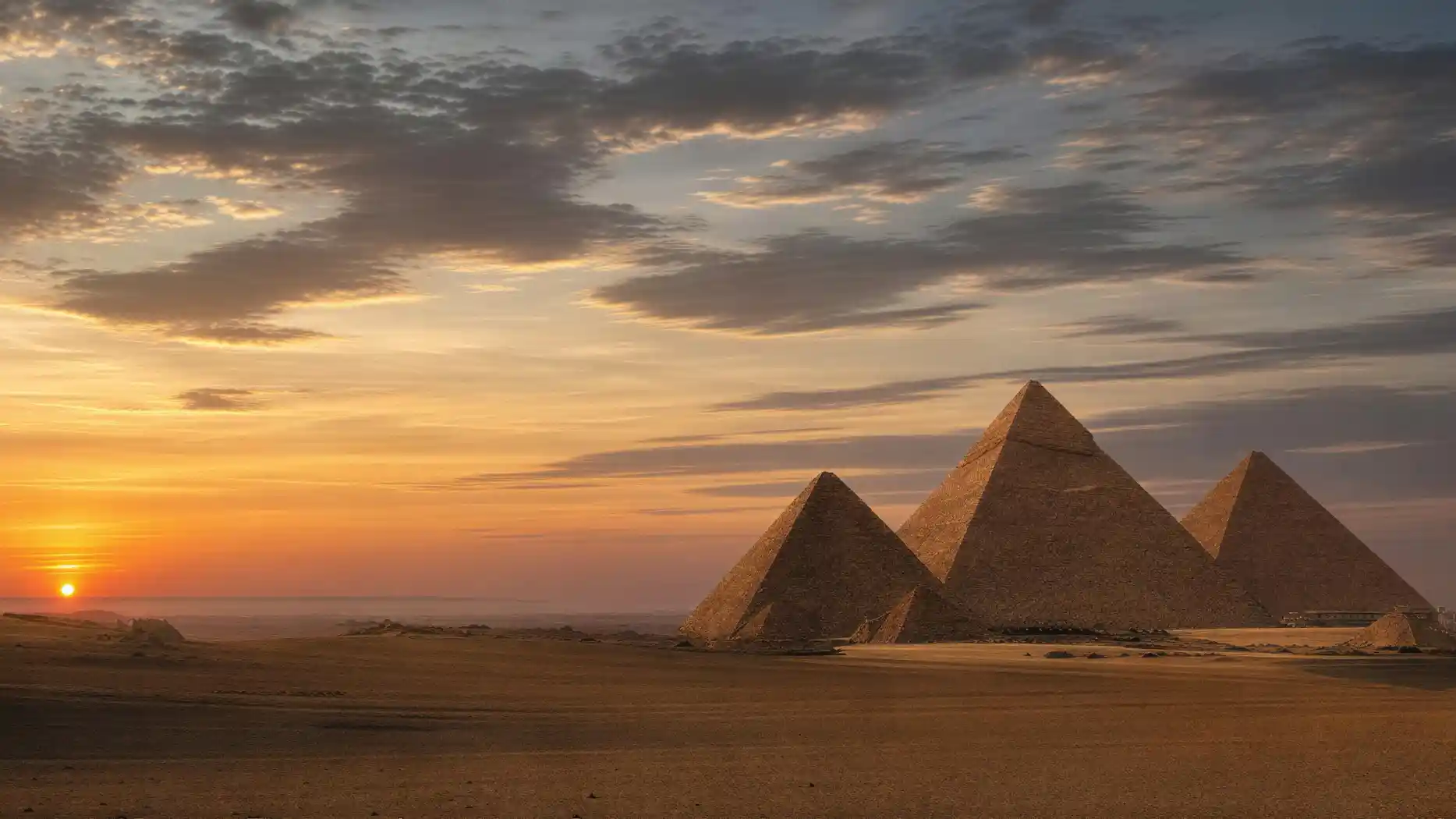
There are two questions, and they are almost always asked as one. The first concerns a specific group: Were Israelite forced laborers involved in the construction? The second is more general: Was it slave labor at all?
There is a clear answer to the first, and it is not a matter of interpretation but of chronology. The pyramids of Giza were built in the 26th century BC. The first non-biblical evidence for a group called Israel dates from the late 13th century BC. Between the two lie around thirteen hundred years.
This earliest evidence is a victory inscription of King Merenptah that lists a series of defeated enemies and includes a group called Israel. Notably, the writing uses the determinative for a people, not for a land or a city. Around 1208 BC, Israel was thus a group known to the Egyptians but not yet a state with territory.
To put that in perspective: This gap is larger than that between Charlemagne and us. Saying the Israelites built the pyramids is roughly the same as claiming the Colosseum was built by construction workers of the 21st century.
The second question is more interesting because it cannot be settled in one sentence. Slavery is not a single condition but an umbrella term for very different forms of unfree labor, and the archaeological evidence from the plateau does not fit neatly into any of them. But it also does not fit a free employment relationship of the modern kind.
This page separates the two questions and answers them individually. It also shows where the idea comes from, because it has a identifiable origin and did not simply arise on its own.
The timeline in question
- around 2560 BC
The Great Pyramid of Khufu is completed. Egypt is in the Old Kingdom.
- around 1279 to 1213 BC
Reign of Ramses II. Most reconstructions date the Exodus to this period.
- around 1208 BC
The Merenptah Stele mentions Israel. The earliest non-Egyptian evidence for this name.
- around 93 AD
Flavius Josephus writes that the Israelites were also used for pyramid construction.
- 1956
A Hollywood epic anchors the image in popular culture.
- 1990 and later
Excavations at the settlement and necropolis of the builders provide the evidence that is discussed today.
Between the top and the second entry lie around thirteen centuries.
The pyramids do not appear in the Bible
The first surprising point for many: The pyramids do not appear in the Bible. Nowhere.
The text on which the idea is based is the opening passage of the Book of Exodus. It speaks of forced labor, overseers, mud bricks, and straw, and it explicitly names two construction projects: the store cities of Pithom and Rameses. Both are cities made of mud bricks, both lie in the eastern Nile Delta, and both can be archaeologically identified.
That is something different from pyramid construction, and in every respect. Different construction method, different material, different region, different era. The pyramids of Giza are made of dressed limestone, stand on the desert edge west of the river, and were already over a thousand years old and long plundered by that time.
The similarity of names adds to the confusion. The city of Rameses in the biblical text refers to Ramses II, a king of the New Kingdom. Connecting this name with the pyramid age unknowingly skips half of Egyptian history. Between the construction of the great pyramids and the reign of this king lie more years than between the construction of Cologne Cathedral and today.
Both named places can be located with high probability in the eastern Delta, although the identification is debated in detail. They are settlement mounds in a humid, green landscape, miles away from any desert. Standing there, you see no horizon with pyramids, but fields, canals, and palm trees.
So reading the text itself reveals a completely different construction site than the story suggests.
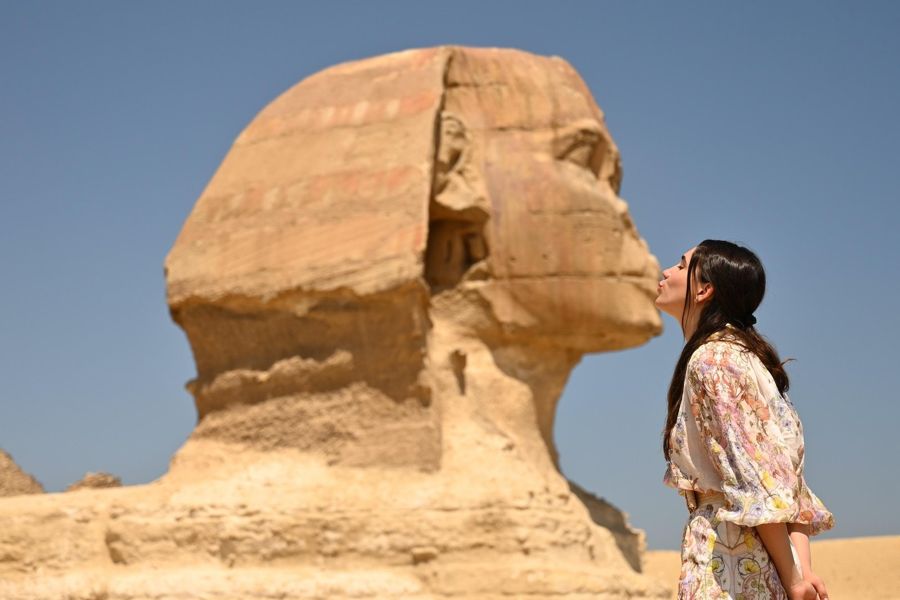

Half-day tour to the Pyramids of Giza and the Sphinx
- A licensed guide explains the construction organization on site instead of repeating movie images
- The view to the southeast shows where the settlement and necropolis of the builders lie
- Plateau entrance, German-speaking guide, and hotel pickup are included
- Free cancellation up to 24 hours before start
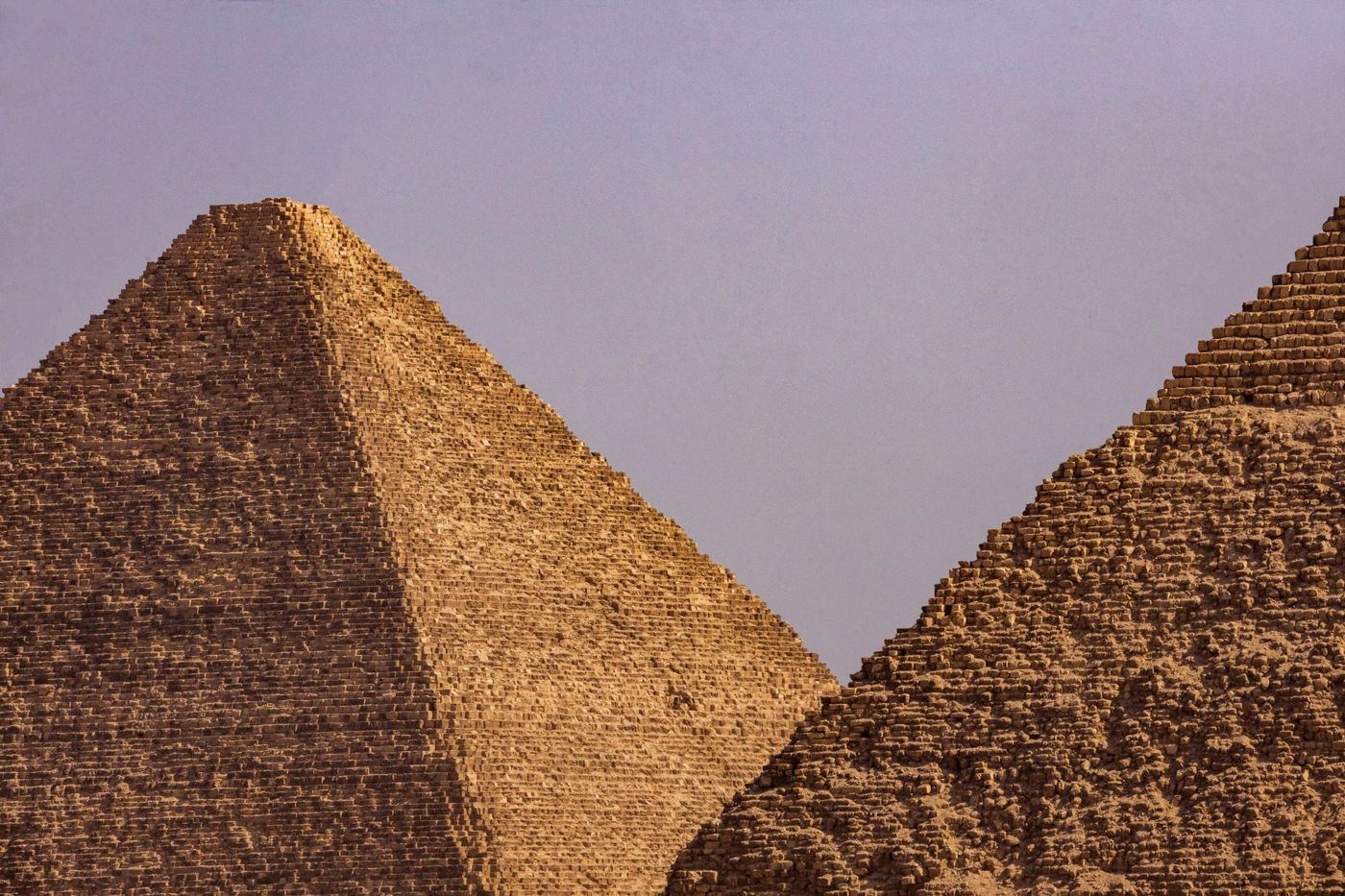
Where the idea comes from
If the idea does not come from the biblical text, where does it come from? It has a concrete origin, and it is surprisingly well documented.
The Jewish historian Flavius Josephus wrote an account of Jewish history for a Roman audience towards the end of the first century AD. In his retelling of the oppression in Egypt, he elaborates on the works that the biblical text only briefly mentions, adding the construction of pyramids as one of the imposed burdens.
Josephus wrote about two and a half thousand years after the construction of the pyramids and more than a thousand years after the events he describes. He was not an eyewitness, and the pyramids were already a mystery in his time, about which stories were told. His addition is thus itself an interpretation, not a transmitted finding.
In the European Middle Ages, a second interpretation emerged that made the same connection from the other side. The pyramids were often regarded there as the granaries that Joseph, according to the biblical narrative, had built for the seven lean years. In a Venetian mosaic cycle of the 13th century, they are depicted exactly that way: as pointed storage buildings into which grain is poured. That a massive stone structure without significant interior space is unsuitable as a warehouse only became apparent when travelers looked more closely.
From there, a long line leads through medieval travel accounts and Bible illustrations to film history. A single Hollywood epic from 1956 has probably done more to spread the image than all texts combined. What it shows is a construction site with whips and stone blocks, and this image persists to this day.
A comparison with an even older account is instructive. Herodotus visited Egypt about five hundred years before Josephus and wrote extensively about the construction. He also describes coercion and shift work, but for him the workers are Egyptians. There is no mention of a foreign group. The attribution to a specific people only appears when the construction was already two and a half thousand years in the past and no one knew how it had actually happened.
It is remarkable that the correction comes from all sides. Egyptian antiquities authorities have publicly stated it several times, and Jewish educational offerings also explicitly note that the attribution is untenable. The question is thus only controversial outside the expert community.
Four claims, examined
- False
Israelite forced laborers built the pyramids of Giza.
Chronologically impossible. The structures stood for about thirteen centuries before the name Israel first appears in a source.
- False
The Bible reports on pyramid construction.
The text mentions forced labor on the store cities of Pithom and Rameses, built from mud bricks in the Delta. Pyramids do not appear.
- False
The builders were slaves in the classical sense.
Settlement, provisions, and necropolis do not fit slave holding. The participants were fed, cared for, and buried in their own facilities.
- Partially
The participants worked completely voluntarily.
There was payment in kind and a rotation system, but also a labor obligation towards the state. It was not voluntary in the modern sense.
If not Israelites, then who?
This brings us to the second question. Were the pyramids built by slaves, if not by Israelites?
The evidence speaks against it, and it is unusually dense. Southeast of the plateau lies an excavated settlement with sleeping galleries, bakeries on an industrial scale, storage facilities, and an administrative building. From the animal bones in the waste, a daily meat consumption can be calculated that far exceeds what an unfree workforce would ever have received. Beef was a status food in the Old Kingdom.
Add to that the necropolis on the slope above. The deceased bore occupational titles, were buried in their own facilities, and lay within sight of the structure they had worked on. The skeletons show healed fractures, i.e., medical treatment. None of this would be expected for people considered property.
Egyptian antiquities authorities have publicly presented this evidence as a refutation of the slave idea, and the expert community largely shares this assessment.
But the honest answer does not end there. For what replaces slavery is not wage labor as we know it.
Three forms of labor, one finding
The question is not slave or free worker. It is which of the known forms fits the finding.
| Feature | Slavery | State corvée labor | What the finding shows |
|---|---|---|---|
| Legal status | Property of a person | Free person with service obligation | Free persons with titles and names |
| Duration | Permanent, often hereditary | Limited, in shifts | Rotation, crews changed |
| Compensation | Subsistence-level upkeep | Food, lodging, equipment | Bread, beer, beef, and provisions |
| Burial | Usually anonymous | Depending on rank | Own facilities with inscriptions |
| Voluntariness | None | Obligation, but regulated | Obligation with compensation |
- Slavery
- Property of a person
- State corvée labor
- Free person with service obligation
- What the finding shows
- Free persons with titles and names
- Slavery
- Permanent, often hereditary
- State corvée labor
- Limited, in shifts
- What the finding shows
- Rotation, crews changed
- Slavery
- Subsistence-level upkeep
- State corvée labor
- Food, lodging, equipment
- What the finding shows
- Bread, beer, beef, and provisions
- Slavery
- Usually anonymous
- State corvée labor
- Depending on rank
- What the finding shows
- Own facilities with inscriptions
- Slavery
- None
- State corvée labor
- Obligation, but regulated
- What the finding shows
- Obligation with compensation
The middle column describes the model that comes closest to the finding. There is no modern equivalent.
State service obligation fits best
The model that fits best is the state service obligation. A large part of the population owed labor to the crown, to be performed in fixed periods, organized in named crews, and compensated in kind. Those assigned could hardly evade it. Once the time was served, they went home.
This form is well documented from later periods and was widespread in pre-industrial states, from Mesopotamia to medieval Europe. It is neither slavery nor an employment contract. The attempt to force it into one of these two categories is the real reason the discussion keeps going in circles.
So to the question of who really built the pyramids, the reliable answer is: the Egyptian population itself, obligated, provisioned, and administered by a state that was set up precisely for that purpose. No foreign group, no prisoners, no single people from outside.
What is lost when one sticks to the slave narrative is the actual achievement. A forced labor camp does not explain joints of a few millimeters or an alignment to the north with a deviation in the range of arc minutes. Such results come from skill, repetition, and organization, and these require people who stay and learn.
In the end, this is also why the correction is not just a footnote. The slave narrative turns a structure into a monument of oppression and the participants into an anonymous mass. The finding tells something else: of named crews, of bakeries and breweries, of overseers with titles, and of people who had themselves buried within sight of their construction site because they apparently did not see it as a punishment.
One does not have to glorify the Old Kingdom state because of this. It disposed of the labor of its population, and those assigned had no choice. But precisely this distinction between obligation and property is what separates the two questions on this page, and it is lost as soon as one calls both slavery.
Frequently asked questions
Does the Bible mention pyramids?
No. The text mentions forced labor with mud bricks and straw on the store cities of Pithom and Rameses in the Nile Delta.
Where does the idea come from then?
From an addition by the historian Flavius Josephus in the first century AD, reinforced by painting and later by cinema.
Were they forced laborers at all?
In a certain sense, yes, but in the sense of a state service obligation with provisions and rotation, not in the sense of slavery.
Were there slaves in ancient Egypt at all?
Yes, unfree people existed, especially prisoners of war in later periods. They cannot be proven at the pyramid construction of the Old Kingdom.
Why does the idea persist so stubbornly?
Because it is a good story, because an epic film illustrated it, and because the alternative, a state service obligation, is harder to tell.
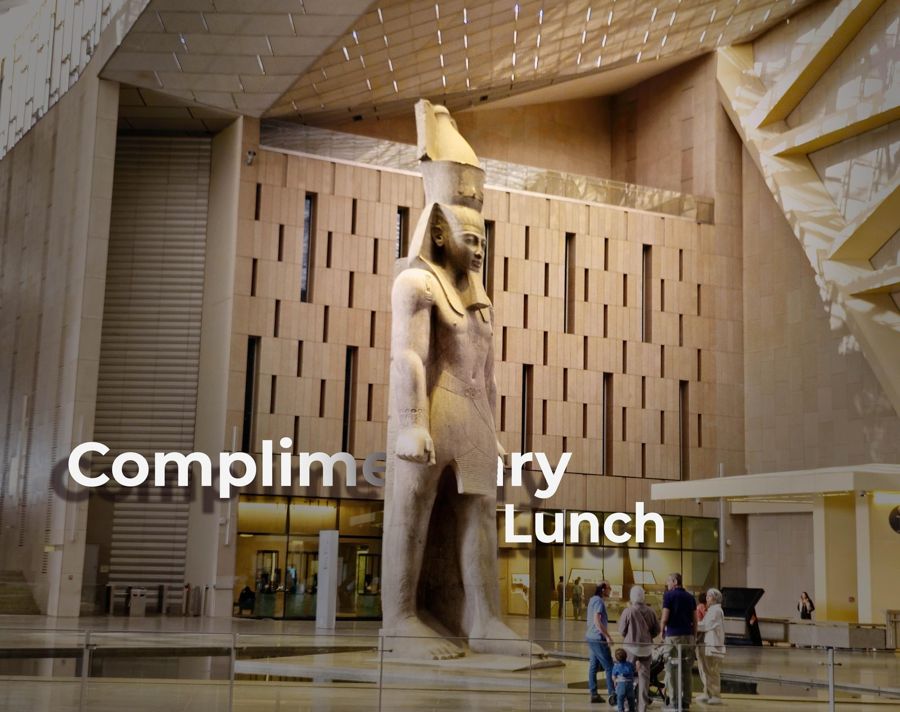
Day tour to the Grand Egyptian Museum and the plateau
The finds from the settlement and necropolis of the builders are in the museum. They are the reason the slave idea is considered refuted.