
Nile cruise which ship is the question that comes next after deciding on the trip. It's justified, and the usual answers don't help.
The reason is a quirk of this market. The star categories for Nile ships date from the 1980s, and since the late 1990s practically nothing has been built or sold below four stars. Older ships were refitted and upgraded. The result: almost the entire fleet now carries four or five stars, and a rating that almost everyone carries distinguishes nothing.
Add to that, these stars are an Egyptian rating for river ships and don't measure the same thing as the stars of a European hotel. Comparing the two is misleading, in both directions.
There are still clear differences between the ships; they just aren't in the category. They lie in the design, the number of cabins, the deck height, and a quirk of the Nile that no one who has never been there expects.



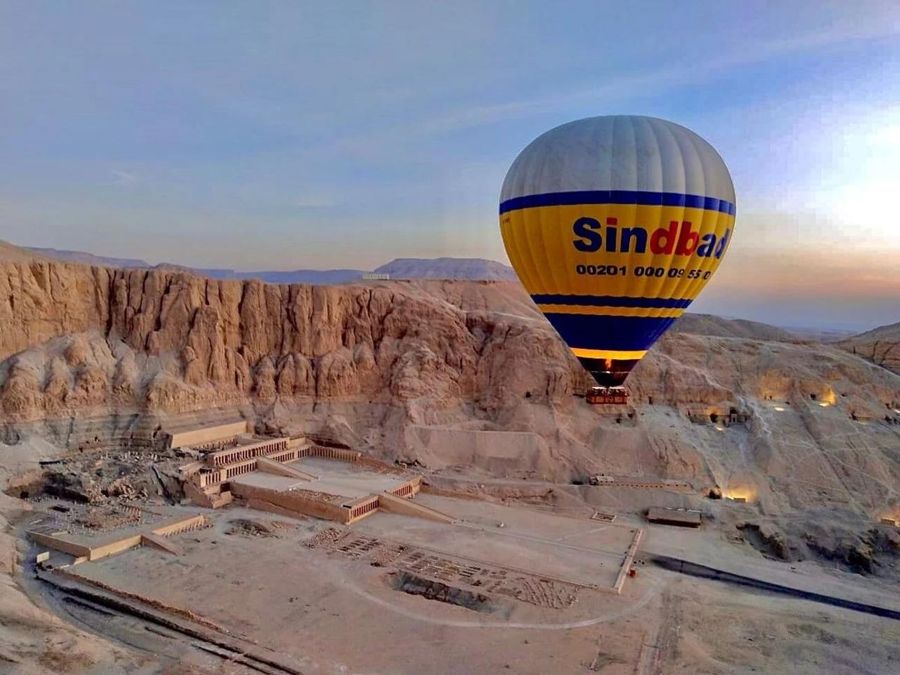
Six days in Egypt with Nile cruise, all inclusive
- A complete package with cruise, German-speaking guide, and included plateau entry
- Six days, i.e., the short form: Cairo and the cruise route without beach extension
- Free cancellation up to 24 hours before
- The rating is good, but the number of reviews at just over forty is manageable. The ship's name is not mentioned in the offer; ask for it before booking
A classic Nile ship in numbers
- Decks
- three to five
- Cabins
- around 50 to 80
- Route covered
- Luxor to Aswan, just over 200 km
- Category
- almost consistently four or five stars
What a classic river ship is
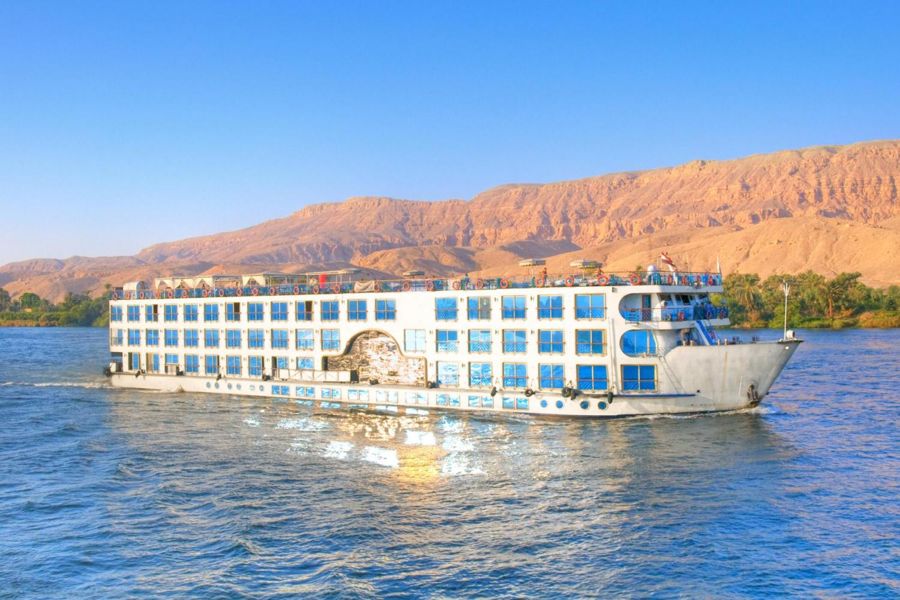
The design on this river is surprisingly uniform, and there's a reason: the locks and the channel between Luxor and Aswan set tight limits on length, width, and draft. If you want to sail there, you build roughly the same ship.
In practice, that means: three to five decks, around fifty to eighty cabins, a restaurant, a lounge, a sun deck with a small pool. Cabins are almost always on the outside, with floor-to-ceiling windows or a French balcony; real walk-out balconies are rare on the Nile because they cost width.
A luxury Nile cruise ship differs from that less in cabin amenities than in the number of guests sharing the same dining room and sun deck. That's exactly the difference you feel after three days and that appears on no data sheet.
A word on dining, because it's often confused with the category. A ship of this size has one kitchen and one bar, not eight restaurants, and meals come from the buffet. That applies to the entire fleet and is not a question of class. What differs is the drinks policy: it ranges from water with meals to everything except imported spirits, and it's rarely where you'd look for it. Ask about it separately.
What the category actually influences is more the age of the last refit than the quality of the operation. A twenty-year-old ship that was fully renovated two years ago is a different experience than one where the renovation was thirteen years ago, and both may carry the same number of stars.
The cabin: deck and side matter more than the category
For the Nile cruise cabin, there are two questions, and neither is prominent in the brochure.
The first is the deck. Lower cabins are closer to the engine and closer to the water; higher up is quieter and the view is better. The price difference between the lowest and highest deck is on most ships smaller than the difference in experience, and that's the upgrade that's most worth it here.
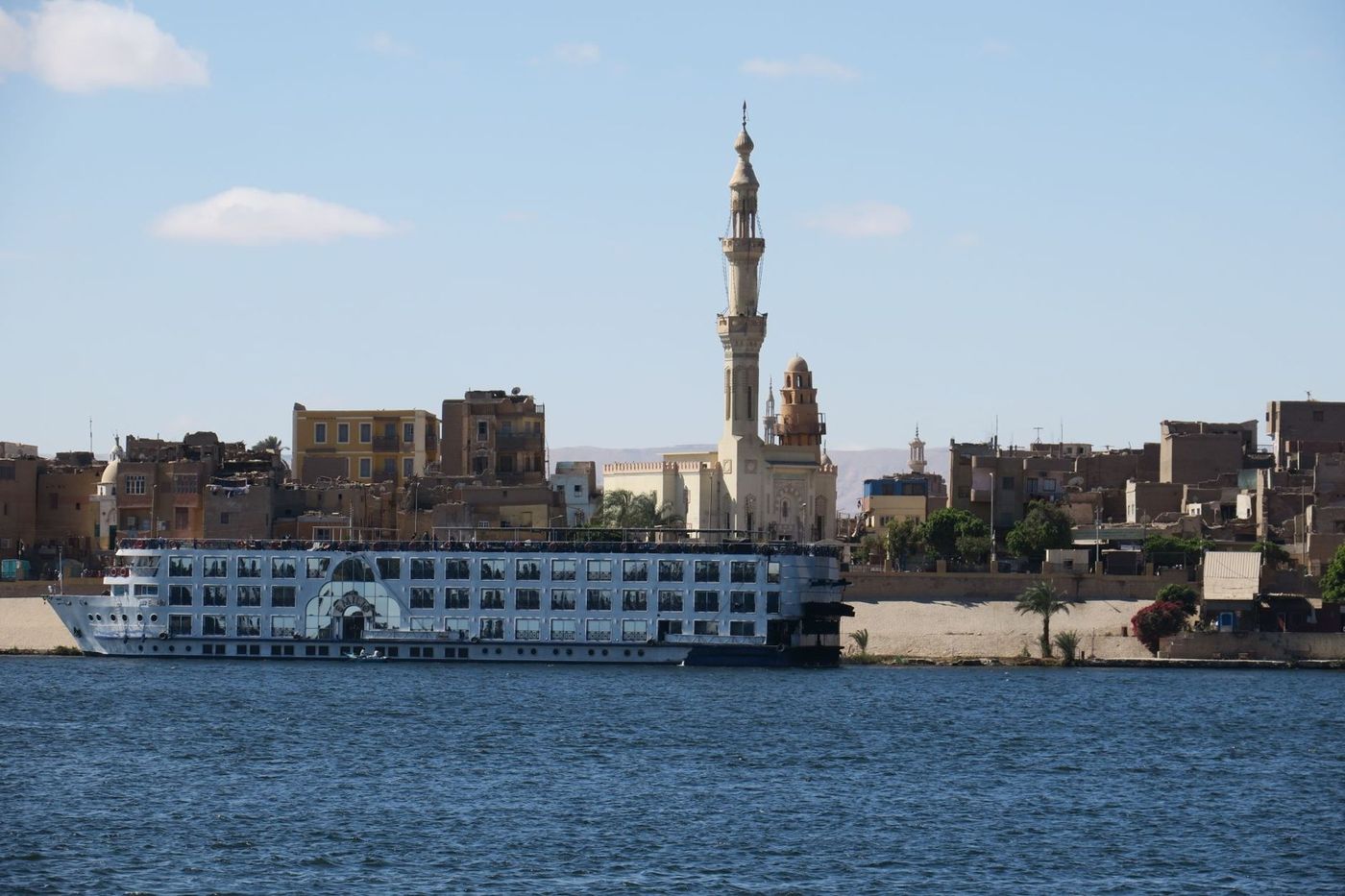
The second is the side you lie on, and it's the real surprise. In Luxor and Aswan, the moorings aren't enough in high season, and ships tie up two or three abreast. If you're on the outside, you go ashore through the lobby of the neighboring ship. If you're on the inside, you look out the window at a white hull, sometimes two.
That's normal, it changes from port to port, and no one can guarantee it in advance. But it's a second argument for the upper deck, because the neighbor's hull often ends there.
Third, less dramatic but nice to know: the ships mostly sail at night or in the midday heat and lie moored during the day. If you book a cabin for the passing shore, you should know that the shore is stationary most of the time.
The ship is the accommodation, not the program
From this follows something that puts the ship choice in perspective: the ship is a hotel that occasionally moves. The program is on land.
And that program is the real reason for the trip. On the east bank at Luxor stand Karnak and Luxor Temple; opposite lies the Theban necropolis with the Valley of the Kings; all three are part of a single World Heritage Site since 1979. Upstream follow Edfu and Kom Ombo, and at the end, near Aswan, the Temple of Isis at Philae, which is among the Nubian monuments between Abu Simbel and Philae and was moved stone by stone to a higher island in the 1960s and 1970s before the reservoir reached it.
These sites look the same from a large and a small ship. What differs is the number of people you arrive with and the time. Large ships send their groups off at similar times; small ones are more flexible.
So if you're torn between two offers and comparing amenities, you're comparing the wrong thing. Compare the group size and the departure time of the shore program. Both are rarely in the brochure and both can be asked.
Small, large, or under sail
Besides the classic river ship, there are two alternatives, and they are fundamentally different.
A Nile cruise on a small ship usually means a river ship of the same design but with significantly fewer cabins. The itinerary is the same, the groups on land are smaller, and mooring is easier because smaller ships are more likely to get their own spot. If you want to see the sights in peace without giving up engine and pool, you'll find the best compromise here.
A Nile cruise on a sailing ship is something else. That means the dahabiya, a traditional two-masted boat that carried wealthy Nile travelers in the nineteenth century and today sails in modern replicas. Six to twelve cabins, no or only a small auxiliary engine, usually no pool, but a large shaded deck. It sails slower, it anchors in places no large ship can reach, and in the evening it's rarely moored next to anyone.
A dahabiya Nile cruise costs correspondingly more and has no evening entertainment. If that's exactly what you're looking for, you're looking in the right place; if you expect onboard entertainment, you're on the wrong boat.
Important here is a point you shouldn't overlook: a luxury Nile cruise in this sense, i.e., on a sailing boat or a very small ship, runs through specialized operators. On the large booking platforms from which the offers on this site come, there are no reliably reviewed products for that. So we don't recommend anything for that and prefer to point out the gap rather than put something unsuitable next to it.

Nine days private, with domestic flights and Nile cruise
The counterpart to the large group in the catalog: privately guided, nine days, with domestic flights and the cruise route, German-speaking guide. The plateau entry is according to the catalog not included and is added on site. Around eighty reviews, the most expensive offer on this page.
The four questions to ask before booking
There is no best Nile cruise ship, because the fleet differs little in amenities and a lot in operation, and the operation is in no catalog. What exists are four questions whose answers make the difference.
First: What is the ship's name? Surprisingly many offers don't name it, but write "5-star ship or equivalent." Without a name, you can't look anything up, and you also have no claim to a specific ship.
Second: When was it last renovated? That's the number the star category doesn't reveal, and it explains most disappointed reviews.
Third: Which deck, and can you book a higher one? That's the only upgrade on this ship that almost always pays off.
Fourth: Are the excursions included? With some providers yes, with others they're sold as a package on board, and the difference is significant. It also determines whether you can stay on board one morning.
You get the answers to these four before booking. The star category you get immediately, and it tells you almost nothing. How thin the data situation is for this travel style overall is shown by our own count under Nile cruise experiences.
Frequently asked questions
Why do almost all Nile ships have five stars?
The categories date from the 1980s, and since the late 1990s practically only the top class has been built or upgraded to it. A rating that almost everyone carries distinguishes nothing.
Which deck should I book?
The highest one you're willing to pay for. Up top it's quieter, the view is better, and when the ship moors next to another, the foreign hull often ends below your window.
Why do the ships lie side by side?
In Luxor and Aswan, the moorings aren't enough in high season. Two or three ships then tie up side by side, and whoever is on the outside goes ashore through the neighboring ship. That changes from port to port.
What is a dahabiya?
A traditional two-masted sailing boat with six to twelve cabins, today in modern replicas. Slower, quieter, without evening entertainment, usually without a pool, and it anchors in places inaccessible to large ships.
Does the ship sail all the time?
No. Between Luxor and Aswan lie just over two hundred kilometers, and no ship needs seven nights for that. Sailing is mostly at night or at midday; the mornings belong to the shore program.
Can I book a specific ship?
Only if the offer names it. Many descriptions say "5-star ship or equivalent," and then you have no claim to a specific ship.