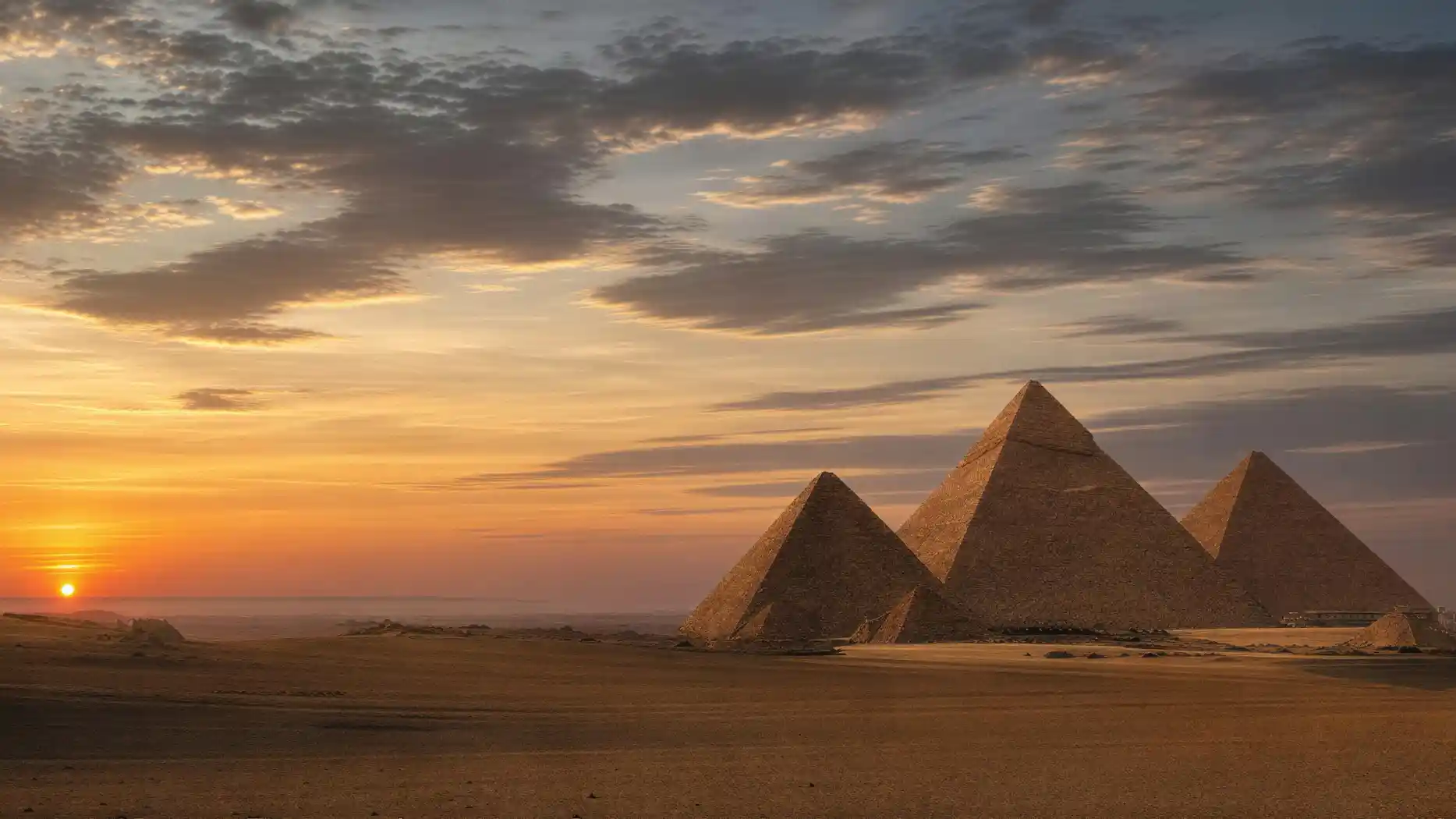
Whether the Pyramids of Giza are mentioned in the Bible is a question with a very short answer: no. They do not appear in any book of the Old or New Testament, neither as a structure, nor as a place, nor as an image.
This is remarkable because Egypt itself appears very frequently. It is the land where Joseph is sold, where his family finds refuge, from which the Exodus leads, and it later reappears as a great power. Much is written in these texts about cities, rivers, harvests, administration, and rulers. Nothing is written about the greatest structures of the land.
It is precisely this gap that creates the question. Those who know the stories and then stand before the site assume that the two must belong together. This is reinforced by an image that has been circulating for centuries: slaves dragging stones under the lash. This image comes from cinema and painting, not from the texts.
A preliminary clarification on approach: this page does not decide matters of faith. It records what is in the texts, who has interpreted them how, and how this relates to the archaeological findings. Nothing is said about the truth of religious statements, and nothing is intended to be said.
This page therefore goes through both books. First, what is actually in the Bible and why the pyramids are missing. Then, how the Middle Ages filled the gap and turned it into one of the most enduring misunderstandings in European visual history. And finally, the two Quranic passages that actually deal with a construction order.
The passage in the Book of Exodus
Let us begin with the passage that is almost always meant when someone brings the Bible and the pyramids together. It stands at the beginning of the Book of Exodus and is surprisingly concrete.
It says that the Israelites were forced into forced labor and had to build store cities for the Pharaoh. Two names are mentioned: Pithom and Rameses. There is no mention of pyramids, and the construction task is different, namely cities with storage and administration. Whoever reads the text as it stands will find mudbrick construction, not stone monuments. This fits the archaeological evidence: Egyptian large-scale construction sites of this later period worked predominantly with sun-dried and fired bricks, made by work crews under supervision, and depictions of such brick-making are preserved in tombs.
In addition, there is the chronology, and it is clear. The second of the named cities bears the name of a ruler who reigned in the thirteenth century BC. The Pyramids of Giza were built about thirteen hundred years earlier. When the text is set, they were already as old as the Roman era is for us today. They were antiquities, not construction sites.
This also explains the silence. For the authors, these structures were not a current experience but the distant past of a neighboring country, and they had no role to play in a narrative about liberation and covenant. The often-heard statement that the Israelites built the pyramids is not in the Bible. It is a later merging of two things that remain separate in the text.
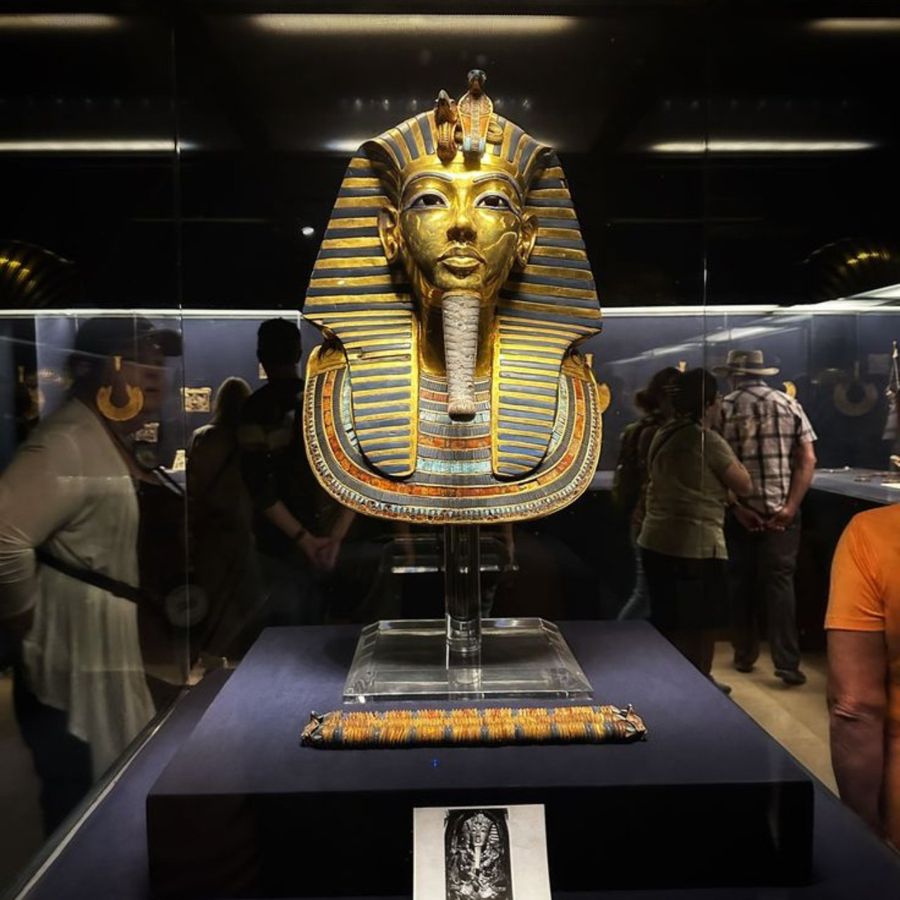
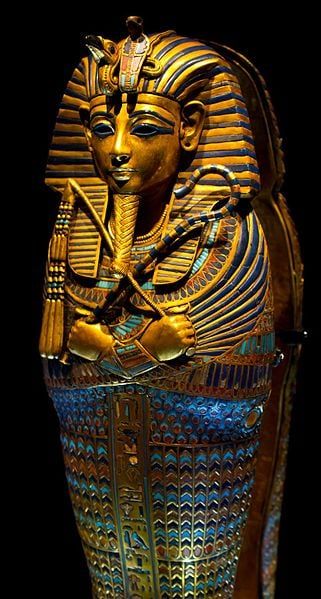
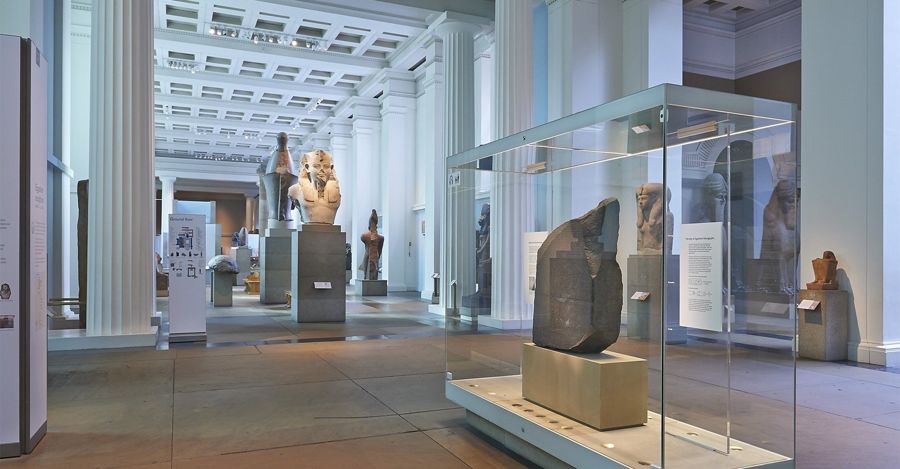
Guided day at the site and in the Grand Museum
- The construction period can be understood on site because the museum and the site together make the time gap visible
- Eight hours with German-speaking guide, pickup, plateau entrance, and lunch according to the provider's information included
- Access to the interior of the pyramids is explicitly not included in this offer
- Free cancellation up to 24 hours before according to the provider's information
Joseph and the seven fat years
When the texts are silent, interpretation fills the gap, and in the European Middle Ages it did so with a specific narrative: Joseph and the seven fat years.
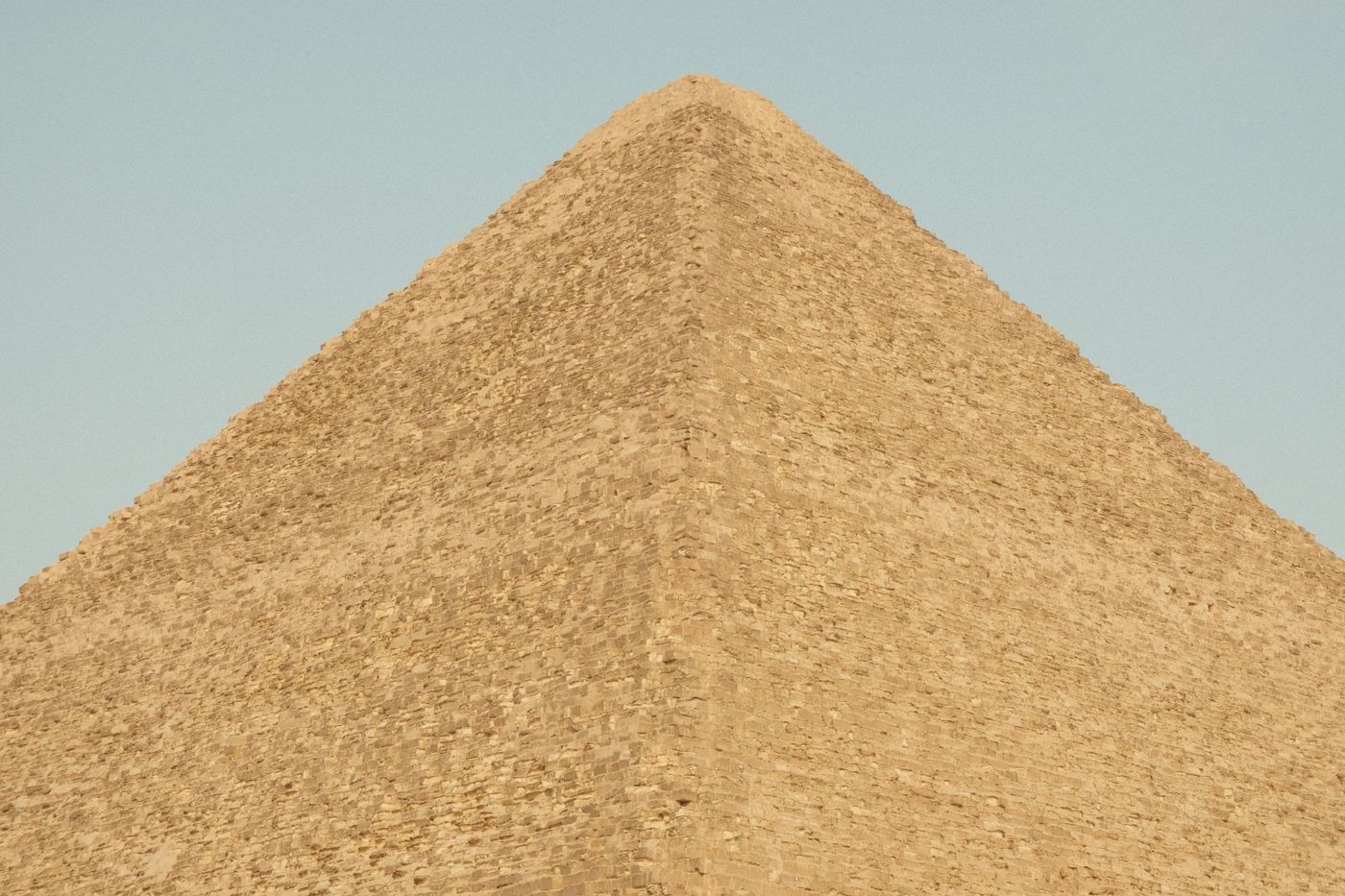
The story was obvious. Joseph stores grain in Egypt to survive a famine. Anyone who heard that there were enormous structures in Egypt whose purpose no one knew had the explanation at hand. Already in the sixth century, Gregory of Tours described the pyramids in his History of the Franks as Joseph's granaries: made of hewn stone, wide at the bottom and very narrow at the top, with a small opening through which the grain was thrown in.
This interpretation lasted more than seven hundred years, and it can still be seen today. In the vestibule of St. Mark's Basilica in Venice, a mosaic from around 1275 shows Joseph's granaries, and the artist depicted them as pyramids. It is one of the finest opportunities to view an error in the original, and it is much closer for Central European travelers than Egypt.
It is remarkable how precisely the error describes the structure and how completely it misses its purpose. The shape is right, the size is right, the material is right. Only the small opening at the top, through which the grain was to be poured, does not exist, and inside there is no hollow space available that could be filled. Anyone who had never been inside could not know that, and for centuries practically no one was inside.
The error had its own logic. A tomb of this size was hard to accommodate in a Christian interpretation, but a storage building fit into the history of salvation. Only when European travelers from the seventeenth century onward entered the interiors and found that there was nothing to store there did the idea gradually disappear.
The pyramids in the Quran
The case is different with the second book. Looking for the Pyramids of Giza in the Quran leads to two passages that actually deal with a construction project in Egypt, and they have therefore been discussed for a long time.
In both cases, the Pharaoh asks his official Haman to build him a high structure in order to look up to the god of Moses. In one passage, it is explicitly said that clay should be burned for this. The Arabic word for the structure denotes a tower or an elevated building, not a specific form of construction.
Striking is the person who is to carry out the order. The name Haman is known from another biblical context, namely from the Book of Esther and the Persian court, which is why the passage was long read as a confusion. Other interpretations point out that an Egyptian official title could be meant, denoting a dignitary responsible for construction projects. This question is not decided, and it only indirectly concerns the pyramids.
How this is to be interpreted is answered cautiously by Islamic scholars themselves. A statement by an Islamic legal institute summarizes that the pyramids are not described so clearly in the Quran that a certain identification could be made. The commentary literature deals mainly with the order and its arrogance, less with the construction technique.
A textual hint also speaks against the obvious equation. Burned clay, i.e., bricks, is mentioned. The structures on the plateau are made of limestone and granite, and bricks play no role there. So whoever reads the passage as a description of a specific structure will rather arrive at the mudbrick buildings of the land than at a stone monument from an epoch a thousand years earlier.
And Pharaoh said: O Haman, burn me clay and build me a high tower, so that I may ascend to the god of Moses. And I truly consider him a liar.Quran, Sura 28 (Al-Qasas), verse 38, in a paraphrased German rendering. In Islam, only the Arabic wording is binding; every translation is interpretation.
What both books have in common
What remains when you place both books side by side is a commonality that yields more for understanding this place than any assignment of individual verses.
Both texts are not interested in architecture. They tell of power, presumption, and liberation, and structures appear only when they carry these themes. A tower that is to reach to heaven is an image of arrogance, not a building plan. Store cities are an image of forced labor, not a location. Whoever looks for building history in such texts is looking in the wrong genre.
For a visit, this means two things. First: the expectation of encountering a biblical place here comes to nothing, regardless of whether one is religious or not. The structures are about a thousand years older than the narratives one associates with Egypt.
It is also worth turning the question around. That a structure does not appear in a text says nothing about its significance, but something about the text. The Greek and Roman authors, on the other hand, wrote extensively about the site because they came as travelers and described what they saw. For building history, therefore, quite different sources are relevant: administrative papyri, tomb inscriptions, worker marks, and the excavation findings themselves.
Second, and this is the more pleasant part: the place loses nothing as a result. What stands here belongs to a culture that has left its own texts, its own ideas about death, and its own administration. It is well enough attested to do without borrowings from other traditions.
Frequently asked questions
Do the pyramids appear in the Bible?
No, not anywhere. Egypt itself appears very often, but the structures do not.
Did the Israelites build the pyramids?
That is not in the Bible. The store cities Pithom and Rameses are mentioned, and these are about thirteen hundred years after the construction period of the pyramids.
Why were the pyramids considered granaries in the Middle Ages?
Because the Joseph narrative offered a suitable explanation. Already in the sixth century, the interpretation was recorded in writing, and it lasted over seven hundred years.
Where can one still see this idea today?
In Venice. A mosaic from around 1275 in the vestibule of St. Mark's Basilica shows Joseph's granaries in pyramid form.
What is in the Quran?
Two passages report that the Pharaoh has a high structure built, one of them from burned clay. The pyramids are not named, and Islamic scholars consider a certain identification impossible.
Are the pyramids tombs or granaries?
Tombs. The interiors contain sarcophagi and no storage areas, which was already noticed by the first modern visitors.