
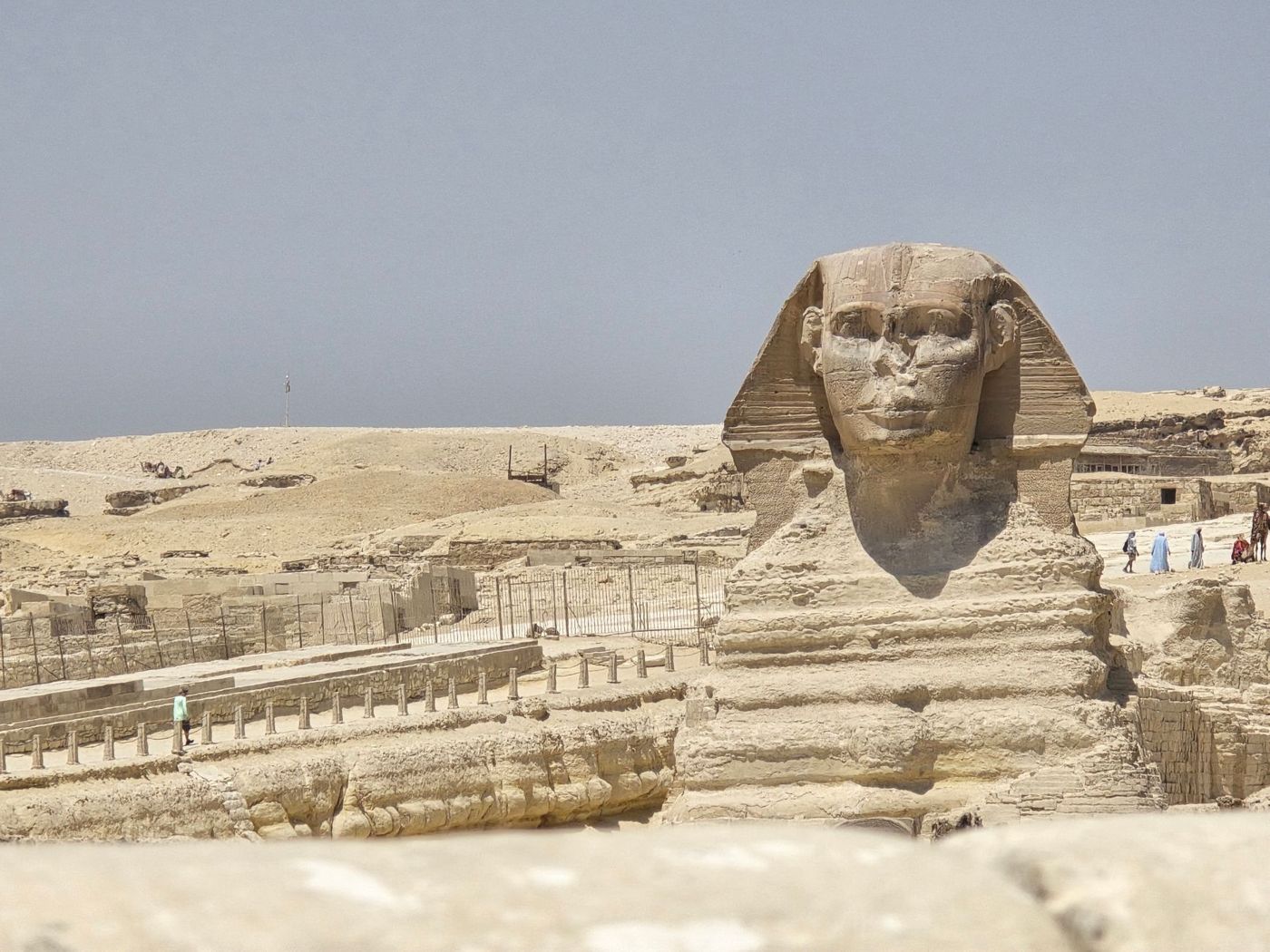
It's the most famous story about this monument, and it's wrong. Napoleon's soldiers did not shoot off the nose of the Great Sphinx of Giza.
The tale is catchy: in 1798, a French army marched into Egypt, the artillery practiced on the figure, a hit struck the face. It's still told by tour guides today and appears in older travel guides. Only it doesn't match the sources.
Because the nose was already missing before Napoleon was born. The Danish traveler Frederic Louis Norden sketched the figure on site in 1737, carefully and with measurements. In his drawings, the face is already without a nose, with the same break surface visible today. Between that drawing and the Egyptian campaign lie sixty-one years.
That basically settles the matter, and yet the question is still worth pursuing. Because if not Napoleon, then who, and above all when? This is where it gets interesting, because the written tradition and the evidence on the stone lead to different answers.
A word about the persistence of the tale. It's not limited to Napoleon: in various versions, British troops, German soldiers, Ottoman gunners, or Mamluks are named, depending on who tells the story and whom they dislike. That the same deed is attributed to different armies is a reliable sign of a migratory legend.
Both versions agree on only one point: it was no accident and no weathering. Someone deliberately removed the nose.
What the Pictorial Sources Narrow Down
The pictorial sources are unusually good in this case, and they narrow down the time frame from one side.
Norden was a naval officer and trained as a draftsman. He traveled to Egypt on behalf of the Danish king and produced views intended as documentation, not art. His plates were only published in print after his death, but the on-site recordings date to 1737. They show a face without a nose. That is the decisive source against the Napoleon story.
Older depictions help less than one might hope. Before Norden, there are European views, but they were often made from memory or from descriptions and show the figure sometimes with a nose, sometimes without, sometimes with entirely invented features. They don't serve as evidence.
From the other side, a written source narrows it down. An Egyptian historian of the 15th century reports that a Sufi named Muhammad Sa'im ad-Dahr defaced the figure in 1378 because local farmers placed harvest offerings there and he considered this idolatry. According to the same account, he was killed for it.
What speaks for the chronicle is its casualness. The author doesn't present the episode as a sensation but within a description of the area, and he names a specific person, a year, and a plausible motive. Invented stories are rarely so unspectacular. What speaks against it is the time gap and the fact that the described aftermath, the killing of the perpetrator, cannot be independently confirmed.
This account was written down about seventy years after the event, by an author who wasn't there. It is thus not an eyewitness report, but also not a legend without basis.

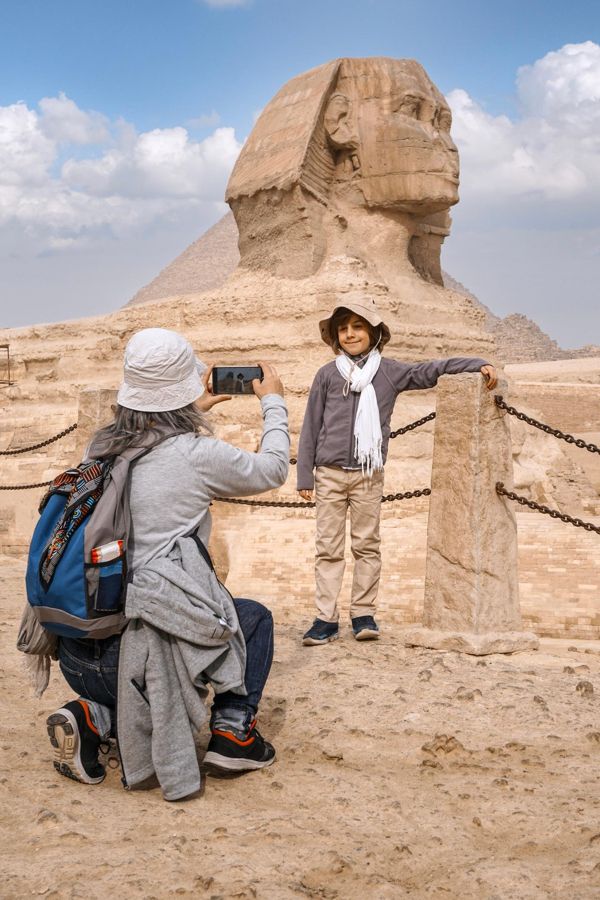
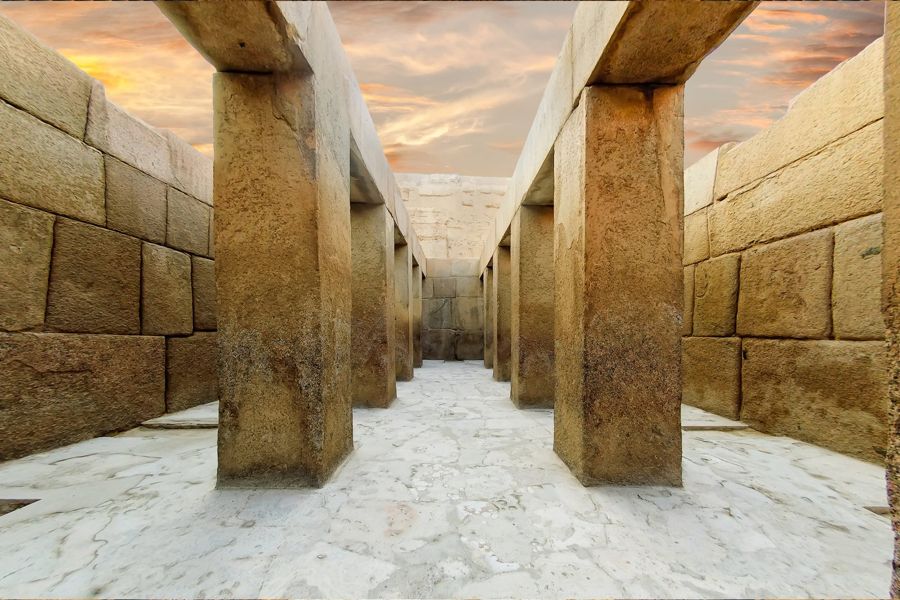
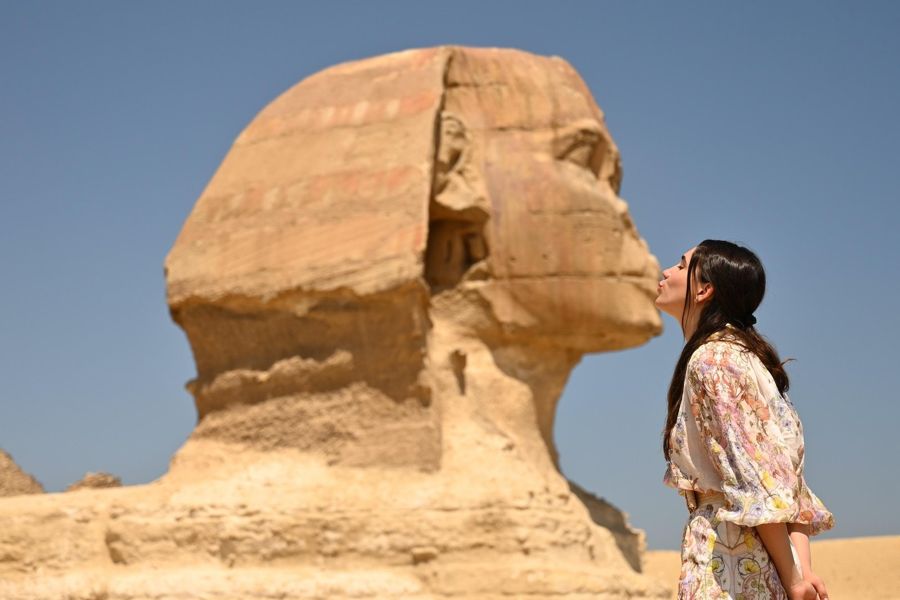

Half-day tour to the Pyramids of Giza and the Sphinx
- The break surface is visible from the terrace, but only with some zoom
- A licensed guide separates the traditional stories from the evidence on site
- Plateau entry, German-speaking guide, and hotel pickup are included
- Free cancellation up to 24 hours before start
Who and When: The Explanations Compared
Napoleon's artillery, 1798
French soldiers shot off the nose during the Egyptian campaign.
Pros
Widely spread, still told on site today, fits the image of a disrespectful occupying army.
Cons
Chronologically ruled out. A drawing from 1737 shows the face already without a nose, sixty-one years before the campaign.
The Sufi ad-Dahr, 1378
A man of God destroyed the nose for religious reasons because the figure was venerated.
Pros
Explicitly recorded in an Arabic chronicle, with name, year, and reason. Fits the iconoclasm against cultically used figures.
Cons
Written down about seventy years after the event, without eyewitnesses. The tool marks on the stone suggest an earlier period according to experts.
Earlier destruction, 3rd to 10th century
The nose was removed much earlier, during ancient or late antique iconoclasm.
Pros
Based on the examination of the tool marks and their state of weathering.
Cons
No written evidence. The dating rests on an assessment, not a measurement.
Weathering and erosion
The nose fell off by itself because it was particularly exposed as a protruding element.
Pros
Protruding parts do weather faster, and the rock is soft in places.
Cons
The break surface is flat and bears traces of levers or chisels. Erosion leaves no straight edges and no leverage points.
The Stone Speaks Clearly
The stone itself is the most reliable source, and it speaks quite clearly.
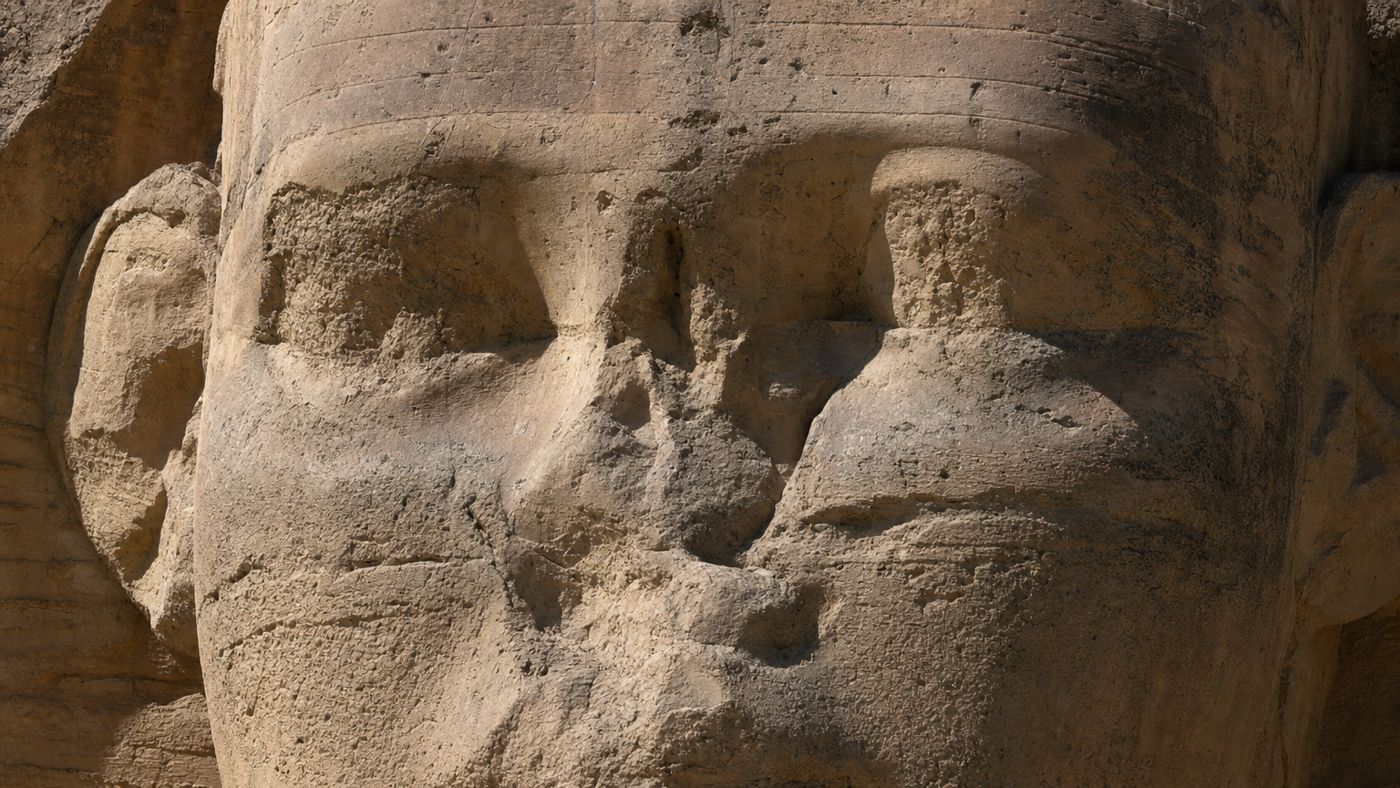
In the 1980s, archaeologist Mark Lehner examined the face in detail. He found traces on the bridge of the nose and below the nostril that indicate applied levers or chisels: narrow, elongated depressions at points where one would place a tool to pry off a component. The examination of the face led to the conclusion that the nose was chiseled off, not broken off.
The damage pattern fits this. A projectile creates a shell-shaped fracture with cracks around it because the energy is introduced at a point. Here we have a relatively flat surface without radiating cracks. Anyone looking at the break from close up sees not a crater but a worked surface.
The method can even be reconstructed. Wedges or levers applied from above, a lateral lever, then the component tips forward and falls. For a nose estimated at about one and a half meters high, that's feasible with simple tools if you can reach it, and the figure was then buried in sand up to the neck. So you were practically at eye level.
For the sake of completeness: tool marks cannot be dated like a find. One can assess how much the break surface has weathered since then and infer a rough time frame, but the result depends on assumptions about climate, sand cover, and material hardness. This method doesn't yield a specific year, only a range, and that range is wide.
The contradiction with the chronicle remains. The time frame suggested by the traces is, in Lehner's assessment, earlier than 1378. The two statements cannot easily be reconciled, and neither is strong enough to displace the other.
What Else Is Missing
The nose is not the only thing missing, and the other missing parts are more revealing than they initially seem.
If you want to know what's missing from the Sphinx of Giza, you get a short list: the nose, the beard, parts of the uraeus (the cobra on the forehead), the entire smooth surface of the body, and the painted finish. Fragments of the beard exist, one in the British Museum, others in Cairo. Of the nose, nothing exists.
That is remarkable. A component of this size doesn't disappear without a trace, and the pit around it has been completely cleared out several times. Yet no fragment that could be attributed to the nose has ever turned up. Either it was smashed and the pieces were reused or carried away, or it lies in a place that has never been examined.
A persistent claim should be explicitly denied here: the nose is not in the British Museum. There is a piece of the beard there, and the confusion between the two finds is probably the origin of this story.
It's conceivable, by the way, that both are true. A figure can be damaged multiple times: first in late antiquity, then again in the 14th century, with the second intervention enlarging an already existing damage. There's no evidence for this reading, but it would explain why a credible chronicle and credible evidence point to different time periods.
Thus the figure has two different kinds of losses. One is destruction by human hand, localized and deliberate. The other is weathering, widespread and slow. In every photo, both are visible at the same time, and they are regularly confused.
Why the Nose of All Things?
Why the nose at all? This question leads away from Giza and explains more than any individual story.
In Egyptian museums worldwide, a striking number of statues stand without noses. That's no coincidence and no transport damage. In Egyptian belief, a statue was not a likeness but a dwelling place: a part of the being could reside in it, receive offerings, and breathe. Whoever wanted to end this effect didn't have to destroy the figure but make it unusable.
There was an established procedure for that. One deliberately damaged the sensory organs and the hands: the nose, so the figure can't breathe; the ears, so it can't hear; the hands, so it can't receive offerings. A statue without a nose is thus not damaged but, in the understanding of the time, decommissioned.
That gives the evidence on the Sphinx a different hue. Whoever removed the nose followed a known practice with a clear purpose, and they did it carefully rather than angrily. The tool marks fit someone who knew what they were doing.
The fact that the uraeus, the second symbol of royal power on the head, was also lost fits this picture. Whether both happened at the same time cannot be said.
For the visit, there's a practical note. The break surface is about a hundred meters away from the terrace and only visible as a shadow with the naked eye. To see the tool marks, you need zoom and flat morning light. Without both, you see that the nose is missing, but not how it was lost.
And the Napoleon story? It persists because it sounds better. A European army shooting at a wonder of the world out of high spirits is a tellable story. A nameless iconoclast with a chisel and a theological motive is less so.
Frequently asked questions
Did Napoleon shoot off the nose?
No. A drawing from 1737 shows the figure already without a nose, sixty-one years before the Egyptian campaign.
Who was it then?
That hasn't been conclusively determined. An Arabic chronicle names a Sufi in 1378. The tool marks on the stone suggest an earlier period according to expert assessment.
Could it have simply fallen off?
Unlikely. The break surface is flat and bears traces of levers or chisels. Erosion leaves neither straight edges nor leverage points.
Where is the nose today?
Lost. No fragment has ever been identified. In the British Museum there is a piece of the beard, not the nose.
Why do so many Egyptian statues lack noses?
Because deliberate damage to the sensory organs was a known practice. A statue without a nose was considered unable to breathe and thus ineffective.
Plateau entry as a QR code on your phone
The viewing terrace with the unobstructed view of the face is in the regular ticket area. For the break surface, you need a telephoto lens.