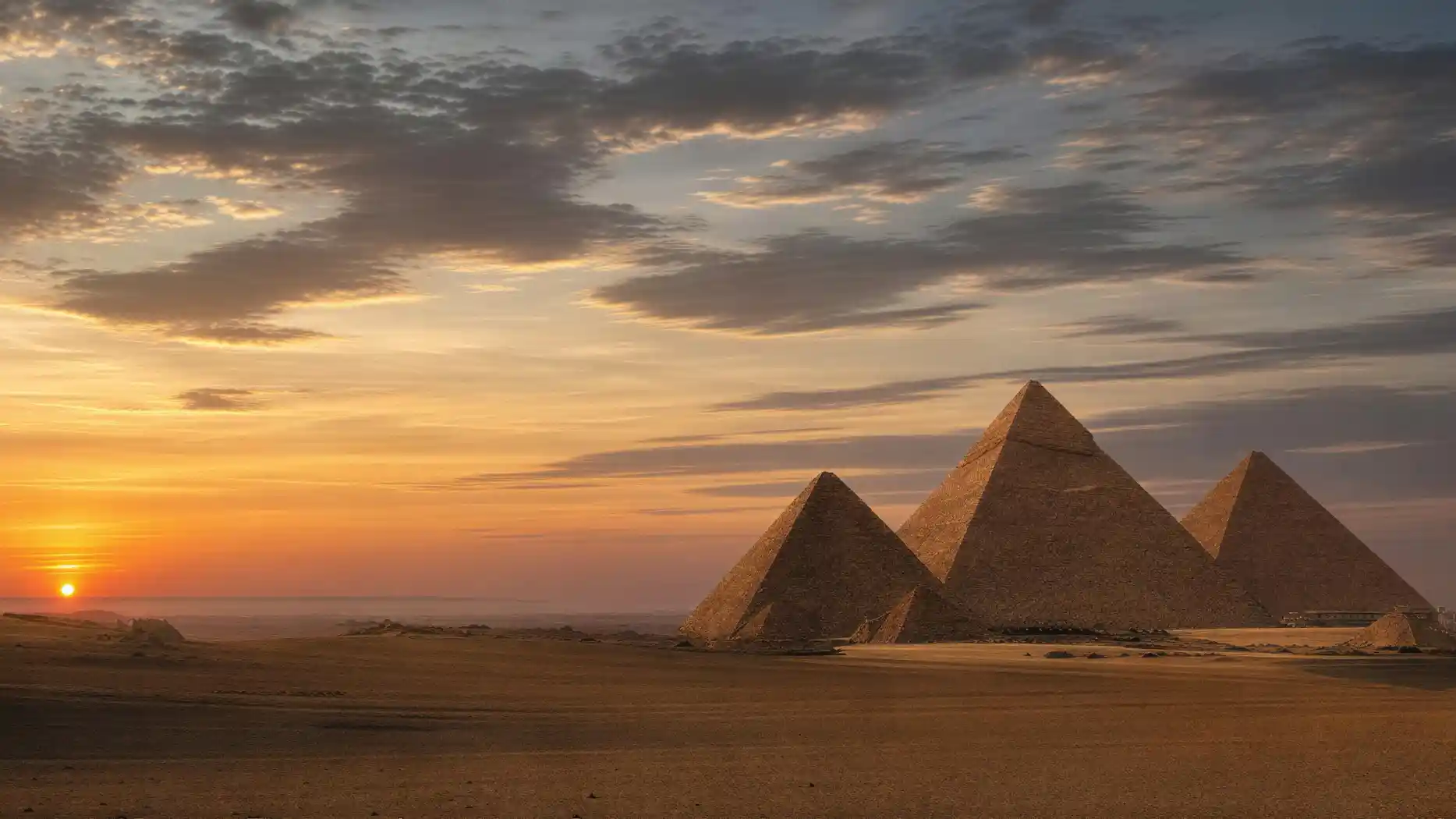
We are used to a sand-colored Sphinx. Gray, beige, ochre, the same color as the surrounding rock. That's exactly how it looks in every photo, and that's not how it originally looked.
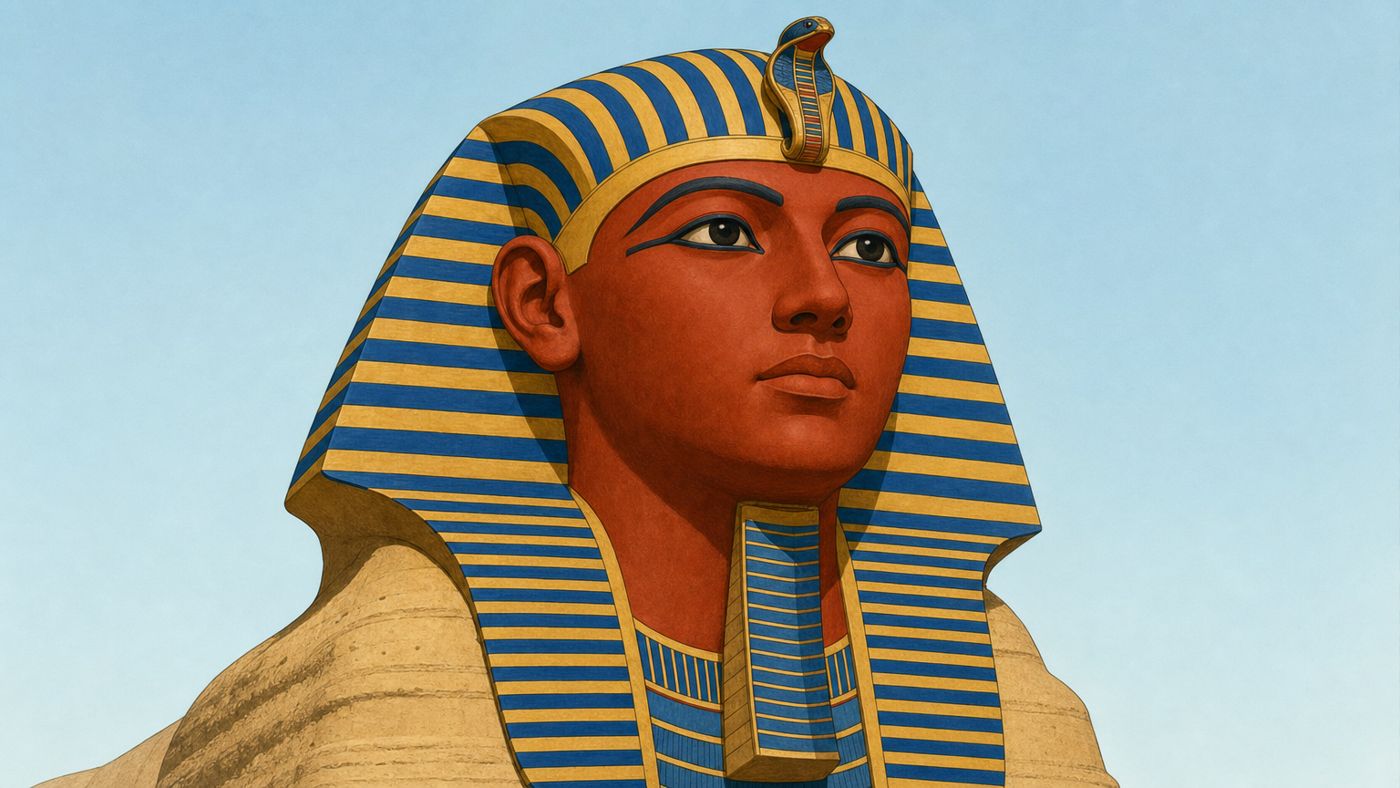
The original Sphinx of Giza was painted. In several places on the figure, traces of pigment have survived, protected in recesses and under later deposits, and they reveal a structure in vivid colors. The most distinct traces are on the face, and they are red.
This is not a peculiarity of this figure but the rule. Egyptian stone sculpture was almost always painted. The white or gray stone we know from museums is a state after three thousand years of weathering, not the intention of the sculptors. Anyone looking at an Egyptian statue in museum lighting sees the sculpture, but not the work.
For the Sphinx, this means: what today appears as a monumental stone figure was a colored image that rose above a painted temple complex and gleamed in the sun.
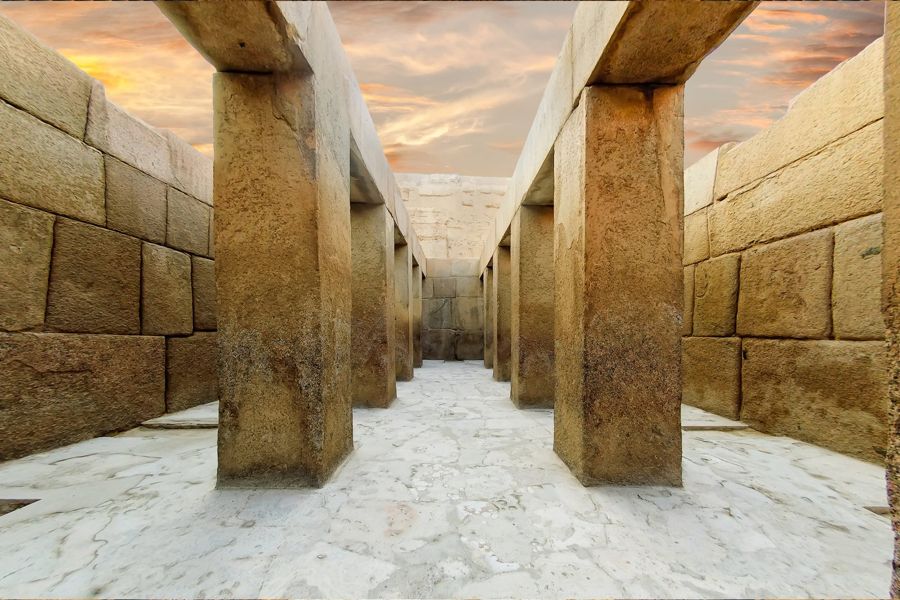
Add to that the surroundings. Directly in front of the figure stood a temple made of massive limestone blocks, partly clad in granite, and this building was also not meant to be left as bare stone. Anyone wanting to imagine the ensemble in its completed state must therefore not only color the figure but the entire complex: smoothed surfaces, paint, polished granite, and around it a pit with cleanly cut walls instead of today's weathered edges.
This page carefully distinguishes between what is actually documented and what reconstructions add. The widespread color images on the internet go well beyond the evidence.
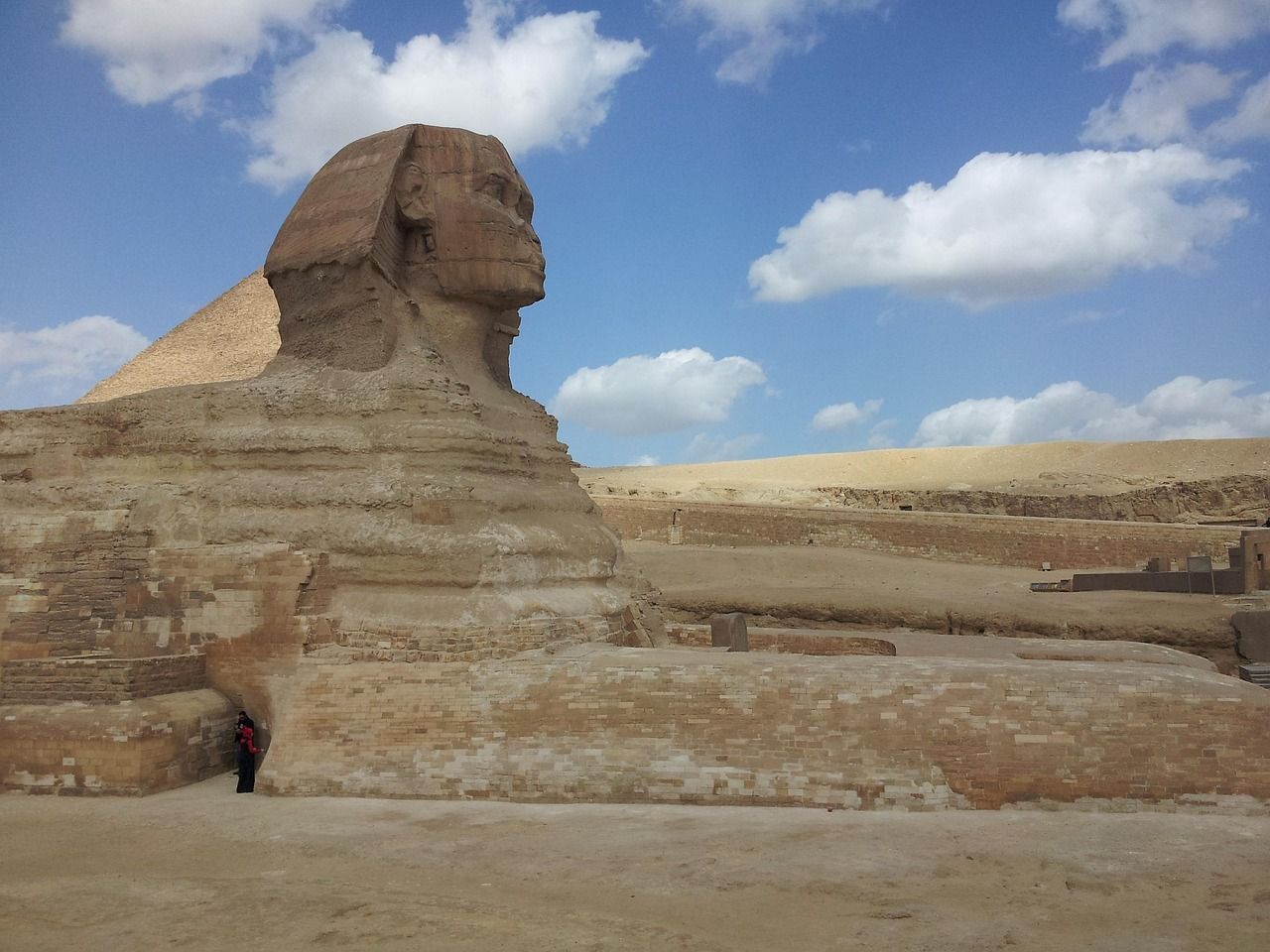
The Paint Remains and Where They Survive
The paint remains are the most reliable part of the reconstruction, and their location explains why anything has survived at all.
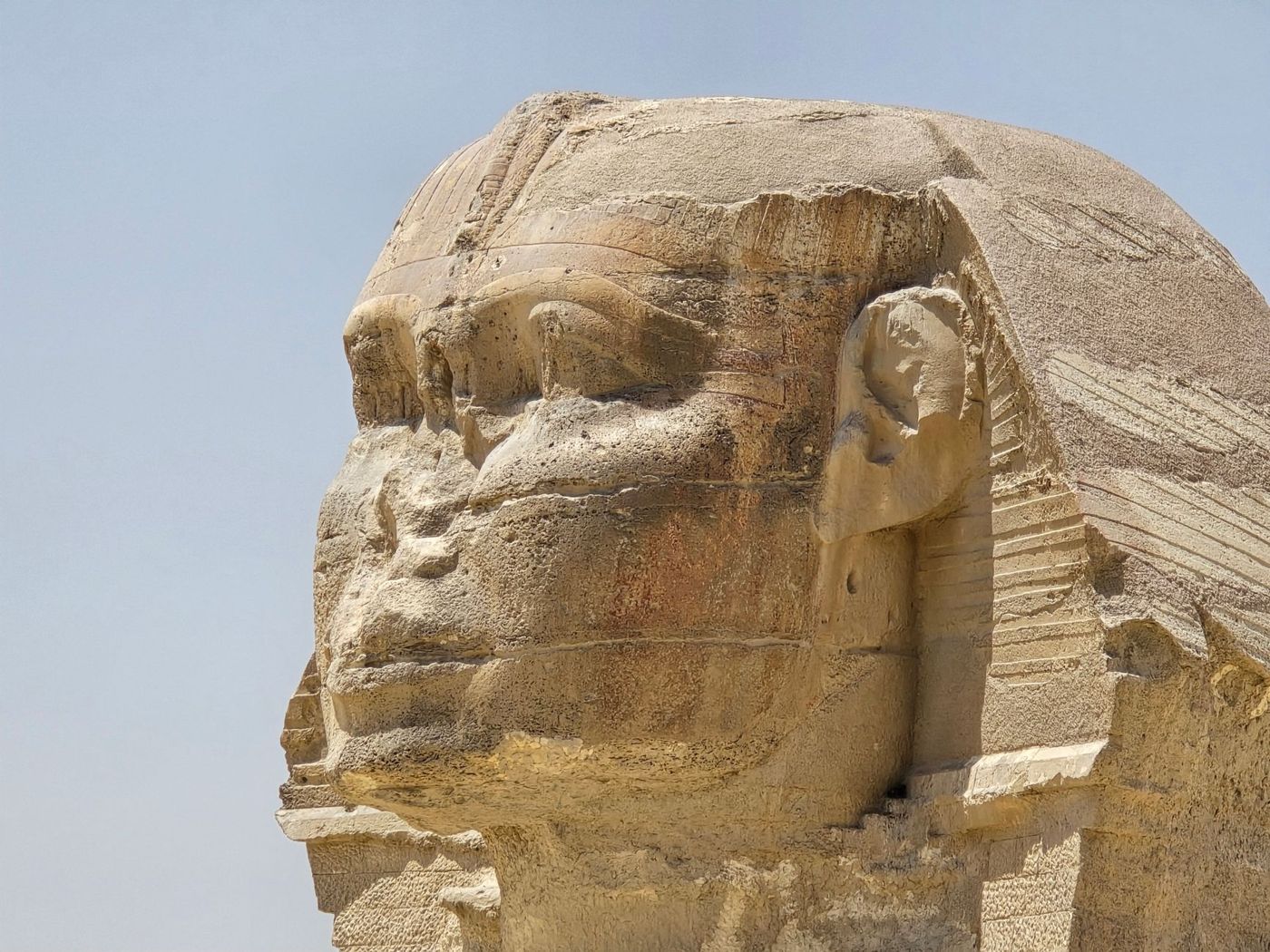
Pigment does not survive on open surfaces; rain washes it away and sand scours it off. It survives in corners, under overhangs, and where a later layer covered it. That's exactly where it has been searched for and found. On the face, remains of a strong red are preserved, distributed in such a way that experts conclude the entire surface was painted red. At other points on the figure, traces of blue and yellow have been described.
From this emerges an original appearance of the Sphinx of Giza that follows Egyptian conventions. Red is the skin color of men in Egyptian depiction. A red royal face is therefore not an extravagance but the norm. Headdresses were usually painted with stripes, often in blue and yellow, and the other traces fit exactly that pattern.
Today, this is examined without contact. Instead of taking samples, researchers use imaging techniques and measurements that determine the chemical composition of a surface from a distance. This allows pigments to be identified without removing anything. For an object under world heritage protection, this is the only permissible approach, and it also explains why the data remains incomplete: you examine what is accessible, not what would be interesting.
The limitation is important. From remains in recesses, one can deduce that a surface was colored, and often also which color it had. What cannot be deduced is how intense the tone was, whether there were gradations, whether it was repainted multiple times, and from which phase the surviving remains date. For a structure that was repaired several times over two thousand years, the last question is no triviality.

Half-day tour to the Pyramids of Giza and the Sphinx
- The paint remains are only visible in the right light and from the right direction
- A licensed guide shows which surfaces are original and which are repairs
- Plateau entry, German-speaking guide, and hotel pickup are included
- Free cancellation up to 24 hours before start
Element by Element: Evidence and Supplement
What is documented on the figure, what is inferred from it, and what remains visible today.
| Element | Evidence | Visible today |
|---|---|---|
| Face | Remains of red pigment | Traces, only up close and in good light |
| Headdress | Traces of blue and yellow, striping common | Shape yes, color no |
| Forehead serpent | Remains of the carved cobra | Base recognizable |
| Beard | Fragments, dating disputed | Not present, fragments in museums |
| Nose | Broken surface, cause disputed | Missing |
| Body | Paint traces, cladding blocks from later times | Mostly repair |
- Evidence
- Remains of red pigment
- Visible today
- Traces, only up close and in good light
- Evidence
- Traces of blue and yellow, striping common
- Visible today
- Shape yes, color no
- Evidence
- Remains of the carved cobra
- Visible today
- Base recognizable
- Evidence
- Fragments, dating disputed
- Visible today
- Not present, fragments in museums
- Evidence
- Broken surface, cause disputed
- Visible today
- Missing
- Evidence
- Paint traces, cladding blocks from later times
- Visible today
- Mostly repair
The middle column contains evidence, not interpretations. The widespread color reconstructions supplement the surfaces between these points.
Headdress, Forehead Serpent, Beard
Three accessories belong to the royal image, and for each the evidence is different.
The headdress is undisputed. It is the striped cloth gathered at the nape and falling over the shoulders, the usual mark of a king. Its shape is fully preserved on the figure and has never been disputed.
The forehead serpent is also documented. Remains of the carved cobra sit above the forehead, where the upright serpent as a protective emblem is placed on every royal depiction. Even without the complete head, the base is recognizable.
The beard is the difficult case. Fragments of it exist, one in the British Museum, others in Cairo. What is disputed is not that there was one, but when. The museum dating assigns the surviving piece to a repair in the New Kingdom, about a thousand years after its creation. Whether the figure originally wore a beard that was later replaced, or whether the beard was only added later, remains open.
The Striping Is Often Misrepresented
A note on the striping of the headdress is worthwhile because it is often misrepresented. The stripes are not painted lines on a smooth surface but plastically worked bands in the stone, which were then colored. On the figure, they are therefore recognizable even without any color, as relief. Anyone seeing the stripes in a photo sees the sculptor's work, not the painting.
This has consequences for reconstructions. An image that wants to show the Sphinx in its completed state and adds the surviving beard may be combining two eras. The careful reconstructions point this out. Most do not.
Where Evidence Ends and Supplement Begins
The boundary between evidence and supplement is particularly blurred on this topic, and there is a concrete reason for that.
The figure consists of rock layers of very different hardness, and the body has correspondingly weathered unevenly. Soft layers have receded, hard ones protrude. Where material is missing, the surface on which paint would have sat is also missing. For large parts of the body, there is simply nothing to examine.
Add to that the repairs. Since the New Kingdom, cladding blocks have been attached, in several campaigns up to modern times. These blocks are not the original surface, and paint on them would not be the original paint. A considerable part of the body visible today is therefore unusable for the question of the original state.
Historical reports do not make things easier but are revealing. Travelers of the 19th century described more distinct paint traces than exist today, partly at places where nothing remains now. That is plausible, because since then two hundred years of weather, tourism, and several restoration campaigns have passed. These descriptions are thus sources themselves, albeit imprecise ones: color information from a time before photography is hard to verify.
What remains is the head. It consists of harder material, is largely original, and therefore carries the most informative remains. Almost everything that can be said about the original coloring is based on this one area, and from there conclusions are drawn about the rest.
That is a legitimate approach and at the same time the point where reconstructions diverge. Anyone who colors the body extrapolates from the head. How far one wants to go is a matter of judgment, not measurement.
What Is Visible On Site
What of this can actually be seen on site? Honestly: little, and only under conditions.
The paint remains are small and sit in places that are about a hundred meters away from the visitor terrace. Without a telephoto lens, nothing is recognizable, and even with a telephoto lens, you need flat light that models the surface. The best chance is in the morning when the sun falls on the face from the front.
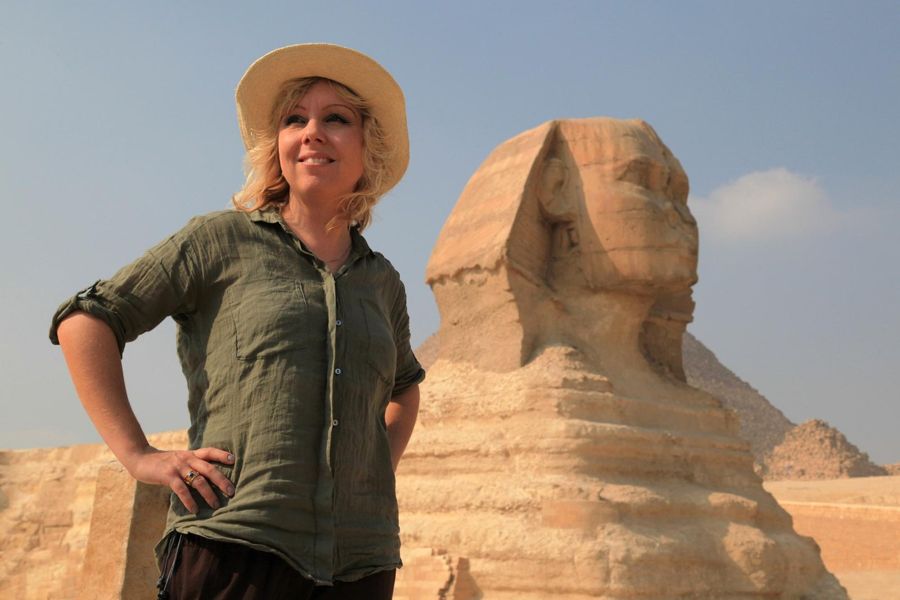
The structures are easier to find. The striping of the headdress is clear, the base of the forehead serpent recognizable, and the boundary between original rock and added masonry runs visibly across the lower half. Anyone wanting to compare a description of the Sphinx of Giza with their own eyes is best off working on these three features.
For the color itself, museums are the better place. Egyptian sculpture with preserved paint gives an impression of how vivid these colors were and makes plausible what remains only in traces on the Sphinx. The leap from a painted statue of vitrine size to a painted figure seventy meters long is then only a question of imagination.
One practical note on expectations. Reconstruction images strike many people as strange, almost kitschy, because we equate antiquity with bare stone. This impression says nothing about the correctness of the reconstruction but something about our viewing habits. The same irritation exists with painted Greek temples and medieval cathedrals, whose facades were also colored.
And perhaps that is the real message of this page. The Sphinx we know is a ruin state that we mistake for a style. The sublimity of bare stone is a modern feeling. For its builders, an unpainted image would have been unfinished.
Frequently asked questions
Was the Sphinx really painted?
Yes. Pigment remains are preserved in several places, most clearly a strong red on the face. Colored paint was the rule for Egyptian stone sculpture.
What colors did it have?
Red on the face is documented, as well as traces of blue and yellow elsewhere. How the surfaces were distributed in detail is inferred, not measured.
Did it have a beard from the beginning?
That is open. Surviving fragments are assigned to a repair in the New Kingdom, about a thousand years after its creation.
Why is the color not visible today?
Because pigment on open surfaces is washed away and scoured off. It survives only in recesses and under later layers.
Are the colored reconstructions on the internet correct?
They are based on real evidence but supplement the surfaces in between. How far this supplement goes differs from depiction to depiction.
Plateau entry as QR code on your phone
The visitor terrace with a clear view of the face and headdress is in the regular ticket area. No one gets closer than about a hundred meters.