
The question is usually asked incorrectly. It typically goes: Do we have the technology for it? And the answer is trivial. Of course, a mobile crane can lift a block of two and a half tons to a height of a hundred meters. It does this on every large construction site, several times a day, without anyone marveling at it.
It only becomes interesting when you describe the task fully. What would be required is not one lift, but well over two million of them, with consistent precision, over years, at a single location, using material that first has to be quarried, dressed, and transported. And in the end, the result should have joints that a credit card cannot fit into.
Calculate the pace, and the difference becomes tangible. Spread over twenty years, 2.3 million blocks average out to just over three hundred stones set per day, every day, without interruption. If you want to compress the construction time to five years with modern equipment, you end up with over twelve hundred per day. That is no longer a crane problem, but a supply chain problem: you need twelve hundred finished blocks at the right place every day, and they must have been quarried, sawn, and transported somewhere beforehand.
This shifts the question from technology to organization, and that is where it gets interesting. There is one point where a modern construction process is worse off than the ancient one, and a second where the project simply fails on the budget.
First, an assessment that underpins the rest of the page: Building such a structure was not a question of tools even four and a half thousand years ago. It was a question of will, supply, and administration. Nothing has changed in that regard, except that today all three are considerably more expensive.
- Blocks to be set
- around 2.3 million
- Mass to be moved
- nearly 6 million tons
- Original height
- 146.6 m, equivalent to 280 cubits
- Required precision
- Joints in the millimeter range, alignment within arcminutes
- Historical construction time
- around 20 years
- Modern estimates
- 5 years and a single-digit billion amount, depending on assumptions
Copper, Stone, Wood, and Rope
What the builders had at their disposal is well known, because much of it has been found. The tools of the pyramid builders consisted of copper, stone, wood, and plant fiber. Copper chisels and copper saws for the limestone, dolerite round hammers for the hard granite, wooden sledges for transport, ropes made of halfa grass, spirit levels made of two slats and a plumb line, measuring cords, squares, and plumb bobs.
That sounds like little, but it is precisely matched to the material. Copper is softer than limestone, but it works when quartz sand is added as an abrasive: the cutting is then done not by the metal, but by the sand that the metal carries. For granite, even that fails, which is why dolerite balls were used, dropped onto the surface for hours.
The real achievement, however, lies not in the tool, but in the planning. In the Old Kingdom, slopes were not given as angles, but as ratios: how many handbreadths does a surface recede horizontally while it rises one cubit? This measure was called the seked. For the Great Pyramid of Khufu, it is five and a half handbreadths, corresponding to an inclination of about 51 degrees 50 minutes.
Lengths were also standardized. Measurements were made in royal cubits of about 52 centimeters, divided into seven handbreadths of four fingers each. Examples of this standard in wood and stone have survived, so there was a physical standard that could be checked. How well it worked is shown by the base: over a side length of more than 230 meters, the four sides deviate from each other by only a few centimeters.
The advantage of this system is practical. A stonemason does not need a protractor, but only a board with two measurements on it. Each casing block can thus be checked individually, without any degree number appearing anywhere. The method is documented in mathematical papyri, which, however, are about nine hundred years younger than the building itself.
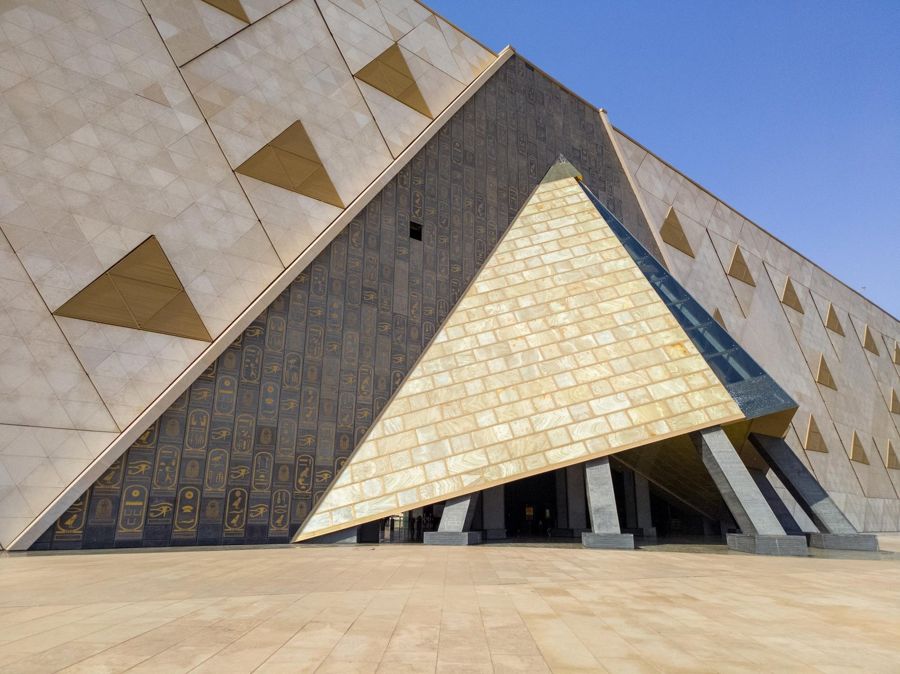
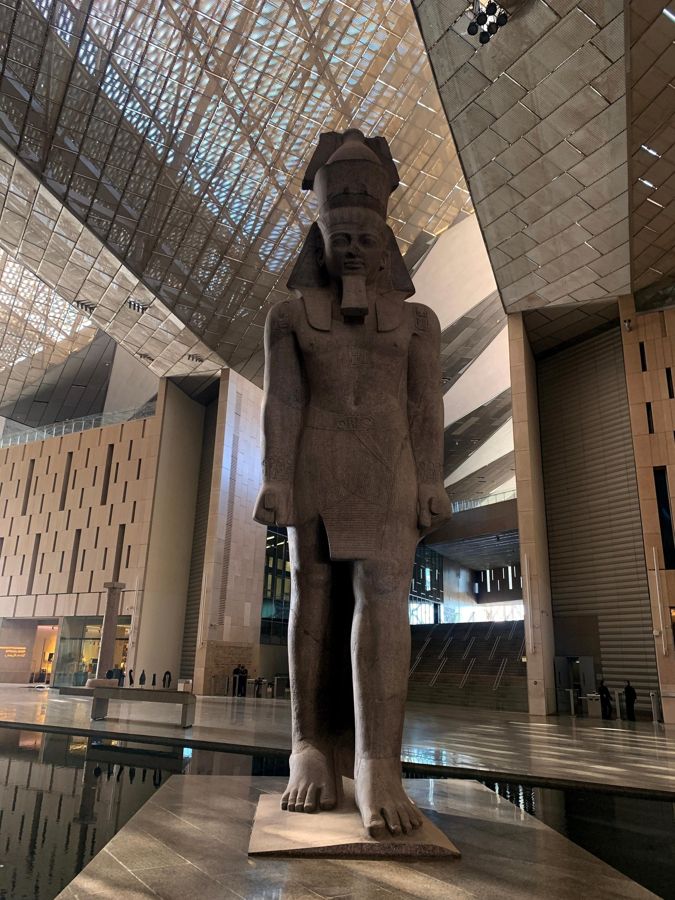


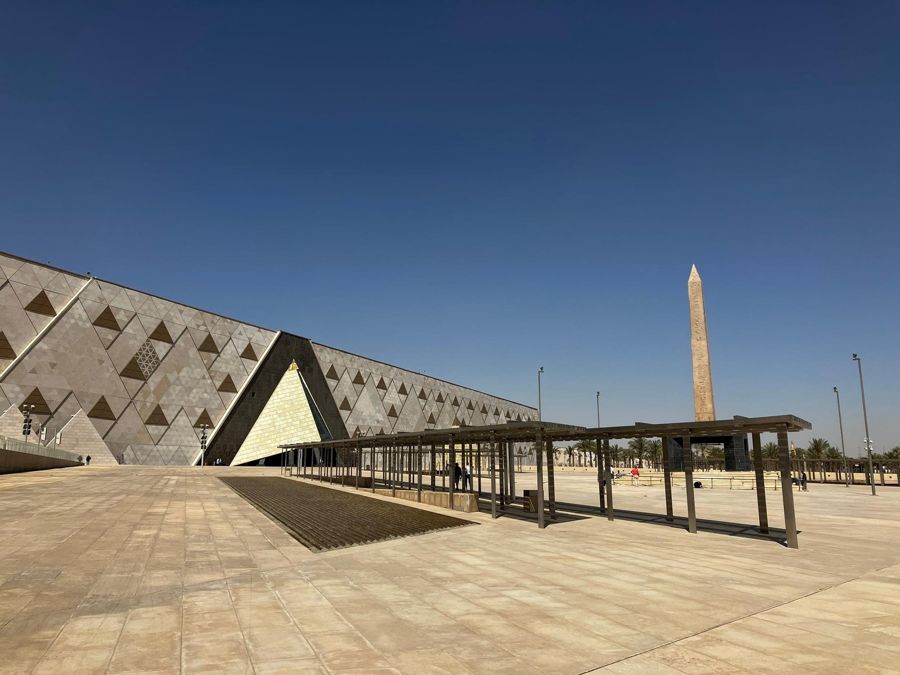
Private Tour to the Grand Egyptian Museum and the Pyramids
- The original tools and measuring instruments are in the museum, not on the plateau
- Privately guided, so time for questions about tool marks instead of a group pace
- Plateau entry, German-speaking guide, pickup, and lunch are included
- Free cancellation up to 24 hours before start
The 1992 Construction Attempt
The most revealing attempt to answer the question practically was made in 1992 for a television documentary, and its result is more sobering than most summaries admit.
A team led by archaeologist Mark Lehner and stonemason Roger Hopkins built a pyramid of just under six meters in height and about nine meters in base length with fourteen experienced stonemasons from Cairo. Fewer than two hundred blocks were used. Twenty-one days were planned.
It was tight, and at a crucial point the team gave in. In the program transcript, Lehner explicitly asks his colleague whether he will do it like the ancient Egyptians or use an excavator, front-end loader, and forklift. For setting the casing blocks, the decision was made for the front-end loader, because otherwise time would not have sufficed.
Scale that up. Two hundred blocks against 2.3 million, six meters against 146, three weeks against two decades. A team of experts with modern equipment at hand reached the point of changing methods at a thousandth of the task.
Positively, the attempt did prove some things. Pulling the blocks on wooden sledges over moistened tracks worked, and with fewer people than expected. Dressing with copper tools and sand also worked, albeit slowly. Not a single step proved impossible. What proved to be the bottleneck was, without exception, time.
That does not refute anything about the ancient methods. It only shows how much we underestimate the scale, and how much of the ancient achievement lay in practice and routine rather than inventiveness. Current research on lifting and counterweight systems therefore assumes well-rehearsed crews, not brilliant individual solutions.
What would be easier today, and what would be harder
Pros
- Lifting and setting are solved. A tower crane reaches the height effortlessly.
- Surveying has become trivial. Alignment and flatness are achieved by any construction team today.
- Blasting, sawing, and dressing the stone are orders of magnitude faster.
- Transport by road and rail is independent of season and water level.
Cons
- There is no quarry of this size within sight. All material would come from far away.
- 2.5 million individually dressed natural stone blocks are a special order today, not a standard product.
- Occupational safety, environmental law, and permits determine the schedule, not the statics.
- There is no client who would finance a building with no usable floor space for two decades.
It Does Not Fail on Physics
So to the heart of the matter. Such a project today fails not on physics, but on three things that have nothing to do with stones.
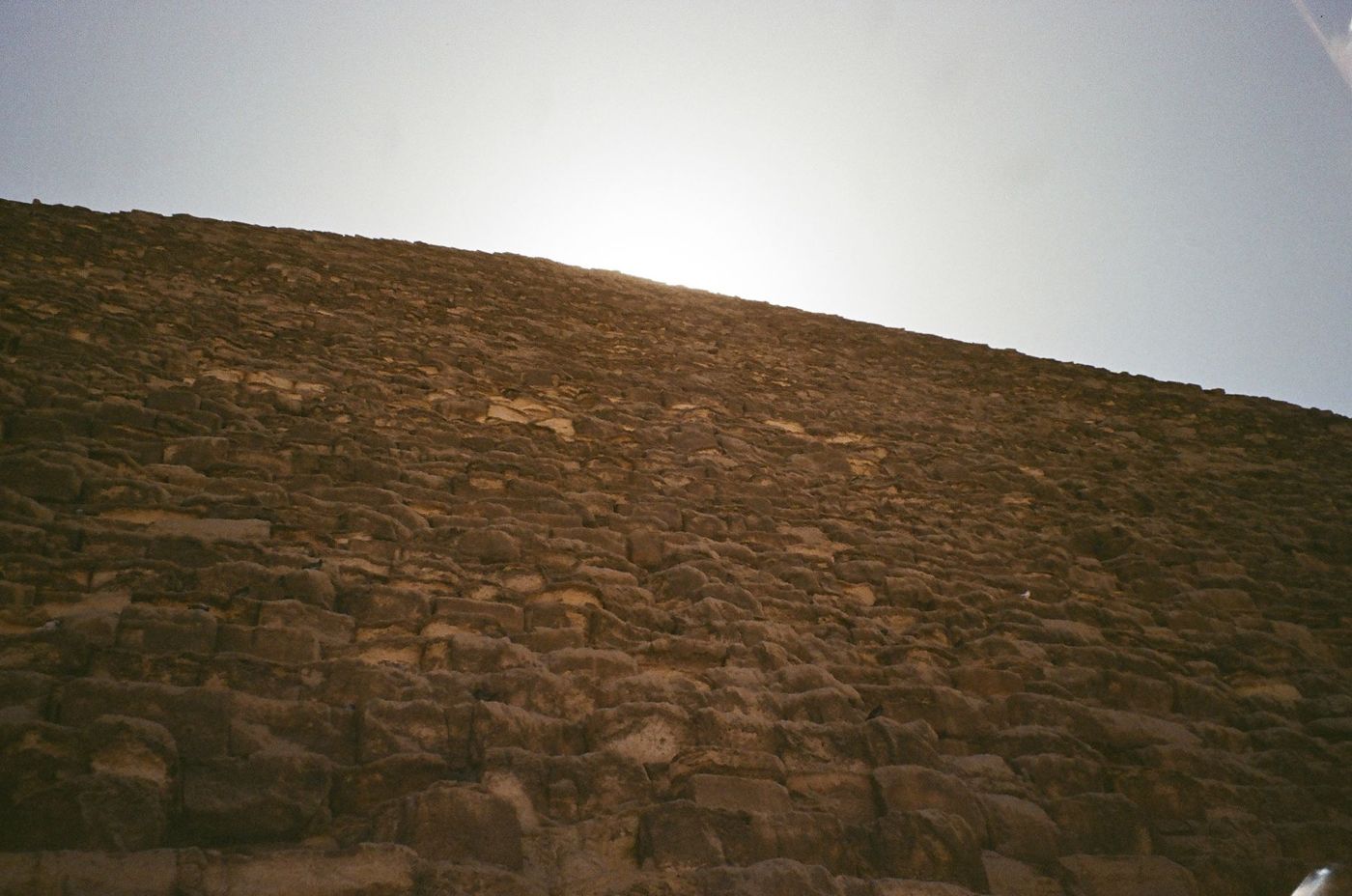
The first is material. The builders had the quarry 300 meters away, and about 90 percent of the mass came from there. That advantage will not come twice. A modern builder would first have to develop a quarry of that capacity, with all the permits, assessments, and conditions attached to it in Europe or Egypt, and then move millions of tons over roads that were not built for that.
How much that weighs is shown by a simple calculation. 5.5 million tons of limestone in five years means about 3,000 tons on every single day. At 25 tons of payload, that is about 120 truckloads daily, arriving loaded and returning empty, over five years, to a single construction site. The ancient site needed no road for the same share of the mass, because the material lay in the ground 300 meters away. This one locational advantage cannot be replaced by any machine.
The second is the bill. Frequently cited is a 2012 estimate that calculates with 1,500 to 2,000 workers and about five years. Other rough calculations come to much less or double that. That the figures differ by a factor of several is itself the result: no one has ever calculated such a thing because no one has ordered it.
The third is the purpose. The Great Pyramid of Khufu has a usable interior of a few hundred cubic meters with a construction volume of over two million. As a building in the modern sense, it is completely uneconomical, and it always was. Its meaning lay outside the usable floor area, in a concept of kingship and afterlife for which there is no equivalent today.
So anyone who seriously wants to answer the question does not end up with technology. They end up with the question of which society wants such a thing.
How to measure the height
meters above ground
For about 3,800 years, this structure was the tallest in the world. Only Gothic church towers surpassed it. The height was never the real point, but the volume behind it.
The Honest Answer Consists of Two Parts
The honest answer therefore consists of two parts that should not be mixed.
Technically, the matter is settled. With today's means, a true-to-scale structure of this size could be built, presumably in a fraction of the ancient construction time and with a precision that surpasses the original. Nothing about the task requires methods that do not exist.
Economically and socially, the matter is just as clearly settled, only in the other direction. There would be no client, no site, no quarry, and no purpose. A full-scale replica would be the most expensive monument in human history, built to prove that it could be done.
And therein lies the real yield of this question. It begins as technical curiosity and ends with a statement about us: we have better tools, more knowledge, and incomparably more energy at our disposal. What we lack is a reason.
The ancient Egyptians had copper, stone, and rope. But they also had twenty years at a stretch, an administration that held up, and a society that considered this building the most important thing it could do. That is the equipment that is missing today.
Frequently asked questions
How were the pyramids of Giza made?
From locally quarried limestone, set with sledges, ramps, levers, and mortar as a sliding layer. The tools consisted of copper, stone, and wood.
How was the Great Pyramid of Khufu planned?
Using ratios instead of angles. The slope was given as a seked, i.e., the horizontal offset per cubit of height, and could thus be checked on each individual block.
How long would it take today?
Estimates mention around five years with a few thousand employees. That is not reliable because a project of this kind has never been calculated.
Have there been reconstruction attempts?
Yes, several on a small scale. The most famous reached just under six meters in height in 1992 and resorted to modern technology for the casing.
Could modern building materials be used?
Yes, and a concrete core would be considerably cheaper. But then it would be a replica, not a reconstruction.

Plateau entry as a QR code on your phone
Tool marks, quarry edges, and the unfinished casing of the third pyramid are in the freely accessible area. The basic ticket is sufficient for that.