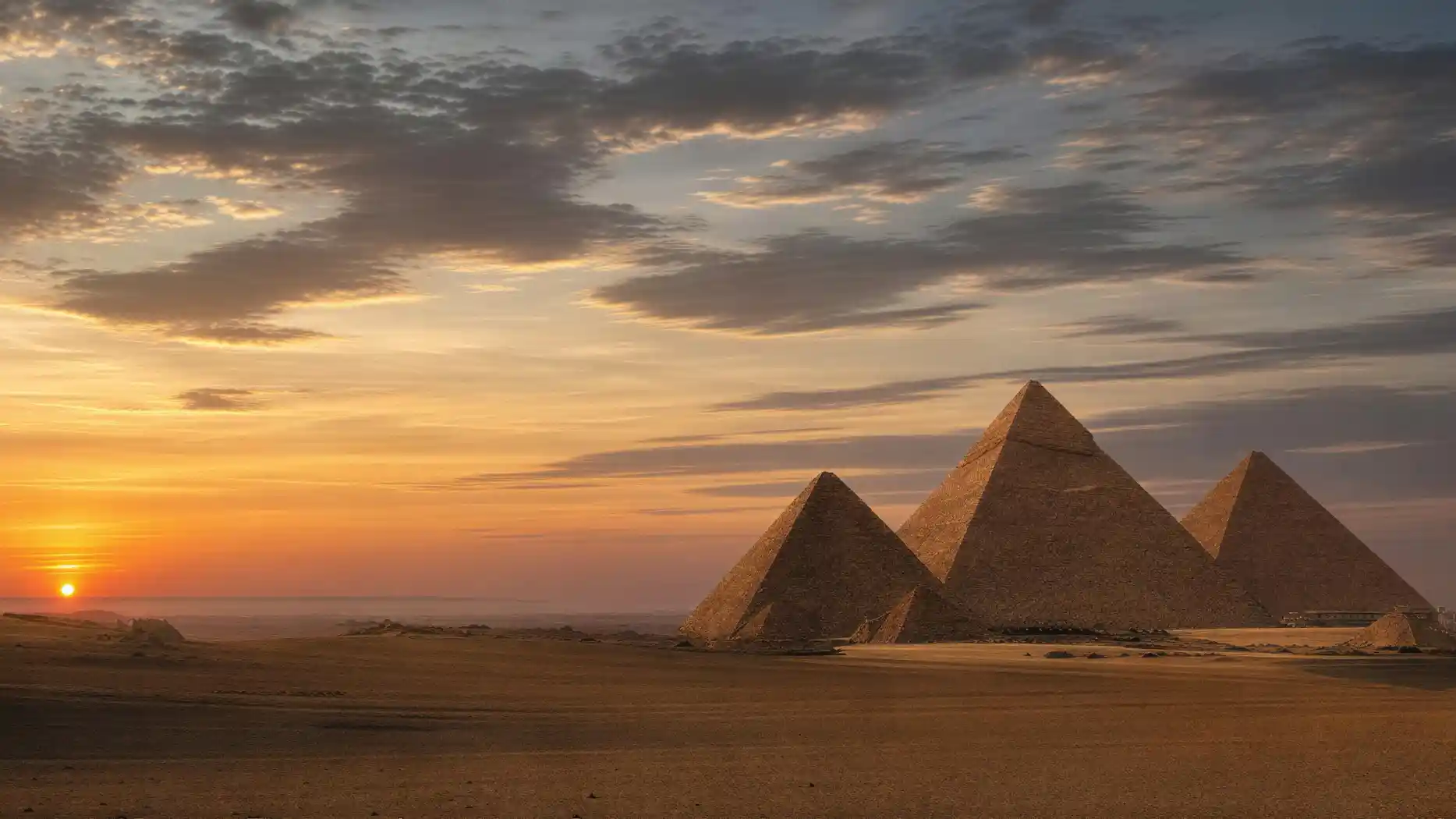
The answer is: the northeastern one, the Great Pyramid of Khufu. It is the largest in every respect: in height, base area, and volume.
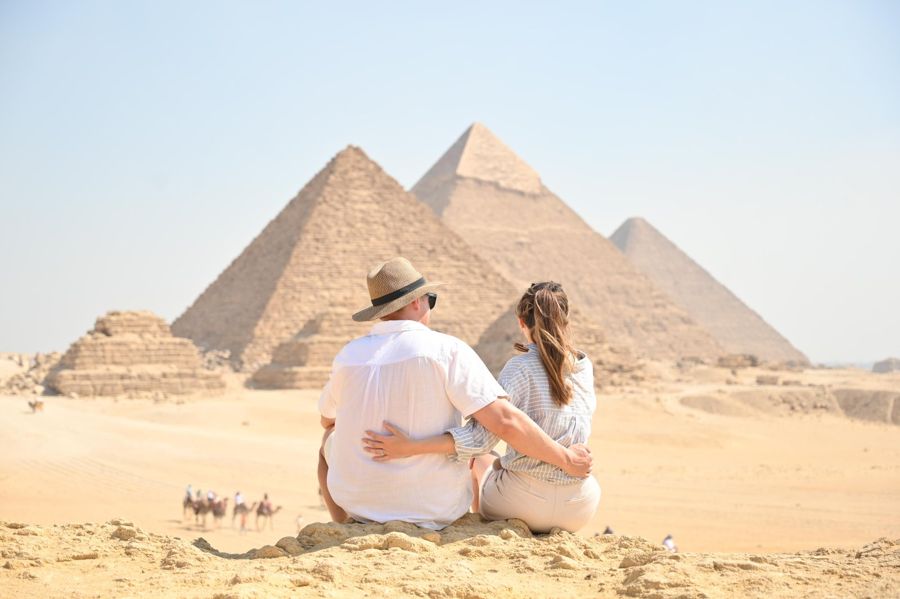
Nevertheless, almost everyone standing on the site for the first time asks the question anew. In most photos, the middle one appears the tallest, and clearly so. It stands on higher ground, is steeper, and is the only one that has retained its tip along with a cap of the original casing.
Comparing the three pyramids of Giza is therefore a good example of how unreliable visual judgment is for structures of this scale. Without a reference point, the eye misjudges, and with a wrong reference point, it systematically misjudges.
More interesting than the ranking, however, is the gap. Between the first and second, there are only a few meters of height; between the second and third, there is a world of difference. The smallest does not even reach half the height and about a tenth of the volume of the largest.
A preliminary note on the numbers themselves. None of the original heights are measured, because all three structures are missing their tips or are damaged. What appears in tables is calculated back from the base side and slope. The volume figures are also calculated values, and they include an unknown proportion of natural rock that the builders left in place and incorporated into the construction. This is sufficient for a comparison, but not for an exact figure to the cubic meter.
This page lays out the numbers side by side, explains the optical effect, and finally answers the question of why three structures stand side by side at all.
The three in direct comparison
All figures rounded. The original heights are reconstructed mathematically because all three are missing their tips or are damaged.
| Great Pyramid of Khufu | Pyramid of Khafre | Pyramid of Menkaure | |
|---|---|---|---|
| Location | northeast | in the middle | southwest |
| Original height | 146.6 m | 143.5 m | about 65 m |
| Height today | about 138.8 m | about 136.4 m | about 61 m |
| Base side | about 230.3 m | about 215.3 m | about 102 by 105 m |
| Slope | 51 degrees 50 minutes | 53 degrees 10 minutes | 51 degrees 20 minutes |
| Volume, rounded | about 2.6 million m³ | about 2.2 million m³ | about 0.24 million m³ |
| Casing preserved | Remains at the base of the north side | Cap at the top | Granite at the base, unworked |
| Subsidiary pyramids | three on the east side | none | three on the south side |
- Great Pyramid of Khufu
- northeast
- Pyramid of Khafre
- in the middle
- Pyramid of Menkaure
- southwest
- Great Pyramid of Khufu
- 146.6 m
- Pyramid of Khafre
- 143.5 m
- Pyramid of Menkaure
- about 65 m
- Great Pyramid of Khufu
- about 138.8 m
- Pyramid of Khafre
- about 136.4 m
- Pyramid of Menkaure
- about 61 m
- Great Pyramid of Khufu
- about 230.3 m
- Pyramid of Khafre
- about 215.3 m
- Pyramid of Menkaure
- about 102 by 105 m
- Great Pyramid of Khufu
- 51 degrees 50 minutes
- Pyramid of Khafre
- 53 degrees 10 minutes
- Pyramid of Menkaure
- 51 degrees 20 minutes
- Great Pyramid of Khufu
- about 2.6 million m³
- Pyramid of Khafre
- about 2.2 million m³
- Pyramid of Menkaure
- about 0.24 million m³
- Great Pyramid of Khufu
- Remains at the base of the north side
- Pyramid of Khafre
- Cap at the top
- Pyramid of Menkaure
- Granite at the base, unworked
- Great Pyramid of Khufu
- three on the east side
- Pyramid of Khafre
- none
- Pyramid of Menkaure
- three on the south side
The volume figures are calculated from the base area and height and include the natural rock core, which was incorporated to an unknown extent in all three.
Greek names in German, Egyptian in specialist literature
What are the three pyramids of Giza called? In German, they bear the Greek forms of their builders' names: Cheops, Chephren, and Mykerinos. In specialist literature, the Egyptian forms Khufu, Khafre, and Menkaure are more common.
The order on the site is also the order of generations. The grandfather built in the northeast, the son in the middle, the grandson in the southwest. So if you look from right to left when coming from the southwest, you are looking back in time.
This attribution is secure. It is derived from the construction sequence on the site, from the surrounding officials' tombs, whose owners can be assigned to a specific king, and, in the case of the largest complex, from markings of the construction crews in inaccessible chambers. The official overview of the site lists them accordingly as three separate complexes.
Confusion almost always arises in the same way. Because the middle pyramid has the most striking silhouette, it is mistaken for the largest and then given the most famous name. In photos taken from the southeast, it also often appears in the foreground.
Adding to the difficulty, the names themselves change. In older German texts, you find Mykerinos; in newer ones, Menkaure is more common, and for the middle builder, Chephren, Chefren, and Chafre appear side by side. They all refer to the same people. If you compare two sources and encounter different names, you are usually not dealing with different kings but with different transliterations.
A simple mnemonic helps: The pyramid with the dark cap at the top is never the largest.
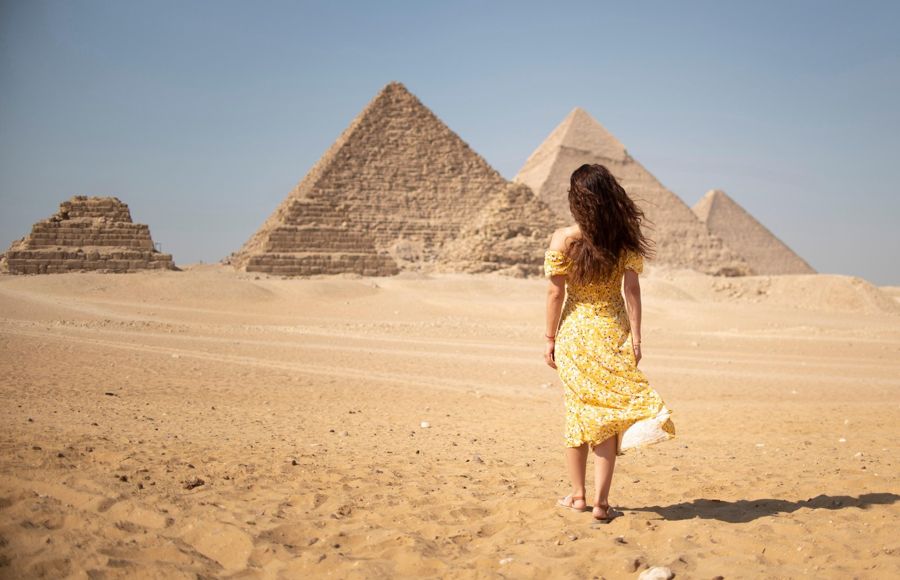
Half-day tour to the Pyramids of Giza and the Sphinx
- The size comparison only works on site, with both base points in view
- A licensed guide shows the spots where the proportions are right
- Plateau entry, German-speaking guide, and hotel pickup are included
- Free cancellation up to 24 hours before start
Why the middle one appears taller
Why the middle one appears taller can be explained in three points, all of which can be verified.
First, the terrain. The rock ridge rises to the southwest, and the base of the middle complex lies about ten meters above that of its neighbor. However, the height of a structure is measured from its own base, not from sea level. The peak of the middle one is therefore actually higher, but the structure itself is not.
Second, the slope. The middle one rises at just over 53 degrees, the largest at just under 52. The difference sounds negligible but is noticeable at over a hundred meters in height: a steeper flank looks slimmer and more towering.
Third, the tip. The largest is missing its top courses and capstone, so it ends in a small platform at the top. The middle one has retained its tip, and the preserved casing cap below it sets it off further.
A fourth, smaller effect comes into play in photos. Telephoto shots from a distance compress space and make structures behind each other appear the same size, while wide-angle shots from close up make the front structure appear exaggeratedly large. Both distortions are common in travel photos, and neither can be corrected with the naked eye.
Together, this creates an impression that contradicts the measurement. If you want to check for yourself, find a spot from which both base points are visible. From there, the effect disappears.
How precisely these structures are measured is shown by studies of their alignments: The deviations from true north are within a few arcminutes for all three.
Volume in relation
Construction volume in millions of cubic meters
The height barely distinguishes the first two, but the volume does clearly, and with the third structure the comparison collapses entirely: it reaches about a tenth of the largest.
Calculated from base area and reconstructed height, rounded.
The volume shifts the picture
The volume is the more meaningful figure, and it shifts the picture considerably.
In height, the first two are separated by just over three meters, or just over two percent. In volume, it is about fifteen percent, because volume grows with the third power of the edge length, and the base side of the middle one is fifteen meters shorter. A seemingly small difference in base area makes a big difference in mass.
With the third pyramid, the comparison then collapses completely. It reaches less than half the height of the largest and about a tenth of its volume. It is therefore not a smaller version of the same task, but a construction project of a different order of magnitude.
This also explains why it remained unfinished. For a structure of this scale, the granite casing could have been completed if time had allowed; the mass was not the problem. What was missing was the reign of the builder.
A comparison within the site makes the scale tangible, and it can be recalculated from the table above. If you add the volumes of the middle and smallest pyramids together, you get approximately the volume of the largest alone. A single structure thus contains about as much material as its two neighbors combined, and that with a height difference of only three meters to the second.
Such rough calculations should, however, be treated with caution. All three structures stand on natural rock that was incorporated to an unknown extent, and no one knows how much volume is attributable to this rock core for each pyramid. The ratios are correct, but the absolute numbers carry an uncertainty.
And it relativizes the ranking. The question of which is the largest has a clear answer. The question of whether the third plays in the same league has an equally clear one: no.
Plateau entry as a QR code on your phone
All three structures can be freely circled with the basic ticket. Only the interiors require a separate ticket each.
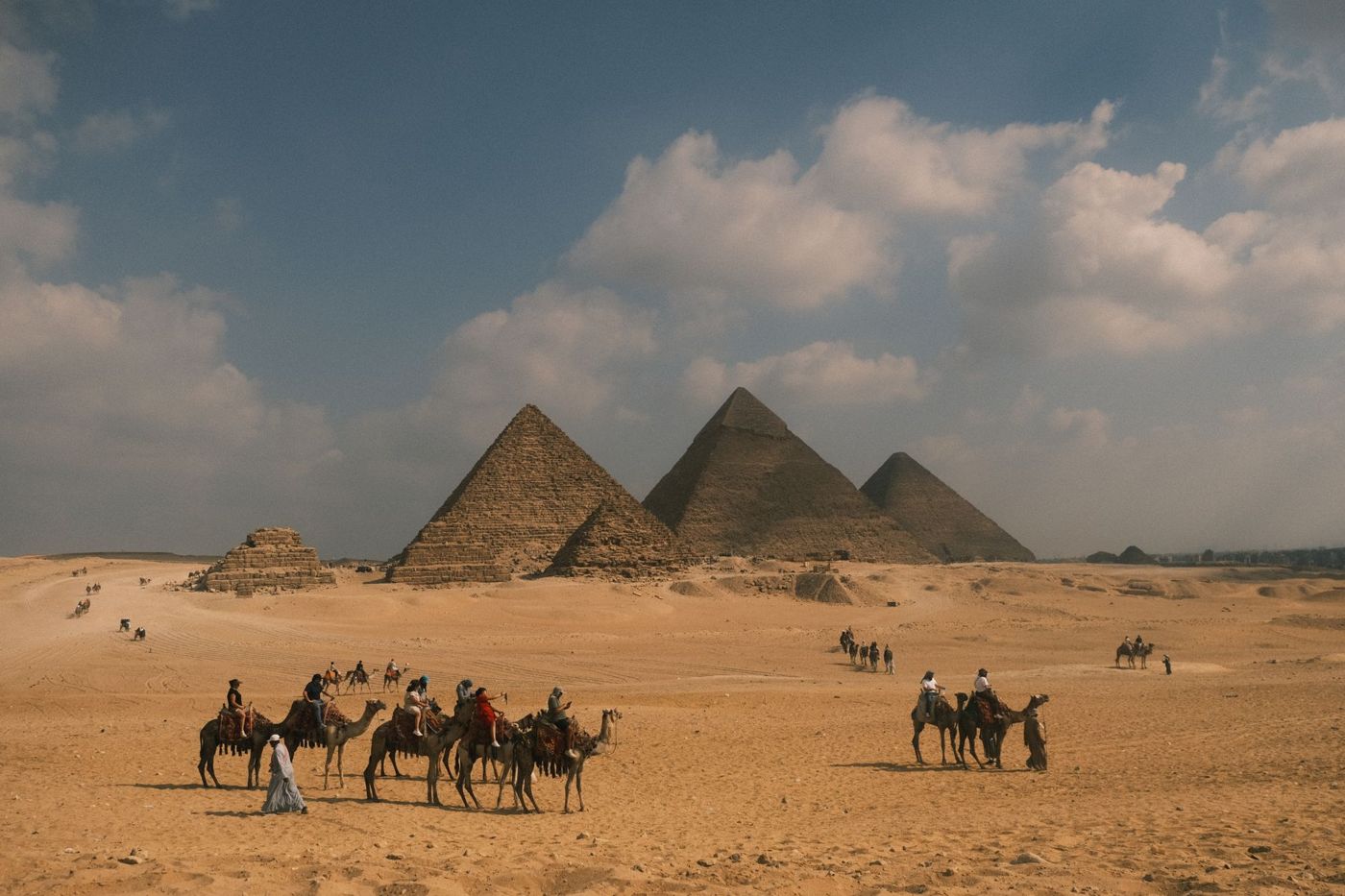
Three, and not one or ten
Why are there three pyramids in Giza, and not one or ten?
Because three successive kings chose the same site. Each ruler of the Old Kingdom had his own complex built, and the location was not a family tradition but a decision made anew at each accession. In this case, it fell on the same rock ridge three times in a row.
That there were not more has two reasons. Between the first and the second, a king ruled who moved to Abu Rawash, and after the third, his successor changed the building form entirely and was buried in a rectangular structure in Saqqara. Pyramid building on this scale thus ended after three generations.
That there were not fewer is due to the space. The first structure stands as far north as the load-bearing rock allowed, leaving room for the two following ones. Whether that was intentional or coincidental is disputed, but the result is clear: exactly three complexes of this size fit on the ridge.
A final observation on the sequence: The structures get smaller, not larger. If you expect a successor to outdo his predecessor, you find the opposite here. The second complex remains just below the first, and the third falls far behind. Whether this was due to available time, changed priorities, or exhausted resources is not clarified.
Today, all three are protected together with the other pyramid fields as World Heritage, registered as a contiguous landscape and not as three individual structures.
Frequently asked questions
Which pyramid is the largest?
The northeastern one, the Great Pyramid of Khufu, with an original height of 146.6 meters and a construction volume of about 2.6 million cubic meters.
Why does the middle one look taller?
Because it stands on ground about ten meters higher, rises more steeply, and is the only one that has retained its tip along with its casing cap.
How big is the difference between the first two?
In height, just over three meters; in volume, about fifteen percent. The base side of the middle one is about fifteen meters shorter.
And the third?
It falls far behind: less than half the height of the largest and about a tenth of its volume.
Are the height figures measured?
The current ones are. The original ones are reconstructed mathematically because all three are missing their tips or are damaged.

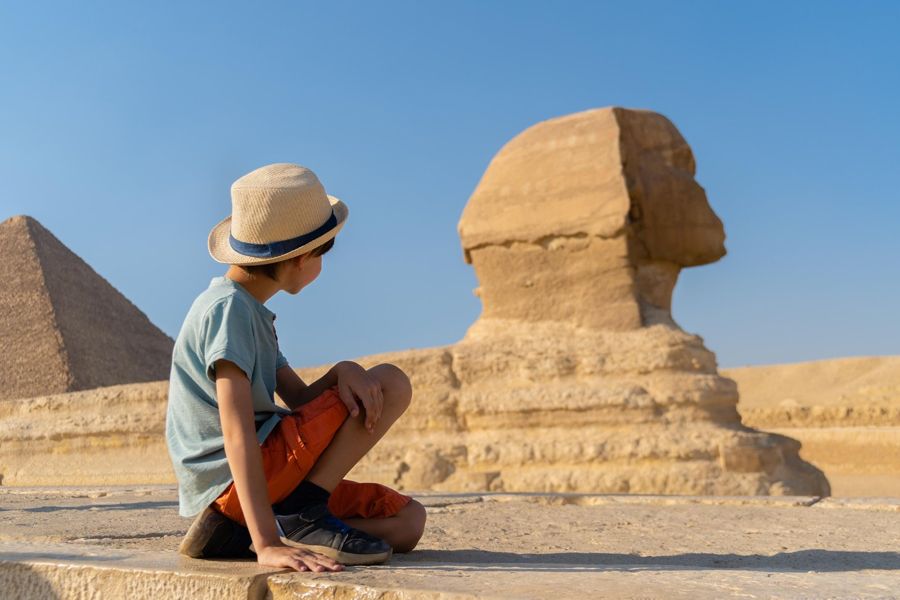
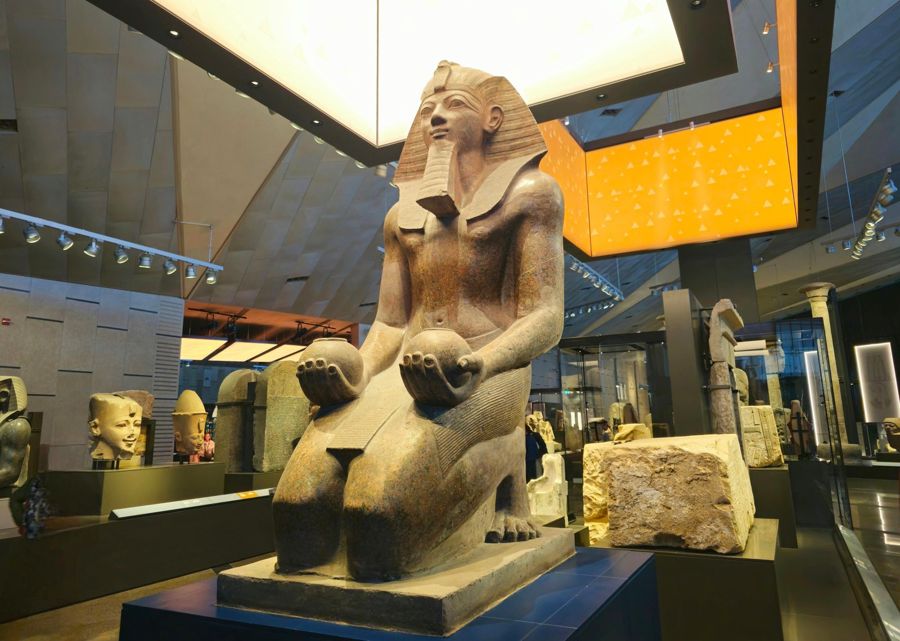
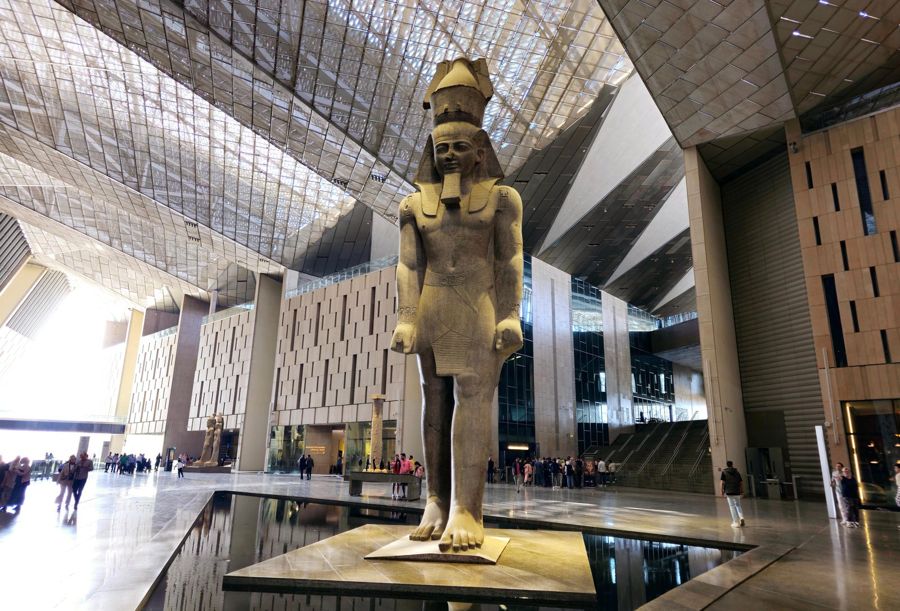
Day tour to the Grand Egyptian Museum and the plateau
- In the museum, the development of the building form up to these three complexes can be traced
- Plateau and museum in one day, without organizing two trips yourself
- Entry fees, German-speaking guide, pickup, and lunch are included
- Free cancellation up to 24 hours before start