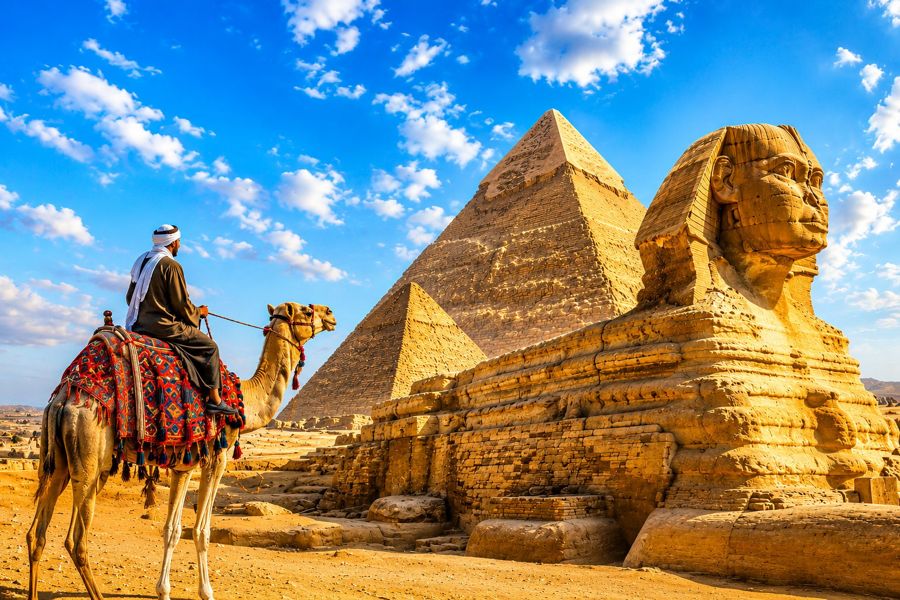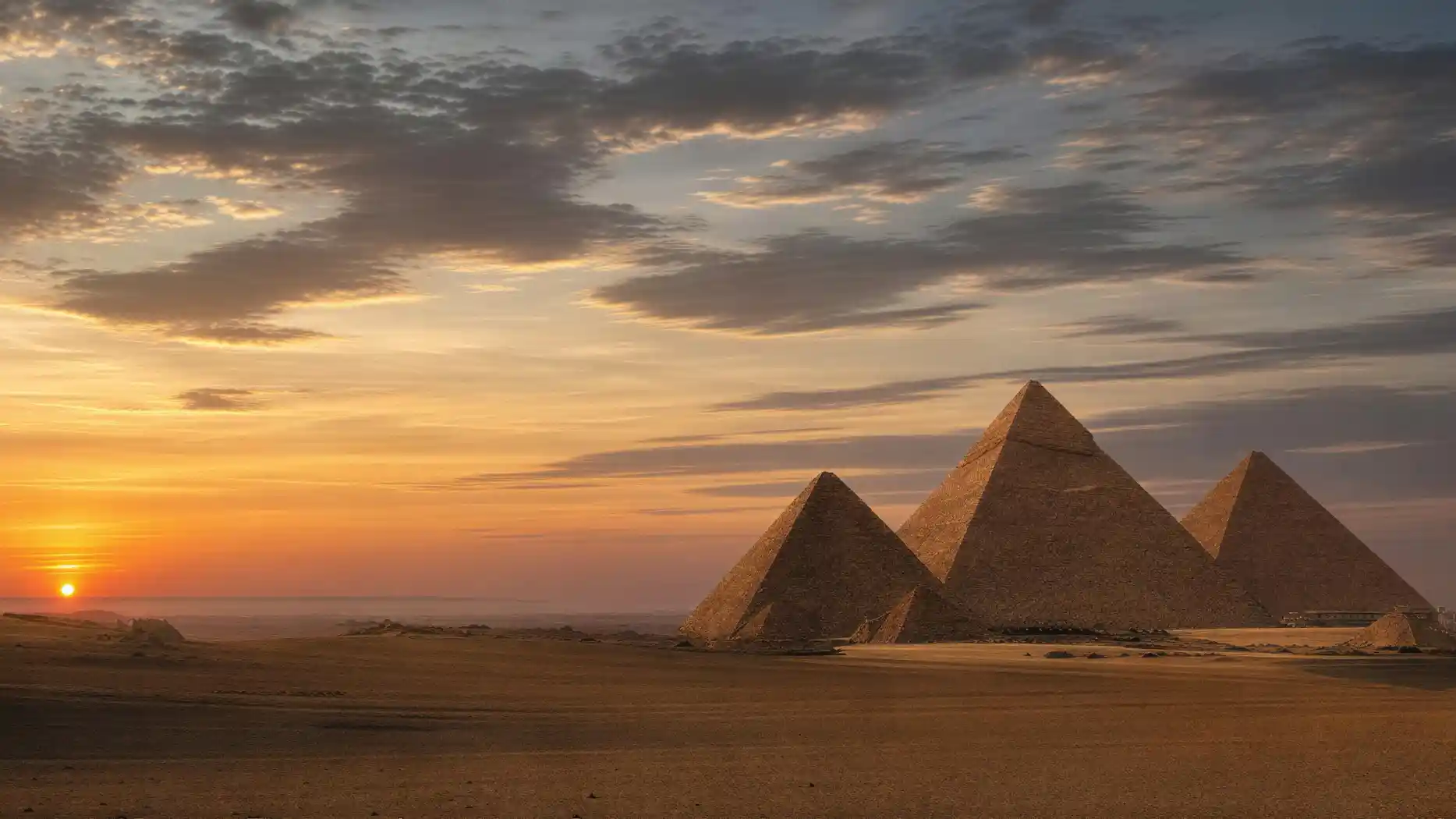
A 3D model of the Pyramids of Giza almost always fails at the same two points, and both can be addressed beforehand.
The first is the slope. If you build a pyramid without checking, you'll end up at forty-five degrees, because that's the angle that naturally results when you take a base and place the apex directly above its center. The real structures are significantly steeper, and this difference is immediately visible at twenty centimeters.
The second is the size ratio. In most school models, three equally sized pyramids stand side by side. In reality, the two large ones are nearly the same height, and the third is not even half as tall. So if you want to build a pyramid model yourself, it makes sense to start with the scale, not the cardboard.
Scales and the Measurements That Follow
All three structures in the same scale, otherwise the point is lost. Measurements in centimeters, each given as base side times height.
| Scale | Largest Pyramid | Middle | Smallest | Fits On |
|---|---|---|---|---|
| 1:500 | 46 by 29 | 43 by 29 | 21 by 13 | A group table |
| 1:1000 | 23 by 15 | 22 by 14 | 10 by 7 | A board for individual work |
| 1:2000 | 12 by 7 | 11 by 7 | 5 by 3 | A shoebox |
- Largest Pyramid
- 46 by 29
- Middle
- 43 by 29
- Smallest
- 21 by 13
- Fits On
- A group table
- Largest Pyramid
- 23 by 15
- Middle
- 22 by 14
- Smallest
- 10 by 7
- Fits On
- A board for individual work
- Largest Pyramid
- 12 by 7
- Middle
- 11 by 7
- Smallest
- 5 by 3
- Fits On
- A shoebox
The two large structures differ in height by just over three meters. At 1:1000, that's three millimeters, so nothing. The fact that the middle pyramid often appears taller in photos is not due to its height, but because it stands on higher ground.
The Right Slope Without a Protractor
You can get the right slope without a protractor, using the same rule the builders used.
The Egyptians didn't think of a slope as an angle, but as a ratio: how far a surface recedes horizontally while it rises one cubit. For the largest pyramid, this measure is five and a half palms, and a cubit has seven palms. Translated to the workshop, that means: five and a half units inward for every seven units upward. If you prefer working with round numbers, use four to five. Both variants land at just under fifty-two degrees, and the difference between them is not discernible on a model.
The practical advantage of this way of thinking is considerable: you don't have to measure anything slanted. You only measure horizontally and vertically, and the slope takes care of itself. That's exactly why this method proved itself on a construction site without a protractor, and the calculation is documented in practice problems on a papyrus at the British Museum.
Building Kits and Puzzle Games on the Topic
If you don't want to build from scratch or need a result with clean edges, go for a ready-made kit. Worth checking before buying: whether the depicted slope is steeper than 45 degrees.
Building the Pyramids of Giza in Minecraft
- Set the Scale
One block equals one meter is the obvious choice. The base then measures 230 by 230 blocks, and the apex is 147 blocks high.
- Don't Step In on Every Layer
If you step in one block on every layer all around, you build forty-five degrees and reach the top after 115 layers. That's the typical game pyramid, and it's visibly too flat.
- Step In Four, Go Straight One
Step in one block on four consecutive layers and pull the fifth straight up. After about 144 layers, you're at the top, and the slope is accurate to half a degree.
- Build Hollow
Only placing the outer shell saves over ninety percent of the material and time. From the outside, there's no difference to be seen.
- Don't Forget the Terrain
The middle pyramid belongs on a rise, otherwise the overall impression is wrong. It's lower than the largest and still appears taller.
How Many Blocks a Model Needs
One more number before you start. A solidly built pyramid in this scale devours about 2.6 million blocks. That's not an estimate, but simply the formula for a pyramid body, i.e., one third times base area times height.
What's remarkable about this is how close the number is to reality. The calculated volume of the real structure is also given as about 2.6 million cubic meters, and the estimated number of stone blocks used is in the same order of magnitude. So one game block roughly corresponds to one stone block in Giza, without anyone having set it up that way.
Practically, this means: by hand, the 1:1 scale is nothing. If you still want it, work with a build function. If you want to invest an afternoon, use a quarter of the edge length. The solid body would then come to just over forty thousand blocks, and built hollow, only a small fraction of that remains.
Are There Ready-Made 3D Files?
The question of ready-made files remains, and the answer is more honest than a search engine's results list.
There is no official, freely downloadable file of the structure itself. What exists is both better and worse. The Giza Project at Harvard University maintains a dedicated section for education under Giza for School: walkable reconstructions of the entire site, videos, a glossary, and objects sorted by teaching topics. For viewing and presenting, it's unmatched, but it's not meant for downloading.
If you really need files, you'll find them in the 3D collection of the associated museum: 182 scanned objects from the site, including statues, false doors, and stelae. Some of them can be downloaded, and the license is stated for each individual model, not for the collection as a whole. So if you're looking for free 3D files of the pyramids, you'll find high-quality objects from the site there, but not the pyramid.
Project Ideas for the Pyramids of Giza
- Build all three structures in the same scale so the size ratio actually comes into play
- Cover only one side smoothly and leave the others stepped, as the construction looked before completion
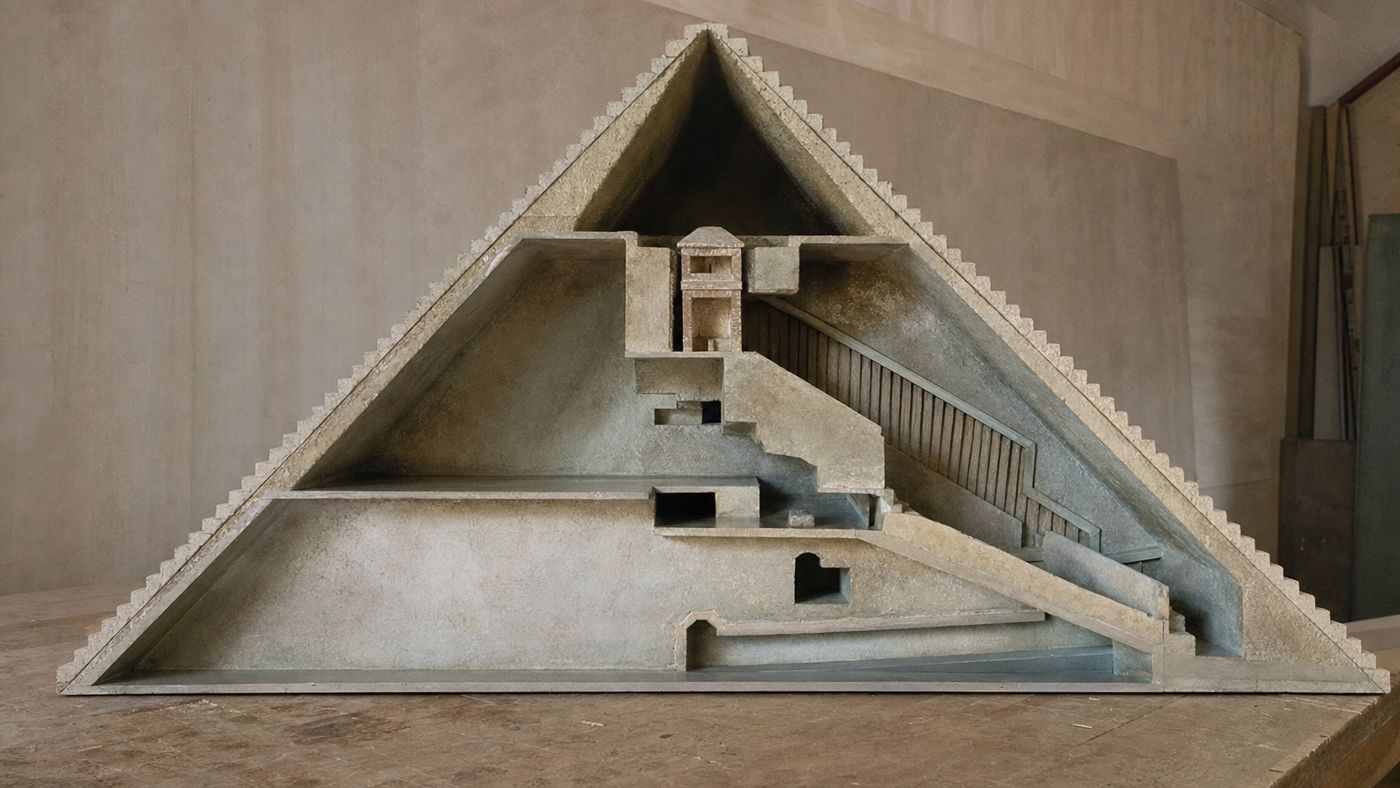
- Instead of a closed body, build a cross-section, because only then do the chambers become visible
- Model the terrain as well, otherwise the most important visual effect remains unexplained
- Place a building from your own town next to it in the same scale
- Calculate the number of blocks yourself beforehand and attach the calculation to the model
Frequently asked questions
What angle does a Pyramid of Giza have?
The largest about 51.9 degrees, the middle about 53.1 degrees, the smallest about 51.5 degrees. None of them has 45 degrees, and that's exactly the most common mistake on a model.
Which scale is suitable for a school project?
1:1000 is the best compromise. The largest pyramid then measures 23 centimeters square and is 15 centimeters high, and all three fit together on a board.
What's the best material to build from?
For edges and slope, sturdy cardboard is suitable; for the stepped effect, sugar cubes or small building blocks. More important than the material is that the base side is correct.
Is there a puzzle with the Pyramids of Giza?
Yes, both flat and as a three-dimensional building kit. It's worth looking at the picture: a model that's too flat stands out immediately next to a scale-accurate one.
How long does a replica take in the game?
Not by hand at 1:1 scale. At a quarter of the edge length and built hollow, it's an afternoon.