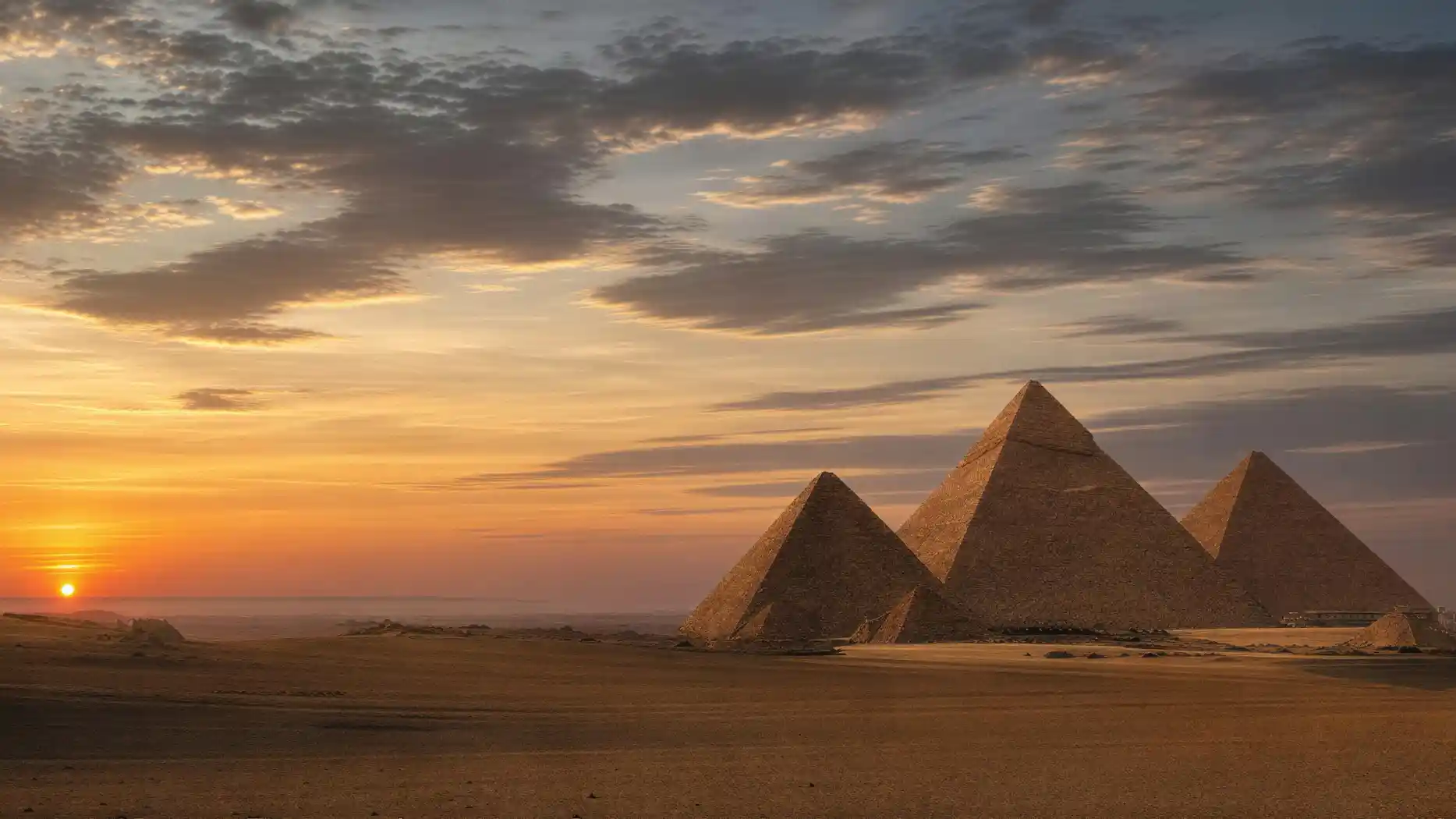
When asked about the original appearance of the Pyramids of Giza, the answer is almost always the same: smooth and white. It is correct, and it describes perhaps a fifth of what has been lost.
Because what is missing is not just a surface. An entire complex of buildings is missing. Each of the three pyramids had a mortuary temple on the east side, a covered causeway several hundred meters long, and at the lower end of that causeway, a second temple by the water. In addition, there were subsidiary pyramids, enclosure walls, boat pits, and the cemeteries of the officials.
The official overview of the site accordingly lists not three structures but a necropolis with a whole series of individual buildings.
Standing on the site today, you see three structures in the desert. Standing there four and a half thousand years ago, you would have seen an enclosed complex that began at the water and ended at the top of the building, with walls, courtyards, and gates in between.
A side effect of the smooth outer surface is often overlooked and is physically obvious: a polished, south-facing limestone surface of several hectares reflects sunlight in a directed way. The structures were therefore not just bright, but blinding under certain sun angles, and from a great distance. When imagining the original state, you should include this effect, not just think of a white color.
This page describes the finished state, not the construction. The casing itself and its fate have their own page, because the story of its disappearance is long enough on its own.
Three States, Three Very Different Images
Around 2500 BC, Completed
Closed white surfaces, pyramidion present, temples and causeways in operation, valley temple at the water.
- Good for
- The image that reconstructions show and that actually existed once.
- Watch out
- Of this state, almost nothing above ground has survived.
2000 Years Ago, Roman Era
The casing still largely standing, the structures at the foot already partly buried in sand.
- Good for
- The state that ancient travelers described.
- Watch out
- Even then, the structure was older than the Roman era is from us.
Today
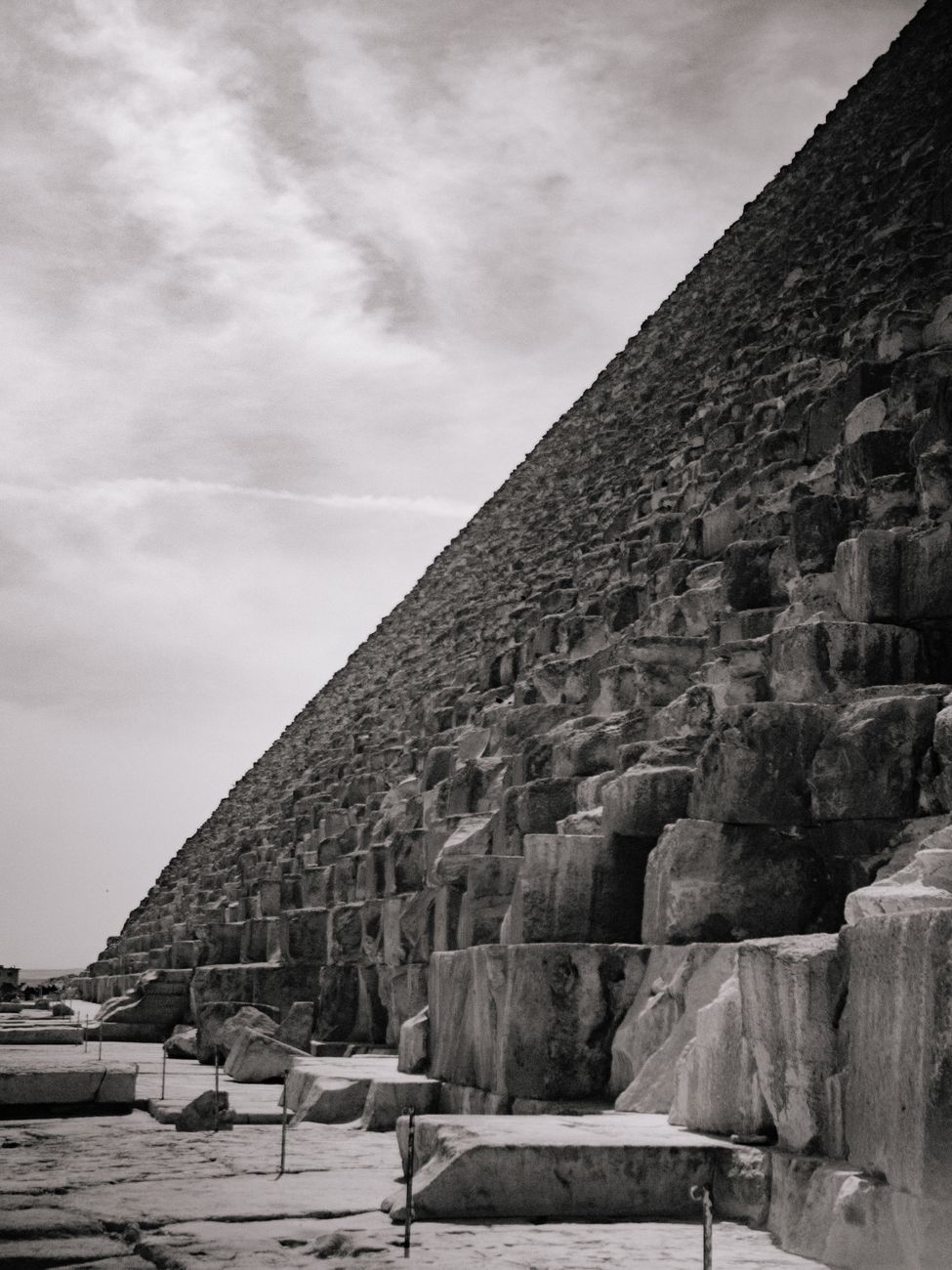
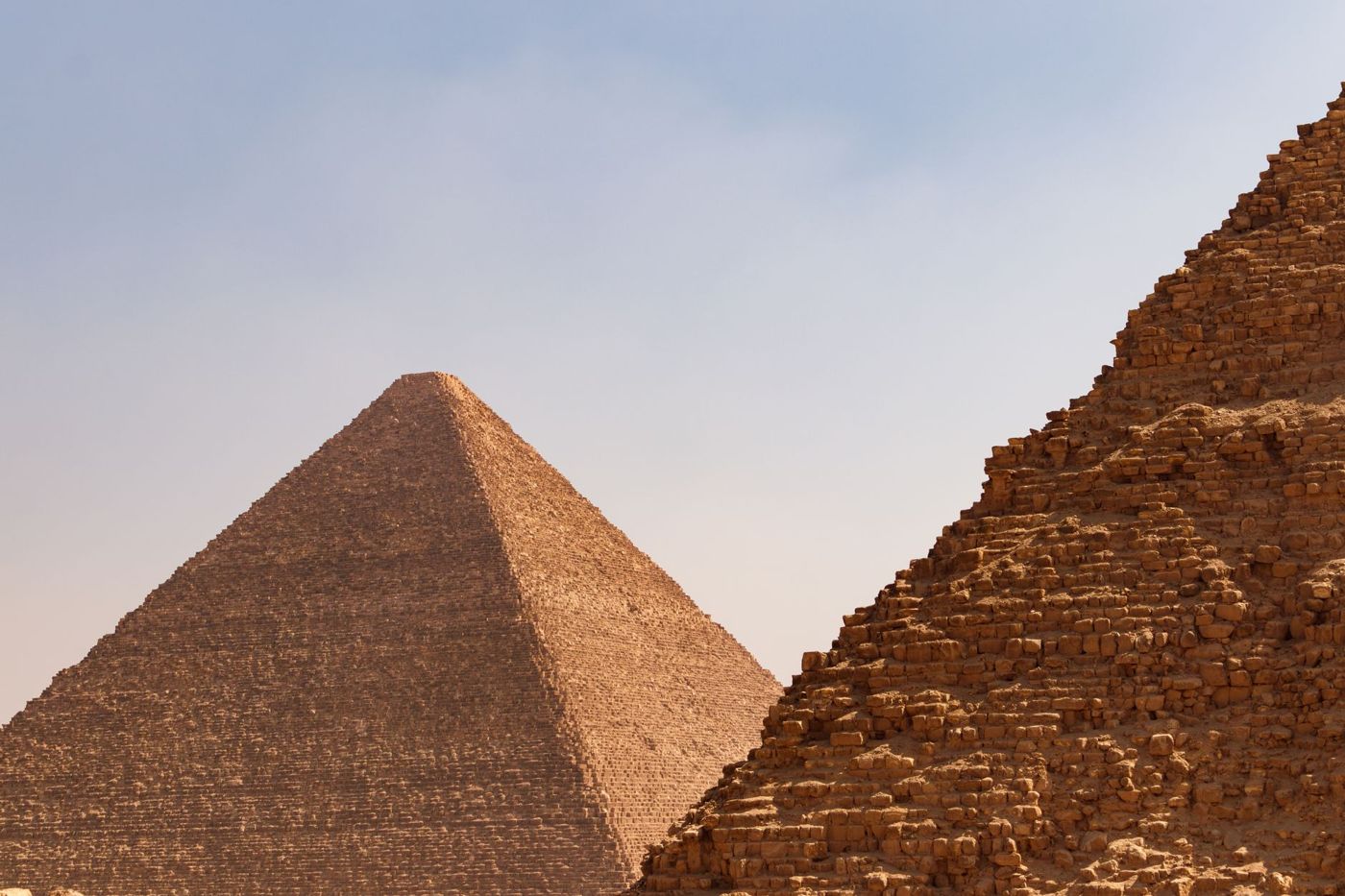
Stepped core masonry, missing pyramidion, only a floor remnant of the mortuary temple, nothing visible of the valley temple.
- Good for
- What you actually find when you visit.
- Watch out
- The loss is mostly medieval, not ancient.
The Complete Complex of the Great Pyramid
What did the Pyramids of Giza originally look like, when you consider the whole complex? This is best illustrated by the Great Pyramid complex, because it has been studied the most.
On the east side of the pyramid stood the mortuary temple. Essentially only the floor remains, and it is made of black basalt. This choice of material is the point where most mental images fail: you imagine the complex as white, but in reality you stood on a polished black surface and looked up at a white wall. In addition, there were pillars of red granite.
From this temple, a causeway led down to the valley. Herodotus, who saw the site in the fifth century BC, gave its length as about a kilometer; modern measurements put it at about seven hundred meters. The causeway was roofed and decorated with reliefs on its walls, so it was not a transport route but a building in its own right.
This combination of materials was not accidental but deliberate. Black basalt came from the Faiyum, red granite from Aswan, and the light limestone from the other side of the Nile. Each of these stones had to be transported over hundreds of kilometers, and the combination was a statement about how far the king's reach extended.
At the lower end stood the valley temple. Nothing of it is visible above ground today, and the reason is very modern: it lies beneath the residential district of Nazlet el-Samman. It was confirmed through excavations that uncovered basalt paving and walls of large limestone blocks.
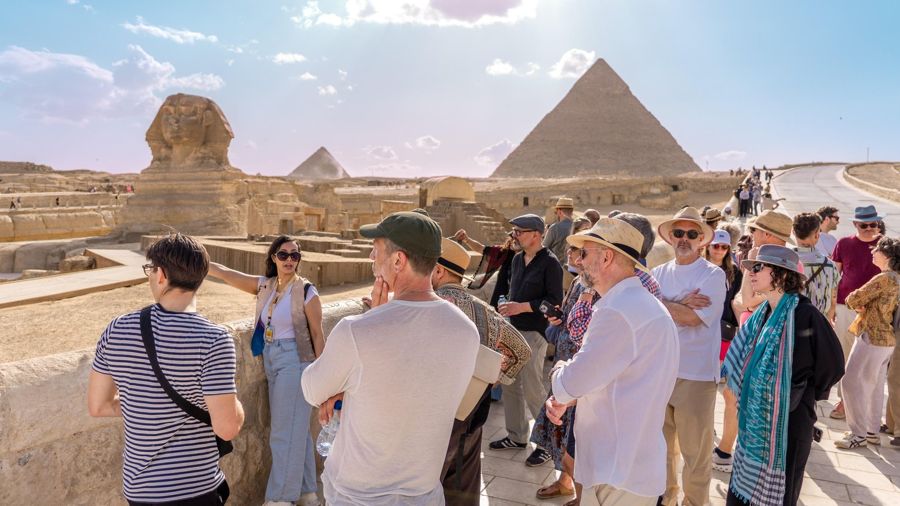
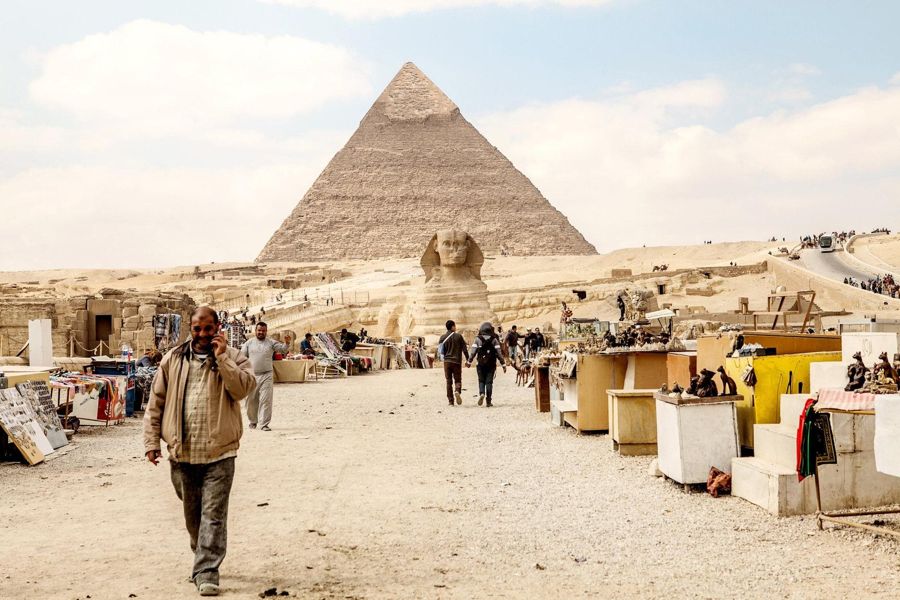
Half-Day Tour to the Plateau and the Sphinx
- The remains of the mortuary temple, causeway, and boat pits lie off the main paths
- Four hours, German-speaking guide, with pickup and priority entry
- Plateau entry included, electric shuttle included
- Free cancellation up to 24 hours before start
It Was a Complex by the Water
The second major difference concerns not the buildings but the landscape. The complex was not a desert installation but one by the water.
The mapping of the site and studies of the water infrastructure of the Fourth Dynasty show a basin that extended from a western branch of the Nile to the area east of the Sphinx. The broad rock terrace on which the valley temple of Khafre and the Sphinx temple stand likely served as a landing stage and transshipment point where building materials arrived. The river was therefore not far away but was part of the complex.
This also explains why the valley temples are where they are. They are not arbitrarily placed forebuildings but the point where the waterway and the complex met. A coffin, a statue, or a delivery of stone came by boat to that point and was then brought up the causeway.
This changes the picture fundamentally. Instead of three pyramids in the sand, you have to imagine a complex that rises from a harbor via ramps and covered paths, with palms and fertile land to the east and the desert only beyond that.
For visualization, a comparison with a European cathedral complex helps. There, too, you have not just a church but an ensemble of forecourt, auxiliary buildings, and walls, and there, too, this surroundings disappears in perception behind the main building. In Giza, the surroundings have additionally physically disappeared.
If you want to see the Pyramids of Giza as they were 2000 years ago, you only need to add the casing and leave out the temples. In Roman times, the smooth outer surfaces were still largely standing, but the structures at the foot were already partly buried in sand and out of use. Ancient travelers therefore described exactly what is still in the foreground today: the size of the structures, not the architecture around them.
The Question of the Golden Capstone
There remains the question that is asked more often than any other on this topic: the golden capstone of the pyramids.
The idea is widespread and it is not silly. Pyramid capstones did exist as a separate architectural element, called a pyramidion, and some have survived. The most famous one comes from the pyramid of Amenemhat III at Dahshur, is made of polished black granite, and bears inscriptions to the sun god. It is now in a Cairo museum and shows what such a piece looked like.
However, for Giza there is nothing of the sort. No pyramidion has ever been found that could be attributed to any of the three pyramids, and no traces of gold have been recovered either. The assumption that the capstone was made of gold or electrum is based on later texts and analogies, not on any find at the site.
Where the idea comes from can at least be plausibly explained. Later Egyptian obelisks are documented to have had gilded tips to catch the first sunlight, and transferring the same idea to a pyramid is a natural mental step. But a plausible transfer does not constitute evidence.
To be honest, the answer is therefore: possible, but unproven. If you draw a reconstruction with a golden capstone, you are making an assumption and should label it as such. If you leave it out, you are on the safe side.
Three Ideas About the Original State
- Partially
The pyramids had a golden capstone.
Pyramidia existed, but the surviving examples are made of stone. For Giza, neither a pyramidion nor gold has been proven; the assumption rests on later texts.
- False
The complex consisted of three pyramids in the desert.
Each pyramid had a mortuary temple, a causeway, and a valley temple at the water, plus subsidiary pyramids and walls. The river reached the foot of the plateau.
- Partially
Everything white was limestone.
The outer casing, yes. The temples, however, worked with contrasts: black basalt on the floor, red granite as pillars.
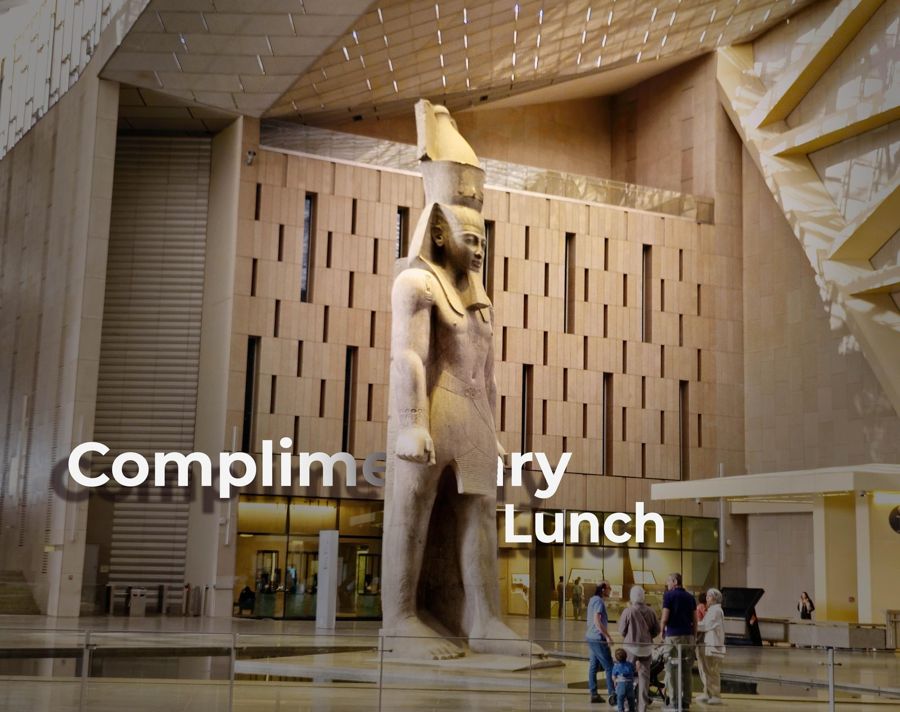
Plateau and the Grand Egyptian Museum in One Day
What remains of the furnishings is no longer at the original site. This tour combines the site with the museum, German-speaking guide, with entry and lunch.
What Disappeared First
If you want to compare the Pyramids of Giza then and now, you should know exactly when what disappeared. The order is different from what most people assume.
First, the structures at the foot were lost, not the casing. Temples, causeways, and enclosure walls decayed and were buried in sand over centuries because they were no longer used and their stones were easier to remove than those of the pyramids. Much of this was already out of operation in antiquity.
The smooth outer surface, on the other hand, lasted a very long time. It was still largely standing in Roman times and was only systematically stripped in the Middle Ages, when Cairo was being built and an earthquake had loosened large quantities of material. The appearance we consider the natural state of aging is therefore the result of a very specific construction period.
This order has a practical cause. A temple consists of manageable, neatly dressed blocks on level ground, while a pyramid flank consists of dressed stones that you first have to bring down from a sloping surface at a height of thirty meters. Anyone looking for building material started at the bottom.
Last to disappear was the capstone. The Great Pyramid is now missing nearly ten meters, which is why its height is given differently in older and newer sources, depending on whether the reconstructed or the current value is meant.
A word about the subsidiary pyramids, because they are often missing in reconstructions. East of the Great Pyramid stand three smaller structures for members of the royal family, and they were part of the completed picture. If you leave them out, you are drawing a complex that never existed.
What follows from this for the image: It was not time that cleared the complex, but use. The pyramids were for centuries a quarry with a view, and that explains the current state better than any erosion story.
Frequently asked questions
Were the pyramids really white?
The outer casing was made of light limestone and was polished smooth. The temples at the foot, however, used black basalt and red granite.
Was there a golden capstone?
Not proven. Pyramidia existed, but the surviving ones are made of stone. For Giza, neither a pyramidion nor gold has been found.
Where is the valley temple of the Great Pyramid?
Beneath the modern residential district at the foot of the plateau. It is confirmed by excavations, but not visible.
When was the casing lost?
Mostly in the Middle Ages, when Cairo was being built. In Roman times, it was still largely standing.
How much height is missing today?
The Great Pyramid is missing nearly ten meters. That is why two different height figures are in circulation.