The question of the number sounds simple, but it has a fundamental problem: there is no list. No Egyptian text mentions a workforce size, no stone tablet records a tally, and the only ancient number that has come down to us comes from a Greek traveler and is almost certainly wrong.
Herodotus wrote of a hundred thousand men working in shifts of three months. This number has persisted for two thousand five hundred years, and to this day it is the first that comes to many people's minds. However, it does not hold up against the excavation. A settlement for a hundred thousand people would have been the largest city of its time, with a supply apparatus that would far exceed anything that can be proven on the plateau.
What exists instead is better than a second-hand number: an excavated city. Since the 1980s, a settlement has been uncovered southeast of the pyramids where the builders lived, ate, and were administered. From their sleeping places, their ovens, and their bone waste, it is possible to estimate how many people lived there at the same time.
The result is an order of magnitude below Herodotus. And it comes with a caveat that is missing from most pages on this topic.
First, it is worth making a distinction that most figures fail to make. Who was involved in the construction is not the same as who was on the construction site. The second group includes the stone setters, the hauling crews, and the craftsmen on site. The first group also includes the quarry workers in Tura and Aswan, the ship crews on the river, the carpenters who maintained sledges and boats, the copper smiths who sharpened tools, and the bakers, brewers, and potters who kept the whole apparatus running.
And behind that is a group that does not appear in any list: the farmers whose surplus provided food for two decades. Depending on where you draw the line, the answer changes by a factor of three. That is exactly why so many different numbers circulate side by side, without any of them necessarily being wrong.
The settlement in numbers
- Excavated area
- about 4 hectares, roughly six football fields
- Sleeping galleries
- four blocks with long halls
- Space in the galleries
- estimated 1,600 to 2,000 people at a time
- Meat consumption
- estimated 21 cattle and 23 sheep per day
- Discovery of the necropolis
- 1990, by chance
- Builders of the settlement
- Khafre and Menkaure, not Khufu
Heit el-Ghurab was a planned city
The site is called Heit el-Ghurab in Arabic, Wall of the Crow, after a massive stone wall that forms the northwestern edge of the area. It has been excavated for decades by the Ancient Egypt Research Associates under Mark Lehner, and what has come to light there is not a collection of barracks but a planned city.
The most striking structures are four blocks of long halls interpreted as sleeping galleries: narrow rooms with raised sleeping benches along the walls, each with its own cooking area at the end. Between them are bakeries with ovens and bread molds in a size that would be pointless for a household. In addition, there are storage yards with round silos, cattle pens, workshops, three main streets, and a large administrative building.
The excavation reports on this settlement also describe thousands of clay seal impressions bearing names, titles, and institutions. They are evidence that this was not improvised but administered: with responsibilities, deliveries, and bookkeeping.
The wall that gives the site its name is itself a structure of some size: about two hundred meters long, several meters high, and built from blocks that would be completely oversized for a mere boundary. A gate passes through it, and the current interpretation sees it as the transition between the harbor area and the pyramid city grounds. This fits another finding: the settlement was not in the desert but at a harbor through which materials and food arrived.
Anyone who equates the workers' settlement of the Giza pyramids with a tent camp underestimates it considerably. A closer comparison is with a company town: built for a purpose, operated for a limited time, with supplies coming from outside.
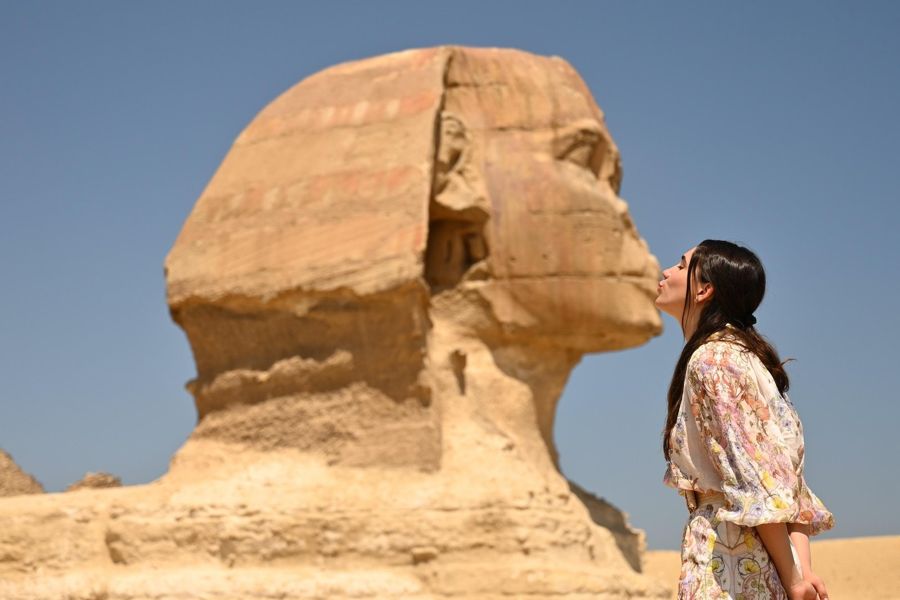
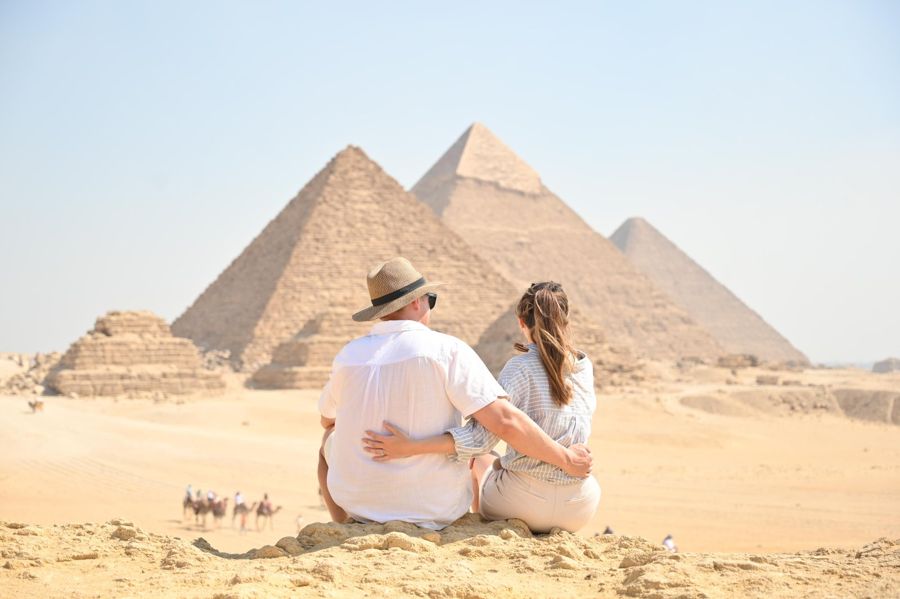
Half-day tour to the Pyramids of Giza and the Sphinx
- A licensed guide explains which structures on the plateau belonged to the construction organization
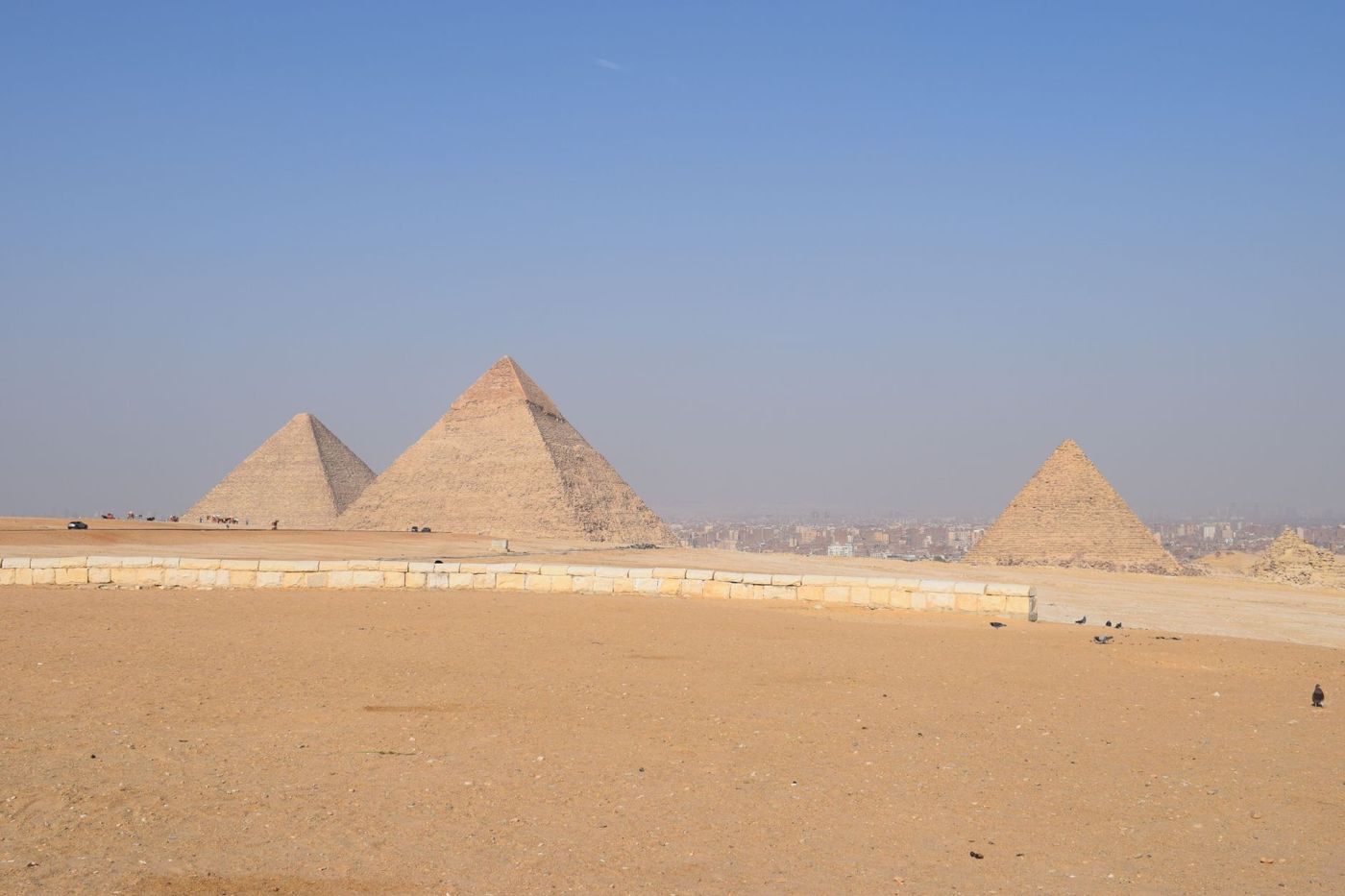
- The view from the plateau to the southeast shows the location of the settlement in the terrain
- Plateau entry, German-speaking guide, and hotel pickup are included
- Free cancellation up to 24 hours before start
Two ways to arrive at a number of people
From these finds, numbers of people can be derived in two independent ways, and that is exactly what makes them reliable.
The first way is through space. The sleeping galleries can be measured, and the sleeping surfaces counted. This yields an occupancy on the order of one and a half to two thousand people who slept in this part of the settlement at the same time. These are not all those involved, but those who slept on site.
The second way is through food. From the animal bones in the settlement waste, meat consumption can be estimated, and the results are surprisingly concrete: more than 1,800 kilograms of meat per day from cattle, sheep, and goats, delivered from estates throughout the country. With realistic rations, that feeds an order of magnitude of about ten thousand people.
How the workforce was organized can be supplemented from inscriptions at other structures. The crews were divided into named units, these in turn into smaller divisions, and the names of these groups appear as marks on stone blocks, including in the relieving chambers of the Great Pyramid of Khufu. So it was a fixed structure with responsibilities, not an anonymous mass.
Both ways do not lead to the same number, and that is not a contradiction. One measures who slept in the galleries, the other how many were supplied in total. Part of the workforce lived in the surrounding area, in their own houses or in the nearby village.
What archaeological evidence for the pyramid workers yields, therefore, is not a single number but a corridor: a few thousand permanently on site, around ten thousand employed at the same time, and over the years a multiple of that because the crews rotated.
Where the different numbers come from
The figures contradict each other less than it seems. They count different things.
| Figure | What it is based on | What it counts |
|---|---|---|
| 100.000 | Herodotus, about two thousand years after the construction | Presumably all ever involved, or an exaggeration |
| 20,000 to 30,000 | Estimate from construction volume and work performance | The entire organization including supply and administration |
| about 10,000 | Meat consumption from the bone evidence | All who were supplied from the plateau |
| 1,600 to 2,000 | Survey of the sleeping galleries | Only those who slept in this part of the settlement |
- What it is based on
- Herodotus, about two thousand years after the construction
- What it counts
- Presumably all ever involved, or an exaggeration
- What it is based on
- Estimate from construction volume and work performance
- What it counts
- The entire organization including supply and administration
- What it is based on
- Meat consumption from the bone evidence
- What it counts
- All who were supplied from the plateau
- What it is based on
- Survey of the sleeping galleries
- What it counts
- Only those who slept in this part of the settlement
None of these numbers is counted. All are estimated from the evidence and carry corresponding uncertainties.
This settlement does not belong to the Great Pyramid of Khufu
And now the caveat that is almost always missing: this settlement does not belong to the Great Pyramid of Khufu.
The dating of the site assigns it to the period of the two later structures. The official description of the site explicitly names the builders of the complexes of Khafre and Menkaure as its inhabitants and merely notes that older remains from the time of Khufu may lie beneath.
For the original question, this means: the city we know is that of the second and third structures. The accommodations of the crews who built the largest of them have not yet been securely identified. They could lie under the younger settlement, have stood at another spot on the plateau, or have disappeared under the modern buildings at the foot of the slope.
A hint that they must have existed is found in the records of Inspector Merer. His logbook from the 27th year of Khufu's reign records trips with casing stones to the plateau and mentions stopping points and accommodations. A construction site of this size without an associated settlement is logistically inconceivable. But that does not mean it has been found.
Therefore, the transfer to the Great Pyramid of Khufu is an analogy, not a measurement. It is well founded because both projects took place in the same generation, with the same institutions, and on a comparable scale. Still, it is not clean, and anyone who gives a number for the largest structure should add that it comes from the neighbor.
Where the settlement is located
- Great Pyramid of KhufuNortheasternmost of the three structures, reference point for distance
- Wall of the CrowMassive stone wall, northwestern boundary of the settlement area
- Settlement area Heit el-GhurabGalleries, bakeries, storage, and administrative building, southeast below the plateau
- Workers' necropolisOn the slope west of the settlement, laid out in two levels
- Modern buildingsReach right up to the site and limit the excavation area
The location is schematic. The site is not part of the usual tours and can only be recognized from the pyramids as a depression.
A horse found the workers' necropolis
The second site came to light by a chance that could hardly be invented. In 1990, a rider's horse stumbled over a wall edge on the slope. Beneath it lay the edge of a necropolis where the builders were buried, laid out in two levels: simple graves at the bottom, larger structures for overseers and craftsmen above.
What makes this site so informative are the inscriptions. They name job titles and ranks, and they name the names of crews who called themselves, as one would name a department today: as followers of their king. People who were considered property did not receive their own structures in sight of the king's tomb in the Old Kingdom, nor inscriptions with professional pride.
The skeletons also show what the work did to their bodies: healed fractures, worn spines, but also traces of medical care. The workers of the Giza pyramids were thus physically heavily strained and at the same time treated when something happened.
Also remarkable is the construction form. Several of the small structures imitate in mudbrick what stands in stone next door: tiny pyramids of a few meters in edge length, some with their own small cult place in front. It is a gesture that says a lot about the self-image of the buried. They did not copy the tomb of an arbitrary nobleman, but the construction form on which they themselves had worked.
The location is also a statement. The necropolis lies on the slope, above the settlement and in line of sight to the structures. Those buried there remained assigned to the project, beyond death. In a society where proximity to the king's tomb was a matter of rank, this is not a random place.
For the question of numbers, the necropolis is only a rough indicator because it was used over decades and is far from fully excavated. For the question of who these people were, it is the most important site of all.
Plateau entry as QR code on your phone
Important: According to the ministry, the area ticket does not cover the workers' necropolis. A separate ticket is required for this area.
Frequently asked questions
Were there a hundred thousand people?
No. The number comes from Herodotus and does not hold up against the excavation evidence. Realistic are a few thousand permanently on site and around ten thousand employed at the same time.
Can the settlement be visited?
It is designated as a site, but it is not part of the usual tours. For the workers' necropolis, the ministry also requires a separate ticket; the area ticket is not sufficient there. Expect an excavation site with foundations, not standing structures.
Where exactly is it?
Southeast of the pyramids, below the edge of the plateau, directly at the modern buildings. From above, it can be recognized as a depression.
Does the settlement belong to the Great Pyramid of Khufu?
Mostly not. The excavated remains belong to the two later complexes; older remains beneath are possible but not confirmed.