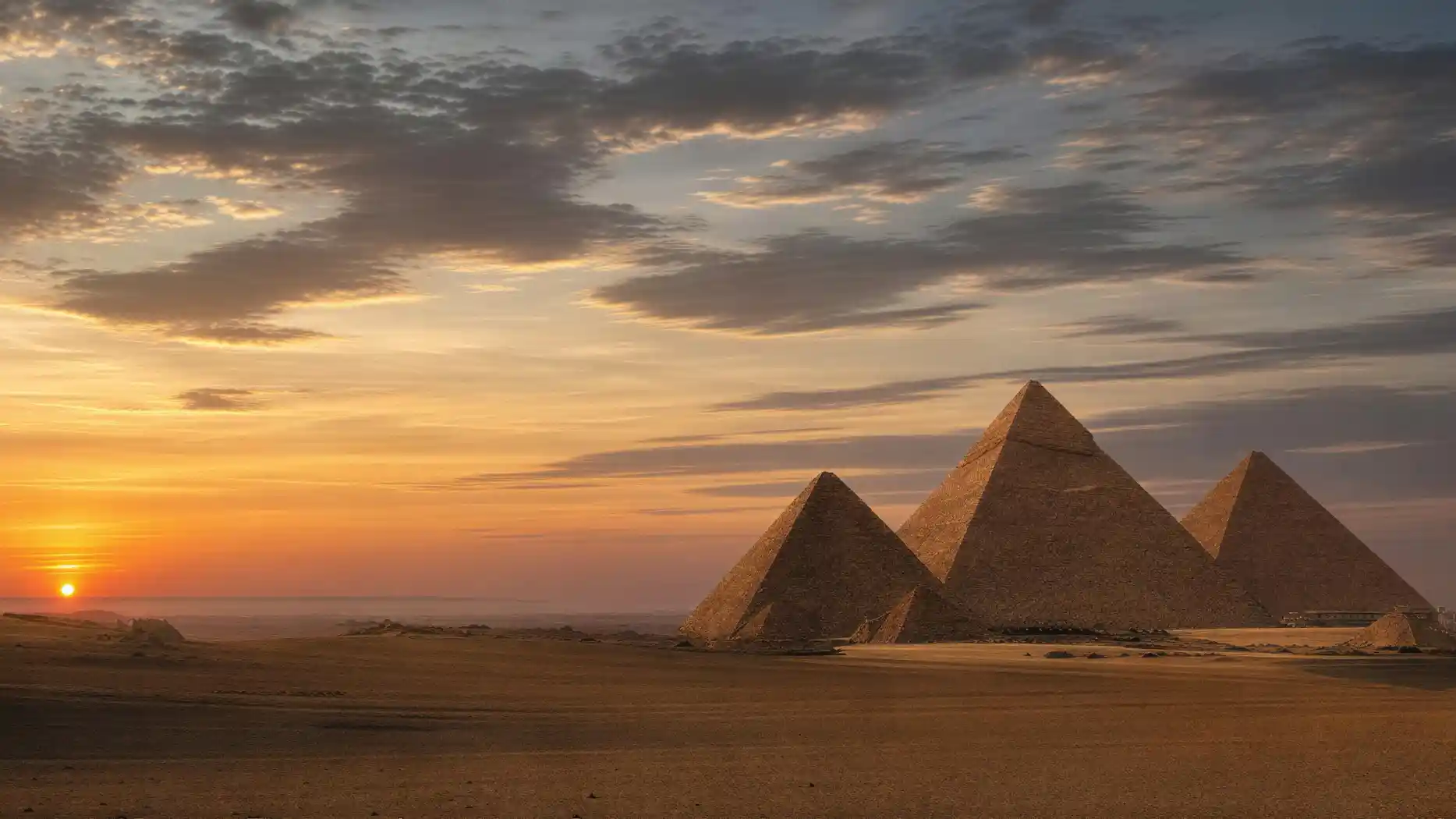
There are two lists, they share the same name, and almost all misunderstandings on this topic arise from confusing them.
The first is ancient. Greek authors compiled a list of particularly remarkable structures in the third and second centuries BC. It included seven entries, one of which was the Great Pyramid of Khufu. Of these seven, only one still stands today: the one at Giza. All the others have been destroyed, and for one of them, its existence is still disputed.
The second is new. In 2007, a worldwide public vote ended, organized by a private Swiss foundation, in which a new list of seven was voted on via the internet and telephone. The status of the Great Pyramid as a wonder was a problem from the start, and it was resolved in a way that still causes confusion today.
In short: The pyramid was not on the ballot in the end, but it did not fail either. It was removed. Why this happened and what this special path practically means is the content of this page.
Both lists side by side
On the left, the ancient list; on the right, the result of the 2007 vote.
| Ancient list | Condition today | New list from 2007 | Country |
|---|---|---|---|
| Great Pyramid of Khufu at Giza | Preserved | Chichén Itzá | Mexico |
| Hanging Gardens of Babylon | Disappeared, existence disputed | Christ the Redeemer in Rio | Brazil |
| Statue of Zeus at Olympia | Destroyed | Great Wall of China | China |
| Temple of Artemis at Ephesus | Destroyed | Machu Picchu | Peru |
| Mausoleum at Halicarnassus | Destroyed | Petra | Jordan |
| Colossus of Rhodes | Destroyed | Colosseum in Rome | Italy |
| Lighthouse of Alexandria | Destroyed | Taj Mahal | India |
- Condition today
- Preserved
- New list from 2007
- Chichén Itzá
- Country
- Mexico
- Condition today
- Disappeared, existence disputed
- New list from 2007
- Christ the Redeemer in Rio
- Country
- Brazil
- Condition today
- Destroyed
- New list from 2007
- Great Wall of China
- Country
- China
- Condition today
- Destroyed
- New list from 2007
- Machu Picchu
- Country
- Peru
- Condition today
- Destroyed
- New list from 2007
- Petra
- Country
- Jordan
- Condition today
- Destroyed
- New list from 2007
- Colosseum in Rome
- Country
- Italy
- Condition today
- Destroyed
- New list from 2007
- Taj Mahal
- Country
- India
The Great Pyramid of Khufu received a special status outside the competition in the 2007 vote and therefore does not appear in the right column.
The ancient list was never a registry
The ancient list is older than most assume, and it was never an official registry.
It was compiled by Greek authors who wrote a kind of travel recommendation for educated readers. The most famous are Philo of Byzantium, who wrote a treatise on the seven sights around 225 BC, and Antipater of Sidon, whose poem from the second century BC is considered the oldest surviving version. It was thus a subjective selection, written in the Greek cultural sphere, and accordingly almost all entries are in the eastern Mediterranean.
What became of the other six is known and partly well documented. The Temple of Artemis at Ephesus was destroyed and rebuilt several times, finally in late antiquity. The Colossus of Rhodes, a bronze statue at the harbor, stood for only a little over half a century before an earthquake toppled it; its remains then lay on the ground for centuries. The Lighthouse of Alexandria survived the longest and only fell into ruin in the Middle Ages after several earthquakes; its blocks are now in a fortress at the same site. The Statue of Zeus at Olympia and the Mausoleum at Halicarnassus have disappeared, with fragments of the latter surviving. And the Hanging Gardens of Babylon are the only entry for which no archaeological evidence exists to this day. An overview of the ancient list shows how different the source situation is for each entry.
One detail makes the matter astonishing: All seven structures stood simultaneously for only a period of less than sixty years. The Colossus of Rhodes collapsed in an earthquake when other entries had not yet been built or were just being completed. The list thus describes not a permanent world order, but a very brief moment.
And in that moment, the Great Pyramid of Khufu was already over two thousand years old. It was the only entry that already seemed ancient at the time of the listing. For the Greek authors, it was what it is for us: a structure from an unimaginably distant past.
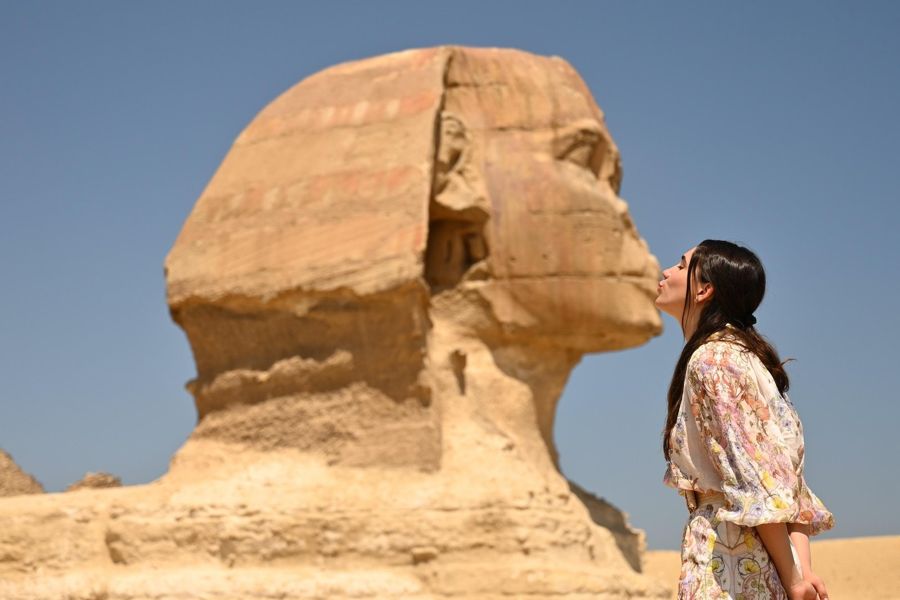
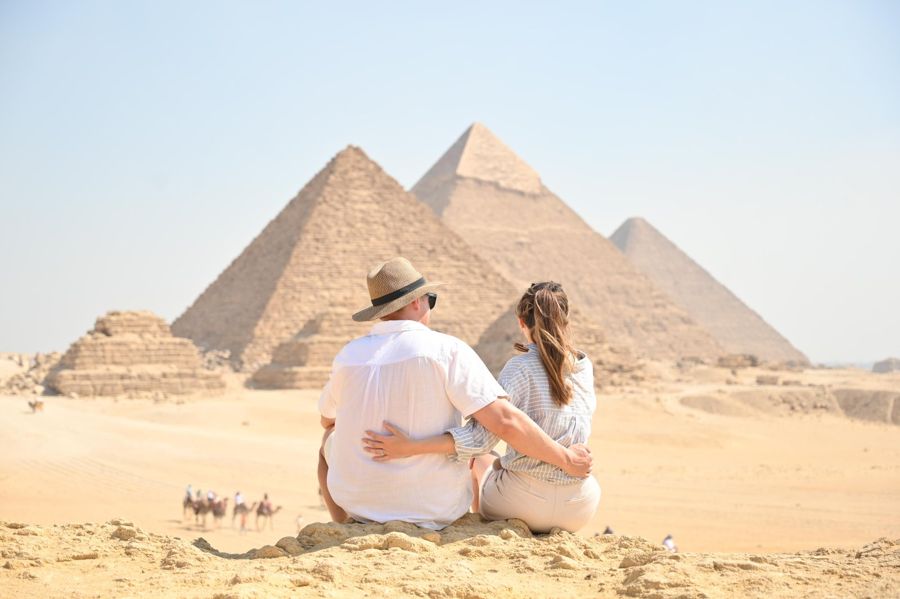
Half-day tour to the Pyramids of Giza and the Sphinx
- The only surviving ancient wonder, with explanation instead of just a photo
- Plateau entry, German-speaking guide, and pickup are included
- Five to six hours, the classic format for a first visit
- Free cancellation up to 24 hours before
The new list emerged from a campaign
The new list emerged from a campaign, and that is not a derogatory description but a factual one.
The initiator was the Swiss filmmaker and entrepreneur Bernard Weber, who organized a worldwide vote through his own foundation. From initially over one hundred proposals, a selection of twenty-one finalists was formed, which could be voted on via internet and telephone. The result was announced on July 7, 2007, in Lisbon.
The scale was considerable. From over one hundred proposed structures, a list of twenty-one finalists was formed, including the Acropolis, the Alhambra, the Hagia Sophia, the Sydney Opera House, and the Statue of Liberty. The organizers later spoke of around one hundred million votes cast, a number that cannot be independently verified because the process did not require registration. The foundation itself describes its relationship with UNESCO as separate, with common goals but no formal connection.
The action was a media success and was also criticized from the start. The main criticism concerned the method: Those who vote do not decide based on which structure is culturally significant, but on which country runs the biggest campaign. Multiple votes were possible, and several governments actively called on their populations to participate.
Professionally, the selection thus stood on a different basis than any scientific evaluation. It measures attention, not significance. That is legitimate as long as you know what was measured, and that is exactly what UNESCO pointed out in a statement.
There is no comparison between Mr. Weber's media campaign and the scientific and educational work that follows from the inscription of sites on the UNESCO World Heritage List.UNESCO statement of July 6, 2007, one day before the announcement of the new list
UNESCO was not involved in the vote and explicitly distanced itself from it. The foundation itself also clarifies that there is no formal connection between the two organizations.
Why Egypt protested
For Egypt, the matter was delicate for a different reason, and the reaction was clear.
The objection was, in essence: A structure that has stood for over four and a half thousand years and is the only survivor of the ancient list does not need to compete in an internet vote against younger structures. From the Egyptian perspective, participation was not an opportunity but a downgrade. The criticism came from the highest level of the antiquities administration and was voiced publicly.
The organizers responded with a compromise. In spring 2007, the site was removed from the vote and instead declared an honorary candidate. The honorary status of the Great Pyramid thus means exactly what it sounds like: It stands outside the competition, explicitly recognized, but not elected.
Practically, this means three things. The pyramid is not a member of the new list of seven. It also did not lose the vote. And it remains part of the ancient list, from which it was never removed and which no one can award or revoke anyway.
Four sentences one often hears about this
- False
The pyramids are no longer a wonder of the world.
They are the only surviving one of the ancient seven. The 2007 vote changed nothing about that status.
- False
The pyramids lost the 2007 election.
They were not up for election. They were removed beforehand and declared honorary candidates.
- False
The new seven wonders were determined by UNESCO.
The vote was initiated by a private foundation. UNESCO was not involved and distanced itself from it.
- False
The ancient list was an official award.
It was a literary enumeration by Greek authors, comparable to a travel recommendation. There was never an awarding body.
The title that actually makes a difference
If you are looking for a title that actually makes a difference, it is neither of the two mentioned so far.
It is the World Heritage status. The Giza Necropolis has been on the UNESCO World Heritage List since 1979, together with the pyramid fields of Abusir, Saqqara, and Dahshur, under the title "Memphis and its Necropolis." This status is not an honorary title but a procedure with consequences.
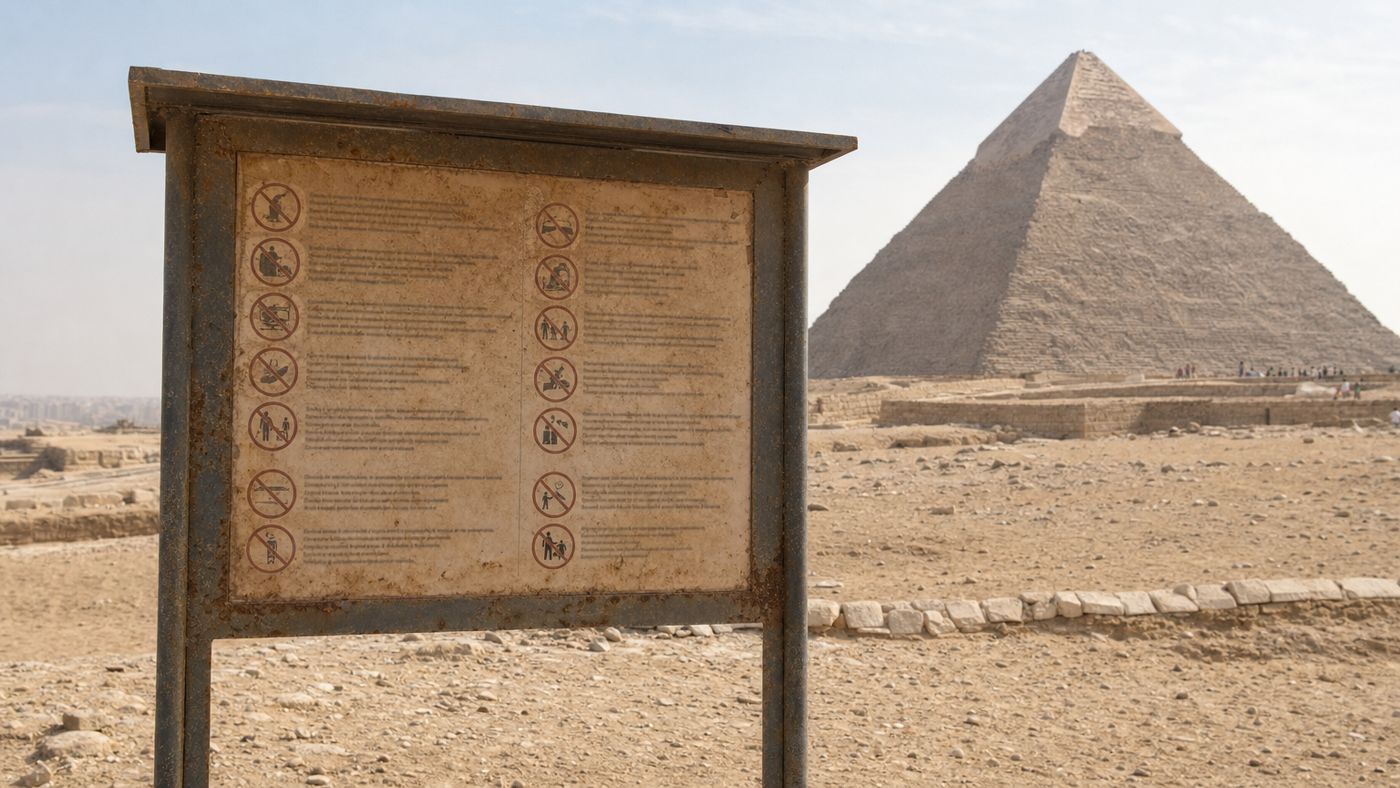
It obliges the state to implement protective measures and reporting, ties interventions to documentation, and allows international participation in conservation and monitoring. A significant part of what visitors today experience as rules on the plateau is related to this: the climbing ban, the barriers around the Sphinx, the construction ban zones at the edge of the site, the limitation of interior tickets.
Concretely, this means: The state party must regularly report on the condition of the site, announce planned interventions, and cooperate with the World Heritage Committee in case of danger. If protection fails, a site can be placed on the List of World Heritage in Danger and, in the extreme case, be delisted. Both have actually happened, albeit rarely. This possibility is the lever behind construction ban zones and regulations, and it explains why the discussion about development on the eastern edge of the plateau has been ongoing for decades.
The difference can be summarized in one sentence. The ancient list is literary history, the 2007 vote was a campaign, and the World Heritage status is administration. Only the third point has an impact on whether the structure will still stand as it does today in a hundred years.
Frequently asked questions
Are the Pyramids of Giza a wonder of the world?
Yes. The Great Pyramid of Khufu is the only surviving one of the seven ancient wonders. In the 2007 public vote, it stood outside the competition.
Why is the pyramid not on the new list of seven?
Because Egypt objected and the site was then removed from the vote and declared an honorary candidate.
Who determined the new seven wonders?
A private foundation through a worldwide public vote via internet and telephone. No governmental or scientific body was involved.
Which status counts professionally?
The UNESCO World Heritage status, because it triggers protection obligations and procedures. The two wonder lists are culturally and historically interesting but have no legal effect.
The pyramid does not need the list
What is remarkable about this whole story is that the pyramid does not need it at all.
It was the first structure on a list that has existed for over two thousand years. It is the only entry from it that still exists. It stood longer at the top of the world's tallest structures than has passed since. And it was already a destination for travelers when Greek authors began writing lists.
A vote in 2007 adds nothing to it and takes nothing away. That was probably also the core of the Egyptian objection: not the fear of losing, but the assertion that the question was wrongly posed.
If you want to explain the matter in one sentence, take this one: The Great Pyramid of Khufu is the only ancient wonder that still stands, and in 2007 it participated outside the competition. Everything else is campaign history.
Plateau entry as a QR code on your phone
If you want to see the only surviving ancient wonder yourself: buy your ticket in advance, show the code at the entrance, and plan your time freely.