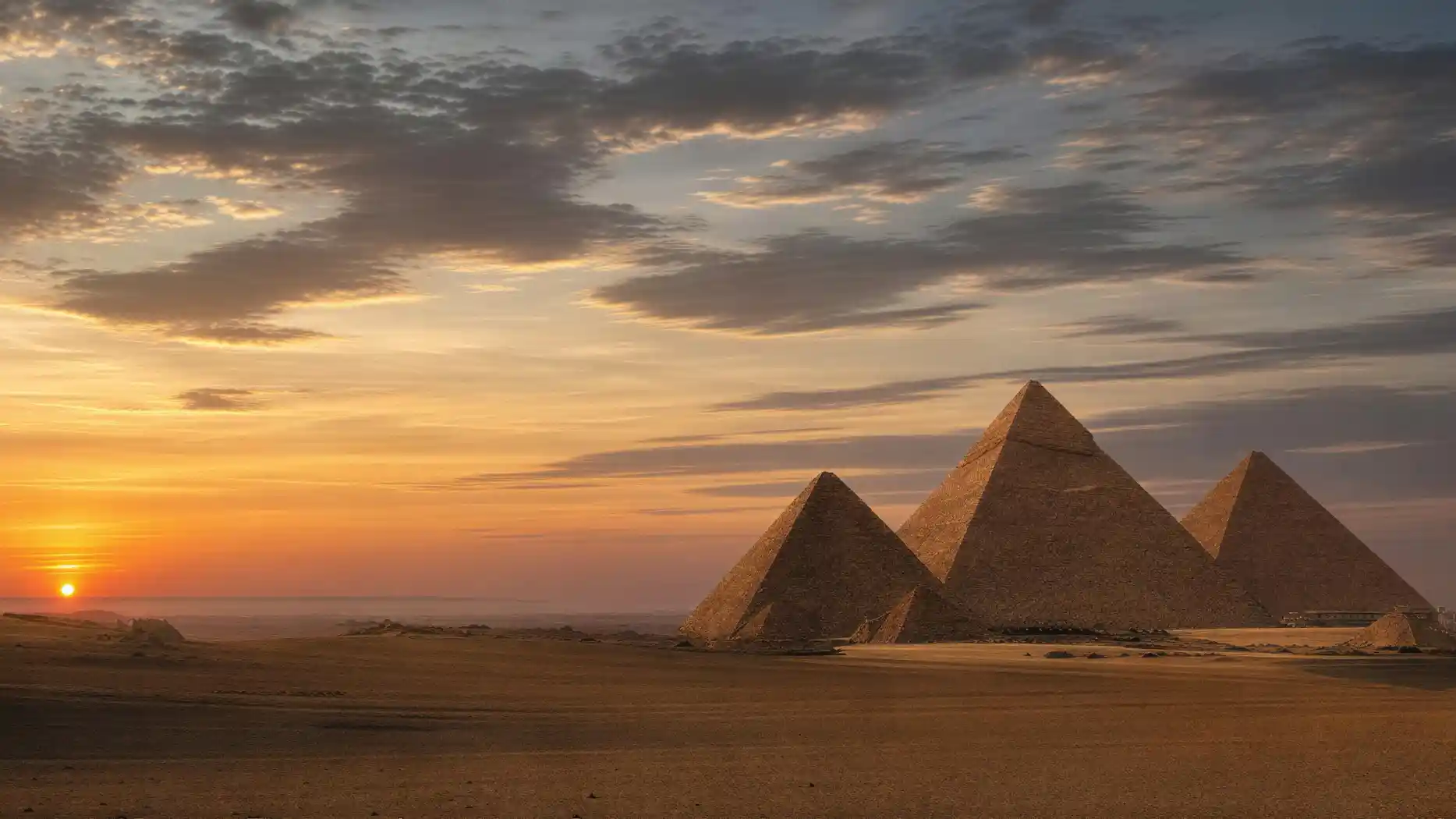
The third pyramid is dismissed by most visitors in passing. It is the smallest, it stands furthest back, and in photos it looks like a footnote next to the other two.
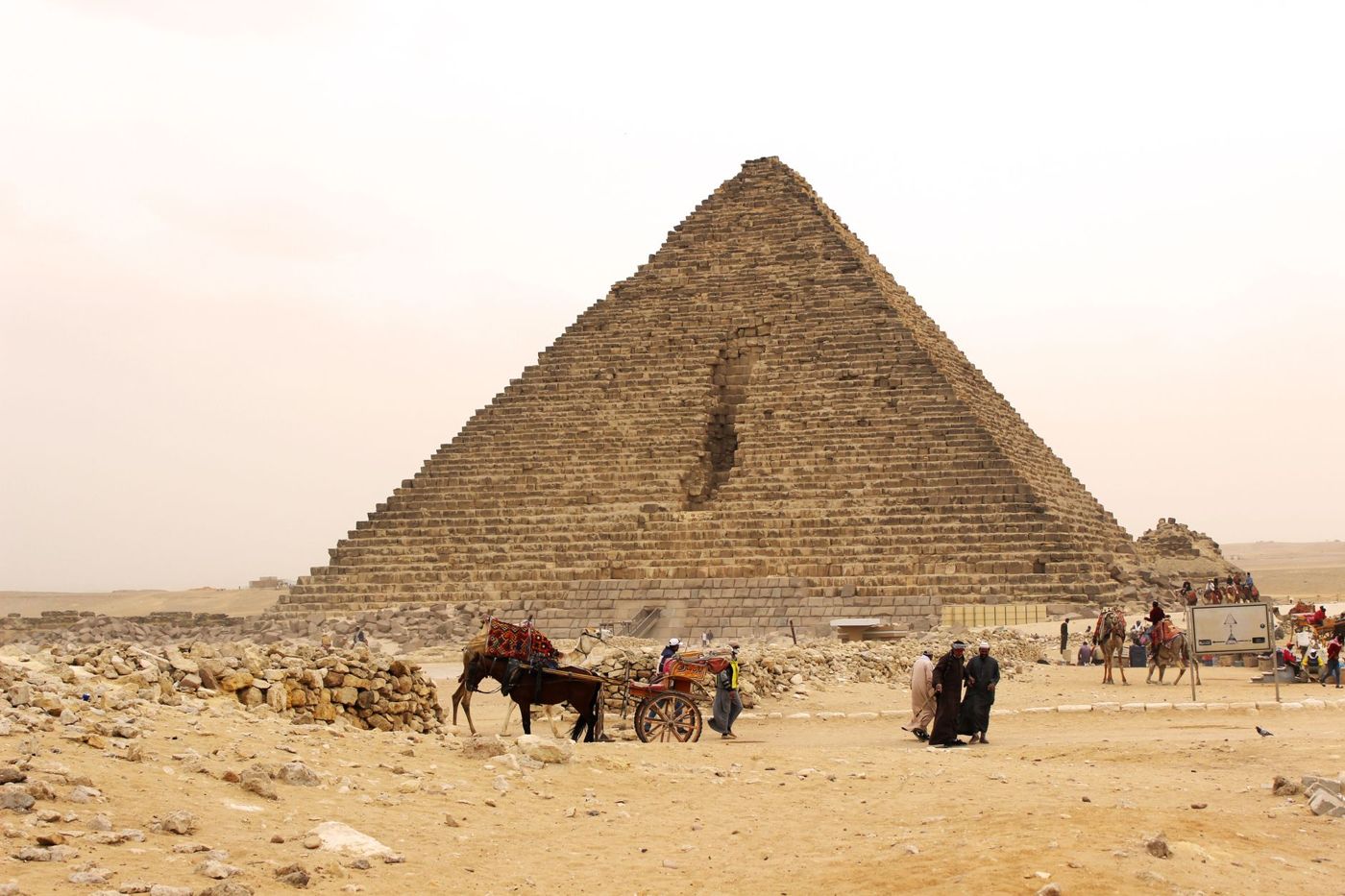
Skipping the Pyramid of Menkaure is nevertheless a mistake, because it shows more than its two neighbors combined. At no other structure on the site can you see so directly how a pyramid was built and what happened when time ran out. The lower courses are clad in granite, and a large part of that has never been smoothed. So you see the finished product and the raw state at the same time, side by side, on the same wall.
Add to that two stories that the others don't have. A medieval demolition notch runs like a vertical wound across the north flank, a remnant of an attempt to dismantle the structure. And the sarcophagus found in the burial chamber in 1837 now lies at the bottom of the Mediterranean.
The builder was the son of the king to whom the middle complex belongs. Here, too, the Greek form of the name has prevailed in German. If you come across the Pyramid of Menkaure, it refers to the same structure.
And since 2024, this structure has also been the subject of the biggest conservation dispute the site has seen in decades.
Dimensions and the Granite Casing
The dimensions make the size difference clear, and it is considerable.
The structure was originally about 65 meters high, with base sides measuring just over 100 meters. That is less than half the height of its great neighbor, and because volume grows with the third power, the mass is a fraction. You can walk around it without getting out of breath, and that is exactly what makes the details accessible.
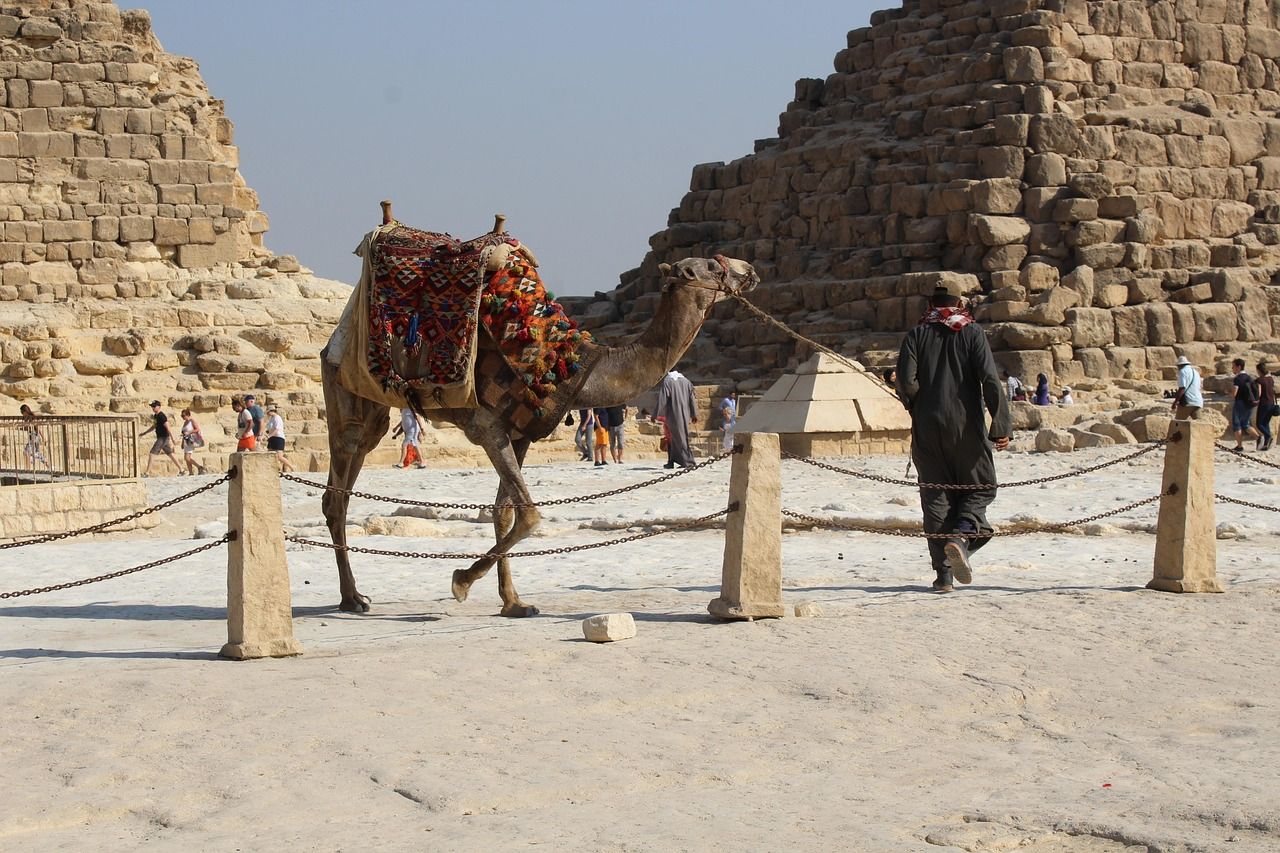
The most striking difference is the material of the outer skin. While the other two structures were entirely clad in light limestone, here the lower zone was made of granite from Aswan, in about sixteen courses. Above that, limestone followed as usual. Granite was the most expensive and heaviest building material Egypt knew, and bringing it over 800 kilometers downstream for a comparatively small structure was a decision against frugality.
This casing was never finished. The granite blocks were set and were then to be smoothed from top to bottom. Part of that work was done, the rest was not. What stands at the base today are blocks with protruding bosses, which served as grips during transport and were normally knocked off.
These bosses are more than a cosmetic flaw; they are a tool mark. A block that is dragged over ramps and levered into place needs something for ropes and levers to grip. That is why material was left on the raw block and only knocked off once the stone was in place. So when you stand before this wall today, you see not just an unfinished state, but the grips used to move the blocks.
Thus, this structure has something no other offers: a cross-section of the work process, frozen at the moment it ended.
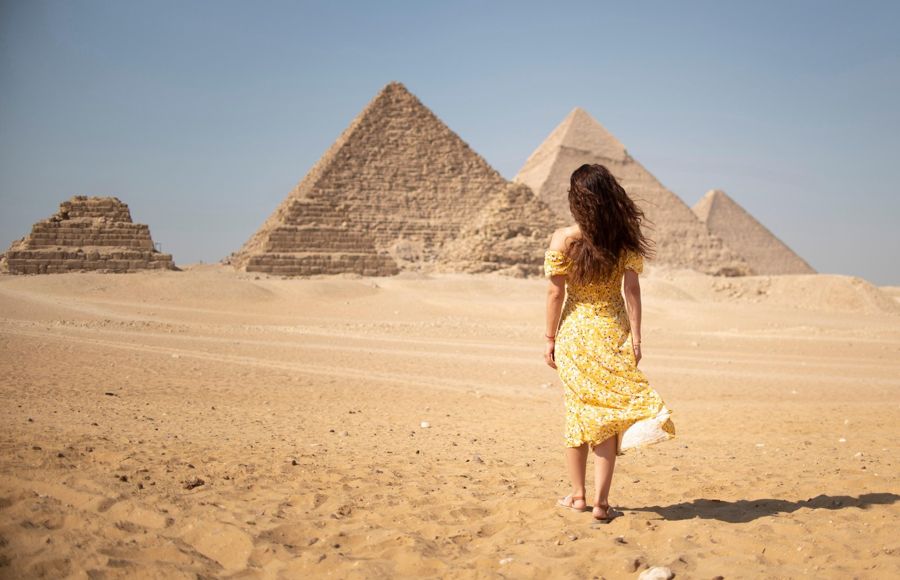
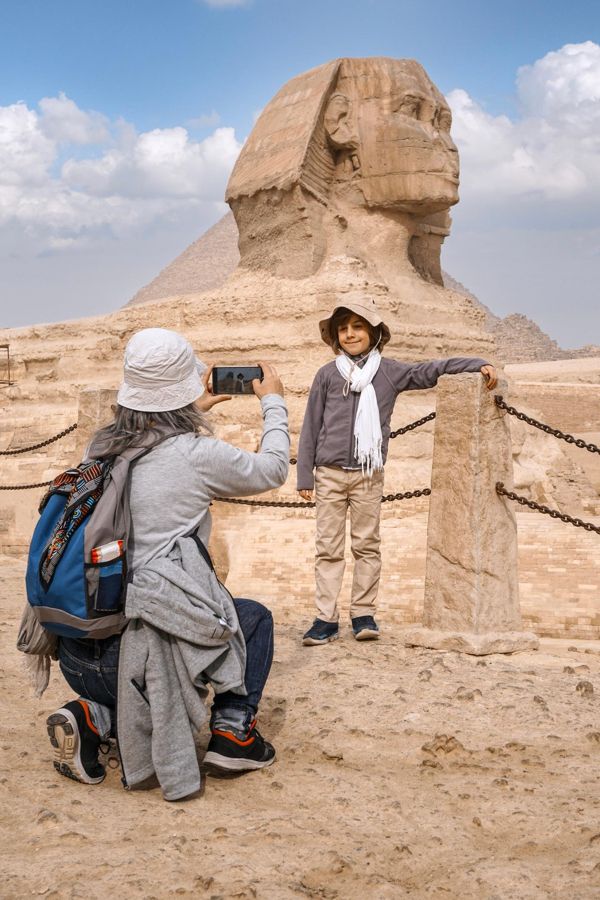

Half-day tour to the Pyramids of Giza and the Sphinx
- The unfinished granite at the base is the most illustrative find on the entire site
- A licensed guide shows which traces come from construction and which from later interventions
- Plateau entry, German-speaking guide, and hotel pickup are included
- Free cancellation up to 24 hours before start
What Was Finished and What Was Not
The complex was completed, but not finished. The difference is visible in several places.
| Component | Planned | Executed |
|---|---|---|
| Lower casing | Granite, smoothed | Granite set, mostly left raw |
| Upper casing | Limestone, smoothed | largely removed |
| Burial chamber | lined with granite | executed |
| Mortuary temple | in stone | finished in mudbrick |
| Causeway | in stone | finished in mudbrick |
| Valley temple | in stone | finished in mudbrick |
| Subsidiary pyramids | three on the south side | one executed, two left as step pyramids |
- Planned
- Granite, smoothed
- Executed
- Granite set, mostly left raw
- Planned
- Limestone, smoothed
- Executed
- largely removed
- Planned
- lined with granite
- Executed
- executed
- Planned
- in stone
- Executed
- finished in mudbrick
- Planned
- in stone
- Executed
- finished in mudbrick
- Planned
- in stone
- Executed
- finished in mudbrick
- Planned
- three on the south side
- Executed
- one executed, two left as step pyramids
The switch from stone to mudbrick is the clearest evidence that after the builder's death, the complex was only completed, not finished.
The Builder Died Before the Complex Was Finished
How that came about can be read from the building parts themselves, and it is the clearest story on the whole site.
The builder died before the complex was finished. His successor brought it to completion, but with different means: the mortuary temple, causeway, and valley temple were not built in stone but in mudbrick. An inscription from the temple area explicitly names the successor as the one who completed the work. That is unusually open for Egyptian standards and makes the sequence comprehensible.
Mudbrick is not inferior, but it weathers differently. Where the neighboring complex has left stone foundations, here you see remains of a material that withstands millennia of weather far less. A considerable part of what is missing is missing not because of looting, but because it was made of mud.
Inside, however, no expense was spared. The burial chamber lies in the rock beneath the structure, is entirely lined with granite, and has a ceiling made of inclined blocks that were hollowed out into a barrel vault. That is more elaborate than anything the great neighboring pyramid offers in ceiling solutions. So care did not diminish everywhere, but where it would no longer be seen.
The same haste is evident in the three small subsidiary pyramids on the south side. Only one was completed as a true pyramid; the other two remained step pyramids whose casing never came.
The entire group has been part of the World Heritage since 1979, which protects the pyramid fields as a connected landscape, not as a collection of individual structures. This point will become important shortly.
Two Interventions from Later Centuries
Two interventions from later centuries have left clear traces, and both are visible on site.
The first dates from 1196. A ruler from Saladin's dynasty had the structure systematically dismantled, apparently to obtain building material and to show that he could. After eight months, the work was abandoned. What remains is a vertical notch in the north flank that still looks like a wound and is regularly mistaken for earthquake damage. It is the most expensive lesson in medieval construction economics: tearing down a structure of this type costs more than the material brings in.
The second intervention took place in 1837. A British officer used explosives to gain access to the interior and found an elaborately decorated basalt sarcophagus in the burial chamber. He had it removed and shipped to England. The ship left Livorno and presumably sank off the Spanish coast; wreckage was washed ashore, but the cargo was never recovered. A reassessment of this event has reconstructed the trade routes through which objects left the country at that time.
The access itself also left traces. Work was done with explosive charges, both on the flank and inside, to open blocked passages. By today's standards, that was destruction; by the standards of the 1830s, it was the usual procedure, and the associated publication is, despite everything, one of the useful sources on the state of the structure before modern excavation.
Only what traveled on another ship was preserved: fragments of a wooden coffin, now in the British Museum. It bears the king's name but does not date from his time; it comes from a later renewal of the burial. Thus, nothing of the original equipment has survived.
Should the Casing Be Reattached?
Pros
- The blocks have lain at the foot of the structure for millennia, unprotected and unexplained.
- A piece of restored outer skin would show visitors what all three structures once looked like.
- The work would have been documented with surveying, photogrammetry, and laser scanning.
- The proposal came from the responsible authority, not from a private investor.
Cons
- For no single block can the original position be determined.
- Any placement would thus be an invention that subsequently looks like a finding.
- The current state is itself a historical document of the unfinished construction.
- An intervention of this scale on a World Heritage site is practically irreversible.
How the Dispute Over the Granite Blocks Ended
How this dispute ended has now been decided, and the reasoning is worth reading.
In January 2024, the Egyptian antiquities administration announced that it would reattach the granite blocks lying on the ground to the pyramid, estimated to take three years. The announcement met with international opposition, across the board in the professional world. The work was halted and handed over to a review committee of experts from Egypt, the United States, the Czech Republic, and Germany.
The result was unanimous. The committee rejected the reattachment and cited as the main reason that the original position of none of the blocks can be determined. Without that information, any reattachment would be a design, not a restoration.
At the same time, the committee did not simply dismiss the matter but endorsed a different project: to scientifically record and organize the blocks, to examine the rubble slope around the structure, and to make the area accessible and understandable for visitors. Thus, a construction project became a research and education project.
On site, something is increasingly visible. The blocks at the base are being measured, numbered, and sorted into rows instead of lying unordered in the rubble. If you look closely, you can see markings and storage places on individual pieces. That is not a spectacular sight, but it is the difference between a rubble field and a documented inventory.
Beyond this single structure, the decision carries weight. Since 2025, several projects have been underway on the plateau to remodel the site for visitors, from access points to paths to catering. The committee has drawn a line that applies to all of this: the surroundings of a monument may be changed, but not the monument itself, and what is announced as restoration must be able to prove that it is one. That is a standard against which future proposals must be measured.
For visitors, this means: the state you see remains. And, properly viewed, it is more informative than a restored wall would be.
Frequently asked questions
Why is the granite at the bottom so rough?
Because the smoothing was never completed. The blocks were set and were then to be worked from top to bottom. The work stopped mid-wall.
Where does the notch on the north side come from?
From a demolition attempt in 1196 that was abandoned after eight months. It is not earthquake damage.
Where is the sarcophagus?
At the bottom of the sea. It was removed and shipped in 1837; the ship presumably sank off the Spanish coast. It was never recovered.
Can you go inside?
Often yes, with a separate ticket on site. The interiors are plain and usually very empty.
Will the casing now be reattached?
No. An international review committee unanimously rejected the project because the original position of the blocks cannot be determined.
Plateau entry as a QR code on your phone
The granite base, the demolition notch, and the three subsidiary pyramids are within the regular ticket area. Only for the interior do you need a separate ticket on site.