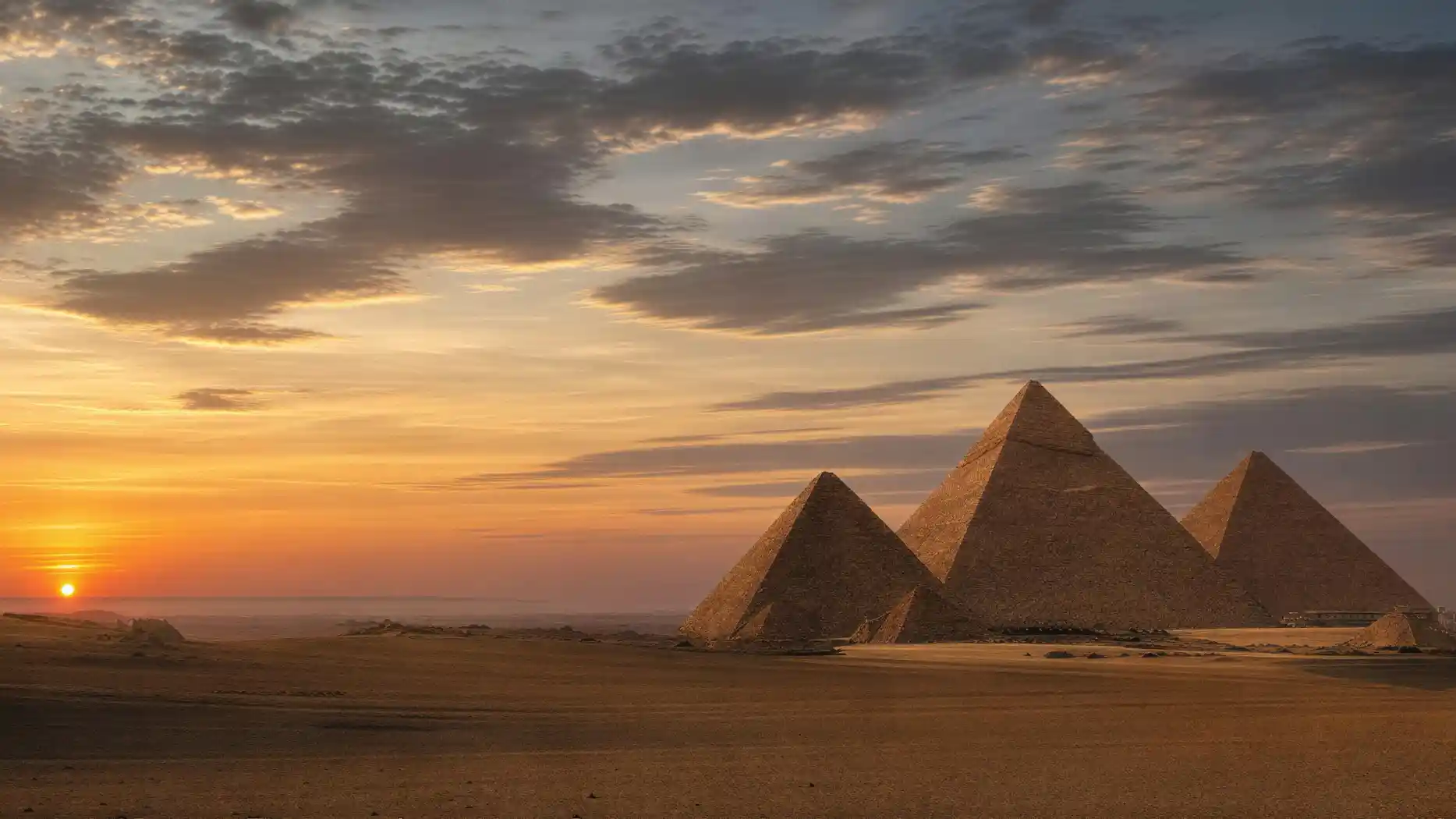
The pyramids of Giza belong to three kings, and these three ruled consecutively in the same family: grandfather, son, grandson, over a period of about eighty years.
This is remarkable because it puts the site in a different light. It is not a necropolis that grew over centuries, with additions made by various people at various times, but a family enterprise spanning three generations. The monuments stand side by side because the builders were related.
These three belong to the Fourth Dynasty, which had more than three kings. The others built elsewhere, for reasons that are partly recognizable and partly puzzling. That too is part of the answer, because it shows that Giza was not an obvious choice.
And then there are the confusions. The most famous Egyptian king of all has nothing to do with this site; he was buried more than twelve hundred years later and several hundred kilometers away. More on that below.
For context, this dynasty was not particularly long. Six kings, together about a hundred years, and within that span falls the entire peak of Egyptian pyramid building. Before that, there was experimentation; after that, they built smaller. The Old Kingdom's legacy in stone is thus concentrated in just a few generations.
A note on names: the common forms are Greek, while the Egyptian ones sound different. Cheops was Khufu, Chephren was Khafre, Mykerinos was Menkaure. Both forms are common and refer to the same people.
Khufu, and why the attribution is unusually secure
Which pharaoh built the Great Pyramid of Khufu? Khufu, the second king of the Fourth Dynasty, and the attribution is unusually well supported.
It is not based on a dedication inscription, because none exists, but on markings made by the work crews in the relieving chambers above the burial chamber. These rooms were never meant to be entered, and the red paint notes there contain his name. A forgery in a place no one was supposed to see would make no sense.
His father was Sneferu, the builder of several pyramids at Dahshur and the one under whom the pyramid form reached maturity. His son Khafre erected the middle complex, including the Sphinx, and his grandson Menkaure the smallest. Thus the order on the site is also a generational sequence.
The absolute dates vary by decades depending on the chronology. A common king list places Khufu around 2550 to 2530 BC; other counts are slightly earlier. This does not affect the order or the intervals between reigns, but it does affect the dates on a sign.
The family relationships themselves are well documented, through the surrounding officials' tombs. In the tomb chapels of the court, titles are inscribed that name family relations and responsibilities, sometimes over several generations. From this network, the royal succession can be reconstructed independently of the king lists, and both agree. That is why the order is considered secure, even though the dates vary.
How long Khufu reigned is also uncertain. Sources give between just over twenty and over thirty years, and a find from 2013 at least proves that construction was still ongoing at the plateau in the 27th year of his reign.
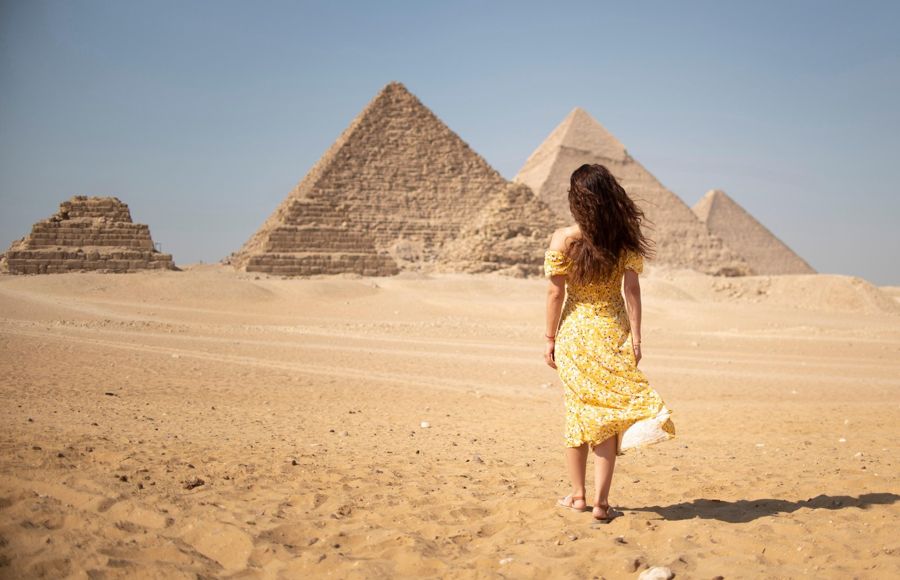
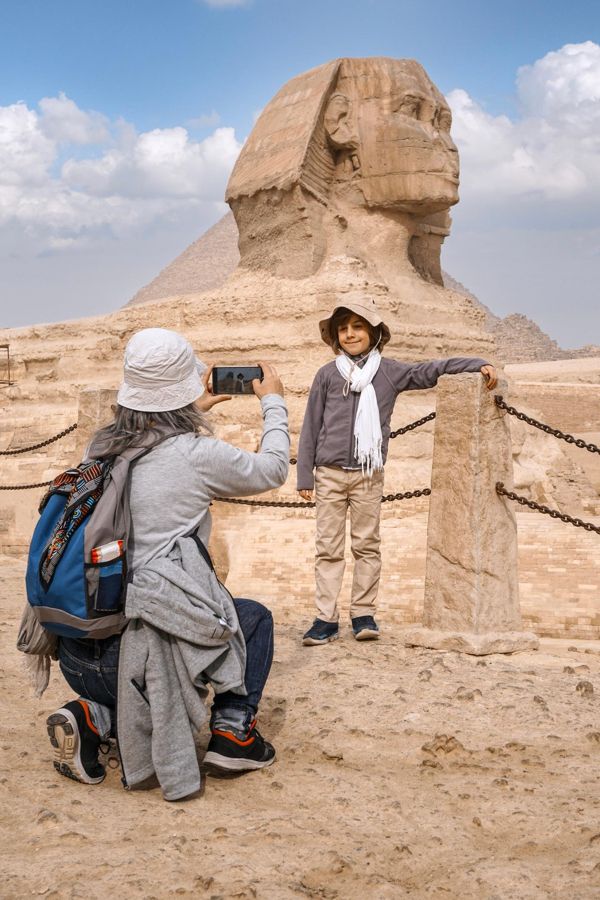
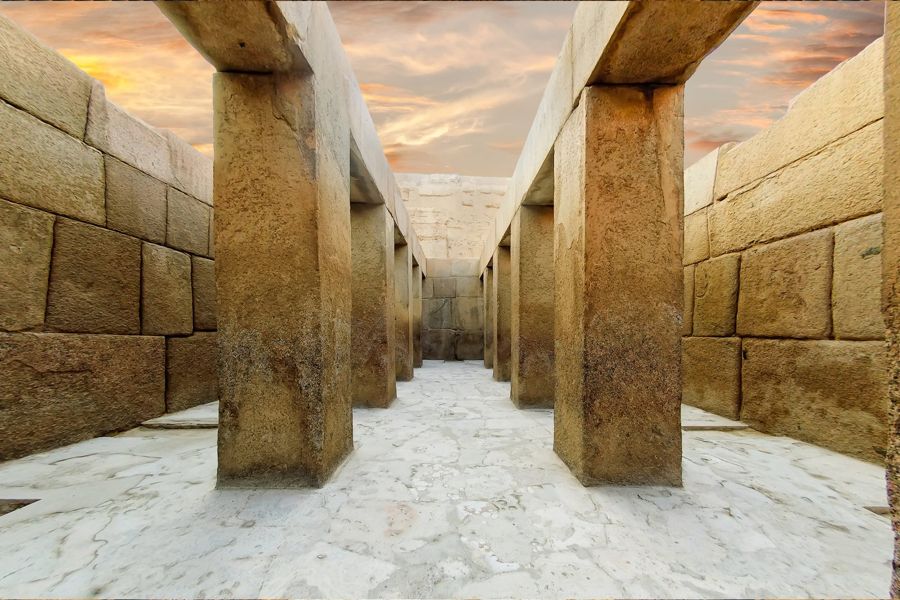
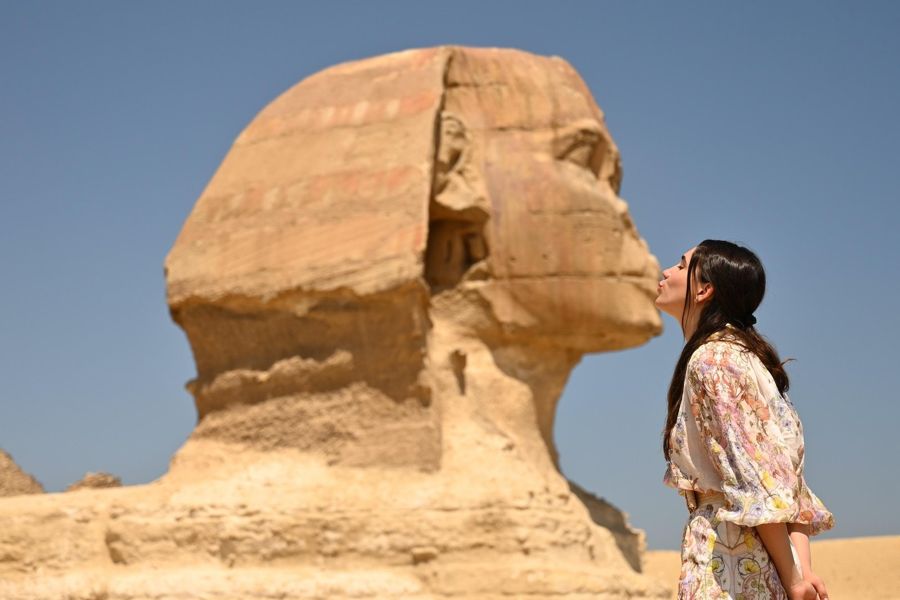
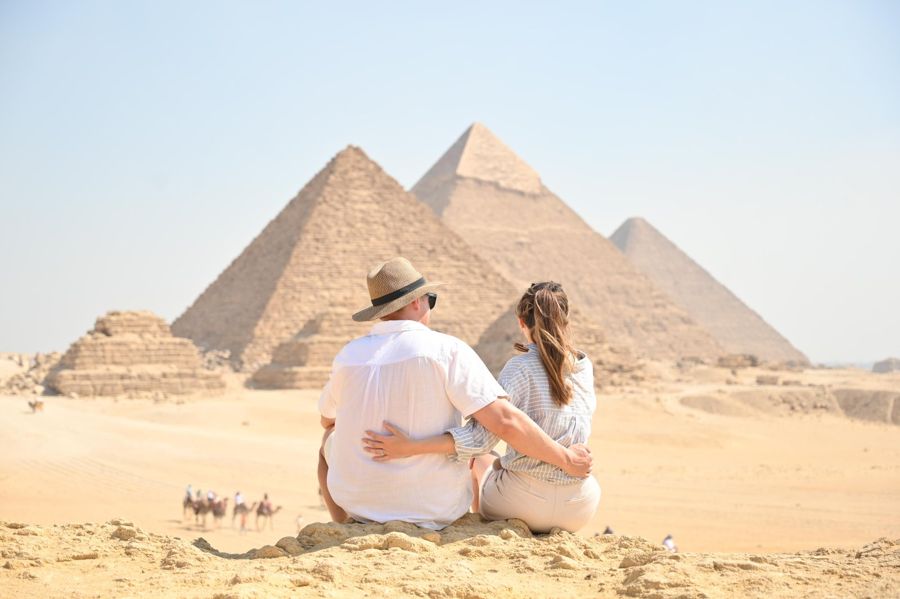
Half-day tour to the Pyramids of Giza and the Sphinx
- The three complexes lie side by side in the order of generations
- A licensed guide explains which monument belongs to which king
- Plateau entrance, German-speaking guide, and hotel pickup are included
- Free cancellation up to 24 hours before start
The three builders of Giza
Khufu, Greek Cheops
Second king of the dynasty, son of Sneferu. Built the largest pyramid, about 146.6 meters high.
- Good for
- The complex with the greatest mass, the most elaborate interior, and the best documentation.
- Watch out
- The only image of him that survives is a seven-and-a-half-centimeter ivory figurine.
Khafre, Greek Chephren
Son of Khufu. Built the middle complex and, in all likelihood, the Sphinx.
- Good for
- The only complex where the complete chain from valley temple to pyramid is preserved.
- Watch out
- Looks taller than its larger neighbor in photos because it stands higher and has kept its casing.
Menkaure, Greek Mykerinos
Grandson of Khufu. Built the smallest of the three complexes, which remained unfinished.
- Good for
- The most illustrative state of construction on the site: rough granite next to polished surface.
- Watch out
- His mortuary temple was completed in mudbrick after his death, not in stone.
Three kings of the dynasty built elsewhere
The Fourth Dynasty had six kings, and only three of them built at Giza. The other three are almost as revealing.
Sneferu, the father of the greatest builder, built at Dahshur, about thirty kilometers to the south. Several pyramids are attributed to him, including one with a bend in its side because the original angle could not be maintained. He thus moved more stone than his son, distributed over several monuments, and brought the pyramid form to maturity.
Between Khufu and Khafre reigned Djedefre, who went to Abu Rawash, several kilometers north of the plateau. His monument is now largely dismantled. Something else is remarkable: he was the first to bear the title "Son of the Sun God," and his change of location is often linked to this religious shift.
At the end of the dynasty stands Shepseskaf, who broke with the pyramid form entirely. He completed his predecessor's complex at Giza but chose not to be buried in a pyramid himself, instead in a large rectangular structure at Saqqara. Why is unknown.
From this distribution, something can be read. The location of a royal complex was evidently not a family tradition but a decision, made anew by each ruler. Only once the plateau already bore two large complexes did it become the obvious place, and even then the last king of the dynasty deviated again.
The official overview of the site accordingly lists only three royal complexes. Everything else on the plateau belongs to relatives, officials, and craftsmen.
What we know about these people
What do we know about these people? Surprisingly little, and the distribution is paradoxical.
Of Khufu, the builder of the largest stone structure on Earth, the only fully preserved round sculpture is an ivory figurine seven and a half centimeters tall. It was found in 1903 at Abydos, in two parts, the head only three weeks after the body. That is all.
Of his son Khafre, by contrast, several life-size statues survive, including a famous seated figure with a falcon embracing his head from behind. There are also images of Menkaure, including group statues with goddesses. Ironically, the most famous of the three is the least attested.
This tells us little about their personalities. Herodotus, two thousand years later, describes Khufu as a tyrant who closed the temples, but there is no Egyptian evidence for this, and the story bears all the marks of a late legend. Egyptian sources from the time itself are administrative texts and titles, not character portraits.
One detail relativizes the image of the all-powerful ruler. The officials' tombs on the plateau show a broad ruling class with their own titles, their own tombs, and their own cult endowments, laid out within sight of the king's tomb. These people are known by name, often better than the kings themselves, because their chapels are decorated and inscribed. Anyone who wants to learn about the Fourth Dynasty learns mostly from them.
What can be said is organizational: these three reigns had an administration that could organize, supply, and coordinate tens of thousands of people over decades. That in itself is the most telling information about them.
Four common confusions
- False
Tutankhamun has something to do with the pyramids of Giza.
He reigned about twelve hundred years later and was buried in the Valley of the Kings near Luxor, several hundred kilometers away.
- True
Cleopatra knew the pyramids.
She lived about two and a half thousand years after their construction. To her, the monuments were older than she is to us.
- False
All pharaohs were buried in pyramids.
The pyramid form was common for only a few centuries. Even the last king of this dynasty chose a different tomb type.
- Partially
The Sphinx depicts Khafre.
The attribution is well founded, but a comparison with surviving statues is only partially possible due to weathering and later repairs.
Tutankhamun has nothing to do with Giza
The most common confusion deserves its own paragraph because it persists stubbornly.
Tutankhamun and the pyramids of Giza have nothing to do with each other. He belongs to the Eighteenth Dynasty and reigned in the fourteenth century BC, about twelve hundred years after the construction of the Great Pyramid. He was not buried in a pyramid but in a rock-cut tomb in the Valley of the Kings near Luxor, more than five hundred kilometers upstream.
The reason for the confusion is obvious. His tomb was found in 1922 almost unlooted, with furnishings that have shaped the image of ancient Egypt ever since. The gold mask and the pyramid are the two most famous images of this culture, and in the mind they come together, although more time lies between them than between us and the Roman Empire.
It is also remarkable how different the state of preservation is. From Tutankhamun we know his face, his clothing, his furniture, even his diseases. From the three kings whose monuments consumed a thousand times more material, we know names, reign lengths, and a few statues. In archaeology, fame does not depend on how big someone built, but on whether their tomb remained unlooted.
For visitors, this has a practical consequence: those who want to see the famous gold objects must go to the museum, not to the plateau. There is nothing of the sort in the pyramids, and there never was anything comparable to see there, because royal burial chambers of this era were unadorned.
A second confusion concerns the order of the monuments. Because the middle pyramid often appears tallest in photos, many take it for the oldest or largest. In fact, the northeastern is the first and largest, the middle is the second, and the southwestern is the third and smallest. The generational sequence thus runs from northeast to southwest, and once you know that, you read the site in the right direction.
Conversely, what stands on the plateau was already an ancient monument to Tutankhamun, just as a Romanesque church is to us.
Frequently asked questions
For which pharaoh was the Great Pyramid of Khufu built?
For Khufu, usually called Cheops in German, the second king of the Fourth Dynasty. He commissioned it and was to be buried in it.
How many kings of the Fourth Dynasty built at Giza?
Three out of six. The others built at Dahshur, Abu Rawash, and Saqqara.
Were the three related?
Yes. They were father, son, and grandson, whose reigns followed one another directly.
Why do the dates differ?
Because different chronologies set the absolute dates decades apart. The order and intervals, however, are certain.
Are there images of these kings?
Several of Khafre and Menkaure, some life-size. Of Khufu, only a seven-and-a-half-centimeter ivory figurine survives.
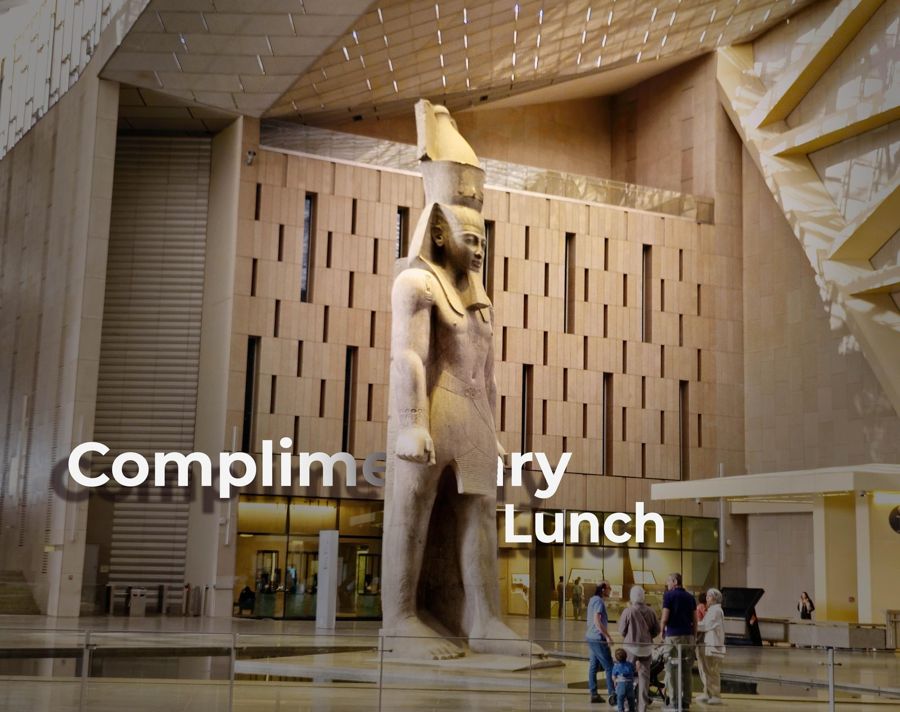
Day tour to the Grand Egyptian Museum and the plateau
The royal statues of the Fourth Dynasty are in the museum, not on the plateau. Entrance fees and guide are included.