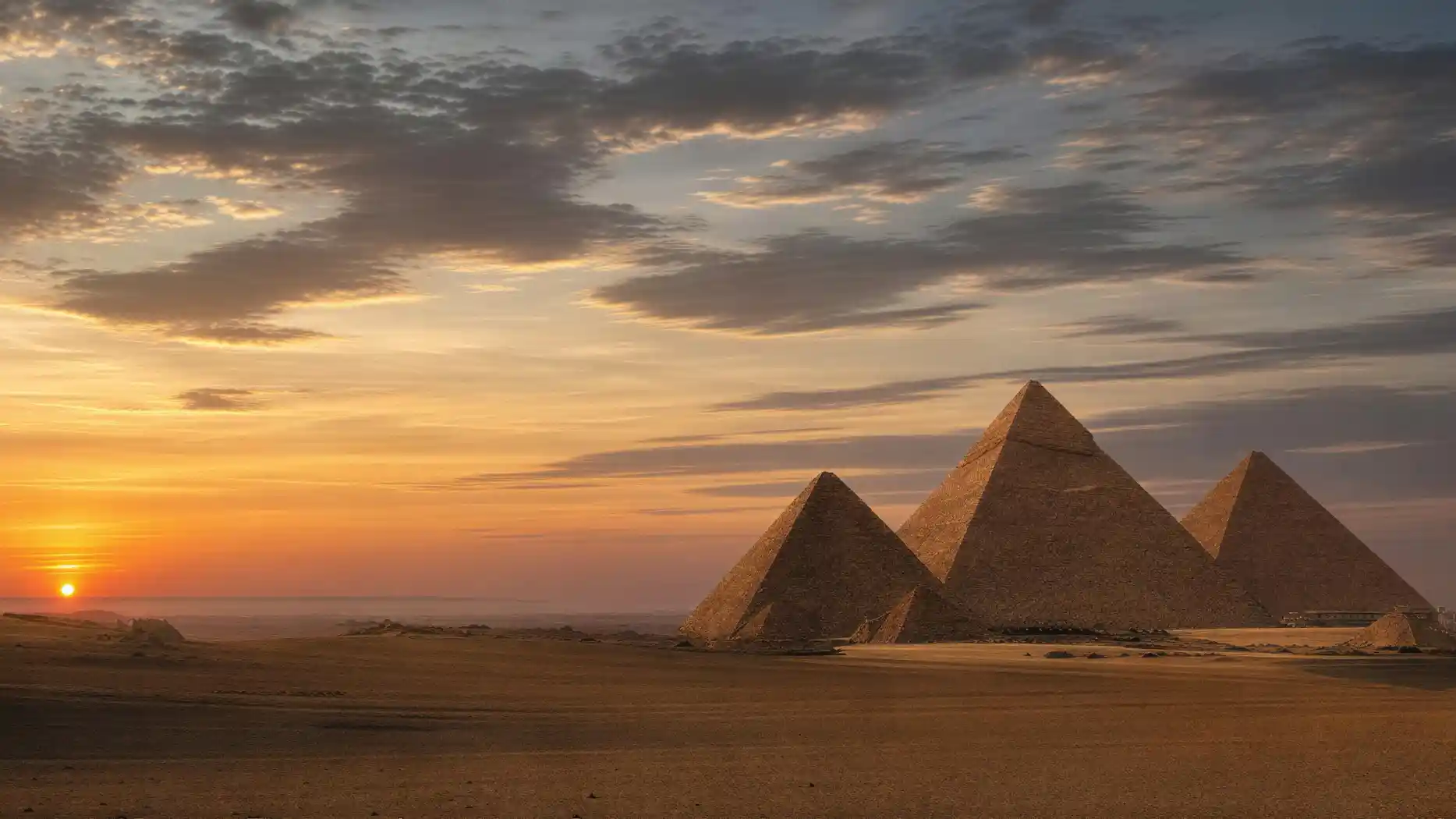
Anyone who wants to draw the Pyramids of Giza almost always reaches for an equilateral triangle. It's the obvious shape, it can be constructed with a compass, and it's wrong.
An equilateral triangle has 60 degrees at the base. The Great Pyramid of Khufu has about 52. That sounds like a small difference, but it's why even careful drawings look pointed and narrow instead of broad and grounded. Eight degrees make all the difference in the overall impression.
Incidentally, the Egyptians never thought of the angle as an angle. They worked with a ratio, the seked: how far a surface recedes horizontally while rising one cubit. This method is documented in practice problems on a papyrus in the British Museum.
For your drawing, that means: you don't need a protractor, but a ratio. And that's easier to remember than it sounds.
The Measurements That Matter for Drawing
- Base
- Height, about 64 percent of the base
- Slope angle about 52 degrees
- For comparison: equilateral, 60 degrees
The height figures are reconstructed original heights. Today, all three structures lack their tips, with the Great Pyramid missing about ten meters.
Three Mistakes with the Group
How do you draw the Pyramids of Giza so that the group looks right? Here are the three most common mistakes, and all three are easy to avoid.
The first concerns sizes. The two large structures are almost the same height, separated by only three meters. The third, however, is dramatically smaller: Menkaure reaches barely half the height of Khufu. If you draw all three roughly the same size, you haven't seen the site.
The second concerns the effect of height. Khafre, the middle one, looks taller than Khufu in almost every photo, but it isn't. It stands on rock that is about ten meters higher, and it is steeper, at about 53 degrees instead of 52. Together, these are enough for the illusion. If your drawing shows this effect, it's correct.
The third concerns arrangement. The three are not lined up side by side on a line parallel to the viewer, but staggered on a diagonal from northeast to southwest. That's why they overlap from most viewpoints instead of standing neatly side by side.
Entry ticket for the plateau as a QR code
If you want to draw from your own templates, you need your own photos. Entry can be booked separately, and the viewpoint in the southwest provides the staggering of all three structures in one image.
In This Order, a Coherent Drawing Emerges
- Base line and center
Draw the base and mark its center. Everything else depends on these two elements.
- Mark the height
Measure vertically from the center upward about 64 percent of the base length. For a ten-centimeter base, that's six and a half centimeters in height.
- Draw the edges
Connect the apex to the two base points. The angle at the bottom emerges naturally and is about 52 degrees.
- Place the neighbors
The second pyramid slightly offset behind, almost the same height, a bit steeper and standing higher. The third clearly smaller, further back.
- Suggest the surface
Not a smooth surface, but horizontal layers. Draw them closer together toward the top to make the stepping effect work.
- Decide on the surroundings
Sand alone gives the postcard image. If you hint at the city edge to the east, you draw the place as it is.
Two Rules of Thumb Without a Ruler
If you want to draw pyramids simply, without a compass and ruler, two rules of thumb will get you through.
The first: the height is just under two-thirds of the width. If you estimate the base and place the apex slightly below two-thirds of that length, you'll be close enough to the 64 percent that no one will notice the difference.
The second concerns the surface, and it's the real trick. The structures today don't look smooth but stepped, because the smooth casing is missing. A few horizontal lines, denser toward the top, turn a geometric triangle into a structure immediately. If you want to draw the smooth version, you're drawing the original state, and that's a deliberate choice, not a simplification.
And a warning about the Sphinx, because it regularly ends up too large in drawings. It is about 73 meters long and about 20 meters high, so lower than a seventh of the Great Pyramid, and it lies in a pit below the plateau, clearly to the east. If you place it the same size next to the pyramid, you're drawing two structures that never appear together in that way.
Which State the Drawing Shows
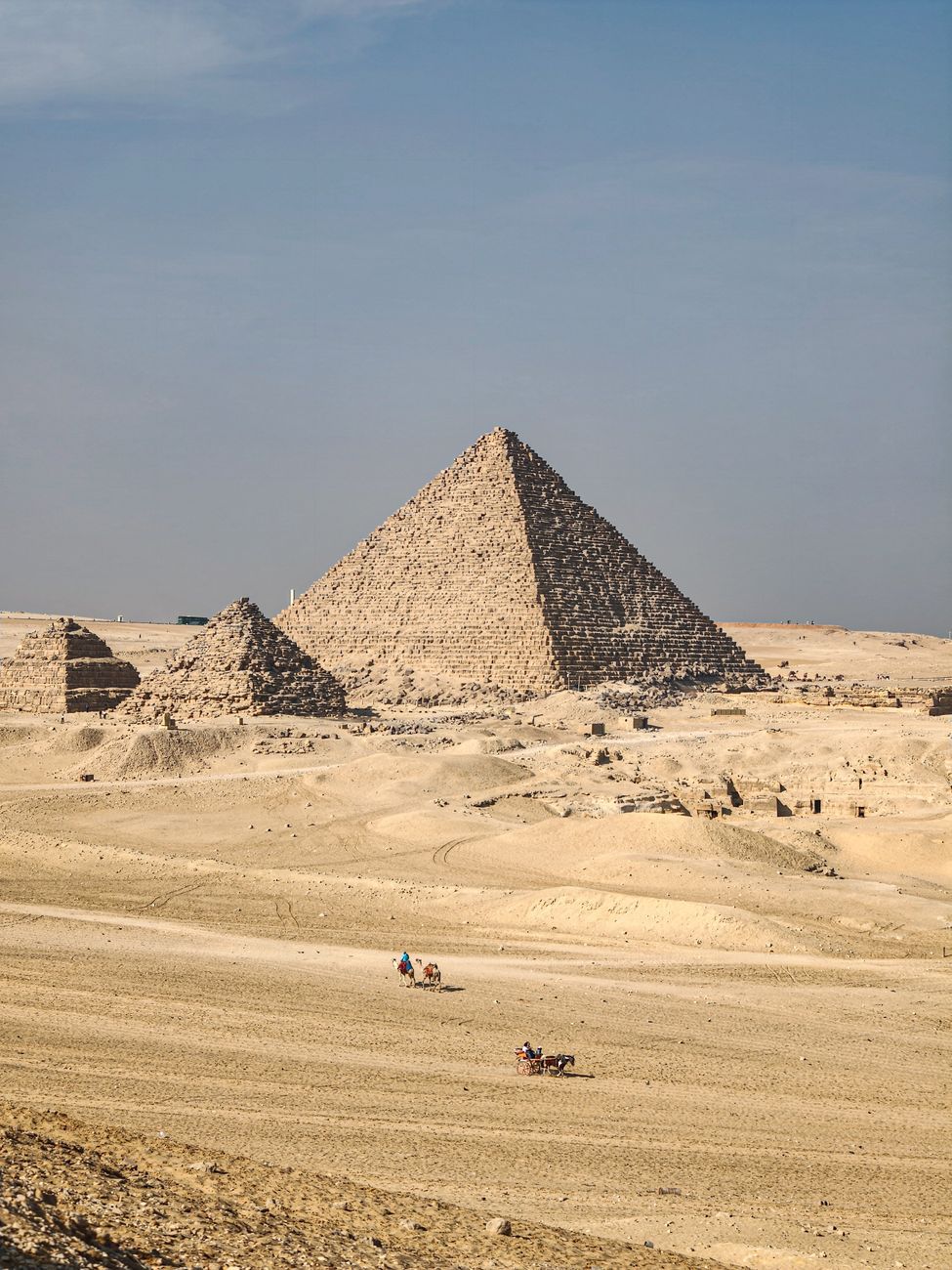
What ultimately makes a drawing convincing is rarely precision, but the decision about which state it shows.
Three states are available. The present one, with a stepped surface, missing tip, and city in the background. The original one, with smooth casing and a tip that only exists as a reconstruction. Or the schematic one, where only the form matters, for example for a diagram.
All three are legitimate, but they don't mix well. A smooth casing with a missing tip is a contradiction, and a stepped surface with an untouched pyramid tip is equally so. If you decide beforehand, you'll draw more coherently than someone who collects details.
For the present state, a look at the official description of the site helps; for the original, the research reconstructions. Both beat any template from an image search, which usually contains an equilateral triangle anyway.
Frequently asked questions
What angle does the Great Pyramid of Khufu have?
About 51.9 degrees at the base. An equilateral triangle would have 60 degrees and therefore looks too pointed.
How tall should I draw the pyramid?
About 64 percent of the base length, so just under two-thirds. For a ten-centimeter base, that's about six and a half centimeters.
Which of the three is the tallest?
The Great Pyramid of Khufu, with a lead of about three meters. The middle one looks taller because it's steeper and stands on higher rock.
Why do the pyramids look stepped?
Because the smooth outer casing is missing. What's visible is the rough core masonry in horizontal layers.
How big is the Sphinx in relation?
About 20 meters high compared to nearly 147 meters, so about a seventh, and it lies lower and further east.