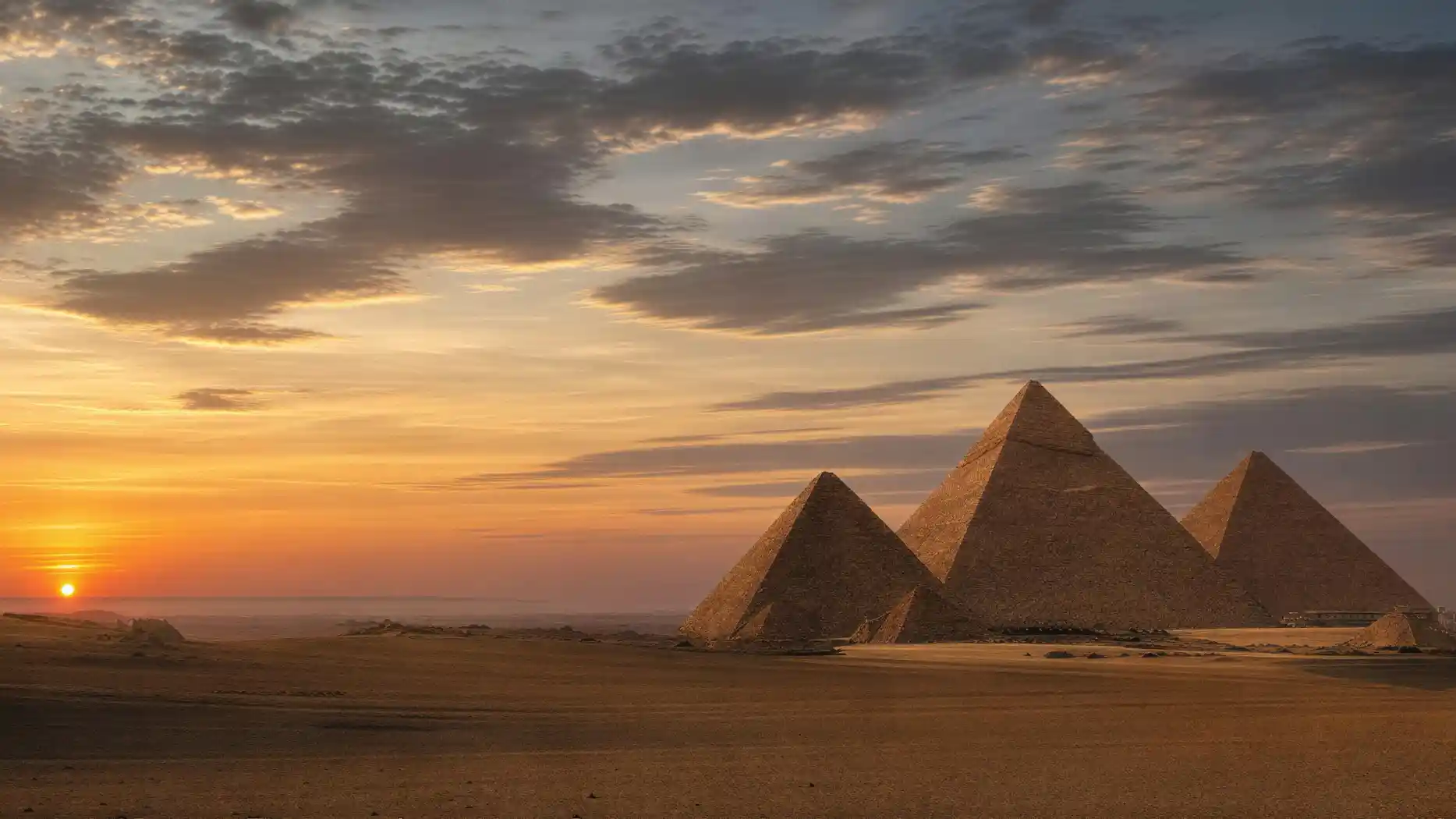
The most important sentence about this structure is: It was not built. It was exposed.
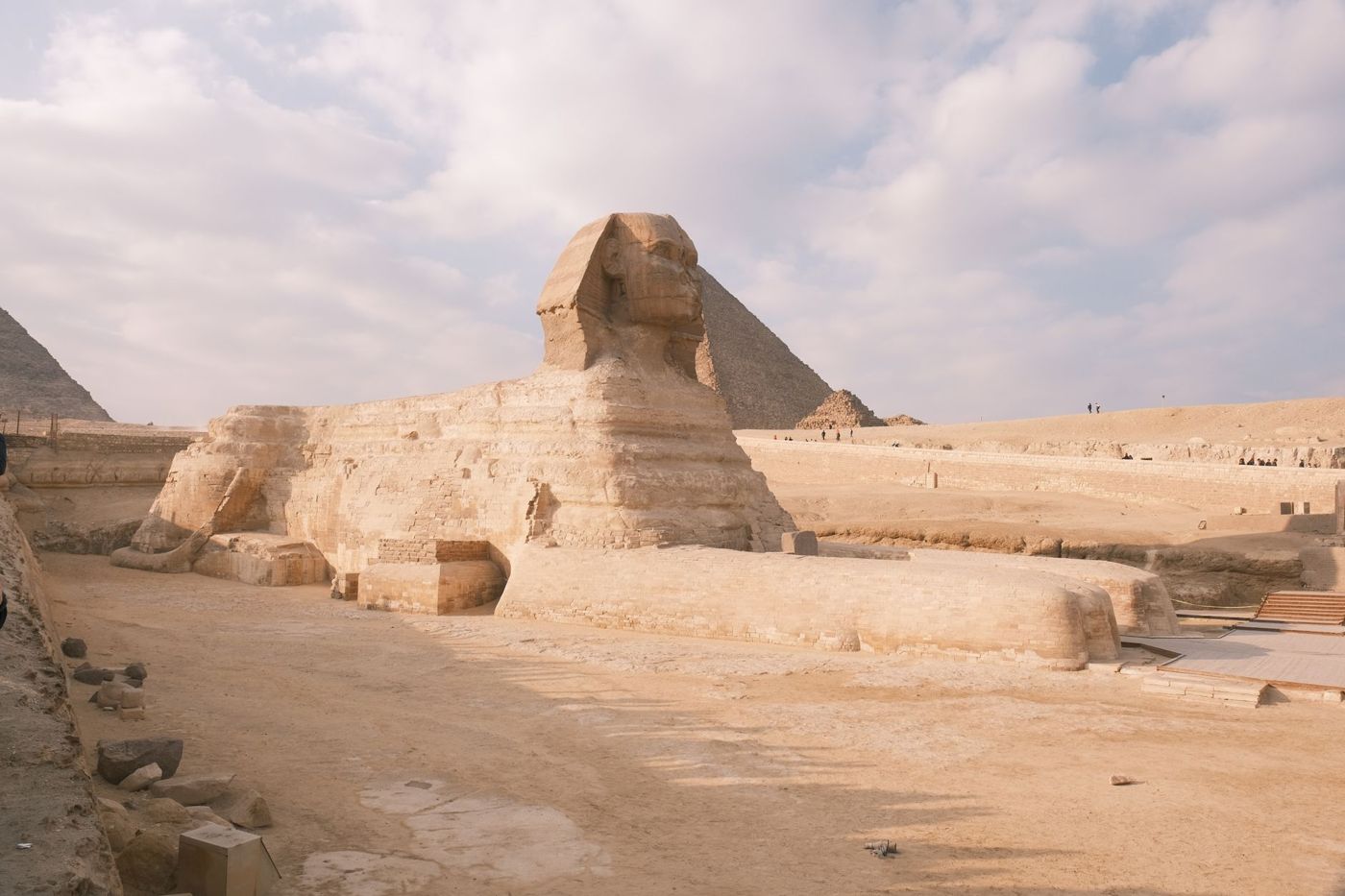
Next to the pyramids, stone was quarried, transported, and stacked. With the Sphinx, the opposite happened. The workers dug a deep trench into the bedrock and left a block in the middle. From this block, they carved the figure. So it is not masonry but sculpture on the scale of an apartment block: 73 meters long from paw to tail, 20 meters high, 19 meters wide at the hindquarters.
This difference explains almost everything that is striking about the Sphinx. It explains why it sits in a pit and not on a surface. It explains why its body crumbles in places while the head remains sharply defined. And it explains why the figure is not perfectly symmetrical: whoever works from an existing rock must take what is there.
The pit, however, has a downside. It fills up. Desert sand blows in, accumulates, and buries the figure if no one removes it—and that has happened again and again over the millennia. For the vast majority of its existence, the figure stood buried up to its neck. Only in the 1920s was it fully and permanently exposed.
That sounds like damage, but it was a rescue. As long as the body lay in the sand, it was protected from wind, sandblasting, and temperature fluctuations. The head, which protruded for millennia, took correspondingly more punishment. That it still looks better than the torso is due to something else, which we will get to shortly.
One consequence is rarely mentioned but is the most interesting. A masonry structure can be dismantled and reused elsewhere, and that is exactly what happened to the pyramids over the centuries. A figure carved from the ground cannot be dismantled. The Sphinx survived because it yielded nothing as building material.
Three rock layers explain the condition
The rock from which the Sphinx is made is not uniform, and that is the key to its condition.
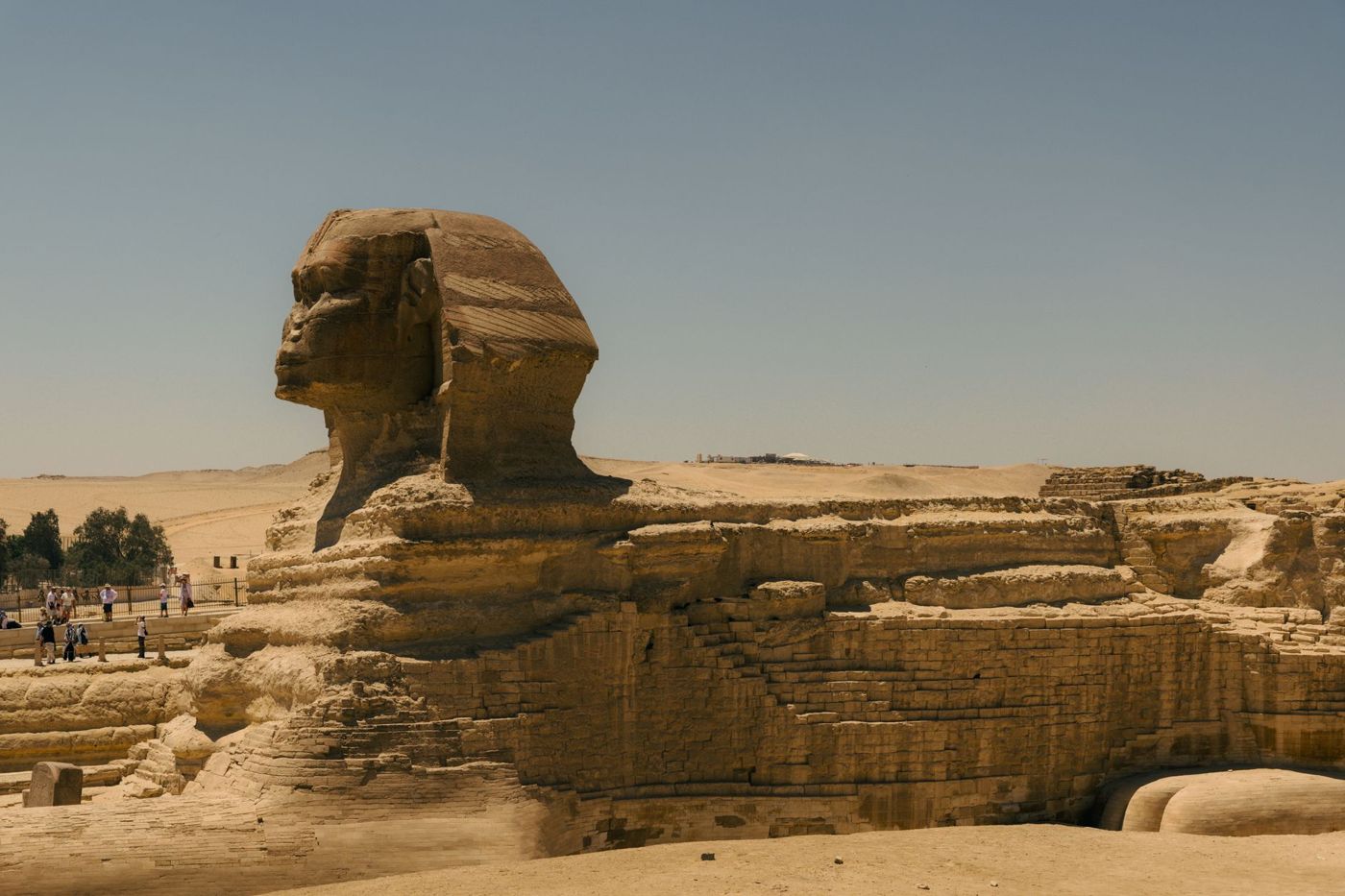
Excavation research distinguishes three rock sections at the Sphinx. At the bottom is the first: hard, brittle rock of a fossilized reef. It forms the base and the paws and is several meters thick at the hindquarters, but only about one meter at the paws. Above it follows the second section, which makes up practically the entire body. It is divided into seven layers that alternate between softer and harder from bottom to top. The third section forms the head and neck. It is softer at the neck and noticeably harder at the head.
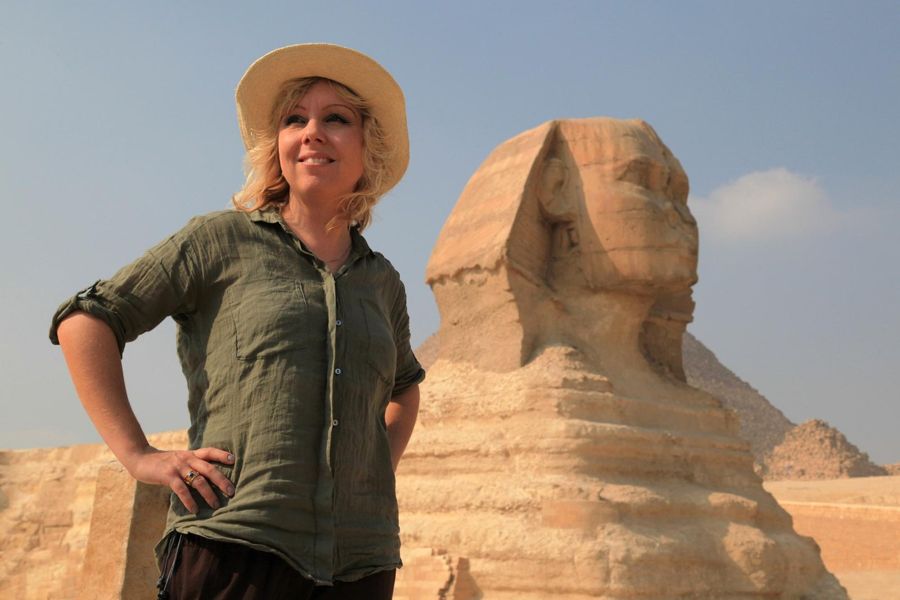
This explains the most striking observation. The body weathers in waves: the soft layers recede, the hard ones remain, creating the ribbed profile seen in every photo. The head, in contrast, sits in denser material and has therefore retained facial features that are four and a half thousand years old.
This must be distinguished from what was added later. Today, masonry sits on the paws, flanks, and base—partly ancient, partly modern. Already in the New Kingdom, cladding blocks were added to support the crumbling torso, and in modern times several campaigns followed. One in the 1980s had to be rebuilt because the mortar used damaged the original rock. Anyone looking at the lower half today therefore sees, to a considerable extent, repairs rather than the original.
So it is not a question of treatment but of the rock layers. Measurements on these limestones show significant differences in density, porosity, and salt sensitivity between adjacent layers. The sculptor had no influence on that. He worked in the rock that stood at this spot.
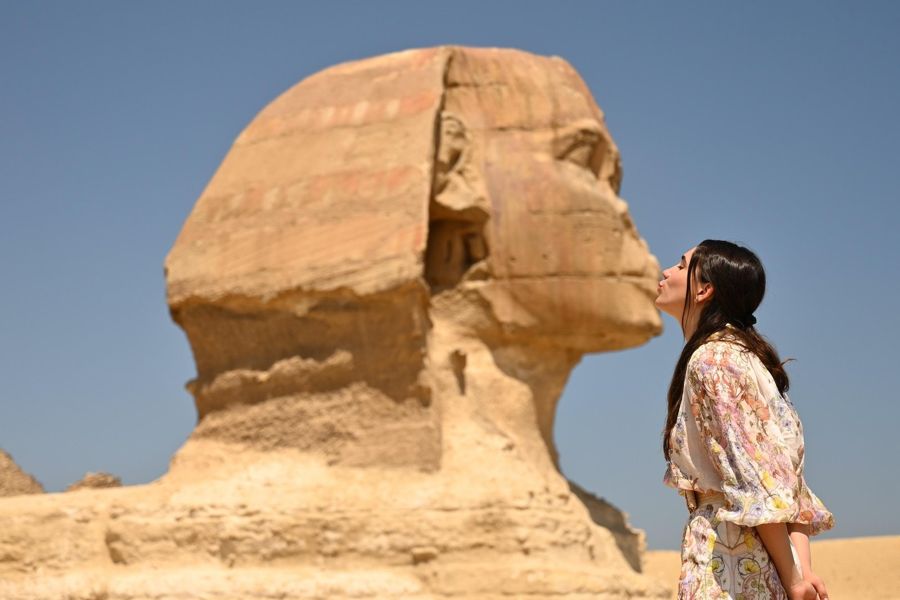
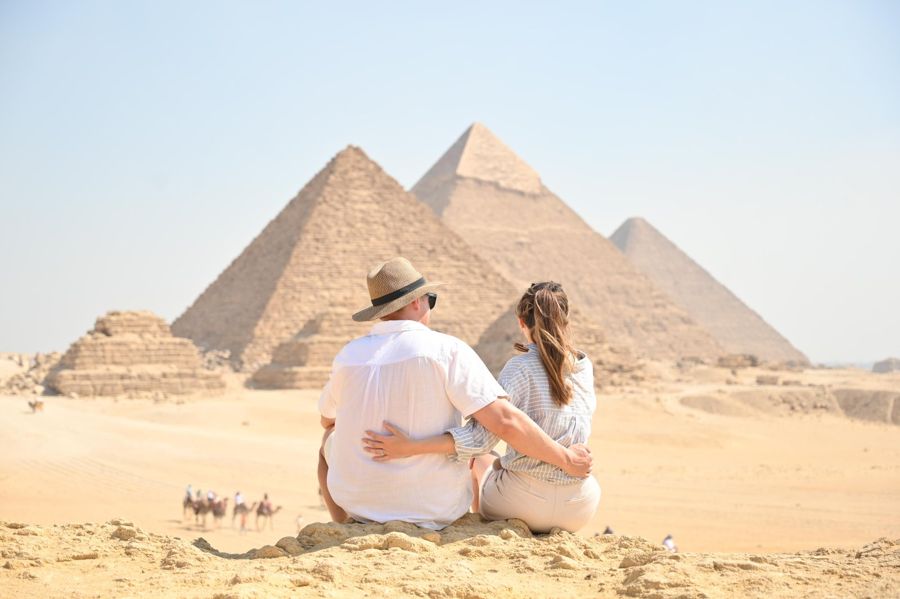
Half-day tour to the Pyramids of Giza and the Sphinx
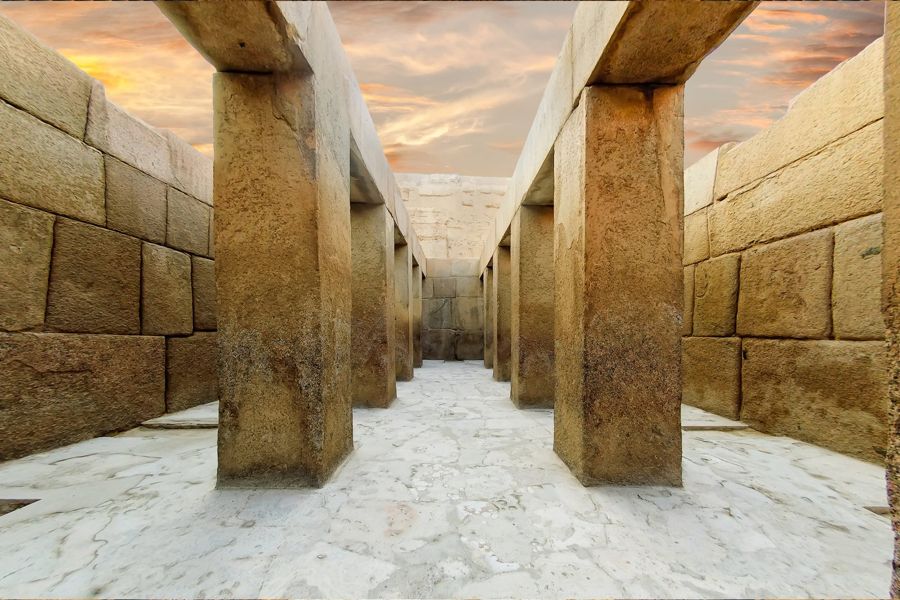
- The temple from the excavated rock stands directly in front of the figure and is overlooked by most visitors.
- A licensed guide shows which weathering traces come from the rock and which do not.
- Includes plateau entry, German-speaking guide, and hotel pickup.
- Free cancellation up to 24 hours before the start.
Three rock sections, three states of preservation
- Base
- Torso with ribbed weathering
- Neck
- Head, best state of preservation
The numbering follows the common classification in excavation research. The illustration is schematic and not to scale.
Where the excavated rock went
Where did all the rock from the trench actually go? This question leads to the finding that supports the dating.
Immediately east of the Sphinx stands a temple built from massive limestone blocks, some weighing several dozen tons. Between 1979 and 1983, an excavation team mapped the Sphinx stone by stone and compared the layering in the temple blocks with the layers in the figure's body. The result: the blocks fit. Core blocks of the temple correspond to specific layers from the Sphinx's torso.
The distribution sharpens the finding even further. Blocks from the lower chest layers are predominantly in the temple walls; blocks from the upper chest layers are concentrated at the temple's front. This corresponds exactly to the order in which a quarry works downward. The temple was therefore built from the excavated rock while the figure was being created.
Thus, the Sphinx and the temple are a single operation. The sculptor and the mason worked on the same material, only in opposite directions: what one removed, the other reassembled fifty meters further east.
The scale of these blocks deserves a moment. These are not handy bricks but monoliths weighing dozens of tons, some even more. They only had to be moved a few dozen meters, from the edge of the pit to the construction site in front, and downhill at that. That is the most favorable transport task imaginable, and it explains why block sizes were used here that would never have been chosen for longer distances.
The temple, by the way, was never finished. That, too, fits the picture of a project that ended at a deadline.
Who had the Sphinx built?
The attribution to a patron is thus largely clarified, though not proven.
The temple in front of the Sphinx and the valley temple of the middle pyramid lie side by side, share a building alignment, and belong to the same construction phase. This phase belongs to the pyramid complex of Khafre. Since the Sphinx temple consists of the excavated rock from the figure, the figure is tied to the same chain. The excavation director puts it cautiously: the evidence for Khafre is stronger, but it is not absolute proof.
There is a serious counter-consideration. Some experts consider it possible that the work began under Khufu or that another family member was behind it. They cite a quarry edge north of the figure that could fit an older transport route, and team names containing the word "lion" found at a harbor site from Khufu's time. That is a hint, not proof, and is treated as such even by its proponents.
A third trail leads to the stele that a later king had erected between the paws a thousand years later. In its damaged text, 19th-century scholars believed they recognized a syllable of the name Khafre, which long served as evidence. That passage is now lost, and what stood there can no longer be verified. As an argument, it is therefore no longer valid, neither for nor against the attribution.
For practical purposes, this means: the usual dating to around 2500 BC is well founded and supported by the scholarly community. It rests on a chain of circumstantial evidence, not on an inscription. No building inscription of the Sphinx exists.
Three datings and what speaks for each
Khafre, around 2500 BC
The figure was created as part of Khafre's pyramid complex, together with the temple in front.
Pros
The temple blocks demonstrably come from the figure's trench. The Sphinx temple and the valley temple share building alignment and construction phase.
Cons
There is no building inscription. The chain consists of circumstantial evidence, albeit well-examined.
Earlier, under Khufu or a family member
The work began a generation earlier; Khafre completed it or claimed it for himself.
Pros
A quarry edge north of the figure and team names with the word "lion" from Khufu's time.
Cons
Both are equally compatible with the usual dating. There is no independent evidence for an earlier start.
Much earlier, before 5000 BC
The deep vertical furrows on the body and pit walls come from heavy rain that no longer occurred since the Old Kingdom.
Pros
The weathering pattern is visibly different from that of other structures on the same site.
Cons
The differences can be explained by the rock layers and salt weathering. For a high culture of this age, no other finds exist.
Why was the Sphinx built?
Why was the Sphinx of Giza built? There is no recorded answer, but there is a well-founded interpretation.
The figure combines a lion's body with a human royal head, recognizable by the headdress and the remains of a beard. In Egyptian thought, the lion stands for vigilance and protection; the royal head stands for the person who exercises that protection. Together, they form a guardian who is not abstract but someone specific.
The orientation is decisive. The figure looks exactly east, toward the sunrise. It lies at the end of the causeway leading down from the middle pyramid, directly next to the temple at the then-harbor. Anyone coming up from the valley to the pyramid complex passed it. It thus stands at the threshold between the land of the living by the river and the necropolis on the rocky ridge.
Later, a second meaning was added. In the New Kingdom, more than a thousand years after its creation, the figure was already largely buried in sand and was venerated as a deity. From this period comes the stele between the paws, on which a later king had recorded that he had the sand removed. By then, the Sphinx was already a monument from a distant past, as distant for them as the Roman era is for us.
The name also reveals something about its function. The word "Sphinx" is Greek and comes from a completely different mythological context. The Egyptians of the New Kingdom called the figure Hor-em-achet, roughly "Horus in the Horizon," connecting it with the sun god at the place of his rising. What it was called during the construction period is not recorded. The common name is thus a foreign designation given about two thousand years after its creation.
What it meant to its builders remains a reconstruction. What it meant to later Egyptians, however, is documented in writing.
Frequently asked questions
When was the Sphinx of Giza built?
According to the usual dating, around 2500 BC, in the 4th Dynasty. The attribution rests on the construction sequence with the temple in front, not on an inscription.
Who built the Sphinx of Giza?
With high probability, Khafre, the builder of the middle pyramid. An earlier involvement of his father is discussed but not proven.
How old is the Sphinx of Giza?
About 4,500 years. The theory of an age of 9,000 years or more is not shared by the scholarly community.
Was it built from blocks?
No, it was carved from the bedrock. Only later repairs on the paws and base are masonry.
Why is the body in worse condition than the head?
Because the body and head consist of different rock sections. The head sits in denser, more resistant material.
Plateau entry as QR code on your phone
The Sphinx, the pit, and the temple in front are within the regular ticket area. There is no ticket booth at the Sphinx gate itself.