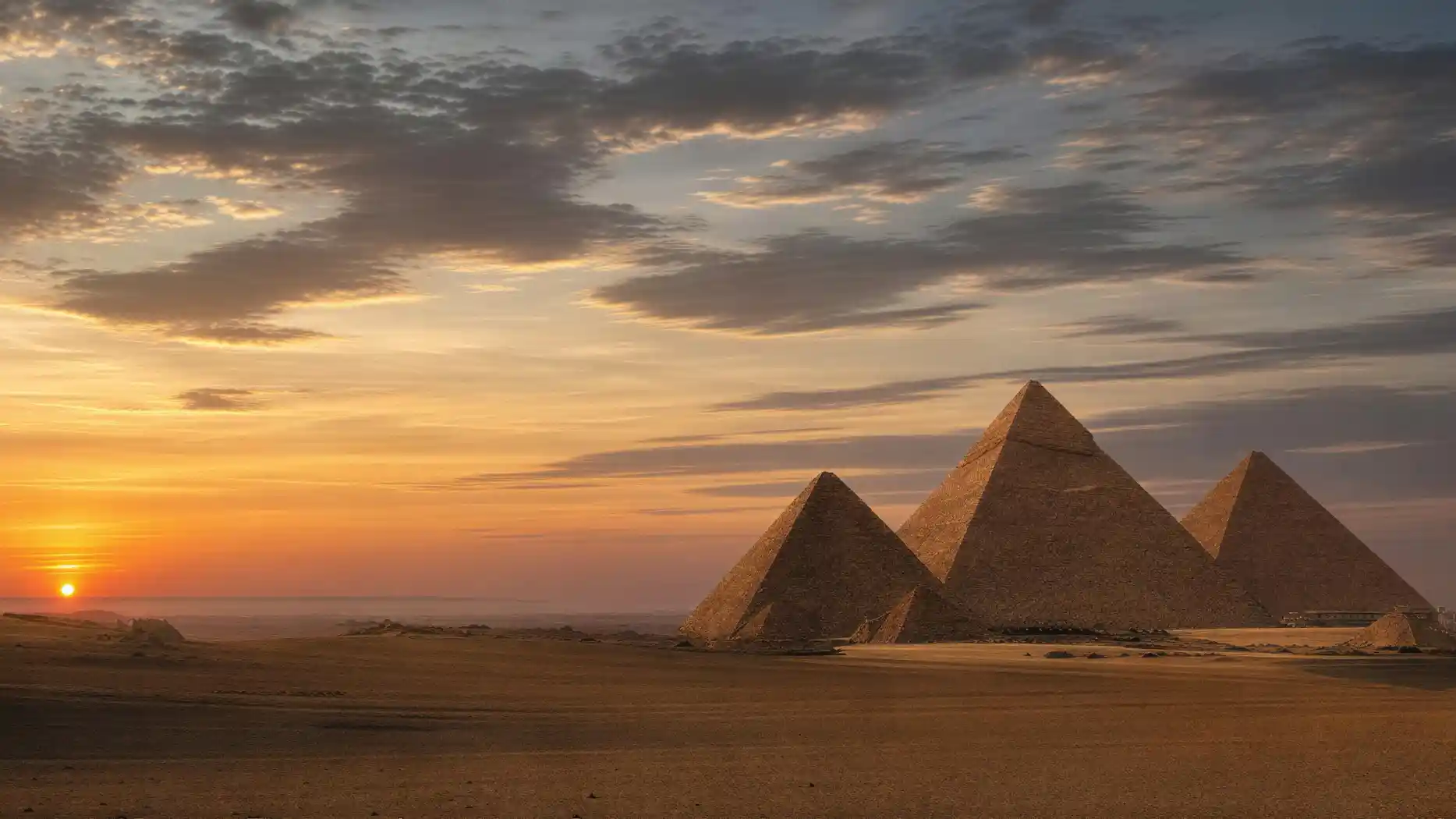
Anyone who wants to know what happened to the Pyramids of Giza gets two answers that tick at different speeds.
The first concerns the structure itself and is essentially complete. What was lost in substance was lost mostly between the Middle Ages and the 19th century, not through decay but through removal. The smooth outer casing was stripped and reused elsewhere. Since then, the stone has changed very little.
The second answer concerns the surroundings and moves quickly. The groundwater level beneath the site has risen, the city reaches right up to the fence, the district on the eastern edge is being redeveloped, and the number of people passing through the narrow internal passages is many times what those passages have ever seen. The serious conservation issues today are almost all about water, air, and people, not quarrying.
This page describes both separately: first the findings—what is missing and what remains—then the processes currently at work, then the decisions that follow. One such decision was made in 2024 and serves as a benchmark for everything else, because it halted an already-begun restoration.
Why the construction itself ensures stability
First, the reassuring news. Anyone asking whether the Great Pyramid of Khufu is still standing can answer yes without reservation, and for a structural reason.
These structures are not shells but massive stone bodies. There is no load-bearing framework that could fail, no dome, no vault over a large space, no roof. The internal cavities take up a negligible fraction of the volume and are supported by relieving structures. Collapse is therefore not a realistic scenario. What can disappear is material on the surface.
That is exactly what happened. The largest pyramid now measures about 138.5 meters instead of the original 146.6 meters, so a good eight meters are missing. The reason is the loss of the polished casing and the tip; today a small platform lies exposed at the top. What you see is the core, which was never meant to be seen. Where the casing went and who removed it is covered on a separate page.
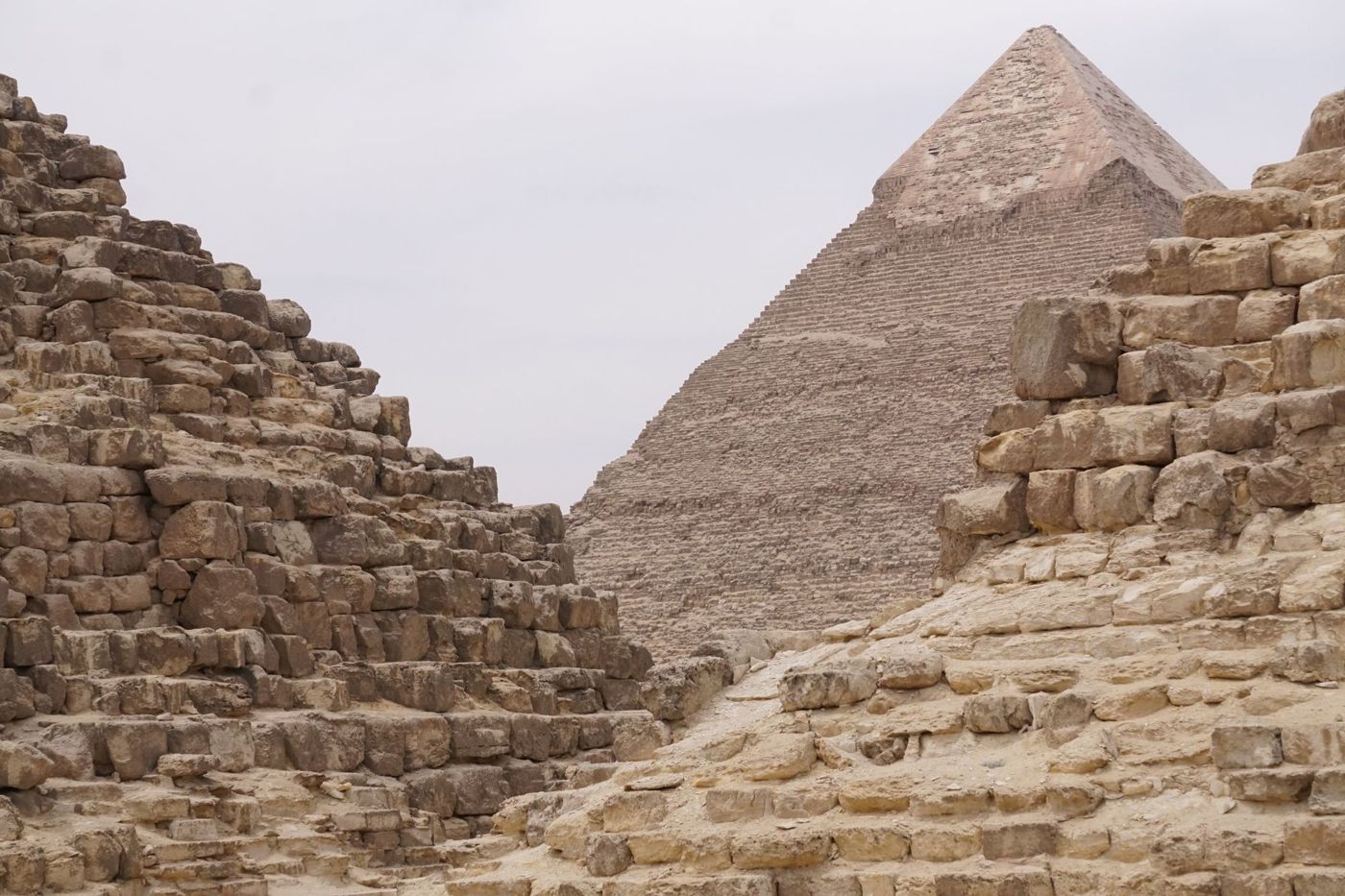
A remnant of the outer casing survives, by the way, in the wrong place for stone theft: at the top. The middle pyramid carries a cap of original casing at its summit, because the removal proceeded from bottom to top and simply stopped there. This cap is the only direct evidence of what the surfaces once looked like, and is therefore more valuable for conservation than its size suggests.
The core is rougher than the lost outer casing and thus more susceptible to wind, sand, and temperature changes. Nevertheless, erosion today is very slow. The visible damage on the flanks dates overwhelmingly from the time of stone theft, not from later periods.
Guided tour of the site with entrance included
- A guide can show which damage is old and which is new, something otherwise hard to distinguish on the monument
- Entrance to the site is included per the provider, pickup as well
- German-speaking guide, duration between three and eight hours depending on the chosen variant
- Free cancellation up to 24 hours before, per the provider
The findings at the three monuments
What is missing at each of the three, what has survived, and what access is like.
| Monument | What is missing | What is preserved | Interior |
|---|---|---|---|
| Great Pyramid of Khufu | Casing and tip, a good eight meters of height | Core complete, passages and chambers accessible | separate ticket, limited daily quota |
| Pyramid of Khafre | Casing except for the upper layers | the distinctive cap of original casing at the top | separate ticket |
| Pyramid of Menkaure | most of the granite casing, lying at the base | lower area with granite, large breach on the north side | separate ticket |
- What is missing
- Casing and tip, a good eight meters of height
- What is preserved
- Core complete, passages and chambers accessible
- Interior
- separate ticket, limited daily quota
- What is missing
- Casing except for the upper layers
- What is preserved
- the distinctive cap of original casing at the top
- Interior
- separate ticket
- What is missing
- most of the granite casing, lying at the base
- What is preserved
- lower area with granite, large breach on the north side
- Interior
- separate ticket
The site ticket does not cover any of the three interiors. Each access is sold separately.
The danger comes from below: groundwater
The greatest current danger comes not from above but from below. Anyone looking at the Pyramids of Giza today sees a site where the groundwater level is significantly higher than it used to be.
The causes lie outside the fence. The densely built district on the eastern edge got a sewage network, and a residential area to the west is irrigated. Both feed the groundwater. As a result, standing water has appeared in several places: at the Sphinx Temple, east and in front of the Valley Temple, and south of the Sphinx in the area of the workers' tombs. For limestone, this is the worst possible stress, because rising moisture carries salts that crystallize as they evaporate and burst the structure from within.
The response is a permanent technical project. The antiquities administration, together with American development aid, had a groundwater lowering system installed: eighteen wells with submersible pumps that switch on automatically when the water level in the aquifer reaches a set height. The work was carried out by the drainage division of an Egyptian construction company.
The hardest hit is not the pyramids but the figure in front of them. The Sphinx stands in an excavated hollow, so at the lowest point of the site, where water collects. There is a second disadvantage: it is not built from brought-in blocks but carved from the bedrock, and this rock consists of layers of varying hardness. Soft layers erode faster than hard ones, which is why weathering there is uneven and has required repeated repairs since antiquity. This problem does not apply to the structures made of laid blocks.
What is remarkable is the shift in responsibility. The preservation of these monuments now depends on pumps, on a power supply, and on how sewage and irrigation are managed in the neighborhood. That is a completely different kind of heritage conservation than repairing a joint.
Breathing air inside
The second stress arises inside, and it has a surprisingly mundane cause: breathing air.
In the narrow, poorly ventilated passages, moisture exhaled by visitors condenses. In the 1990s, this led to visible damage. Salt crystallized out of the stone on the walls, and mold grew. The antiquities administration then closed the interiors of all three pyramids one after another for repairs and had ventilation installed. The process is documented in the specialist press of the time.
This results in the condition visitors find today. The interiors are open again, but they are managed: each access costs a separate ticket, and for the largest pyramid there is a limited daily quota of a few hundred tickets. Anyone who wants to see the inside of the Great Pyramid of Khufu today must do so early in the day, because tickets can run out. The official overview of the site explicitly lists the interiors as separate items alongside the site ticket.
The quota is therefore not a sales trick but a conservation measure with a measurable basis. It limits exactly the factor that causes the damage, namely the number of people breathing simultaneously in an enclosed stone room.
How strict interventions are today
How strict interventions are today is shown by the most important development of recent years.
In January 2024, the antiquities administration announced that it would reattach the granite blocks lying at the base of the smallest pyramid, estimated to take three years. International opposition came quickly, the work was stopped, and a review committee with experts from Egypt, the United States, the Czech Republic, and Germany took up the matter. Their result was a unanimous rejection: the original position of no single block could be determined, so reattaching them would be invention, not restoration.
Instead, the committee recommended what turns a construction project into a research project: survey, sort the fallen blocks, excavate the rubble slope, and make the results accessible to visitors. The current state thus remains the state.
The principle behind this is not new in heritage conservation, but here it is applied with unusual consistency: an intervention must be reversible and must not create a state for which there is no evidence. A re-laid block looks like a finding but is an assertion.
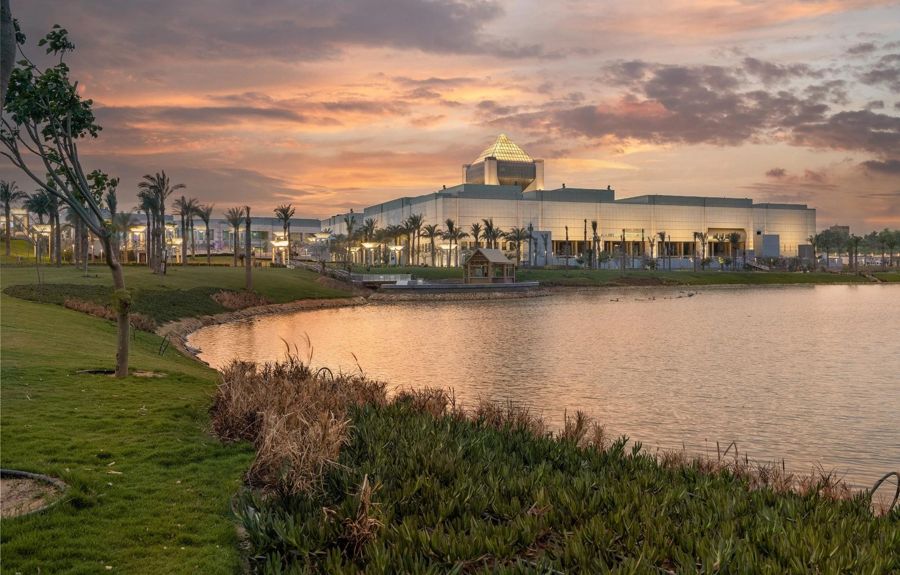
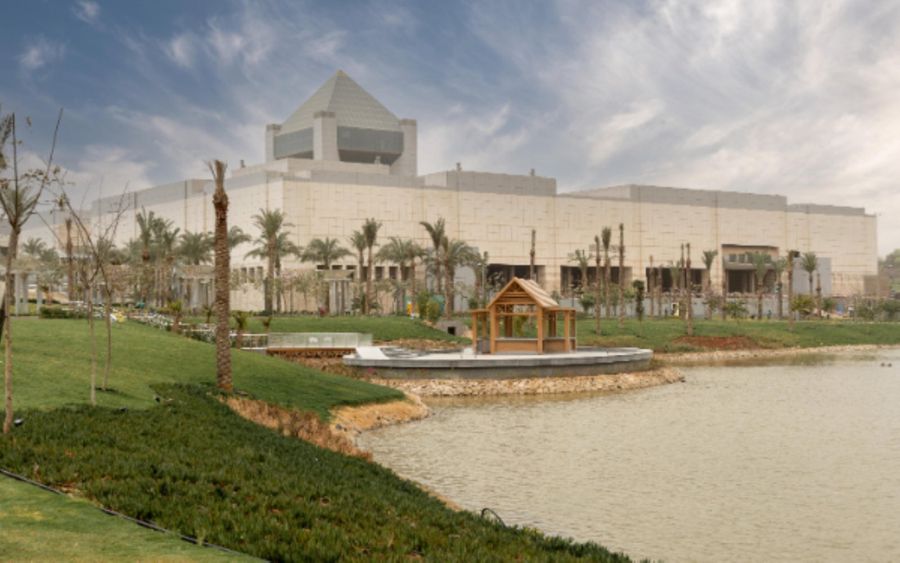
This line runs through everything. Little is changed on the site itself, while the surroundings are indeed being reshaped. The latest conservation report of the World Heritage committees points in the same direction: a planned footpath between the Grand Museum and the site was assessed as an unacceptable intervention in the cultural landscape, and a formally designated buffer zone around the site is still missing. The procedures for this belong on the page about World Heritage status.
How long will the pyramids last?
The question that arises remains. How long the Pyramids of Giza will last cannot be seriously answered with a year, and any source that gives one has made it up.
The reason is that the decisive factors have nothing to do with the stone. A massive stone body in a dry climate weathers extremely slowly; the last four and a half millennia are the proof. What determines the time span are pumps, sewage pipes, irrigation in the neighborhood, air quality, and how many people stand in the chambers for how long. These are all factors that depend on decisions, not on natural laws.
The honest answer is therefore: indefinitely, as long as the surroundings are managed, and considerably shorter if they are not. That sounds unsatisfactory, but it is exactly the point where heritage conservation starts today.
Accommodation on the eastern edge, as long as it exists. The district immediately east of the fence is being redeveloped; the small houses with rooftop terraces and unobstructed views are therefore a stock with an expiry date. Three houses that cover this:
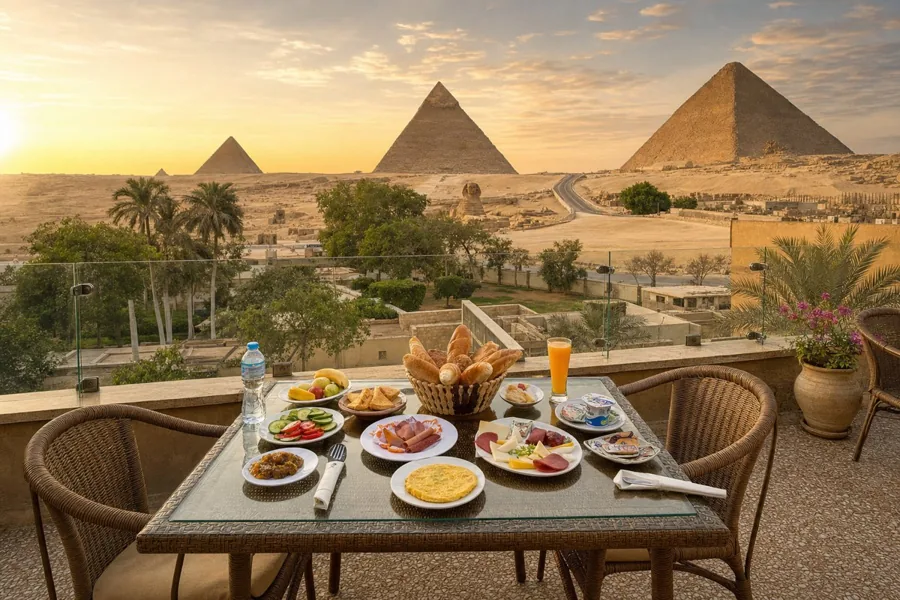 At the Sphinx
Giza Pyramids View Inn
- Good breakfast
- Airport shuttle
- Two restaurants
- 24-hour reception
- Free Wi-Fi
For those who want to see the Sphinx from their breakfast chair
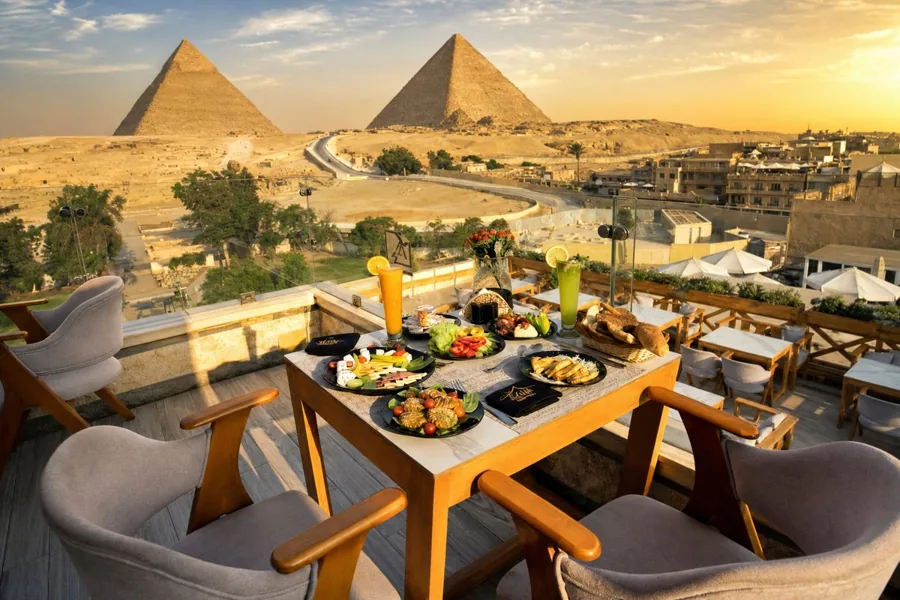 Most reviewed
Great Pyramid Inn
- Fabulous breakfast
- Rooftop terrace restaurant
- Bar
- Airport shuttle
- 24-hour reception
Most who want to stay in the neighborhood
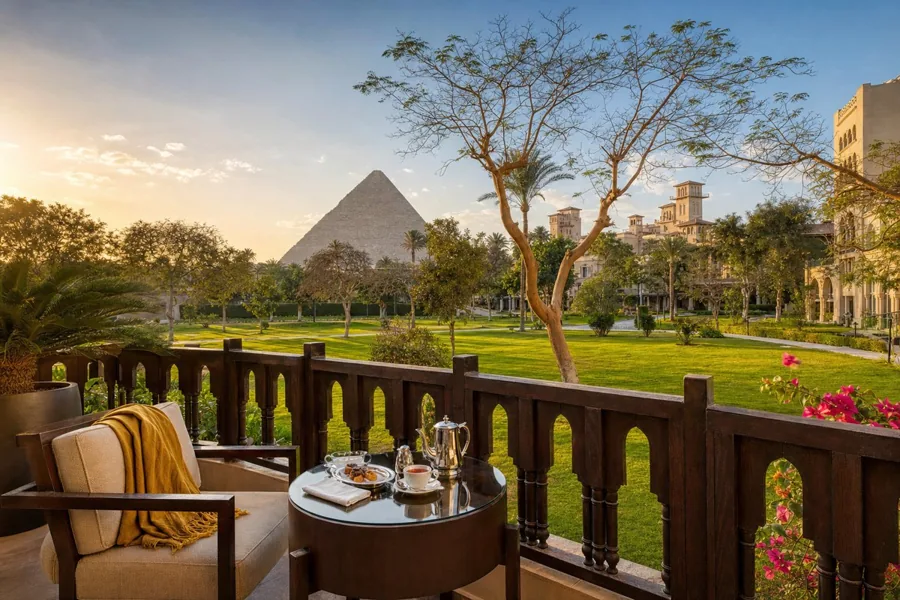 Garden & pool
Marriott Mena House
- Excellent breakfast
- Outdoor pool
- Spa and wellness center
- Three restaurants
- Fitness center
For those who want space, garden, and pool instead of a rooftop terrace
Frequently asked questions
Can the pyramids collapse?
No. They are massive stone bodies without a load-bearing structure that could fail. What can be lost is material on the surface, not stability.
Why is the largest pyramid lower than it used to be?
Because the polished casing and the tip are missing. From originally 146.6 meters, it became about 138.5 meters; today a small platform lies exposed at the top.
What currently threatens the monuments most?
Rising groundwater and the salts it carries. That is why a permanent groundwater lowering system with eighteen wells is running at the site.
Why is access to the interior limited?
Because the moisture exhaled by many visitors in the narrow passages causes salt efflorescence and mold growth. In the 1990s, all three interiors had to be repaired for this reason.
Will the casing be restored?
No. A corresponding project on the smallest pyramid was stopped in 2024 and unanimously rejected by an international committee because the original position of the blocks cannot be determined.