
The alignment to the north is the feature of the pyramids of Giza that impresses experts more than any measurement of size. Height and mass are a matter of effort and organization. Precision is a matter of skill.
The sides of the largest pyramid are aligned with the four cardinal directions, and the deviation from true north is within a few arcminutes, i.e., fractions of a degree. For comparison: a standard compass does not point to true north but to the magnetic pole, and depending on location, it can be off by several degrees. If you wanted to check the alignment of these structures with a compass, you would find the structure to be the more accurate reference.
This was achieved without a telescope, without a protractor in the modern sense, and without a clock. How it was done is still not fully understood, and that is exactly what makes the question interesting. There are several plausible methods, all feasible with the means of the time, and none has been proven.
A measure of what we are talking about helps to put it in perspective. An arcminute is one sixtieth of a degree. Over a base side of more than two hundred meters, a deviation of a few arcminutes corresponds to a shift of centimeters to a few decimeters at the end of the line. So the builders not only found the direction but maintained it over two hundred meters, on terrain they had to level first, and four times in a row for the four sides.
This page proceeds in order: first the measurement, i.e., what was actually measured and by whom, then the proposed methods, then a finding from a recent survey that slightly shifts the usual narrative, and finally the claims that attach to the topic.
How Accurate Is the Alignment Really?
First, the measurement, because without it any explanation is worthless.
The professional world became aware of the accuracy through the survey by Flinders Petrie in 1881, who worked with a theodolite on the plateau. Since then, it has been re-measured several times, with different methods and instruments, including in the 1980s and later with satellite-based surveying. The order of magnitude has not changed: the deviations are within a few arcminutes.
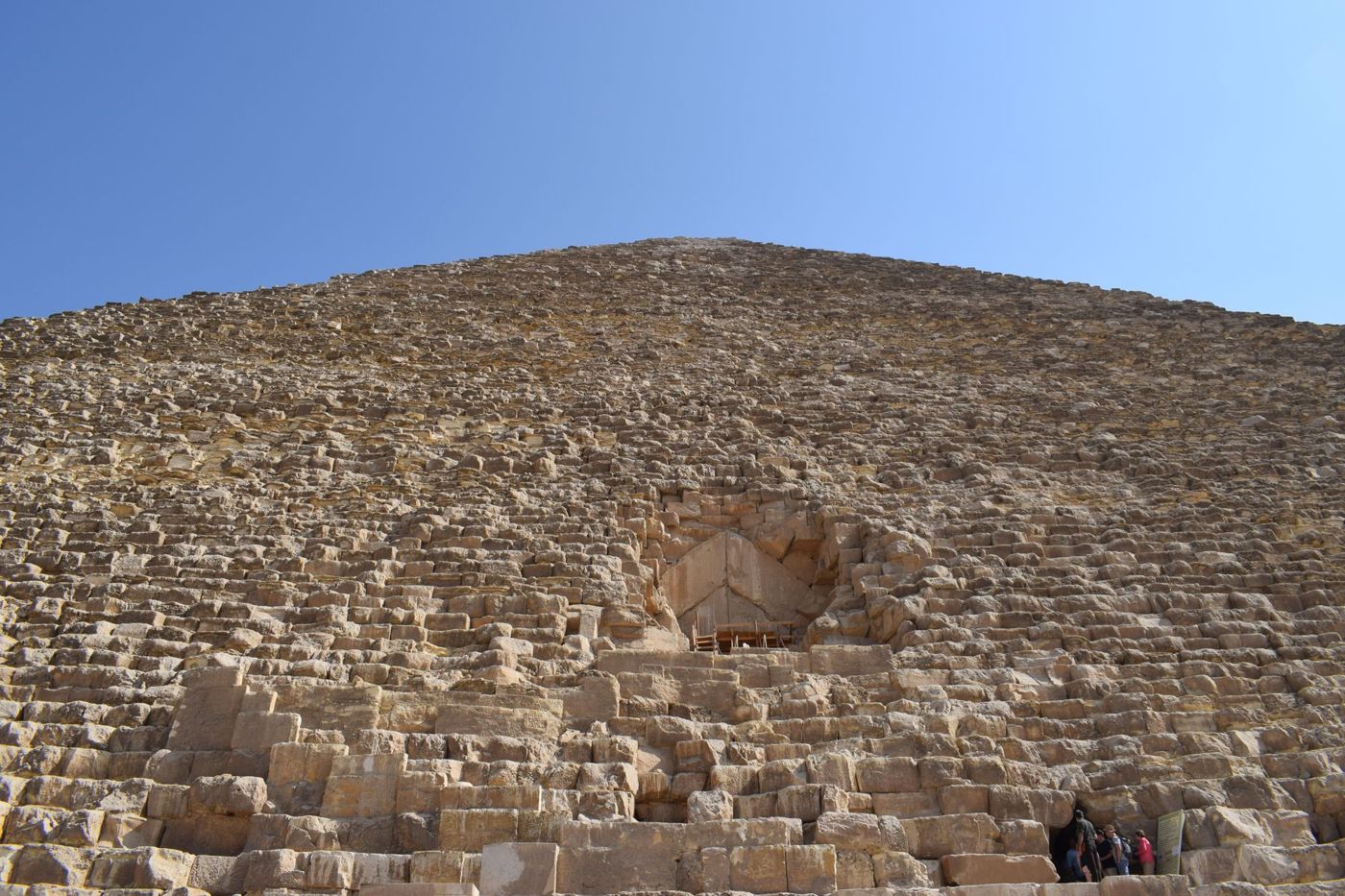
Important here is a distinction that popular accounts often overlook: today, we measure not the pyramid as it was planned, but the state it is in. The smooth casing is almost entirely missing, the edges are broken, and the corners are partly reconstructed. Therefore, any statement about alignment is a statement about the measurable remains, not about the builders' intention. This is not an objection to the accuracy, but it explains why different surveys yield slightly different values.
The most recent detailed work on this comes from Erin Nell and Clive Ruggles, who measured the site for a week in December 2006 with a total station. Their approach differs from earlier measurements in one point that is crucial for the result: instead of triangulating between corners, they recorded sequences of points along well-preserved wall sections and derived the best-fit line from them. Thus, the result no longer depends on two points, both of which may be damaged.
The publication of this survey provides some findings that rarely appear in popular accounts. The difference between the north-south axes of the Great Pyramid and the Pyramid of Khafre is only about half an arcminute. The sides of the Pyramid of Khafre are more perpendicular to each other than those of the Great Pyramid. And one point we will return to: the east-west axis is closer to the exact cardinal direction in both structures than the north-south axis.





Guided tour where the edges can be shown
- You can only see the alignment if you stand in the right place and look along an edge
- Entry to the site is included; pickup and interior visit are add-ons
- About three hours, German-speaking guide possible
- Free cancellation up to 24 hours before, according to the provider
How Did They Do It Without Instruments?
The simultaneous transit of two stars
Choose two stars that circle the celestial pole and wait for the moment when they are vertically aligned. A plumb line between them then points to the pole and thus to the north.
Pros
The method can be carried out with a plumb line and a sightline and theoretically achieves the observed accuracy. It also explains why the deviations of several structures point in the same direction.
Cons
It assumes that exactly this pair of stars was chosen, for which there is no text or find. The attribution is based solely on back-calculation.
The shadow cast by a vertical rod
A rod casts a shadow during the day. If you mark two shadow points of equal length in the morning and afternoon, the line connecting these points bisects the angle and gives the north-south direction.
Pros
Only needs a rod, a flat surface, and a day. A method of this kind is attested in several ancient cultures and requires no astronomical knowledge.
Cons
The achievable accuracy depends heavily on the flatness of the surface and the sharpness of the shadow. Whether arcminutes are achievable is disputed.
Sunrise on a fixed date
Instead of determining north first, one fixes the east-west axis according to the sunrise point on a specific day and derives north from it.
Pros
The recent survey finds the east-west axis more accurate than the north-south axis and sees indications in the surrounding structures that sunrise was the actual reference.
Cons
The sunrise point shifts over the year, so the date and visibility conditions would have to be exactly fixed. There is also no written record for this.
North Alignment or Solar Alignment?
Now to the finding that shifts the usual narrative, and it deserves more attention than it gets.
The story is almost always told as a north alignment. The builders sought north, found it with astonishing precision, and the other sides resulted from that. The 2006 survey suggests a different order. If the east-west axis is more accurate than the north-south axis, then perhaps it was the reference, and north was the result, not the starting point.
What stands around also supports this. The authors examined not only the three large structures but also the smaller installations and temples of the site, and conclude that for many of them, the east-west alignment in relation to sunrise, and in one case sunset, could have been a significant, perhaps the significant, factor.
This is more than a fine point. A north alignment points to the starry sky and to the idea of an imperishable region around the celestial pole into which the king enters. An east alignment points to the sun, to rising and return. Both are known from Egyptian texts, and they are not mutually exclusive. The question of which one the builders first laid out is not an academic quibble but a question about what this structure was about.
One argument additionally supports the solar reading, and it comes not from surveying but from the terrain. The installations of the plateau are open to the east: there lie the valley temples, there the causeway arrives, there the procession begins. The entire operation of these installations was oriented to the east, toward the river and the rising. That the axis defining this direction was laid out more carefully than the other would therefore not be a coincidence but a setting of priorities.
It is not decided. The study is cautious, and other experts maintain the north alignment as the primary reference. What can be said: the popular version, in which the north direction is self-evidently at the beginning, is not the only possible one.
Not a Flash of Inspiration but a Series of Measurements
A practical thought should be added, because it makes the method more tangible than any calculation. None of the proposed methods yields the direction in a single moment. All require repetition: several nights or several days, each time the same observation, and at the end an average. What we have here, then, is not the brilliant idea of an individual but the result of a series of measurements, carried out by people who knew that a single observation is not enough. That is less spectacular than a secret and more impressive in substance.
A second strand of the discussion concerns not the method but the date, and it is the reason this topic has made it into the daily press.
The idea behind it is elegant. If the builders oriented themselves by two stars, then the direction indicated by this pair of stars slowly drifted past the celestial pole over time, because the Earth's axis rotates in a cycle of about twenty-six thousand years. This drift is calculable and amounts to a few arcminutes per century. So if you know the deviation of a structure, you can calculate in which decade the method would have produced exactly that deviation.
Applied to several pyramids, this yields a relative chronological sequence, and the deviations of the structures do indeed fit such a sequence. The proposal was published in a respected journal and widely discussed.
However, it has also been criticized, and the objections are not far-fetched. The most serious is that the calculation presupposes what it aims to prove: it works only if the assumed pair of stars was actually used and if the builders made no other errors. Any deviation that comes from inaccurate measurement rather than from the drift of the sky shifts the result. A critical examination of such back-calculations points out how easily a plausible assumption can yield an apparently precise year.
In addition, there is a methodological point that anyone can understand without expertise. The deviations in question are of the same order of magnitude as the differences between the various surveys of the twentieth century. Deriving decades from such values works at the limit of what the data can support. The 2006 survey therefore explicitly notes how few reliable basic data exist despite the long debate.
For you as a reader, the classification is more important than the result: dating via alignment is an interesting proposal, not a proven method, and it does not replace any of the established dating methods.
What Is Made of It
- False
Something like this is impossible without modern instruments.
Several methods are known that work with plumb line, rod, cord, and patience and theoretically achieve the observed accuracy. The difficulty is not the principle but the clean execution over two hundred meters in length.
- Partially
The pyramid points to a specific star.
The structures are aligned with the cardinal directions, not with an object. There are stellar references, for example in the shafts inside, but that is a different question from the alignment of the base.
- False
The deviation proves a specific construction date.
The back-calculation assumes a specific method and error-free execution. It provides a hypothesis, not a date.
- False
A compass at the structure confirms the alignment.
A compass points to the magnetic pole, not to true north. The difference between the two at the site is significantly larger than the deviation of the structure.
For further reading: Astronomy and Surveying in Ancient Egypt
This page summarizes a debate that has been running for over a hundred years and is about series of measurements. If you want to read it in context, you will find comprehensive accounts of Egyptian astronomy and Old Kingdom surveying techniques.
Frequently asked questions
How accurate is the alignment?
The deviation from true north is within a few arcminutes, i.e., fractions of a degree.
How did they do it?
That is open. Methods discussed involve two circumpolar stars, the shadow of a rod, and sunrise.
Is the north direction really the reference?
Possibly not. A 2006 survey finds the east-west axis more accurate and considers sunrise to be the essential reference.
Can the construction date be calculated from it?
It has been proposed, but it is not proven. The calculation presupposes exactly the method it aims to prove.
Can I check it on site?
Not meaningfully with a compass, because it points to the magnetic pole. Looking along an edge shows the straightness better than any device.
Are all three pyramids aligned the same?
Nearly. According to the 2006 survey, there is about half an arcminute between the north-south axes of the two large ones.