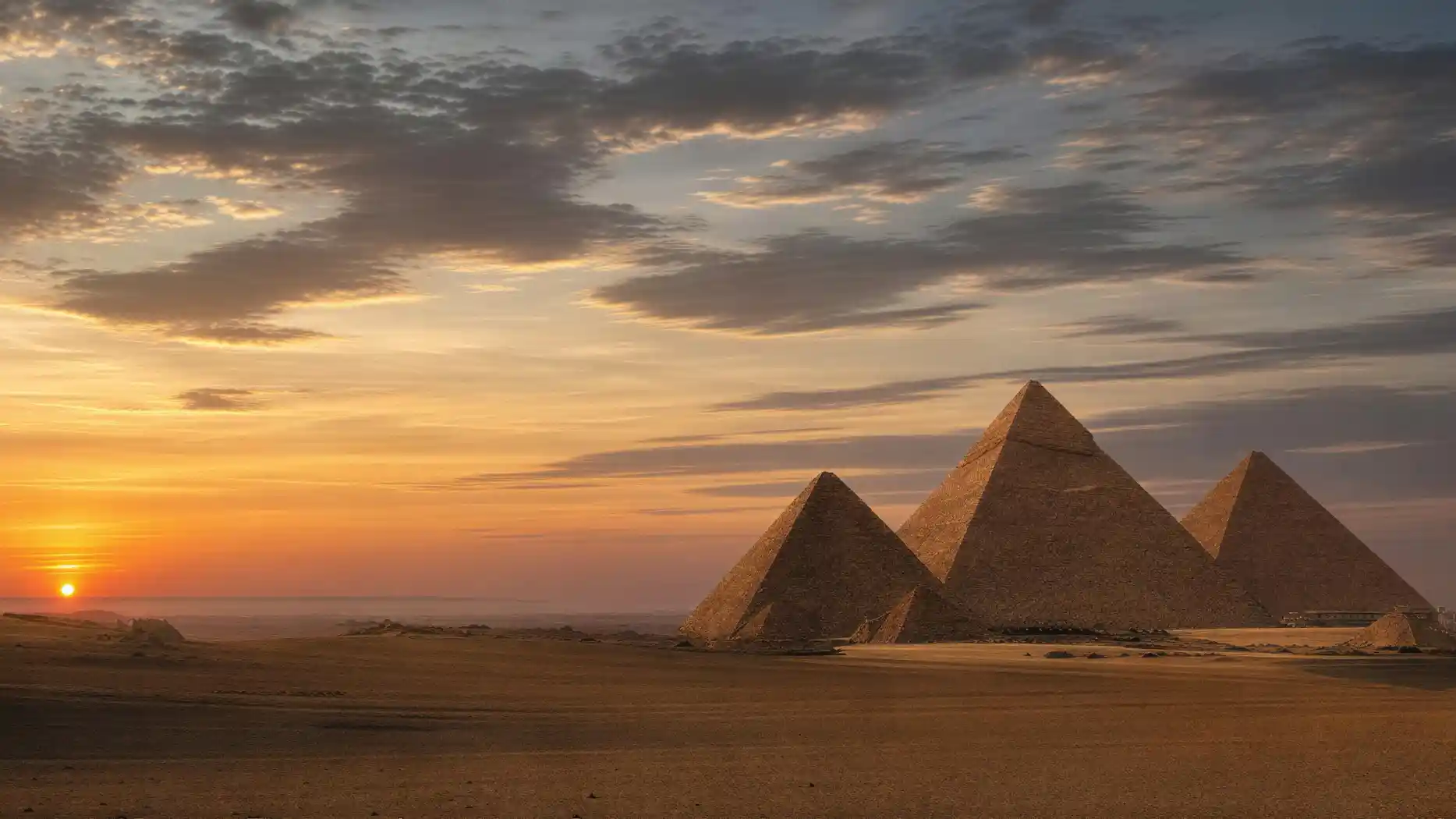
The mastaba tombs of Giza are the part of the site that most visitors walk past, because at first glance they look like rubble: low rectangular stone boxes, half buried in sand, without labels or entrances.
From the air, the same area looks completely different. Then you can see rows, alignments, and repeating intervals, with alleys in between. What lies there is not a cemetery that grew organically over centuries, with people buried wherever, but a planned complex: standardized tomb structures, laid out in blocks and apparently allocated.
That is the real finding of this site, and it tells us more about the society of the Fourth Dynasty than any measurement of height. Whoever builds a pyramid needs an administration. Whoever lays out a cemetery with streets and assigns plots has one.
This page explains how the fields are structured, who lies in the east and who in the west, where the numbers on many tombs come from, and what you can actually enter. The answer to the last question is short, but it is worth it.
The Two Great Fields
Both lie directly next to the Great Pyramid of Khufu, both are included in the regular site ticket, and they differ not in appearance but in who is buried there.
| Field | Location | Who Is Buried There | What You See |
|---|---|---|---|
| Eastern Field | Between the pyramid and the eastern part of the site | Members of the royal family, plus the small pyramids of the queens | Larger structures, some cut into the rock, including the only reliably open painted tomb |
| Western Field | West of the pyramid, toward the desert | Officials, priests, and overseers of craftsmen at the court | The more extensive of the two fields, in clear rows with alleys in between |
- Location
- Between the pyramid and the eastern part of the site
- Who Is Buried There
- Members of the royal family, plus the small pyramids of the queens
- What You See
- Larger structures, some cut into the rock, including the only reliably open painted tomb
- Location
- West of the pyramid, toward the desert
- Who Is Buried There
- Officials, priests, and overseers of craftsmen at the court
- What You See
- The more extensive of the two fields, in clear rows with alleys in between
Both fields are included in the basic admission. Individual burial chambers have their own small tickets and variable opening hours.
To the East the Family, to the West the Apparatus
The division follows a logic that you can read on site once you know it.
To the east lies the family. There stand the small pyramids of the queens, there lie the sons, daughters, and grandchildren of the builder, and there is also the rock tomb of Meresankh III, which has its own page because it is the only one whose paintings are fully preserved and regularly accessible.
To the west lies the apparatus. Officials, priests, overseers of workshops and administrations—the people who organized the construction and the later mortuary cult. Their tombs are smaller, but there are many of them, and they stand in rows like houses along a street.
This principle has a technical term from the excavation reports: core cemeteries. It refers to groups of largely identical mastabas that were laid out as a unit and then assigned. So they did not wait for a death and then build, but built in advance and allocated. Between the blocks there are reserved alleys, which the excavation records explicitly list as streets.
What you would see in these tombs is fundamentally different from what the pyramids offer. In the chambers of the officials, there are not empty stone rooms but walls with depictions of daily life: fieldwork, crafts, cattle breeding, storage, along with the names and titles of the deceased. Everything we know about the organization of this society comes to a significant extent from such chambers, not from the royal monuments. The pyramids show what was possible; the mastabas show who made it possible.
Knowing this, when you walk through the western field you no longer see rubble but a ground plan. And you see that proximity to the pyramid was a matter of rank: the closer to the king, the closer to the center of the complex.
Half-Day Tour with Time for the Fields
- The cemeteries are not signposted; without explanation they remain a collection of stone boxes
- Admission to the site is included, as is pickup from your accommodation
- About four hours, German-speaking guide possible, interior visit as an add-on
- Tickets for individual burial chambers are not included and are purchased at the entrance
The Numbers Are Addresses
The numbers on many tombs are not museum decoration but the addresses of this grid, and they have a backstory you should know.
Around 1900, the three great pyramids were considered largely exhausted. The cemeteries, on the other hand, were seen as promising. In 1902, the Egyptian Antiquities Service granted excavation concessions to three missions: to the Italian Ernesto Schiaparelli, to the German Georg Steindorff, and to the American George Reisner. How the site was divided among them was decided at a meeting at the Mena House, the hotel at the foot of the plateau that still stands today.
Reisner himself records the course of events in the introduction to his excavation report. From this division comes the numbering system still used today: G 1000 and G 2000 in the western field, G 7000 in the eastern field, each with sequential numbers for individual structures. So if you see the inscription G 7530 on a stone, you are not looking at an ancient inscription but at a catalog number from the early twentieth century.
Practically, this is more than a footnote. These numbers are the key to everything published about a single tomb. If you are interested in a particular structure, you can find excavation diaries, plans, and find lists under its number, freely accessible in the Harvard University archive, down to individual diary pages with dates.
From the eastern field comes the most enigmatic find of the entire plateau. In the 1920s, Reisner's team discovered a sealed shaft there containing the burial equipment of a queen, complete and undisturbed: gilded furniture, a carrying chair, a bed, jewelry. The sarcophagus inside was sealed, and when it was opened, it was empty. How that fits together has not been conclusively resolved to this day, and it is one of the most famous open questions in Giza research.
The excavations of the expedition under my direction were carried out in the concession granted to me in 1902, as well as in Schiaparelli's concession, which passed to me in 1906.George A. Reisner, preface to the first volume of his excavation report on the necropolis (translated from English)
What You Can Enter
That leaves the question of what you can enter, and here the answer is honestly thin.
The vast majority of mastabas are closed. Their chambers are sensitive from a conservation standpoint, many shafts are unsafe, and only a small selection is open to visitors, which changes. Which tombs are accessible on a given day changes without a recognizable schedule, and you can only reliably find out at the ticket office.
At least it is possible to say from which circle this selection comes. The better-preserved structures of the eastern field and some in the western field are repeatedly mentioned: Iymery, Qar, Idu, Khufukhaf, Nefermaat, Seneferuchaef, and Seshemnefer IV. When they are open, they are included in the general ticket. According to consistent visitor reports, about three of them are accessible at the same time, without a recognizable schedule, with Qar being the most frequently open. That Qar and the neighboring Idu are often open has a plausible reason: both were extensively conserved in 2020.
These names are meant for asking, not as a promise. None of these tombs should be planned on, and if you arrive with a list, you will pass by most doors.
What Is Reliably Worth It
One thing is reliably worth it: the tomb of Meresankh III in the eastern field. The Egypt Exploration Society describes it as the most extensive of the accessible tombs, it costs a small separate ticket, and it is the only one with fully preserved paintings. If you enter only one tomb, make it this one.
There is also a trap, and it is not in any travel guide. The workers' cemetery at the southern edge is not included in the site ticket but has its own, and the ministry's price list attaches a condition to this line that changes everything: a minimum of five tickets are sold at once. A couple cannot buy this ticket at all, and a family of three cannot either, at least not without paying for five. This is not a question of price but of access, and it explains why this part of the site is so empty.
For everyone else: the value lies in walking, not in entering. The official overview of the site does not list the fields as a separate attraction, which explains why hardly anyone goes there deliberately. Take twenty minutes for an alley in the western field, look at the alignments and the intervals, and compare the size of the structures with their distance from the pyramid. This is not a detour, because the fields lie directly on the circular path, and it is the part of the site with the fewest people.
A practical note: there is no shade there, and the ground is unpaved. So schedule your walk through the fields for early morning rather than midday, when you are better off in the valley temple or a burial chamber anyway.
Frequently asked questions
Are the cemeteries included in the admission?
Yes, both fields belong to the open area. Individual burial chambers have their own small tickets.
Can you go inside the mastabas?
Not into most of them. A small, changing selection is open; ask at the ticket office.
Which tomb is most worth it?
That of Meresankh III in the eastern field. It is the only one with fully preserved paintings.
What do the numbers on the tombs mean?
They are catalog numbers from the excavations of the early twentieth century, not ancient inscriptions.
Who is buried in the western field?
Officials, priests, and overseers of the court. The royal family lies in the eastern field.
How long should I plan?
Twenty minutes is enough for an impression. The fields lie directly on the circular path.