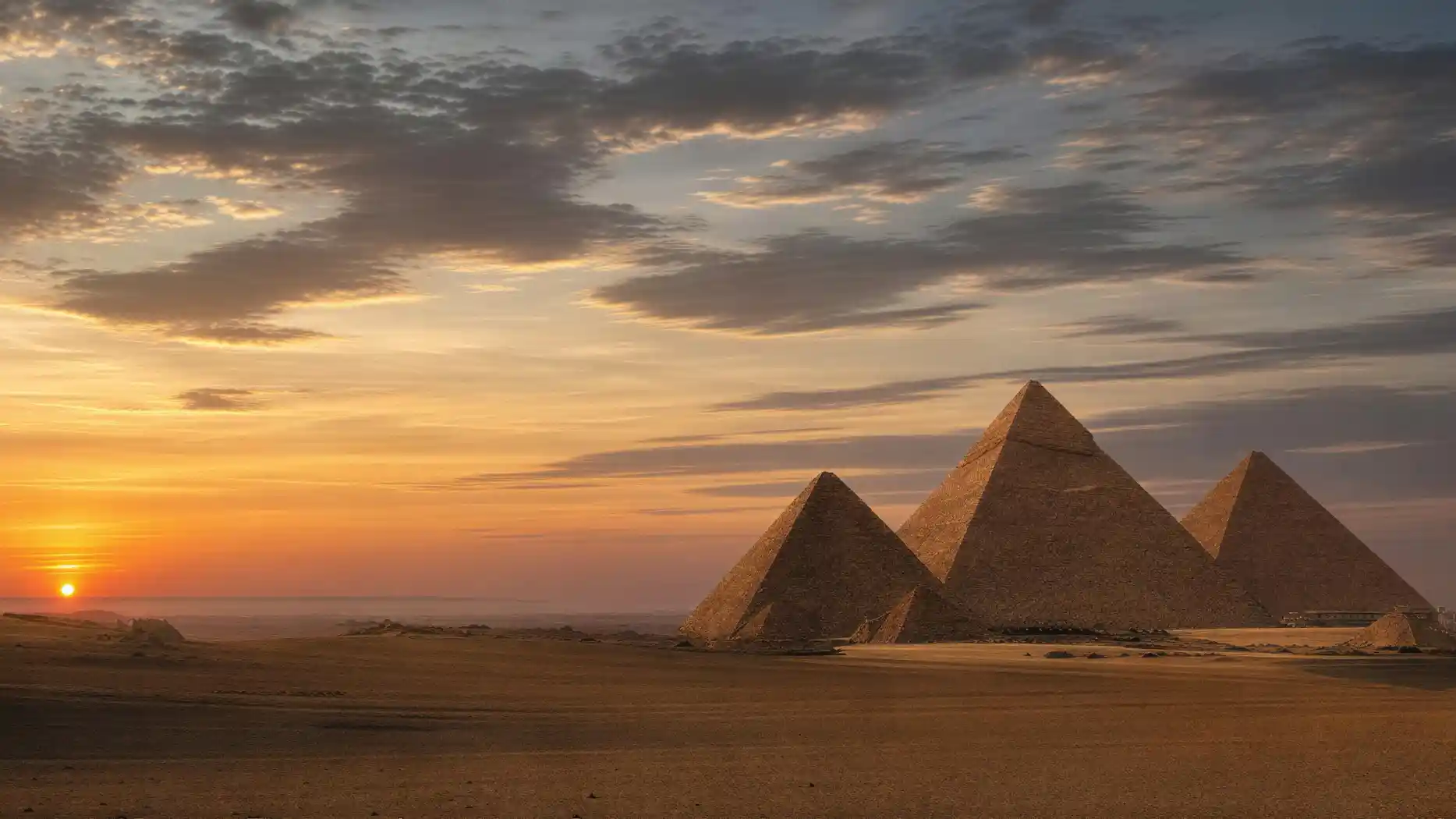
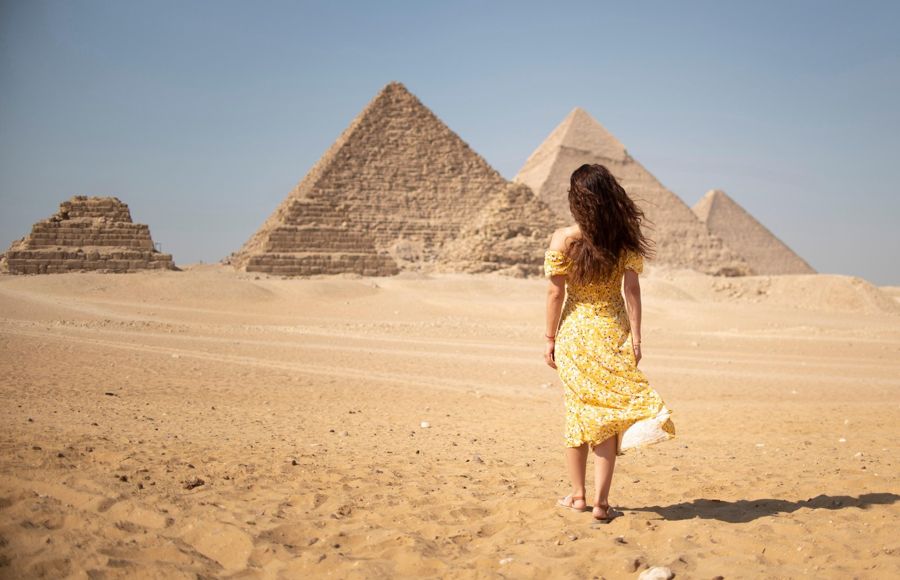
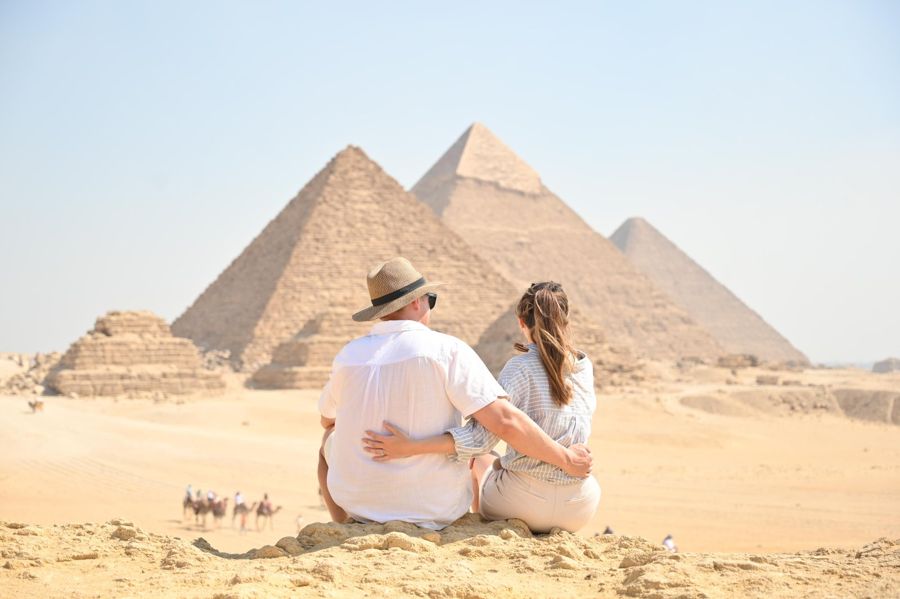
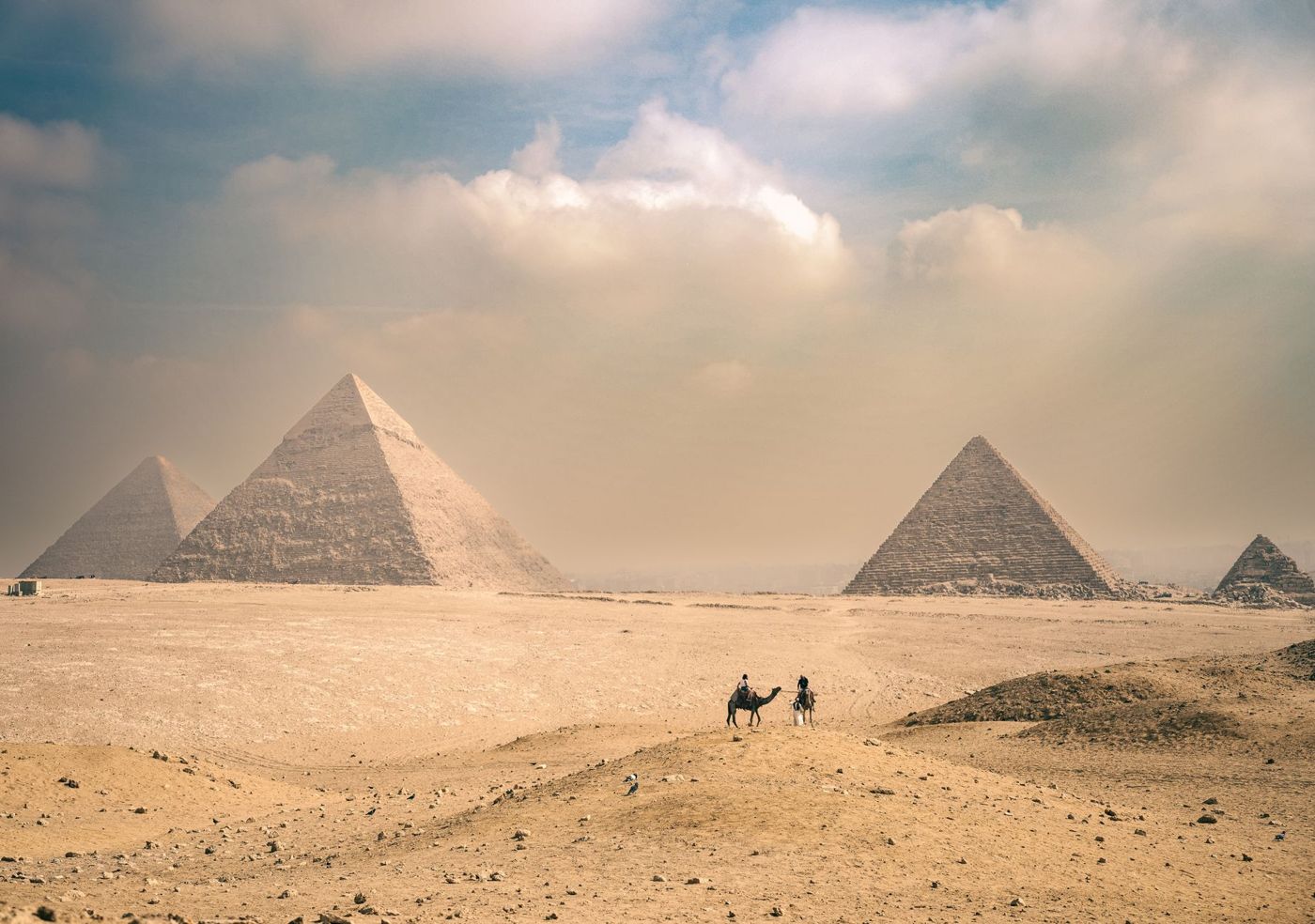
They appear in every photo, and almost no one notices them. At the foot of the great structures stand several much smaller pyramids, squat, some only preserved as stumps, and they are regularly mistaken for rubble or foundations.
They are independent structures. Six of them belong to the two outer complexes of the site: three on the east side of the largest pyramid and three on the south side of the smallest. In addition, there is a seventh, even smaller one, which only reappeared in 1993.
The collective term "Queen's Pyramids of Giza" is convenient but not entirely accurate. For some of these structures, the attribution to a specific person is disputed; for others, it is certain that they were not intended as tombs. The term thus groups together several different construction tasks.
They are interesting for another reason. Because they are small and less carefully executed, they reveal what is hidden beneath the casing of the great structures: the layer-by-layer construction, the building sequence, and the points where work stopped.
The proportions help with classification. The three on the east side each reach roughly a fifth of the height of their large neighbor, so they are still structures on the scale of a multi-story building. They only seem inconspicuous because the largest stone structure on Earth stands next to them. Standing alone in the landscape, each one would be a sight worth seeing.
And one of them has had a second career that began over two thousand years after its construction.
Where the Small Structures Stand
- Three structures on the east sideNext to the largest pyramid, in a row from north to south
- Cult pyramid at the southeast cornerMuch smaller, rediscovered in 1993
- Middle pyramidWithout subsidiary pyramids of this kind
- Three structures on the south sideNext to the smallest pyramid, only one of them completed
The illustration is schematic. All seven structures are within the regular ticket area and can be freely walked around.
The Three on the East Side and Their Names
The three on the east side of the largest pyramid are the better known, and with them the problem with names begins.
In the specialist literature, they bear simple designations, numbered from north to south. This does not say who they belonged to, and that is exactly what has been debated for decades. The northern one is sometimes attributed to the builder's mother, sometimes to one of his wives. For the middle one, several proposals stand side by side, including a known queen and an unknown one. Only for the southern one is the attribution fairly stable.
The reason for this uncertainty is banal and revealing at the same time: there are no inscriptions. None of these structures bears a building inscription with a name. The attributions are based on excavation finds in the vicinity, on the arrangement of the structures, and on conclusions drawn from later sources. That is solid work, but it is circumstantial.
Measurements, excavation reports, and photographs of all structures on the site are available in the digital archive of Harvard University, including documentation from the major excavation campaigns of the early 20th century.
Adding to the difficulty, these structures were robbed early and thoroughly. Their interiors are small, their closures were simpler than those of the large complexes, and they were less in the public eye. What remains of the furnishings comes mostly from the surrounding shafts and chapels, not from the chambers themselves. Thus, exactly the kind of find that would make an attribution unambiguous is missing.
For the visitor, this means: if a sign or a guide gives a specific name, you are hearing an attribution, not a fact. This does not diminish the value of the structures; it only puts the information into perspective.
Half-day tour to the Pyramids of Giza and the Sphinx
- The subsidiary pyramids lie directly on the circular path and are usually overlooked
- A licensed guide explains which structure belongs to which complex
- Plateau entry, German-speaking guide, and hotel pickup are included
- Free cancellation up to 24 hours before start
The Seventh Structure Under the Road
The seventh structure is the most recent in research history and the smallest on the site.
At the southeast corner of the largest pyramid stood a so-called cult pyramid, a secondary structure whose purpose has not been fully clarified to this day. Discussed are a symbolic second tomb, a place for certain rituals, and a container for entrails. What is certain is that such structures were part of the standard program and were never used for a burial.
For a long time, little was known about this structure because a modern road ran over it. It was only in 1993, during work to remove this road, that the foundations came to light again. A pyramidion was also found, i.e., the capstone of a pyramid, and in remarkable condition: all four edges are preserved. The discovery of this piece made it one of the few complete examples at all.
That is worth more than it sounds. None of the three great pyramids has its tip preserved, and whether a separate capstone sat there at all is open. A complete pyramidion from a secondary structure of the same complex at least shows what such a piece looked like and how it was worked.
Also remarkable is how small this structure was. Cult pyramids usually reached only a few meters in height and had a tiny chamber not intended for humans, or none at all. They were part of the program, not functional buildings. Anyone who orders the site by significance must therefore distinguish between very different construction tasks, all of which have the shape of a pyramid.
The find also reminds us how much has disappeared under the modern development of the site. Roads, parking lots, and paths lay over findings for decades, and only the renovation of recent years is bringing some of it back.
Two Groups, Two States
The three on the east side
Belonging to the largest complex, in a north-south row, all three executed as true pyramids.
- Good for
- Understanding the layer-by-layer construction and the building sequence on a small scale.
- Watch out
- The attribution to specific persons is disputed and based on circumstantial evidence.
The three on the south side
Belonging to the smallest complex, none of them completed. One is a true pyramid with granite elements, two remained step pyramids.
- Good for
- Seeing what a pyramid looked like before casing: as a step structure.
- Watch out
- Easily mistaken for ruins from the outside. The stepped state is the construction state, not decay.
The cult pyramid at the southeast corner
Much smaller than all the others, not a tomb, rediscovered under a road in 1993.
- Good for
- Understanding that the program of a complex also included structures that were not accessible.
- Watch out
- Only foundations preserved. Without a hint, hardly recognizable as a structure.
The Unfinished Three in the South
The three on the south side of the smallest pyramid are the most instructive structures on the entire site for understanding pyramid construction.
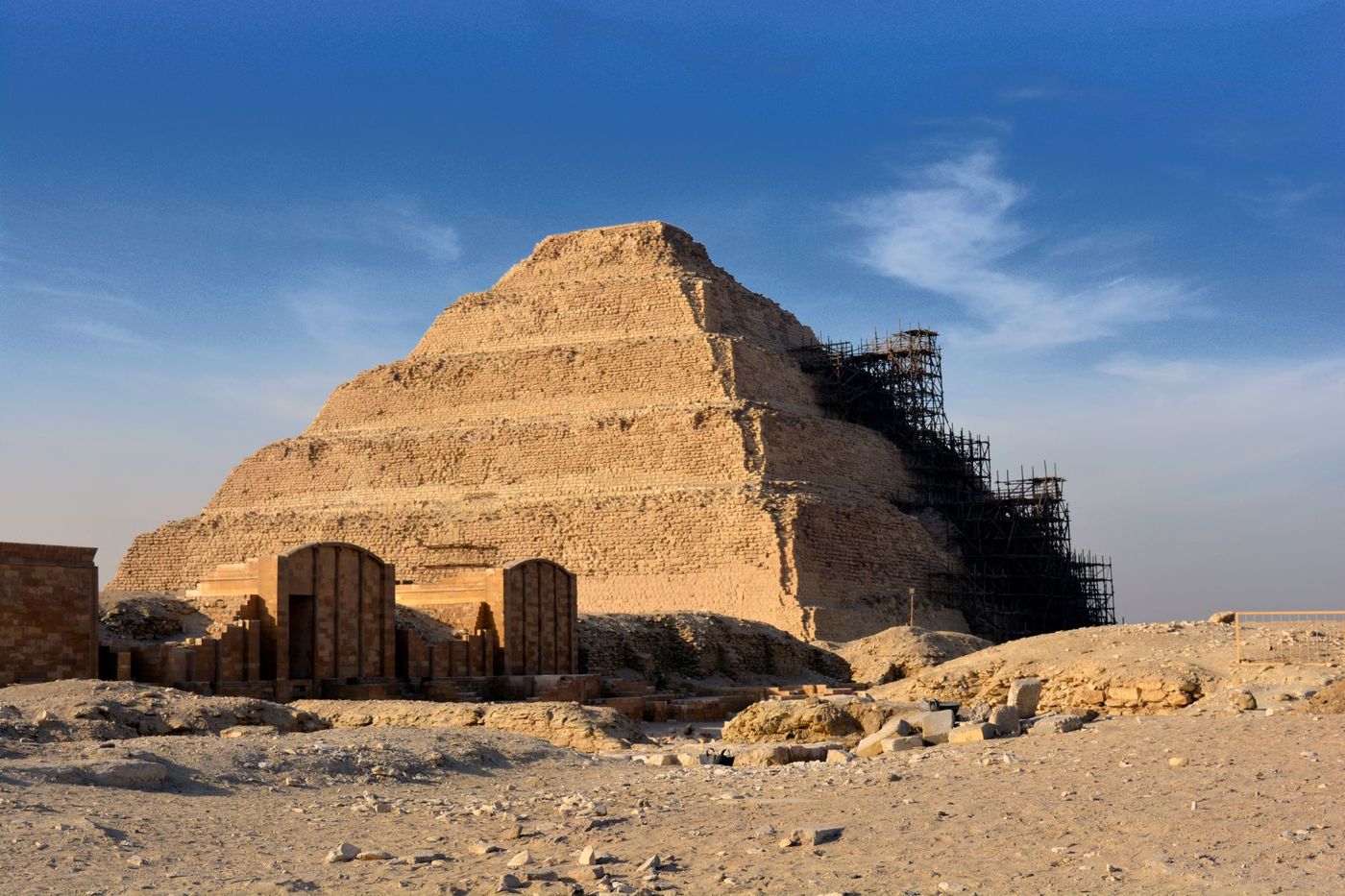
None of them was completed. The largest of the three was planned as a true pyramid and partially provided with granite, like the main structure next to it. The other two remained step structures of a few layers of masonry, without casing, without smoothed surfaces.
That is exactly what makes them valuable. A true pyramid is created by erecting a step structure and then filling the steps with casing blocks to form smooth surfaces. In the two unfinished structures, the first step is visible and the second is not. Anyone who wants to know what a pyramid looks like under its skin does not have to speculate but can look here.
In one of these small pyramids, there is also a burial chamber at the end of a descending passage, but without the heavy blocking devices one would expect in an actually used complex. That also fits a structure that was abandoned before it could fulfill its purpose.
A note on the order is worthwhile. The three structures were not added later but were part of the program from the beginning. Their foundations sit on the same leveled rock as the main structure, and their alignment follows the same axis. Whoever planned a royal complex planned these secondary structures with it, and that they remained unfinished therefore says something about the time pressure at the end, not about waning interest.
That the middle of the three great pyramids has no subsidiary pyramids of this kind at all is also a statement. The program of a complex was apparently not rigid but was put together differently by each builder.
The Chapel That Became a Temple
The southernmost of the three on the east side has a history that none of the others has.
On its east side stood, as usual, a small chapel for the funerary cult. This chapel was much later rededicated and expanded into a temple of the goddess Isis, who was worshipped there as "Mistress of the Pyramids." The rededication began no later than the New Kingdom and was formally expanded in the Late Period, i.e., well over two thousand years after the construction of the structure.
That is a remarkable process. A secondary structure of a royal complex, whose original owner had already been forgotten, became the center of a living cult that was practiced for centuries. Inscriptions and votive offerings date from this period, and they are part of what is known about the attribution of the structures at all.
Incidentally, this case explains why attributions are so difficult. A structure that was reused, reinscribed, and provided with new offerings over two millennia bears traces from many eras superimposed. An inscription in it initially only proves who placed it, not who was originally buried there. Research must separate these layers before it can even begin to ask about the origin.
For understanding the site, this means: it was never a completed monument but a place with continuous use. Between the construction and the Roman period lie more years than between the Roman period and today, and in that span, building, rebuilding, looting, worshipping, and forgetting again took place.
Today, the entire area is protected together as a World Heritage Site, so not just the three great structures, but every one of these secondary structures as well.
Frequently asked questions
What are the names of the three small pyramids of Giza?
In the specialist literature, they bear designations instead of names. They are attributed to members of the royal family, but none bears a building inscription, and the attributions are disputed.
How many small pyramids are there?
Seven. Three on the east side of the largest pyramid, one cult pyramid at its southeast corner, and three on the south side of the smallest pyramid.
Why does the middle pyramid have none?
That is not clarified. The building program of a complex was apparently not fixed but was put together differently by each builder.
Can they be visited?
From the outside, yes; all are within the regular ticket area and can be freely walked around. Interiors are generally not accessible.
Why do two of them look like steps?
Because they are unfinished. A pyramid is created as a step structure, whose steps are then filled with casing to form smooth surfaces. This second step is missing.
Plateau entry as a QR code on your phone
All seven subsidiary pyramids are within the regular ticket area and can be freely walked around. No additional ticket is required for this.