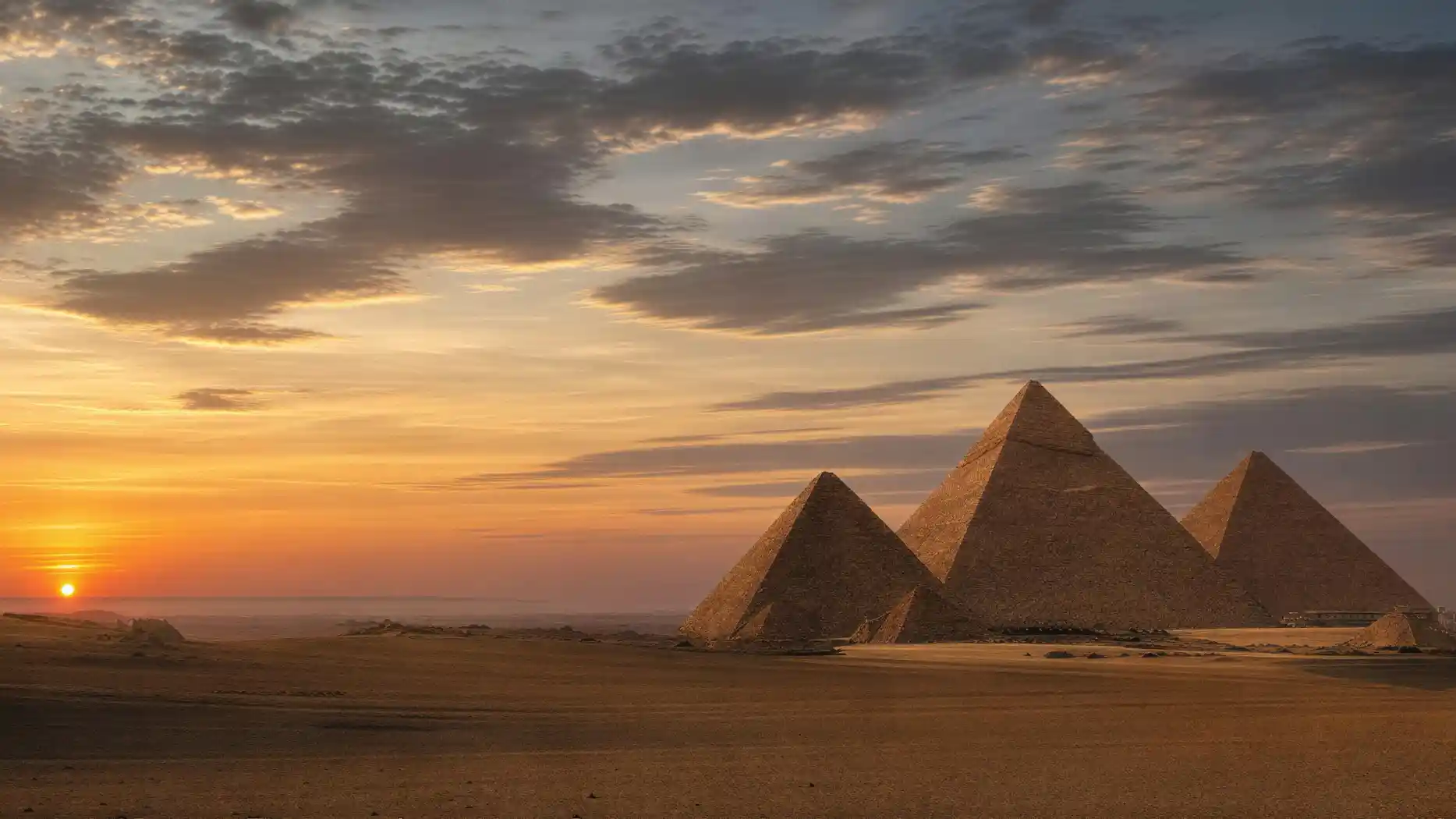
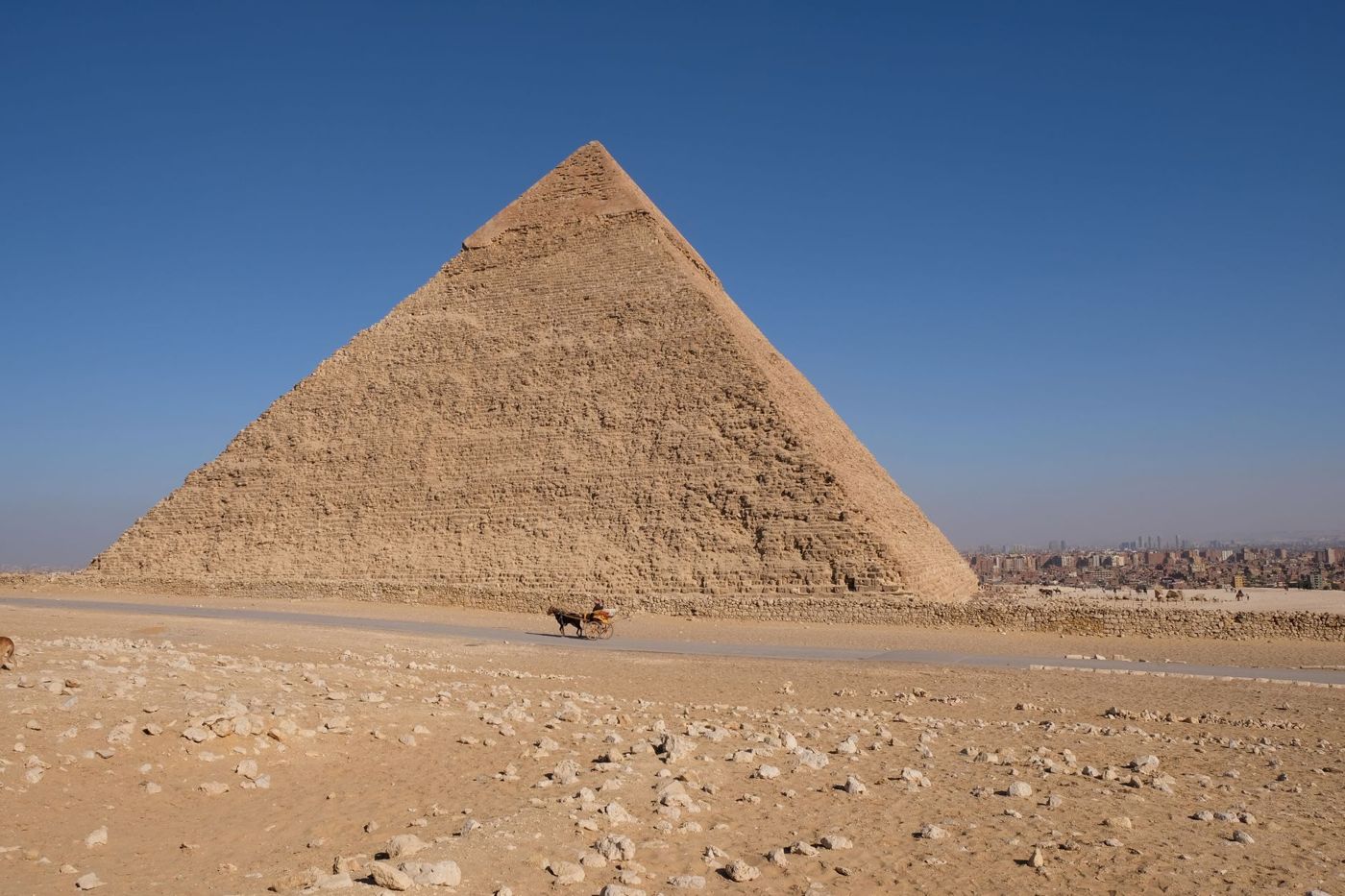
Almost everyone standing on the site for the first time points at the wrong building. The pyramid with the striking dark cap at the top, which seems the tallest and dominates most photos, is not the largest. It is the second.
The Pyramid of Khafre is indeed the second-largest on the site, yet it looks like the first. There are two reasons for this impression, and both can be verified. First, it stands on higher ground: the bedrock rises to the southwest, and its base sits about ten meters above that of its neighbor. Second, it has kept its tip, while the neighbor has lost its topmost layers. If you compare two silhouettes without considering the ground, you inevitably reach the wrong conclusion.
Add to that a steeper incline, which reinforces the effect. The sides rise at just over 53 degrees, compared with just under 52 for the large neighbor. The difference sounds small, but at a height of over a hundred meters, it is clearly visible.
The builder was the son of his predecessor. In German, the Greek form of the name has prevailed, but in specialist literature the Egyptian form is more common. If you encounter the name Khafre, it refers to the same building.
Incidentally, this king has something his father lacks: life-size portraits that have survived. From his valley temple comes a seated statue of dark stone, with a falcon embracing the back of the king's head, and remains of further statues have been found. While only a small ivory figurine of the builder of the largest pyramid has come down to us, the face of this king is known from several depictions. That is precisely why he also plays a role in the debate about the face of the Sphinx.
And there is another difference from its more famous neighbor: the interior is simpler, mostly emptier, and it is the only one of the three complexes where the complete chain from the valley to the peak can still be traced in the terrain.
The Interior Layout in Section
- Upper descending passage
- Lower descending passage
- Horizontal passage
- Burial chamber
- Sarcophagus in the floor
Unlike the large neighbor, there are no chambers stacked above one another and no grand gallery. A single passage leads to a single room.
The Numbers and the Cap
The numbers come first because they form the basis for everything else.
Originally, the structure was 143.5 meters high, the base side measures 215.25 meters, and the incline is 53 degrees and 10 minutes. Today, the topmost layers and the capstone are missing, so the height is somewhat less. In all dimensions, the building is below its northern neighbor, but clearly above the third pyramid, which does not even reach half its height.
The most striking feature is the cap. On the upper section, the original casing of fine limestone still remains, a closed surface covering about the upper quarter to a third of the height. It is the only larger remnant of a pyramid's outer skin on the entire site and shows what all three buildings once looked like: smooth, bright, without visible steps.
At the lower end, the casing was different. The bottom layer was not limestone but granite, a more labor-intensive and much harder material that protected the base and also displayed status. Remains of it can be seen in several places at the base. The same solution appears, on a much larger scale, at the third and smallest pyramid on the site.
It survived for an unromantic reason. Over the centuries, casing blocks were quarried away as building material, and people sensibly started at the bottom. What sat at a height of eighty meters was not worth the effort and remained. The rest of the surface disappeared; the tip stayed.
The surrounding complex has been part of the UNESCO World Heritage since 1979, together with the other pyramid fields, which explicitly protects not individual buildings but the entire landscape from Giza to Dahshur.
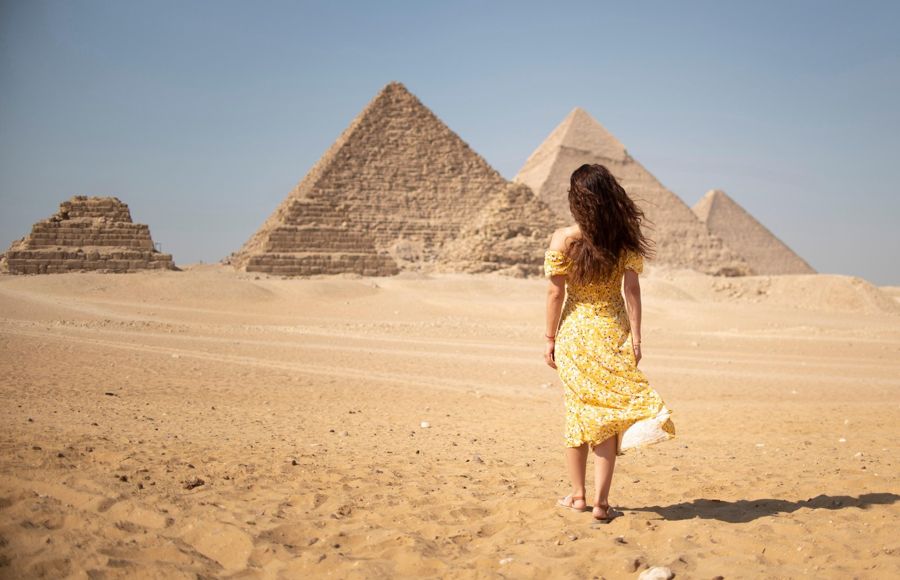
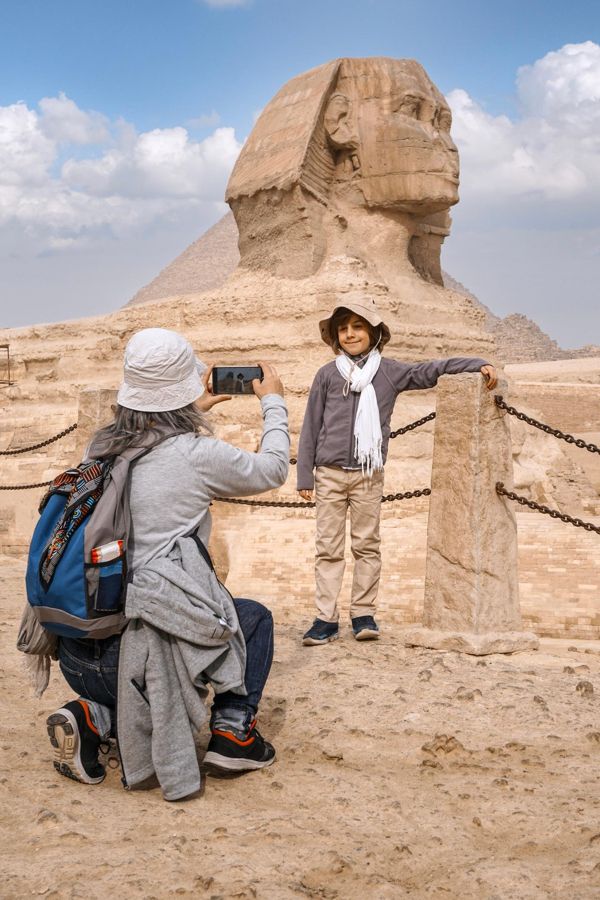
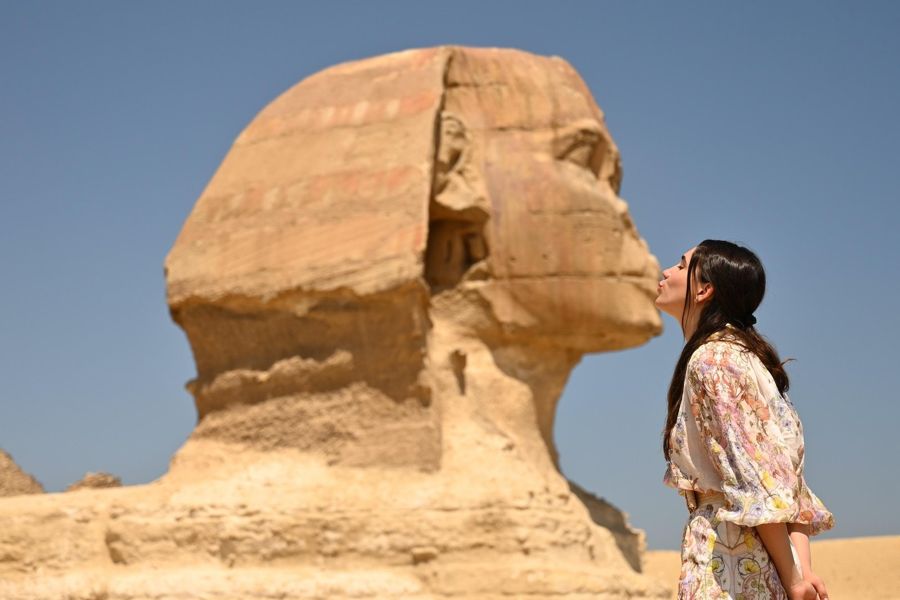
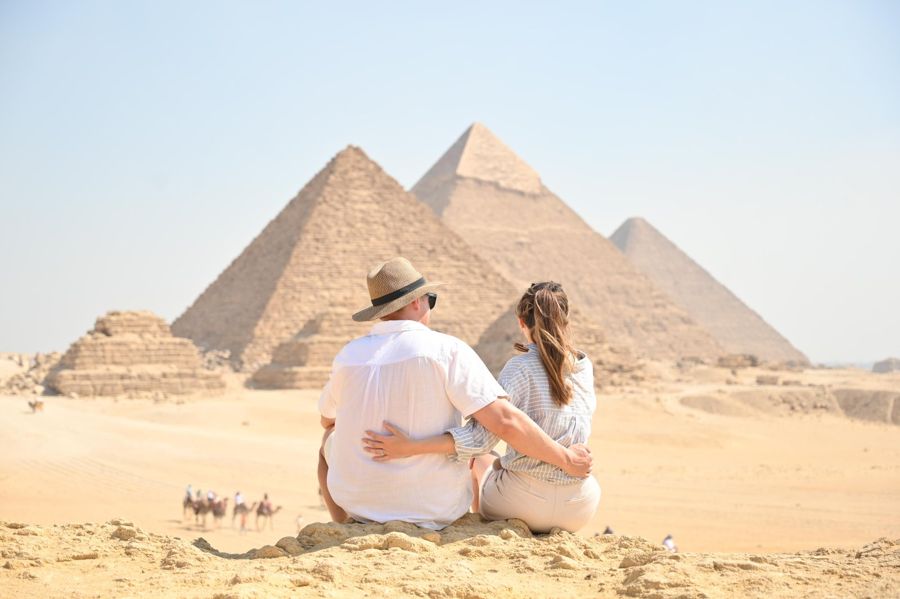
Half-day tour to the pyramids of Giza and the Sphinx
- The casing cap and the difference in elevation are explained on site
- The associated valley temple next to the Sphinx lies on the walking route
- Plateau entrance, German-speaking guide, and hotel pickup are included
- Free cancellation up to 24 hours before the start
Inside, Simplicity Surprises
The interior is the real surprise, and precisely because of its simplicity.
There are two entrances, both on the north side. The upper one lies about eleven and a half meters above the ground, the lower one at ground level a bit further north. Both lead via descending passages to a horizontal passage and from there into a single chamber. No chambers stacked above one another, no tall gallery, no relieving structures. Why two entrances were built has not been conclusively clarified; the common interpretation assumes a redesign during construction.
The burial chamber lies mostly in the natural bedrock and not in the masonry; only the ceiling consists of obliquely placed limestone blocks. In its floor sits a sarcophagus of dark granite, sunk to the upper edge, with a broken lid.
In modern times, the chamber was first entered in March 1818 by Giovanni Belzoni, a former circus performer who worked as an excavator. He found the sarcophagus empty and the chamber plundered, and he left an inscription on the wall with his name and the date, which can still be seen today. Documents and photographs concerning the exploration of the building are available in the digital archive of Harvard University.
But Belzoni was not the first. In the chamber, evidence was found that the building had already been opened in the Middle Ages, which fits the empty sarcophagus. Belzoni was the first European of the modern era to rediscover the way and document it. He had previously appeared as a strongman at fairs and came to Egypt through hydraulic engineering, which earned him little respect among the specialists of his time. Nevertheless, his records remain usable to this day.
Anyone coming from the large neighboring pyramid notices the difference immediately. The path is shorter, the passage somewhat more comfortable, and rarely more than a handful of people stand in the chamber.
If You Want to See Only One Pyramid from the Inside
The interior visit of this building costs a fraction of that of the large neighbor, is rarely sold out, and is significantly less crowded. In both cases, you see bare chambers without paintings or inscriptions. If you care about the spatial experience rather than the most famous name, this is the better choice. The interior ticket is purchased on site and is not included in the plateau entrance fee.
What Hangs on This Pyramid
What makes this building so valuable for understanding the entire site lies not in itself but in what is attached to it.
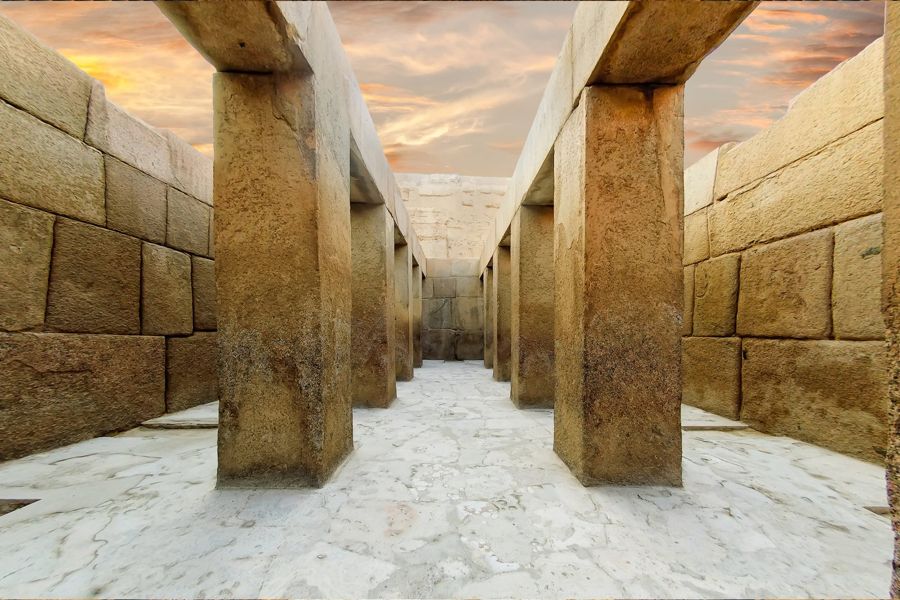
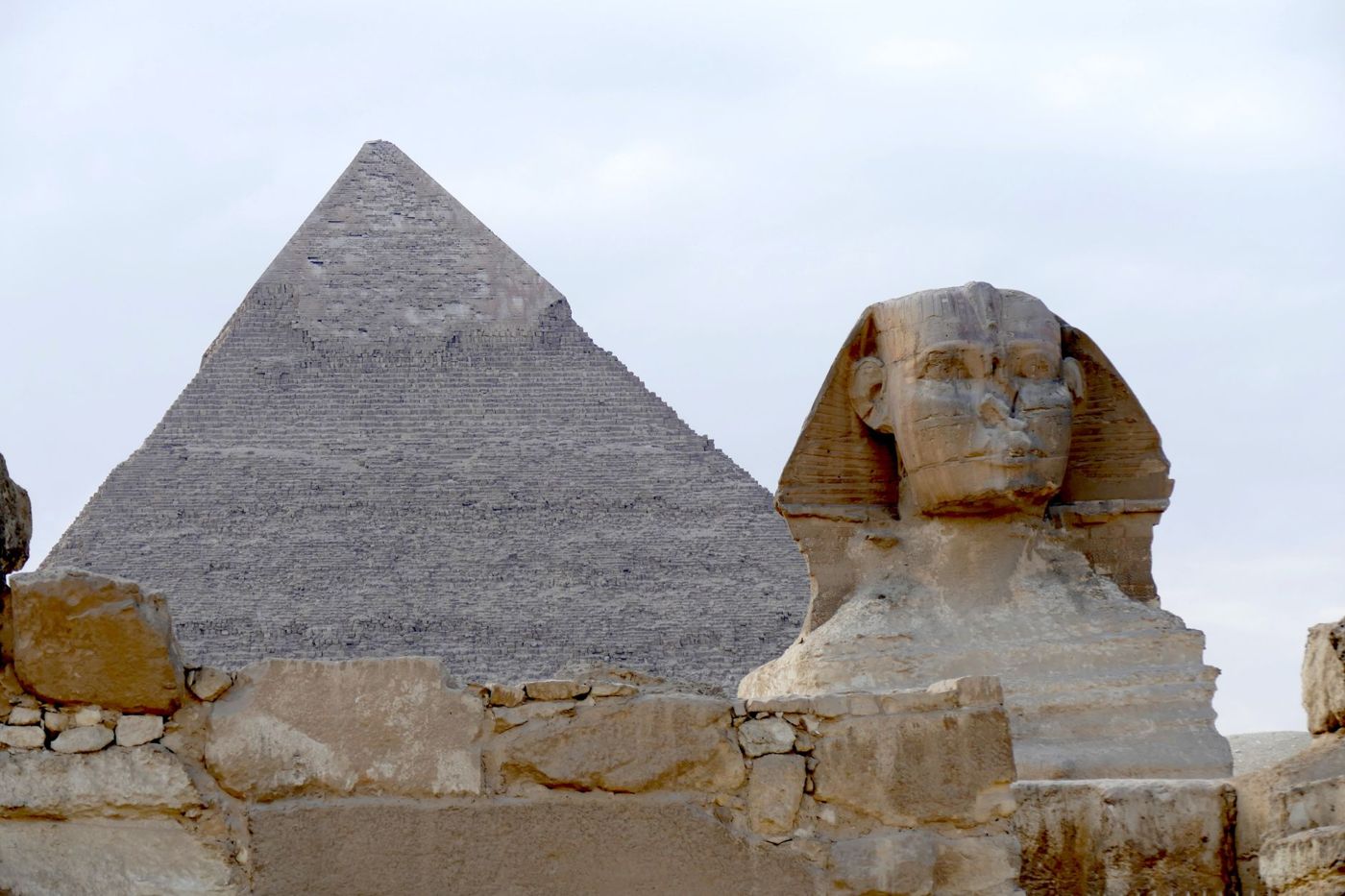
Every pyramid complex included a temple at the water, a causeway, and a temple on the east side of the pyramid. In the case of the large neighbor, almost nothing of this chain remains. Here, it still stands: the valley temple at the lower edge of the site is preserved upright, a structure of limestone cores with a casing of Aswan granite, square pillars, and a floor of alabaster. From there, the causeway leads in a recognizable line up to the mortuary temple.
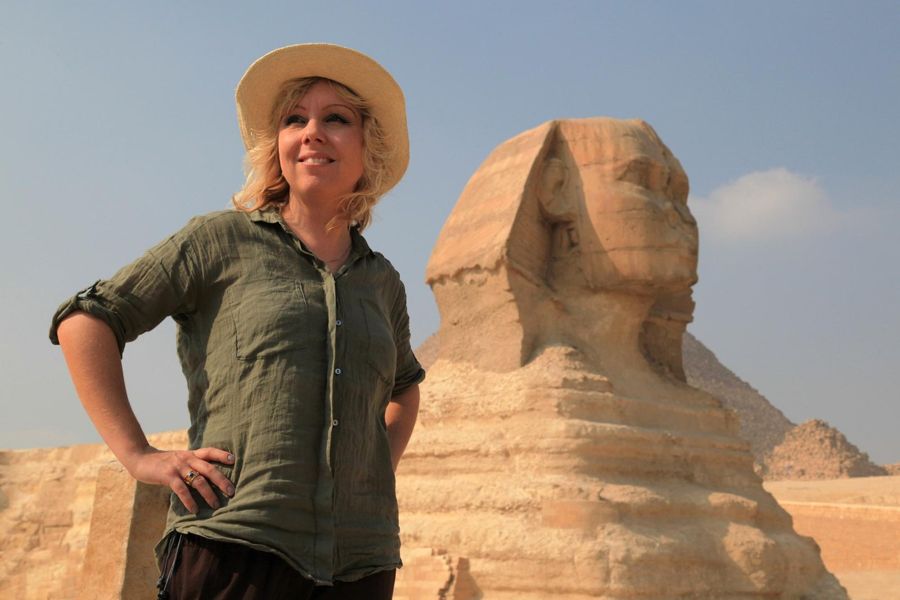
And this valley temple stands immediately next to the Sphinx. That is not a coincidence of topography but the core of the dating argument: the blocks of the Sphinx temple next door come from the same quarrying process from which the figure was cut, and both temples belong to the same building phase. Anyone who wants to know why the Sphinx is attributed to this king must look at this building group.
The mortuary temple on the east side was, in its time, the largest Egypt had seen. Mainly the foundation walls remain, but the ground plan can still be read: an entrance area, an open courtyard, rows of magazines, and a cult area directly against the pyramid flank. From this complex, the cult was maintained for generations, financed by specially assigned estates.
The complex also included five boat pits and a cult pyramid on the south side, whose foundation has been proven. Unlike the northern neighbor complex, there are no subsidiary pyramids for queens here.
Three Things Worth Doing on Site
Three things are worth doing on site, and none of them costs extra.
The first is the view of the edge of the cap. There, where the smooth casing ends and the rough core masonry begins, you see in a single line the difference between the finished building and what remains of all three today. This edge is the only place on the site where both states stand directly side by side.
The second is the walk around the base. Around the building runs an enclosure, and in several places you can see that the rock was not leveled but incorporated into the construction: the lowest layers sit partly directly on natural bedrock that was left in place.
The third is the path from the valley temple up. It takes about a quarter of an hour, is unmarked, and is skipped by most groups because they take the electric bus. Those who walk it experience the sequence for which the entire complex was designed.
Should the interior be closed, and that does happen, the loss is manageable. The chamber is bare, and the truly worth-seeing parts of this complex lie outside: the cap, the granite at the base, the causeway, and the valley temple. Of the three pyramids, this is the one where a visit works fully even without going inside.
For photos, a simple rule applies: in the morning, the sun is in the east and illuminates the northeast flank including the cap. In the late afternoon, the same surface lies in shadow, but the low light traces the steps of the core masonry.
Frequently asked questions
Is the Pyramid of Khafre taller than the Great Pyramid of Khufu?
No. It is lower, but it appears taller because it stands on higher ground, has kept its tip, and rises more steeply.
Why does only it have a cap?
Because casing blocks were removed from the bottom upward. What sat at the very top was not worth the effort and remained.
Can you go inside?
Usually yes, with a separate ticket purchased on site. It is significantly cheaper than that of the large neighbor and rarely sold out.
What is there to see inside?
A descending passage, a horizontal passage, and a single chamber with a granite sarcophagus in the floor. No paintings, no inscriptions except for one by an excavator from 1818.
Why does it have two entrances?
That is not clarified. The common interpretation assumes a redesign during construction, in which the complex was shifted to the south.
Plateau entrance as a QR code on your phone
The cap, the walk around the base, the causeway, and the valley temple are all within the regular ticket area. Only for the interior is a separate ticket added on site.