
The simple answer is four, plus the square base. A pyramid has four triangular faces that meet at a point, and this structure is no different.
The interesting answer is eight. The four faces are not perfectly flat. Each one is slightly indented in the middle, so it actually consists of two very gently sloping halves. If you count them, you get eight surfaces.
The indentation is minimal. It is less than one degree, which over a face length of about two hundred meters results in a deviation of roughly half a meter to a meter. From the ground, this is not visible, no matter how closely you look.
So if you're looking for eight sides on the Great Pyramid, you're looking for a feature that cannot be seen in person. It can only be photographed under certain conditions, and that's the real crux of this story.

Plateau entry as a QR code on your phone
The base edges, where you can appreciate the precision of the construction, are within the regular ticket area.
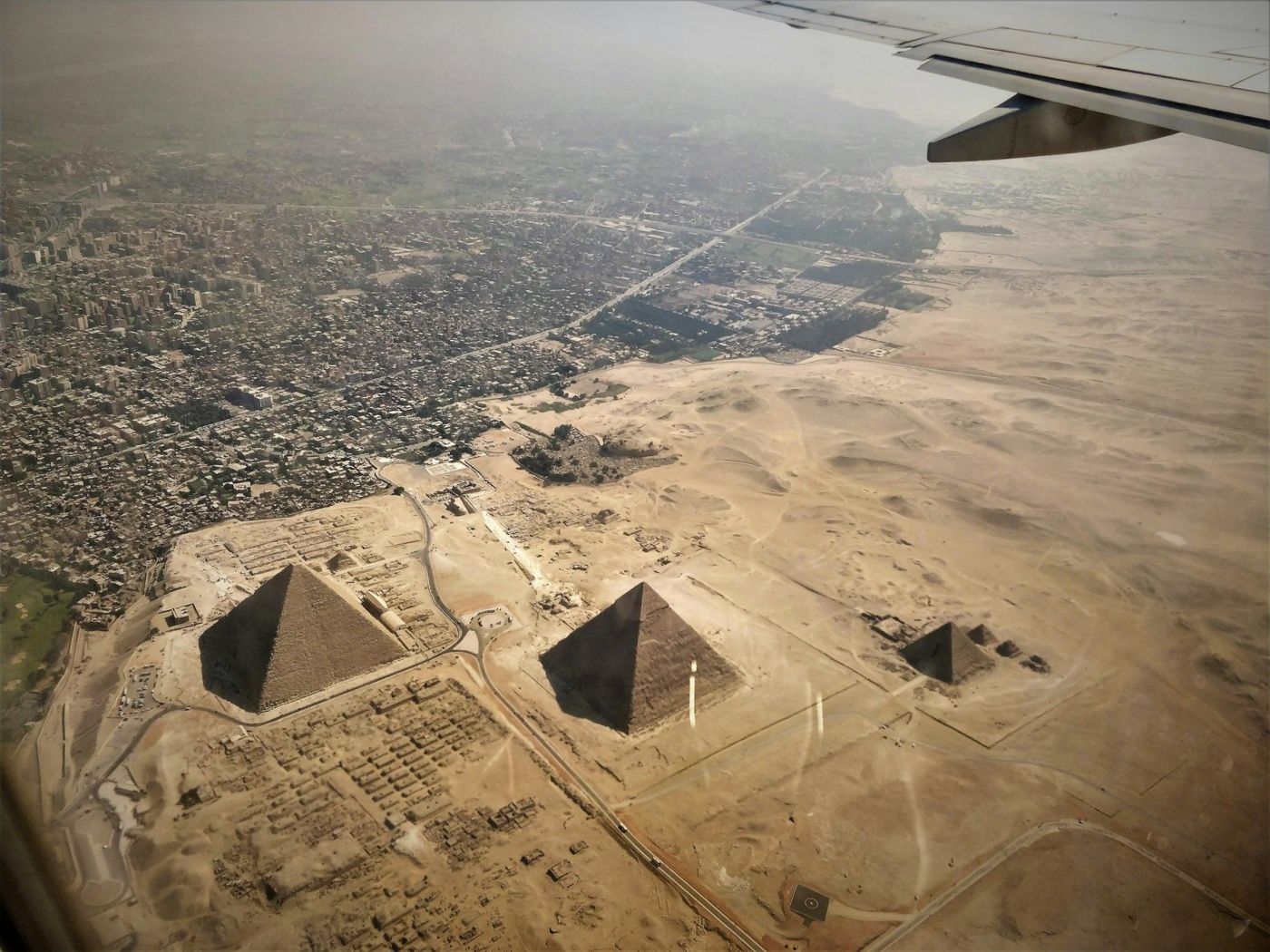
Discovered in 1940, by chance from the air
This was only noticed in 1940, and by chance from the air.
A British pilot photographed the structure during a flyover, and in his photo a faint line appeared on each face, running from the base to the apex. It was not a crack or a shadow from a neighboring building, but the ridge between two minimally differently inclined surfaces, made visible by low sun.
That it took four and a half thousand years for this discovery says less about the attentiveness of earlier observers than about the conditions. The division is only visible from the air, only at a suitable sun angle, and only as long as the surface is not disturbed by vegetation or weathering shadows. In practice, this means around the equinoxes, in the morning or evening.
From a surveying perspective, however, the effect has long been measurable. The precise recordings of the building's geometry work with deviations of this magnitude anyway, because the entire complex is measured in arc minutes.
For context, the indentation is mainly documented for the largest structure. For the two neighboring pyramids, the data is less clear, partly because their surfaces are preserved differently.
Why the faces are indented
Intent
The indentation was planned, perhaps to stabilize the casing or achieve an optical effect.
Pros
For a structure aligned to arc minutes, an unintentional deviation of this regularity would be unusual.
Cons
There is no text or evidence that such an intent existed, and no parallel at other pyramids.
Construction method
The courses were set slightly inclined inward toward the center, which inevitably dented the faces.
Pros
Inward-sloping courses increase stability and are documented at other structures.
Cons
Does not explain why the effect appears so uniformly on all four sides.
Settlement
The structure has settled over millennia, and the surfaces have subsequently sunk.
Pros
Settlement in structures of this mass is inevitable.
Cons
Settlement would be uneven, depending on the ground. But the effect is regular.
Loss of the casing
The indentation only appeared when the smooth outer skin was removed and the core masonry was exposed.
Pros
The core masonry is rougher than the casing and could show this shape.
Cons
Then the effect should appear on all pyramids that have been stripped, and that is not the case.
You won't see it
For your visit, the answer is short: you won't see it. If you're collecting mathematical facts about the pyramids of Giza, here's one that can only be understood through calculation or from the air.
From the ground, a one-degree deviation over two hundred meters is imperceptible, especially on a surface of roughly hewn blocks with rubble at the base. Even standing at a corner doesn't help, because the effect is in the middle of the face and the perspective swallows it up.
Your own aerial photos are also out of the question. Drone operation is generally prohibited in Egypt, and even bringing one in without a permit regularly leads to confiscation. If you want to see the eight-sidedness, you have to rely on existing imagery.
What you can check on site, however, is the precision that makes the effect noticeable in the first place. The official description of the structure gives a base side of about 230 meters, and the four sides deviate from each other by a few centimeters. If you look along a base edge, you see a line that stays straight over that length.
That's exactly why the eight-sidedness is worth reporting. In a poorly built structure, a one-degree deviation would go unnoticed.
Frequently asked questions
Does the Great Pyramid of Khufu have four or eight sides?
Four faces, like any pyramid. Because each face is slightly indented, it actually consists of two surfaces, making eight in total.
How strong is the indentation?
Less than one degree. Over a face length of about two hundred meters, that corresponds to roughly half a meter to a meter.
When was this discovered?
In 1940, through an aerial photograph in low sun. From the ground, the effect is not perceptible.
Is the indentation intentional?
Unresolved. Discussed are deliberate design, a construction method with inward-sloping courses, settlement, and consequences of casing loss.
Can you see it on site?
No. It is only visible from the air at the right sun angle, and your own aerial photos are not allowed in Egypt.