Few monuments have as many figures attached to them as this one, and an astonishing number of them are simply copied incorrectly.
That is partly due to the shape. A rectangular building is easy to measure: length, width, height – done. But with a reclining figure, the questions start immediately. Does the tail count towards the length? Do you measure the height to the top of the head or to the top of the headdress? Do you take the width at the front paws or at the hindquarters, where the figure is widest? Depending on the answer, the result shifts by several metres.
Then there is the history of measuring itself. The older figures come from a time when the figure was still partially buried in sand, so the base point had to be estimated. Later surveys were able to include the floor of the pit and thus arrived at greater heights. If you place an old and a new number side by side, you often see not an error but two different reference points.
That is why this page does not just give figures, but also states what they refer to. Only values that hold up to re-measurement and are consistently listed in reference works are used.
The second part of the page deals with a question that almost never appears in fact lists, but is crucial for understanding what you see on site: which part of what you see is actually the original rock from back then, and which part is repair work from later millennia? With hardly any other monument in the world is this proportion so high.
- Length
- 73.5 m, from the front paws to the end of the tail
- Height
- 20.22 m, from the floor of the pit to the top of the head
- Width
- 19.3 m, measured at the hindquarters
- Material
- Natural limestone, carved from the bedrock
- Facing direction
- Exactly east
- Date of creation
- Around 2500 BC according to current dating
- Record
- Largest sculpture in the world carved from a single block of stone
The record only applies with a qualification
The record is the point where many lists become imprecise, because there are larger statues and there are older sculptures.
The decisive factor is the restriction to a single block of stone. The largest monolith sculpture in the world is not an assembled figure and not a cast structure, but one that was carved entirely from a single connected piece of rock. Larger statues of the modern era are made of segments, concrete or steel with cladding. If you remove the category, you lose the statement.
It is also frequently read that this is the oldest monumental sculpture at all. The cautious version is more reliable: it belongs to the oldest large-format sculptures and is the oldest of this size that has remained visible without interruption.
The orientation, on the other hand, is undisputed and easy to verify: exactly east. At both equinoxes in spring and autumn, the sun rises precisely in front of the figure. That is no coincidence and no secret, but a deliberate alignment, as was the rule for tombs and cult buildings of this era.
What is less well known is how carefully the figure as a whole is designed. The tail curves around the right hind paw, the front legs are worked down to the claws, and between them lies a small open courtyard. If you only know the figure from the front, you easily mistake it for a head on a box. Seen from the side, it is a complete, anatomically thought-out animal figure – just on the scale of half a football field.
And one more thing that surprises: there is no inscription on the structure naming a builder. No name, no date, no dedication formula. Everything that is said about authorship and dating comes from the construction sequence with the neighbouring buildings.
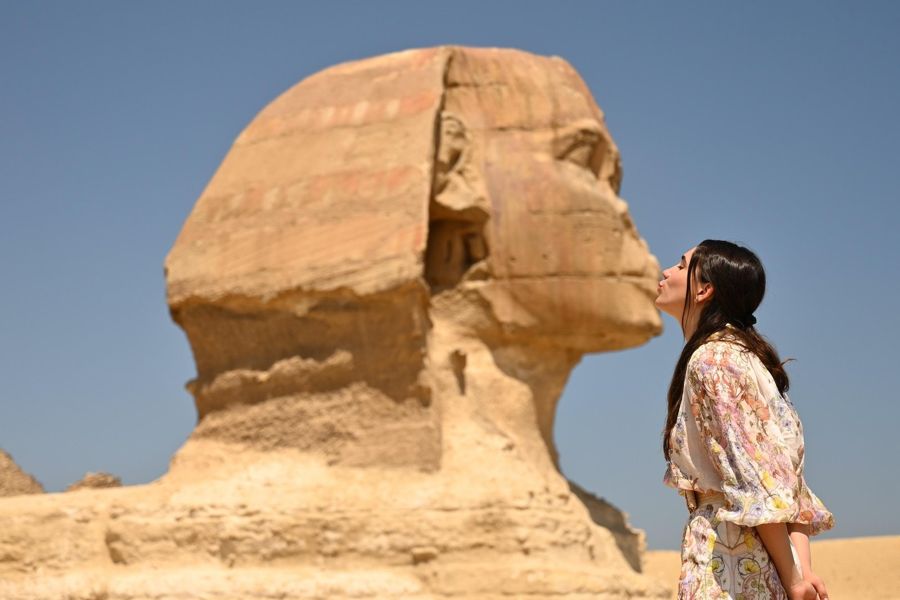
Half-day tour to the Pyramids of Giza and the Sphinx
- The boundary between original rock and repair is clearly visible on site
- A licensed guide explains which parts date from which period
- Includes plateau entrance, German-speaking guide and hotel pickup
- Free cancellation up to 24 hours before the start
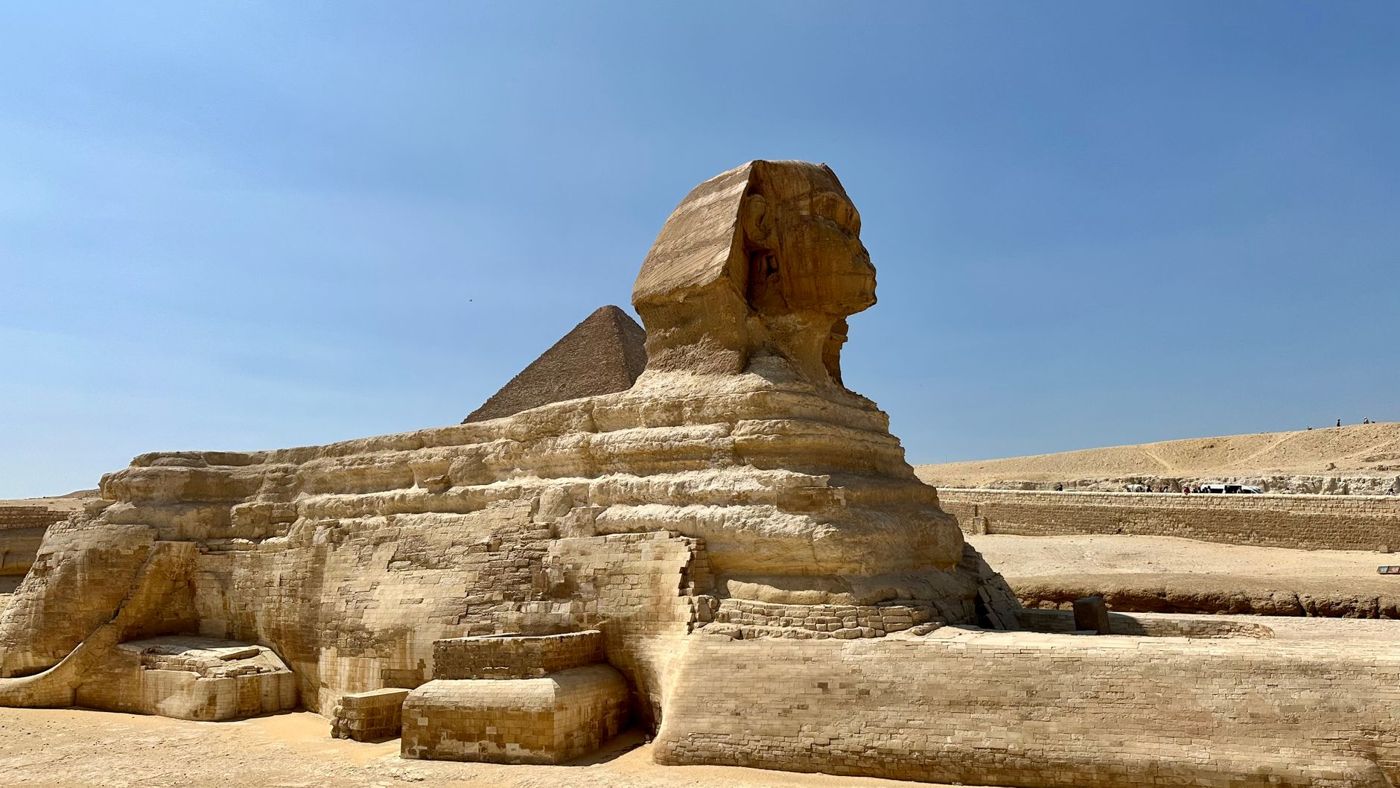
Rock below, masonry outside
Now to the most important distinction on this page. What you see on site consists of two very different things.
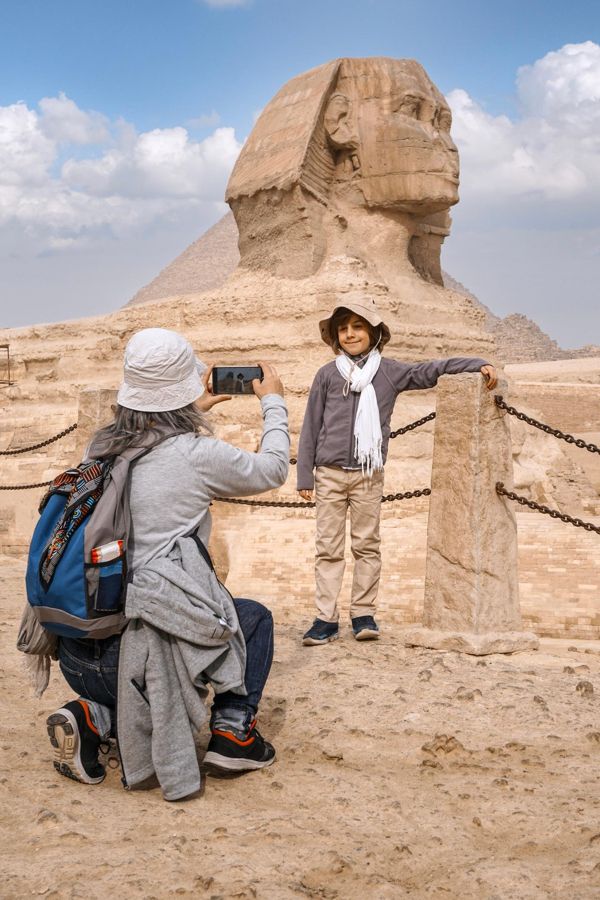
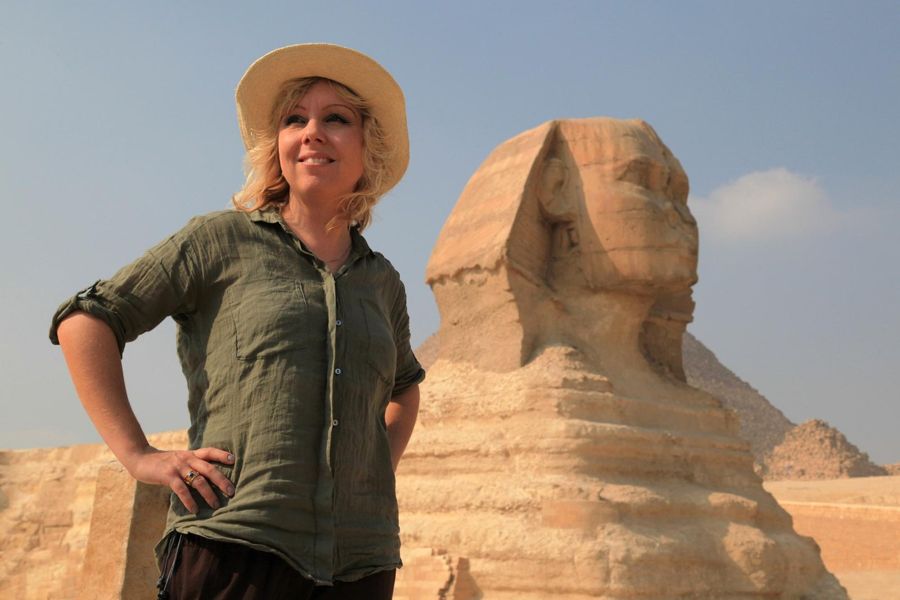
The core is natural rock: the body, the neck, the head, and the pit all around. These parts were cut out of the bedrock four and a half thousand years ago and have not been moved since. They show corresponding weathering, in horizontal bands, because the rock layers have different hardness.
The outer skin of the lower half, on the other hand, is largely laid masonry. As early as the New Kingdom, about a thousand years after the figure was created, cladding blocks were added to support the crumbling torso. Further campaigns followed in Greco-Roman times and then in several waves in the modern era. The paws, which look so clearly defined in every photo, are in their present form almost entirely reconstruction.
That is not a scandal, but the normal case for an object made of soft limestone in the open air. Nevertheless, it is important because many observations depend on it. If you infer the age from the sharpness of an edge, you may be measuring a repair from the 20th century.
The approach to this has changed fundamentally. Earlier campaigns set new blocks with cement mortar that was harder than the original rock and thus increased damage instead of slowing it down. Today's conservation uses softer, more adaptable mortars, documents every stone layer used, and permanently monitors moisture and salt content. The principle is that a repair should be recognisable and removable. That is precisely why the newer blocks are deliberately not matched to the original colour.
A rule of thumb helps on site: the smoother and more regular a surface appears, and the more clearly individual block joints can be seen, the younger it is. The original rock is irregular, banded and without joints, because it never consisted of blocks.
How big is it really?
meters above ground
The height is the least spectacular of the three figures. The length of 73.5 metres is more meaningful: that corresponds roughly to two tour buses placed end to end, plus a third.
Three finds you can touch
Three finds belong to the most reliable facts of all, because you can touch them.
The first is in London. A fragment of the beard is in the British Museum, a good 34 centimetres high and about 15 centimetres thick. What is remarkable about it is less the find spot than the dating: the beard was not an addition by the builders, but was probably attached only in the New Kingdom, during a restoration, and fell off again later. Further fragments are in Cairo. What that means for the original appearance is covered on a separate page.
The second is still in place: a stone stele between the front paws, erected by a king of the 18th Dynasty in the first year of his reign, according to current dating 1401 BC. It is thus about eleven hundred years younger than the figure itself and reports on a clearing of the sanded-up monument. There is also a separate page about this.
The third is not a single piece but a layer: the sand. The pit fills up by itself, and for most of the past four and a half thousand years the figure lay buried up to its shoulders. Several rulers had it cleared, and then the sand came back. The complete and permanent clearance was only achieved in the 1920s.
The sand also explains the uneven state of preservation, independently of the rock layering. The head protruded for most of the time and was exposed to wind, sandblasting and temperature fluctuations. The body lay buried and thus protected, but was exposed to the weather again at every clearance and dried out differently. The two parts therefore have very different stress histories, and both effects overlap with the hardness of the respective rock layer.
Together, these three things create a picture that fact lists rarely convey: for long stretches of its history, the Sphinx was not a landmark but a half-buried rock that someone occasionally took care of.
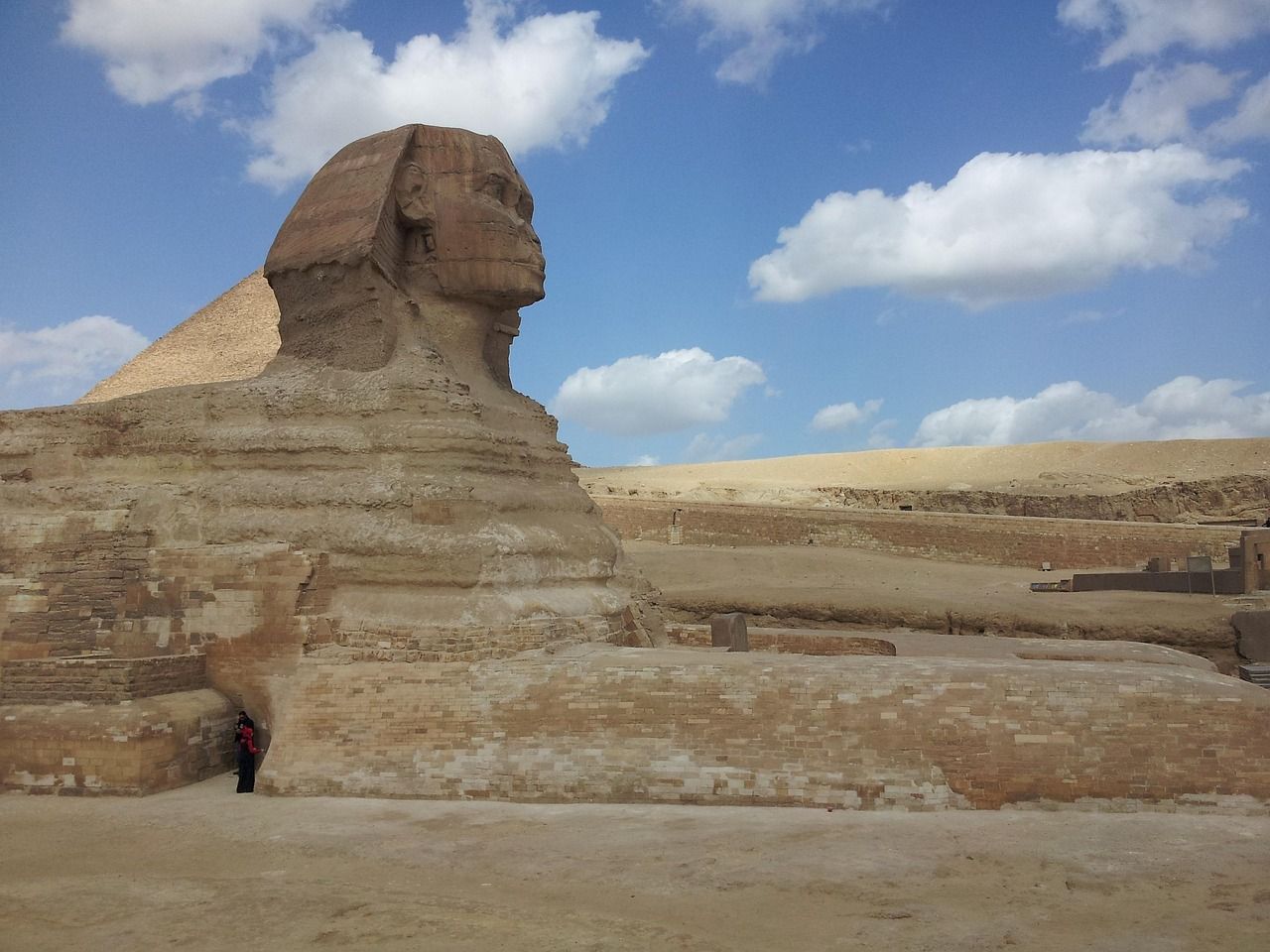
On site: original or repair?
- Visible block joints in regular rows mean masonry, i.e. repair.
- Horizontal banding without joints means natural rock, i.e. original.
- The paws and the lower flank are almost completely clad.
- The head is original rock apart from small additions.
- Cleanly worked, uniformly light blocks date from the 20th century.
- The floor of the pit and the walls around it are cut surfaces from the time of construction.
Figures that are regularly quoted incorrectly
Finally, a few figures that are regularly quoted incorrectly, with the respective reliable version.
The Sphinx is not built from blocks, but it is also not completely from one piece: the core is a connected rock, while attached parts such as the paws and cladding consist of individual blocks. Both statements are therefore true, depending on what you point at.
It is not the oldest structure on the site. The Great Pyramid is, according to current dating, one generation older, and the necropolis around it was already in use before.
It is not unique in Egypt. Sphinxes exist in large numbers, including as avenues in front of temples. This one is the largest and the oldest known in this form, hence the addition in the name.
And it is not an independent monument but part of a complex. Immediately to the east stand two temples, and the figure lies at the end of a causeway. The entire surroundings have been jointly protected since 1979.
And the face is not a verified portrait. It is traditionally associated with the builder of the middle pyramid, but a comparison with surviving statues of this king is only possible to a limited extent because of weathering and later repairs. Studies on this come to different results. What is reliable is that a king's head is depicted, recognisable by the headdress and the uraeus. Which king it is, is an attribution.
Anyone who passes on the figures on this page should therefore include the reference point. Twenty metres of height say little unless it is clear that the figure sits in an excavated pit and this height is measured from the pit floor.
Frequently asked questions
What is the Sphinx of Giza?
A figure carved from the natural rock with a lion's body and a king's head, 73.5 metres long and 20.22 metres high, created around 2500 BC according to current dating, on the eastern edge of the plateau.
How big is it exactly?
73.5 metres long, 20.22 metres high and 19.3 metres wide at the hindquarters. The height is measured from the floor of the excavated pit.
Is it really from one piece?
The core is. The paws, base and lower flank today consist of attached masonry from various periods.
Why does it face east?
Because that is where the sun rises. For tombs and cult buildings of this time, the eastward orientation was the rule.
Is there an inscription by the builder?
No. There is no name and no date on the structure itself. The attribution results from the construction sequence with the neighbouring buildings.
Plateau entrance as QR code on your phone
The viewing terrace at the Sphinx and the path above the pit are in the normal ticket area. There is no ticket office at the Sphinx gate itself.