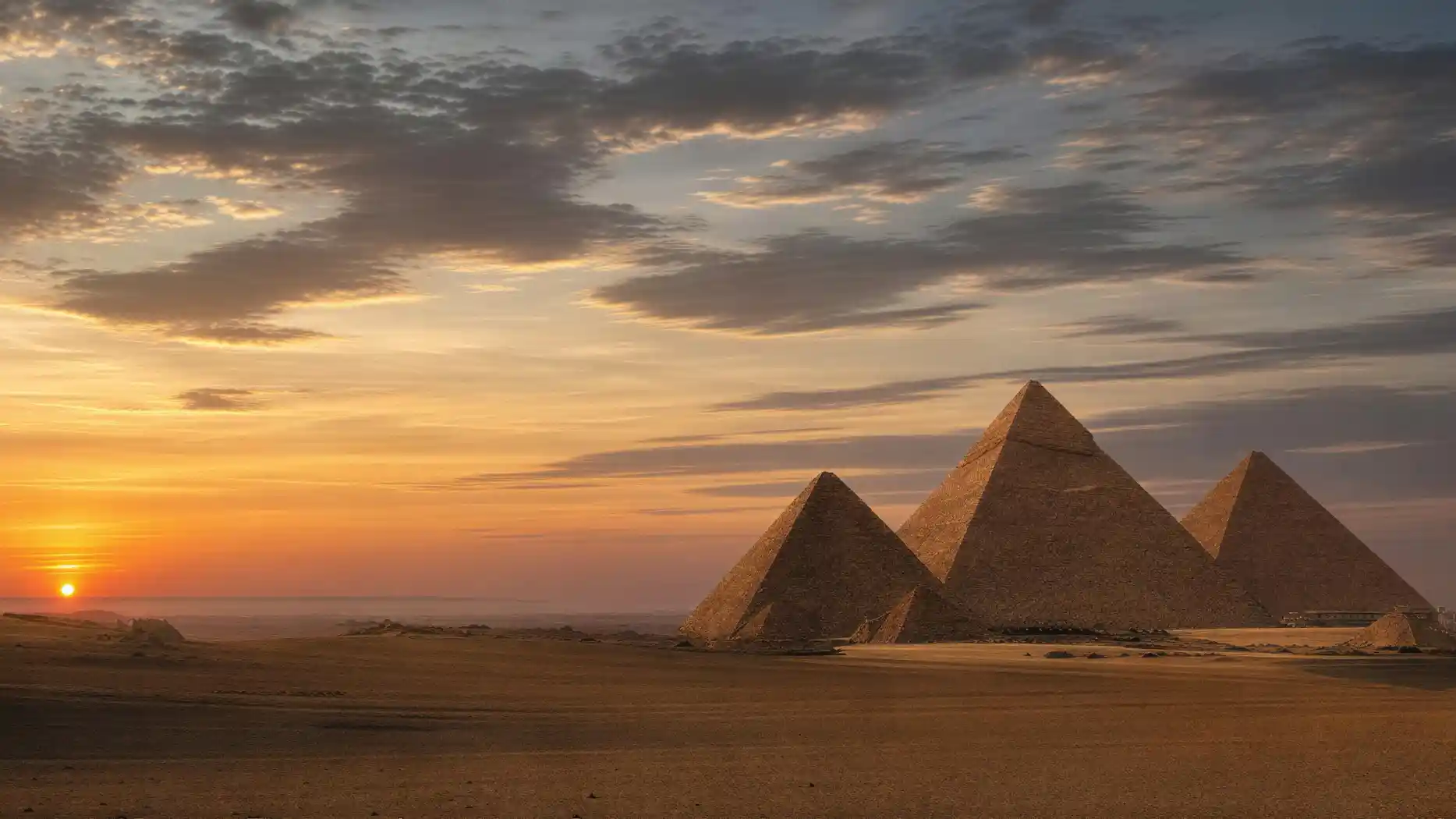
A virtual tour of the Pyramids of Giza starts for most people with a Google search. That's understandable but misleading.
The images there are over a decade old, show only exterior surfaces, and were created as a byproduct of mapping, not as a means of education. What actually exists is considerably better and practically unknown: walkable models of the entire site, photorealistic tours of burial chambers, and a way into the interior of the largest pyramid that you can traverse on screen.
This wasn't made by a travel provider but by a research project. Behind the good tours is the Harvard University digitization project for the Giza Plateau, which has been digitizing the site's excavation documentation for years, partly in collaboration with the Egyptian antiquities authority. It's funded in part by the National Endowment for the Humanities.
Why this came about in Cambridge specifically has a historical reason. The American-British excavations at the plateau have amassed documentation over decades that ranks among the most extensive holdings for a single site: excavation diaries, glass plate photographs, floor plans, object cards. The models are computed from exactly this material. They are therefore not an artistic interpretation but a visualization of excavation data.
The price for all of this is zero. This isn't an introductory offer or a trial phase; it's the very purpose: it's science communication, not a product.
What Actually Exists
Four offerings that differ significantly. Only the first two lead inside.
| Offering | Who's Behind It | What You See | Technology |
|---|---|---|---|
| Walkable 3D Models | Harvard University Digitization Project | Thirteen models, from the entire plateau to individual temples and tombs | In the browser, controlled with arrow keys or WASD |
| Photorealistic Tomb Tours | Harvard University Digitization Project | Six mastaba tombs, captured in the original | Matterport and Sketchfab, in the browser |
| Joint Exhibition with the Antiquities Authority | Antiquities Authority and Harvard Project | Among other things, the path into the interior of the largest pyramid | In the browser, no registration required |
| Street View | Only exterior surfaces, footage from 2014 | In the browser or in the maps app |
- Who's Behind It
- Harvard University Digitization Project
- What You See
- Thirteen models, from the entire plateau to individual temples and tombs
- Technology
- In the browser, controlled with arrow keys or WASD
- Who's Behind It
- Harvard University Digitization Project
- What You See
- Six mastaba tombs, captured in the original
- Technology
- Matterport and Sketchfab, in the browser
- Who's Behind It
- Antiquities Authority and Harvard Project
- What You See
- Among other things, the path into the interior of the largest pyramid
- Technology
- In the browser, no registration required
- Who's Behind It
- What You See
- Only exterior surfaces, footage from 2014
- Technology
- In the browser or in the maps app
All four are free. None require a VR headset.
The 3D Models from Excavation Data
The 3D tour of the pyramids is the entry point that most underestimate because the word sounds like a gimmick.
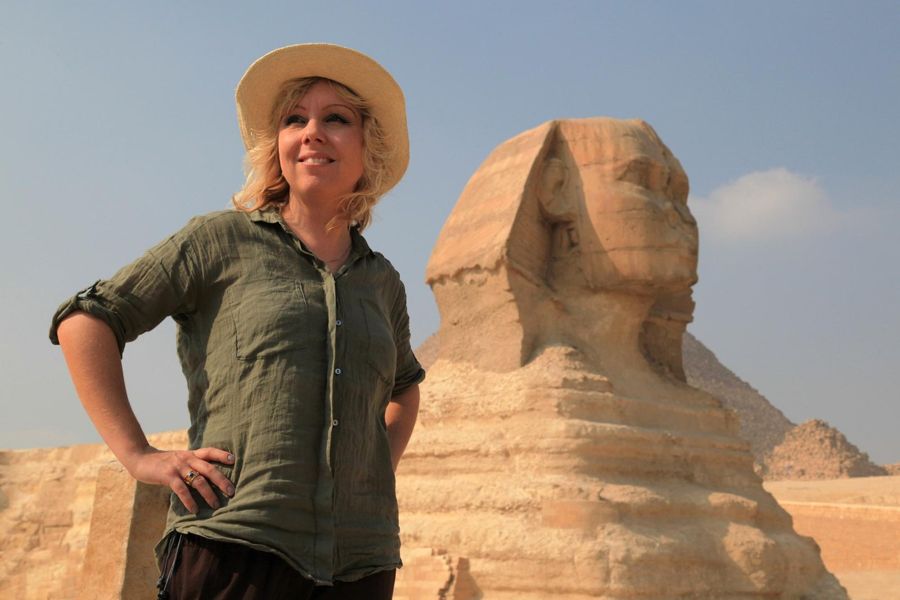
In fact, these are thirteen models reconstructed from excavation data that you can walk through in the browser. This includes a tour of the entire plateau, the three great pyramids with their mortuary temples and valley temples, the Sphinx with its temple, and the tombs of Queens Hetepheres I and Meresankh III. You control it with the arrow keys or WASD, like in a computer game. No installation is needed.
The value lies not in the graphics but in the reconstruction. You see the complexes not in their current state but as they originally looked according to the current state of research: with casing, with standing temple walls, with the causeway between the valley temple and the pyramid. That's exactly what you can no longer see at the site itself and what no photo can show.
A second value lies in what you can try out on the model. You can walk around a structure without covering a kilometer in the sand, and you can take views from spots that are cordoned off on site. If you want to know how the three pyramids relate to each other from a certain point, you can try that on screen in a minute instead of in an hour on the site.
For preparing a visit, this is the most useful part of the entire offering. Once you've virtually walked the causeway, you'll understand on site why the rows of stones lie in the sand where they do.



Guided Day to Plateau, Sphinx, and Museum
- In case the tours have made you want to see the original
- Eight hours, German-speaking guide, with hotel pickup and lunch
- Plateau entry and priority access included, pyramid interior as an add-on
- Free cancellation up to 24 hours before start
The Tomb Tours Show What's Off-Limits
The most remarkable part, however, isn't the reconstructions but the tomb tours. Because there you see rooms you're not allowed to enter on site.
Six mastaba tombs of the plateau have been fully photographed and turned into walkable tours: the complexes of Queen Meresankh III, Khufukhaf, Iasen, Neferbauptah, and the tombs of Qar and Idu. Four run on Matterport technology, two on Sketchfab, and all six work in a regular browser.
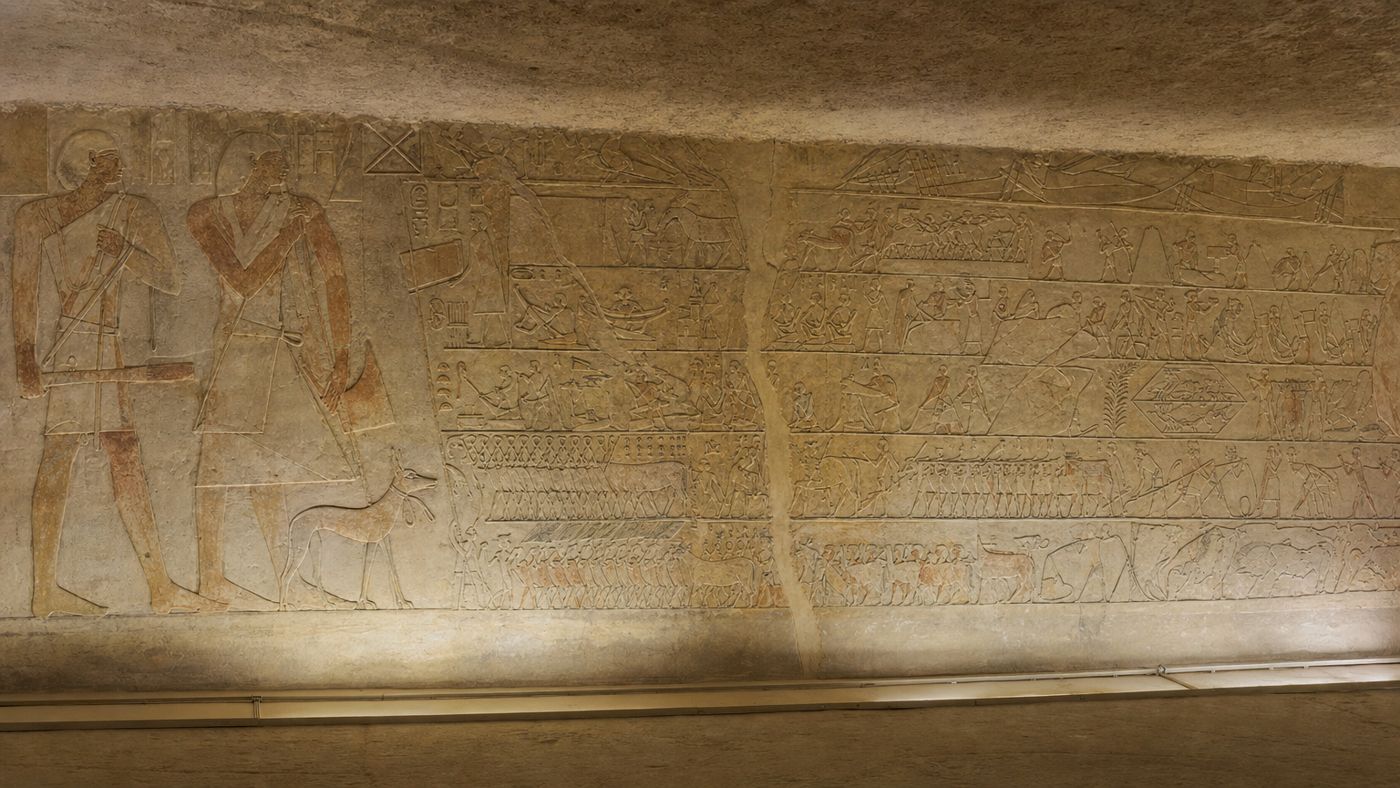
The difference from a photo is considerable. You stand in the chamber, turn around, move on, and the painted walls are captured at a resolution where individual figures can be made out. In Meresankh III's tomb, that includes ten female figures standing side by side, an unusual depiction for Giza.
On site, none of this is easily possible. The plateau's burial chambers are either off-limits, accessible only with a separate ticket, or closed for conservation reasons. The virtual path here is thus not the poorer substitute but, in several cases, the only option at all.
A word on the designations you'll encounter. The tombs carry numbers like G 7530 or G 2196, and that's not a cataloging quirk but the excavation's ordering system: the digits reveal the location in the cemetery. Once you get used to it, you'll find the same numbers in the specialist literature and can continue reading from a tour.
These tours are, by the way, the reason the Egyptian antiquities authority is on board. In April 2020, it published five free virtual tours of Egyptian monuments, including the tomb of Meresankh III, created with the Harvard project's modeling. The collection extends beyond Giza and includes, among others, a synagogue, a monastery, and a mosque-madrasa.
You Don't Need a VR Headset
That leaves the question of equipment. A VR experience of the Pyramids of Giza in the strict sense, i.e., with a headset, you don't need, and none of the mentioned offerings require one.
All run in a regular browser, on a computer as well as a tablet. They work on a phone too, but it's a chore: the tours live off screen space, and on a phone display you'll lose your bearings in a burial chamber immediately. A screen as large as possible brings more than any accessory.
If you do own a headset, you have a real advantage on exactly one point: scale. The difference between a chamber two meters high and a gallery eight meters high is a number on screen and a physical experience with a headset. For everything else—reliefs, inscriptions, and construction sequence—the monitor is better because you can move in closer and look longer without feeling sick.
Practically, that means: start on the largest screen you have and take your time. The tours reward slow looking. If you rush through a burial chamber, you'll get the same as with a group tour on site—images without details, just without the journey there.
A warning about what else is offered under the keyword VR. Commercial applications circulate that advertise tours of the pyramids and actually show freely invented interiors, some with chambers that don't exist. You can recognize the offerings mentioned here by the fact that they state their data basis.
In What Order You Should Start
- First the Plateau Tour
The walkable overall model shows how the complexes relate to each other. Without this orientation, the individual models seem arbitrary.
- Then a Pyramid with Its Complex
Valley temple, causeway, mortuary temple, pyramid. This sequence is the actual building plan and is barely readable on site anymore.
- Then a Tomb in Photo Quality
The jump from reconstruction to photo capture makes clear what has been reconstructed and what has been preserved.
- Finally, the Interior of the Largest Pyramid
The path through the passages only makes sense once the exterior complex is known. The other way around, it remains a tunnel.
- Street View Only for Comparison
Useful for holding the current state next to the reconstruction. As an entry point, it's the weakest option.
What a Virtual Tour Doesn't Achieve
What a virtual tour doesn't achieve belongs on this page just as much as what it can do.
It doesn't convey scale. A block that reaches over an adult's head is a rectangle on screen, and the number 146 meters remains a number. Exactly this impression is why people travel there, and it's the only one that can't be transferred.
It also doesn't convey the surroundings. On the site, heat, dust, wind, the noise of the city to the east, and the silence to the west are part of the experience. The models are rightly empty and silent; they show the structures, not the place.
And it shows a state that doesn't exist. The reconstructions represent the current state of research, not the actual findings. If you mistake them for photographs, you'll go with false expectations and be disappointed that the casing is missing. It has been missing for centuries, and the official overview of the site accordingly describes what is visible today, not what once was.
And finally, it doesn't replace an encounter. On the site, people work, there's selling, asking, and bargaining, and part of what travelers tell afterward has little to do with the structures. Whether you see that as a burden or as part of the journey is a matter of taste; it can't be thought away, and it doesn't occur on screen.
The most honest sequence is therefore this: prepare virtually, go in person, follow up virtually. The third step is almost always forgotten and is the most rewarding because then you know what you're looking for.
Entry Ticket for the Plateau as QR Code
If you're so well prepared virtually that you no longer need a guide: The entry can be booked separately and shown at the Sphinx Gate, where there's no ticket booth.
Frequently asked questions
What do the virtual tours cost?
Nothing. They are part of a research and outreach project and publicly funded. No registration is needed to use them.
Do I need a VR headset?
No. All mentioned offerings run in a regular browser. A headset only helps with the sense of scale; otherwise, a large screen is better.
Can I virtually go inside the Great Pyramid of Khufu?
Yes. The joint exhibition by the antiquities authority and the Harvard project includes a path through the interior. On site, a separate ticket is required for that.
Are the tours photos or reconstructions?
Both, depending on the offering. The thirteen models are reconstructed and show the original state; the six tomb tours are photographic captures of the current one.
Is this suitable for teaching?
Yes, because nothing needs to be installed or paid for. The plateau tour as an entry point also works on a projector.