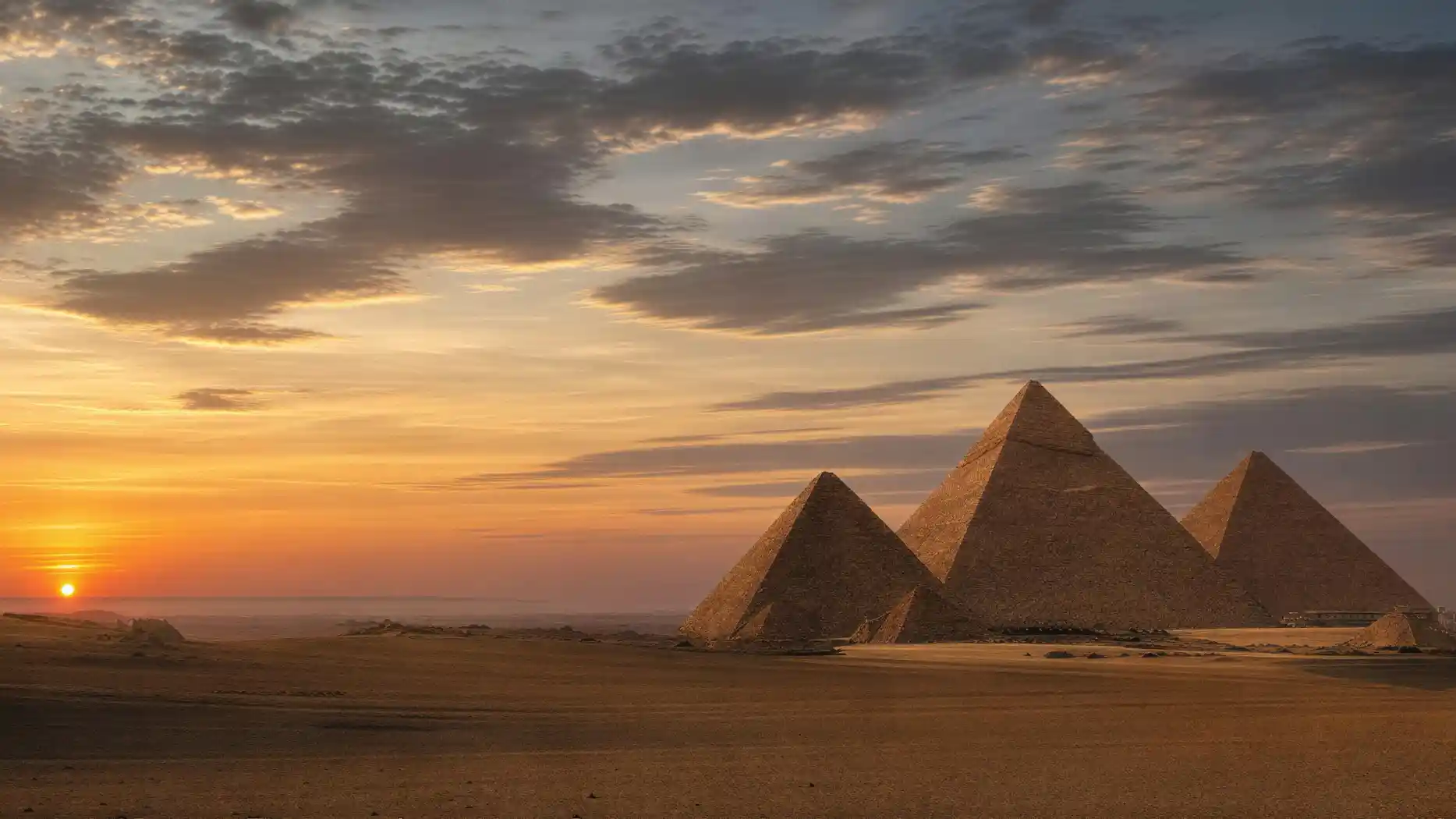
In four and a half thousand years, exactly three objects have been recovered from the interior of the largest pyramid. A stone ball, a metal hook, and a piece of cedar wood.
That's all. Lists of ten interesting facts about Giza like to cite the millions of stone blocks, the tons, and the centuries, but they omit how astonishingly empty this structure is. Engineer Waynman Dixon found the three pieces in 1872 in one of the narrow shafts of the Queen's Chamber. Nothing has come since.
Why this is remarkable is shown by comparison with other tombs. Over five thousand objects came from Tutankhamun's tomb. From the largest stone structure on Earth came three, and they don't even come from a burial chamber but from a shaft that no human can fit into.
The ball and hook are in the British Museum. The wood disappeared. A Scottish medical student named James Grant had assisted Dixon in Egypt, and after Grant's death his collections went to the University of Aberdeen. His daughter donated a five-inch piece of cedar in 1946. Then the trail was lost for over seventy years.
At the end of 2019, an employee noticed a cigar box in the Asian collection that didn't belong there. Inside were the splinters of the missing wood. Subsequent radiocarbon dating yielded a period between 3341 and 3094 BC, about five hundred years before the construction. The museum management's explanation is unspectacular and precisely for that reason interesting: either the sample comes from the core of a very old tree, or wood was so scarce in Egypt that it was kept and reused over generations.
The most conspicuous hieroglyphs are 180 years old
The most conspicuous hieroglyphs on the Great Pyramid of Khufu are not four and a half thousand years old, but a good hundred and eighty.
King Frederick William IV sent a scientific expedition to Egypt in 1842, led by Richard Lepsius. For three years the group measured and drew monuments from Cairo to Sudan; the result filled twelve volumes of plates and five volumes of text and remained the most important source in the field well into the 20th century.
On October 15, 1842, the team climbed to the top of the Great Pyramid and celebrated their king's birthday there. As a gift, they carved an inscription in Egyptian hieroglyphs onto a specially smoothed stone above the original entrance, in the style of an ancient Egyptian stela, with the names of those involved. It is considered one of the first inscriptions at all to use hieroglyphs as a means of communication after their decipherment.
The expedition left a second trace, and it is more consequential. On this journey, Lepsius numbered the pyramids of Egypt, and his numbers are still used in the specialist literature today. A structure can thus bear an ancient Egyptian name, a modern designation after its builder, and additionally a Prussian number from the 1840s.
It is still there today. From the ground it is hardly visible without binoculars, which is why most visitors walk right past it. Those who know what to look for see two layers of script on the structure: the anonymous marks of the construction crews, hidden deep in the masonry, and a Prussian king's birthday, clearly visible on the facade.
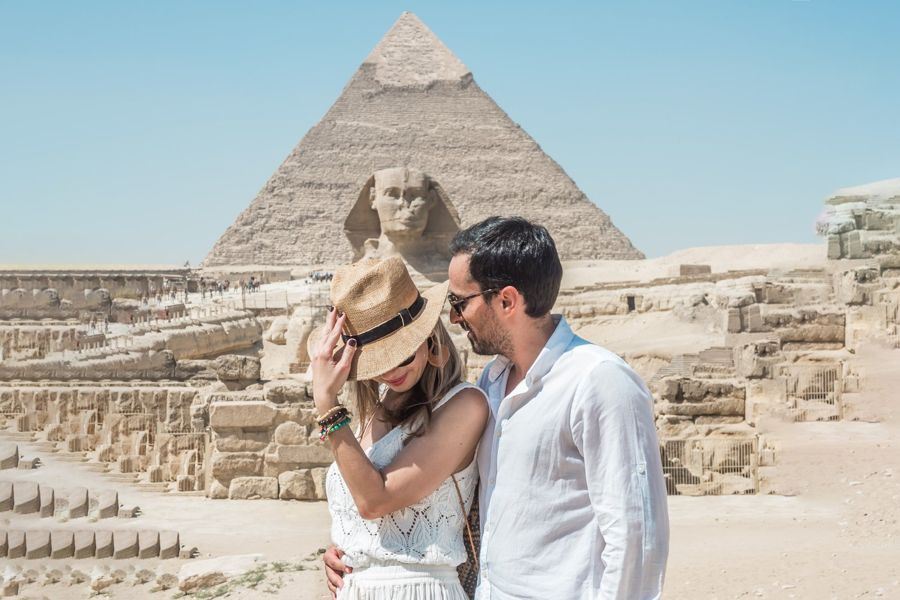
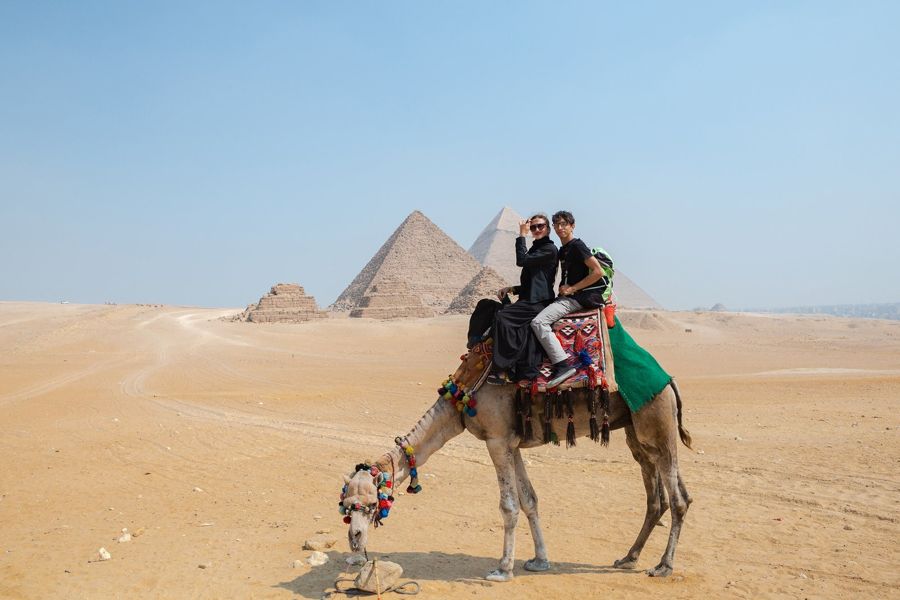

Half-day tour to the plateau and the Sphinx
- German-speaking guide you can ask for details beyond the standard points
- Four hours duration, with hotel pickup and priority entry
- Entry to the plateau is included
- Free cancellation up to 24 hours before start
The wall from the stones of the pyramid
Among the curious facts about the Great Pyramid, one anecdote is particularly persistent, and it has the advantage of being verifiable.
It dates from the time of the French Egyptian expedition and goes like this: From the stone of the pyramids, a wall could be built around France. It has been told for over two hundred years, usually without anyone checking whether it is true.
It is roughly true. The volume of the largest pyramid is estimated at about 2.6 million cubic meters. France's land borders are about 2,900 kilometers long. A wall of three meters high and thirty centimeters thick over that distance needs about 2.6 million cubic meters of material. That is not a rounded approximation but hits to two decimal places.
Who first came up with the calculation, however, can no longer be clearly determined. Usually the scholars who accompanied Napoleon to Egypt are named, and in some places Napoleon himself. Neither attribution is documented, and the anecdote thus falls under the same reservation as most superlatives on this page: The number is correct, the origin story is unverified.
Two limitations belong to it. First, the anecdote usually calculates with the stone of all three pyramids, and that then suffices for a good double wall. Second, it is a volume calculation and not a construction plan: The blocks are not cut to wall dimensions, and a considerable part of the pyramid body consists of coarse fill. As an order of magnitude, the comparison still works, and unlike most superlatives, it can be checked with a pocket calculator.
The wall around France, for you to recalculate
Preset are three meters height, thirty centimeters thickness, and 2,900 kilometers, i.e., France's land borders without coast. The construction volume of 2.6 million cubic meters is itself a calculated value from the external dimensions and contains an unknown proportion of left-in-place rock.
The shafts that no one can explain
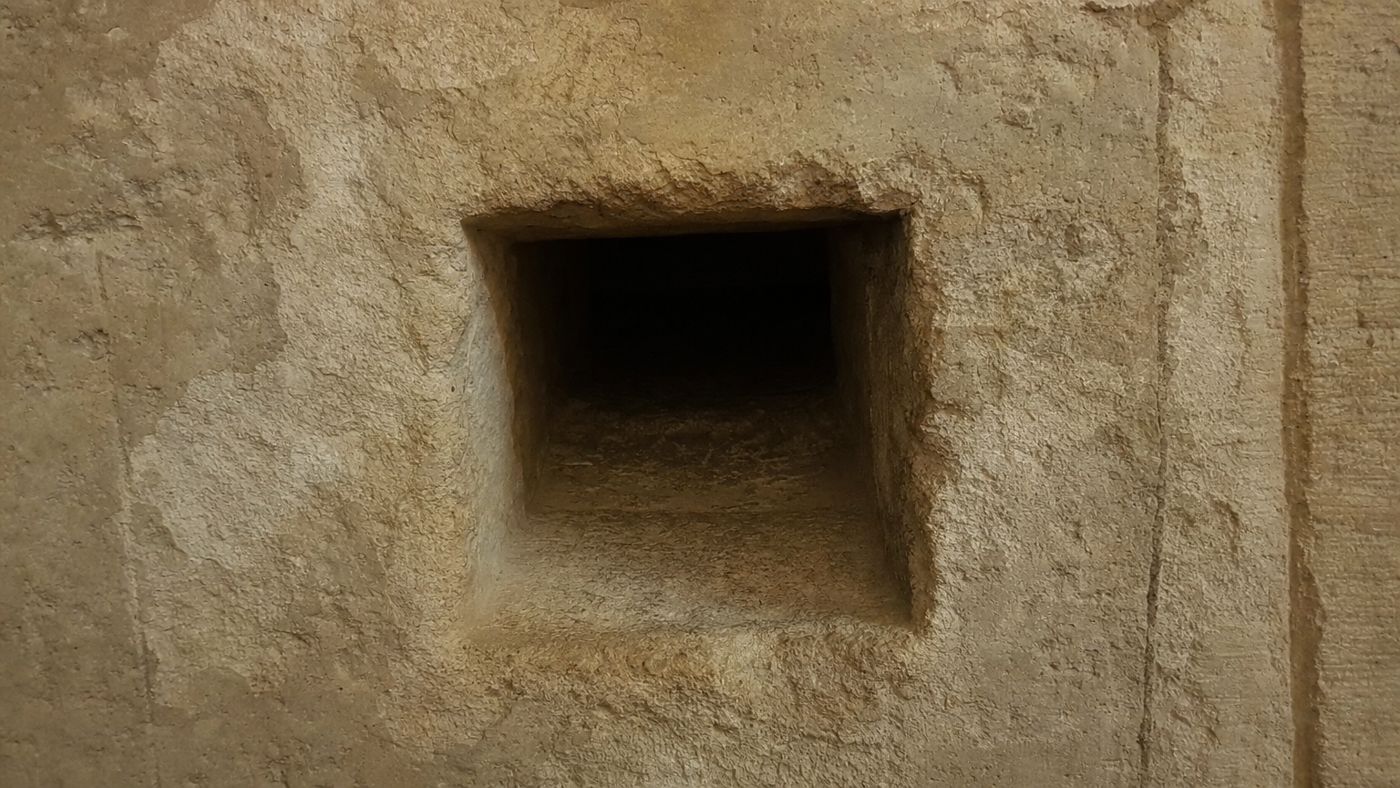
From the Queen's Chamber, two narrow shafts lead diagonally upward into the masonry. For what purpose, no one knows. They are among the puzzling facts about the pyramids of Giza that have defied explanation for over a century.
The attempt that got furthest began as a commissioned job. A German engineer installed ventilation in the pyramid in 1992 because the visitors' breath was damaging the structure. While working on the shafts, he had the idea that something could be sent into them. He built a tracked vehicle weighing a few kilograms, named after the ancient Egyptian god Upuaut, the opener of the ways.
In 1993, the device drove into the southern shaft of the Queen's Chamber and stopped after a good sixty meters in front of something that shouldn't be there: a smoothed stone slab with two embedded metal pins, probably copper. Spektrum der Wissenschaft locates the stone 64 meters from the chamber and 15.5 meters from the outer wall.
The way there was not easy. The shaft has a cross-section of about twenty by twenty centimeters, rises, has offsets at the block joints, and was partly filled with construction debris. A vehicle thus had to be small enough to fit in, powerful enough to climb, and had to pull a camera and a cable over the entire distance.
Since then, more robots have gone in; behind the slab, a small cavity and a second slab were found. What the pins were for, whether they were handles, closures, or something else, remains unanswered. That is the honest state: no secret in the sense of a hidden chamber, but an open question that has been worked on for thirty years.
Three claims from the same corner that don't hold up
- False
It is pleasantly cool inside the pyramid.
There is no functioning ventilation, and the air that circulates has taken the same narrow path as the visitors. With many people at once, it becomes warm and stuffy, especially in the ascending passage.
- False
Treasures were recovered from the Great Pyramid.
Three objects in four and a half thousand years: a ball, a hook, a piece of wood. The sarcophagus in the King's Chamber was already empty when the first documented visitors reached it.
- Partially
The name of the builder is nowhere on the structure.
It is in red paint in the relieving chambers above the King's Chamber, i.e., in a place never intended for viewing. Visible on the outside, however, are Prussian hieroglyphs from 1842.
Plateau and Museum of Egyptian Civilization in one day
The counterparts to the objects in London and Aberdeen are in the Cairo collections. This tour combines the site with the Museum of Egyptian Civilization, German-speaking guide, duration between three and eight hours, plateau entry included.
Why false information persists better
There remains the question of why false information about these structures persists so much better than correct information. An example that has been running for a millennium and a half gives the answer.
In the early sixth century, the geographer Julius Honorius noted that there were pyramids in Egypt called Joseph's granaries. Shortly thereafter, Bishop Gregory of Tours took up the idea in his history of the Franks and expanded it: Joseph had built these structures from ashlars and rubble stone, with openings at the top for pouring in grain, to provide for the seven lean years. Historian Richard Flower has traced how the interpretation spread.
It held for over a thousand years. Anyone entering the narthex of San Marco in Venice today sees in a dome a mosaic from around 1275 depicting Joseph storing the grain of the fat years. The granaries are shown as pyramids, with windows.
The mechanism is always the same. An explanation that fits a known story spreads faster than one that requires new terms. The granaries fit the Bible, the slaves fit Hollywood, and number mysticism fits the desire that something so old should mean something. The most useful test is banal: ask who said that first and where they knew it from. For the three objects from the shaft, the Prussian birthday, and the robot in the shaft, that can be answered. For most superlatives, it cannot.
Frequently asked questions
What was actually found inside the largest pyramid?
Three objects: a stone ball, a metal hook, and a piece of cedar wood, found in 1872 in a shaft of the Queen's Chamber. The ball and hook are in the British Museum, the wood in Aberdeen.
Why is the wood older than the pyramid?
The dating shows the time when the wood grew, not when it was used. Either the sample comes from the core of an old tree, or the scarce wood was reused over generations.
Are there really Prussian hieroglyphs on the pyramid?
Yes, above the original entrance. The expedition under Richard Lepsius placed them in 1842 for the birthday of Frederick William IV. From the ground, they are hardly discernible without binoculars.
What is behind the stone slab in the shaft?
A small cavity and another slab. What the shafts were for and what the embedded metal pins mean is unresolved.
Were the pyramids built as granaries?
No. The idea is a European interpretation from the sixth century that held for over a thousand years and even made it into a Venetian mosaic.


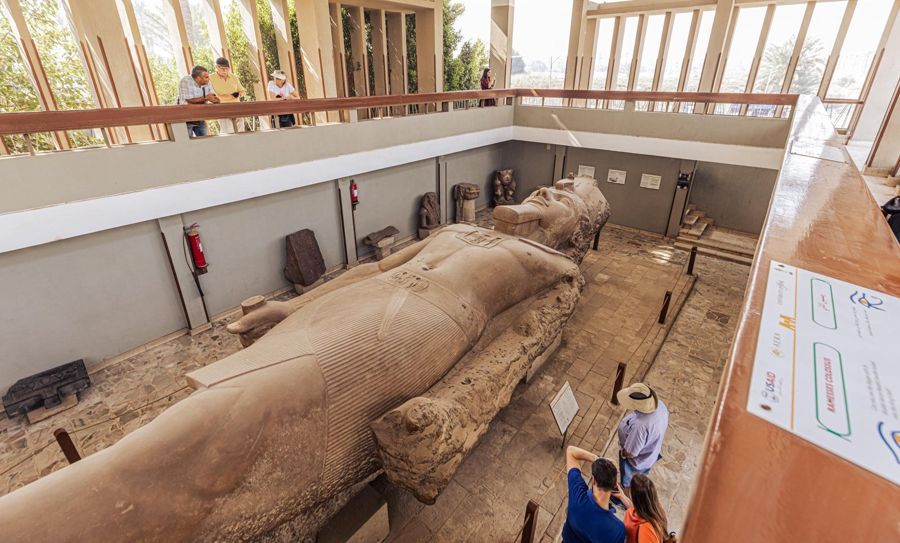
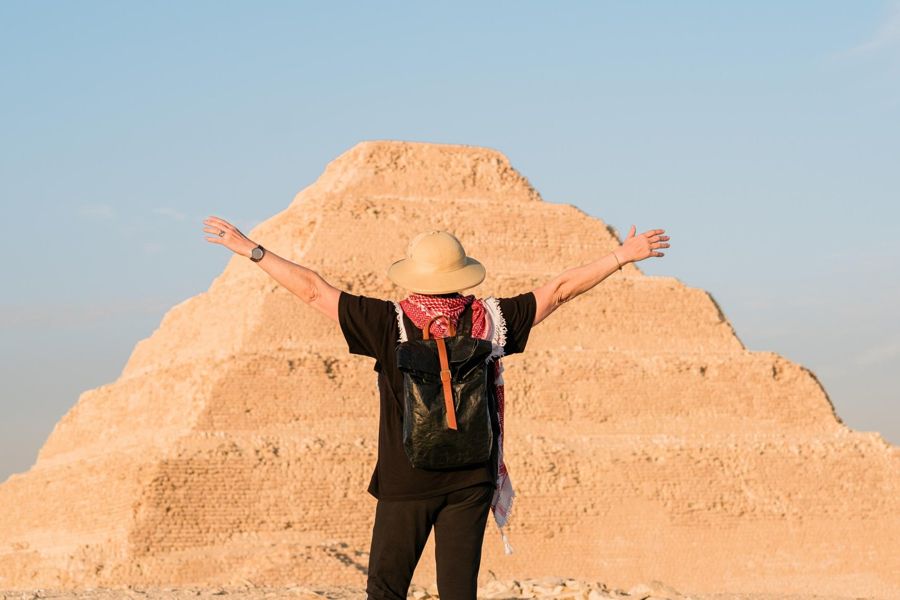
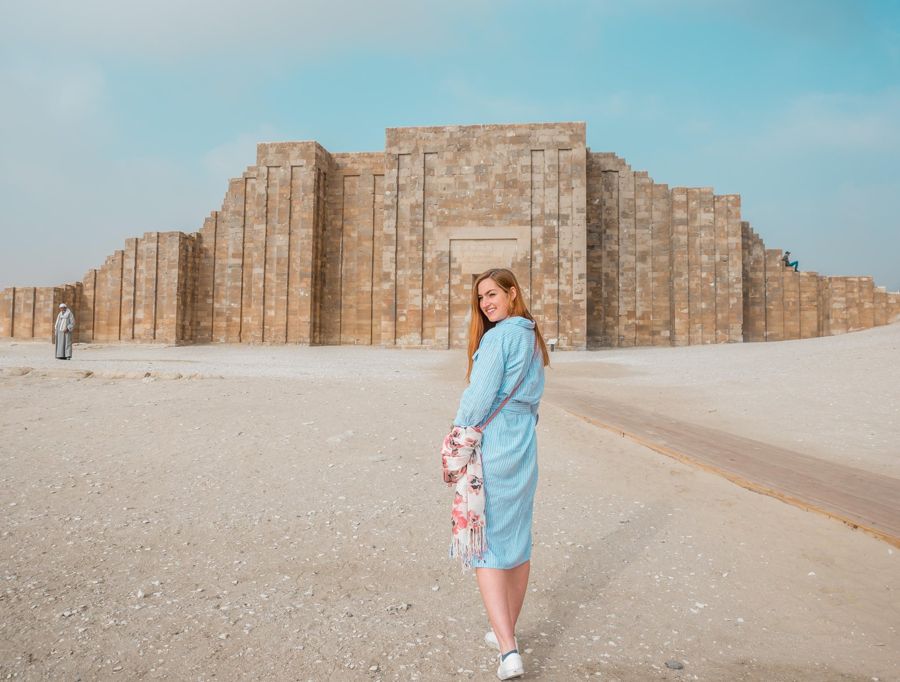
Day trip to the plateau, Sphinx, Saqqara, and Memphis
- Saqqara shows the older step pyramid, where the development of the building form can be seen
- Eight hours in a small group, German-speaking guide, with hotel pickup
- Plateau entry and priority entry are included, lunch as an add-on
- Free cancellation up to 24 hours before start