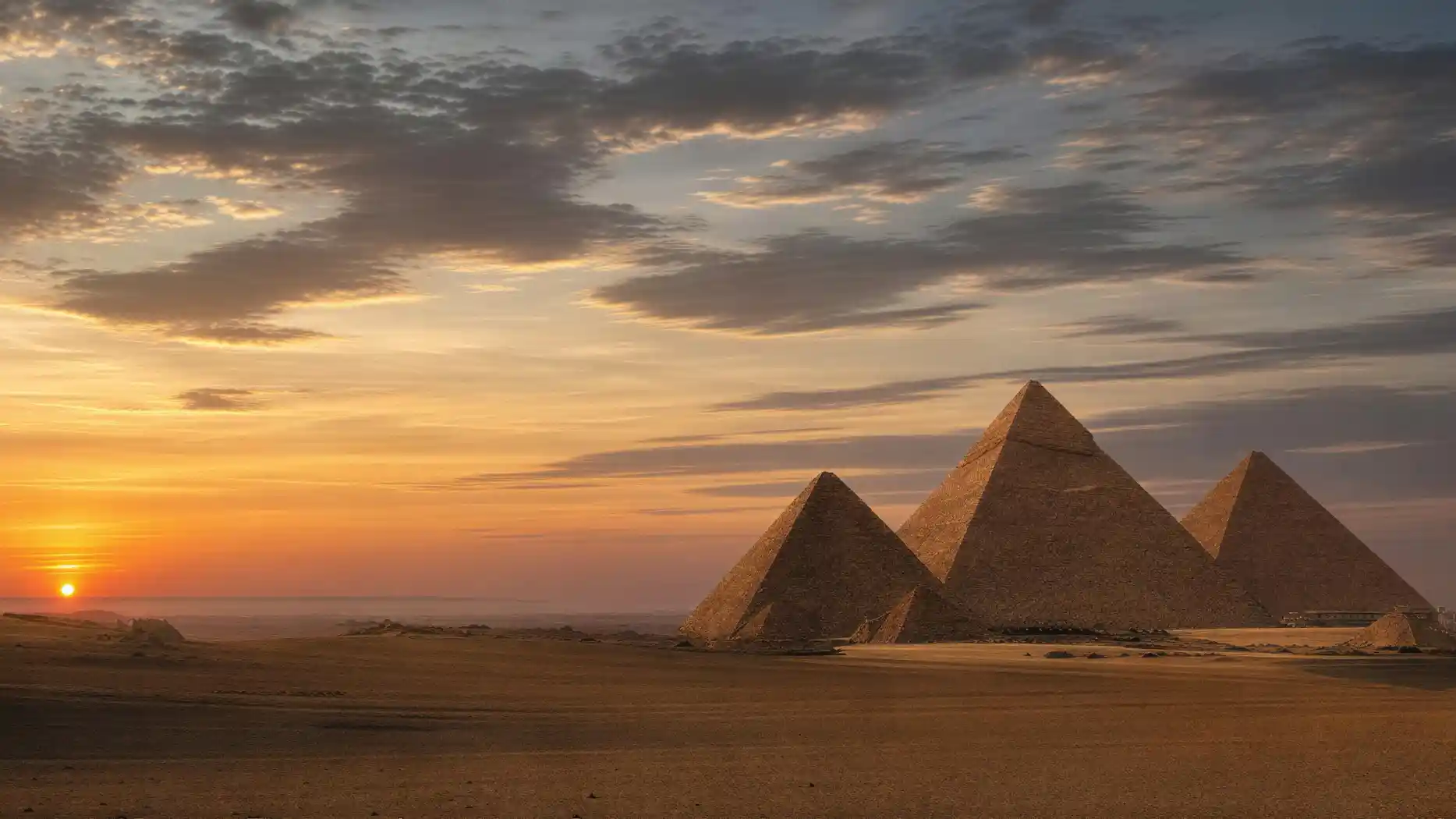
The Great Pyramid of Khufu and the speed of light: hardly any pair of numbers is placed side by side as often online. The claim behind it is elegant, and that is exactly what makes it persistent.
It goes like this: The speed of light is 299,792,458 meters per second. The latitude on which the largest pyramid stands is 29.9792458 degrees north. Same digits, same order. If you search for speed of light pyramids of Giza, you usually end up with a graphic that places both number sequences one below the other and leaves the rest to your imagination.
The digits do match. That is the true part of the matter, and one should not argue it away. The interesting question is what follows from it. And the answer hinges on a number that is not a natural measure but a decision.
The meter is the length of the path traveled by light in vacuum during a time interval of 1/299,792,458 of a second.Definition of the meter, valid since 1983, Physikalisch-Technische Bundesanstalt
The Number Is a Stipulation, Not a Measurement
Read the sentence again. The number appears in it not as a measurement result but as a stipulation.
Until the 1970s, the speed of light was measured, and the measurements became so precise that they surpassed the then definition of the meter. In 1983, the order was reversed. Since then, the numerical value is fixed and the meter is derived from it. The Physikalisch-Technische Bundesanstalt notes that this value no longer has any measurement uncertainty because it is no longer measured but agreed upon.
Thus, the claim is turned on its head. The sequence of digits 299792458 was not found in nature. It is the result of a meeting in 1983, where the value was chosen so that the new meter matched the old one. Had the old meter been a tiny bit different, a different sequence would stand there, and the pyramid would not have moved a millimeter.
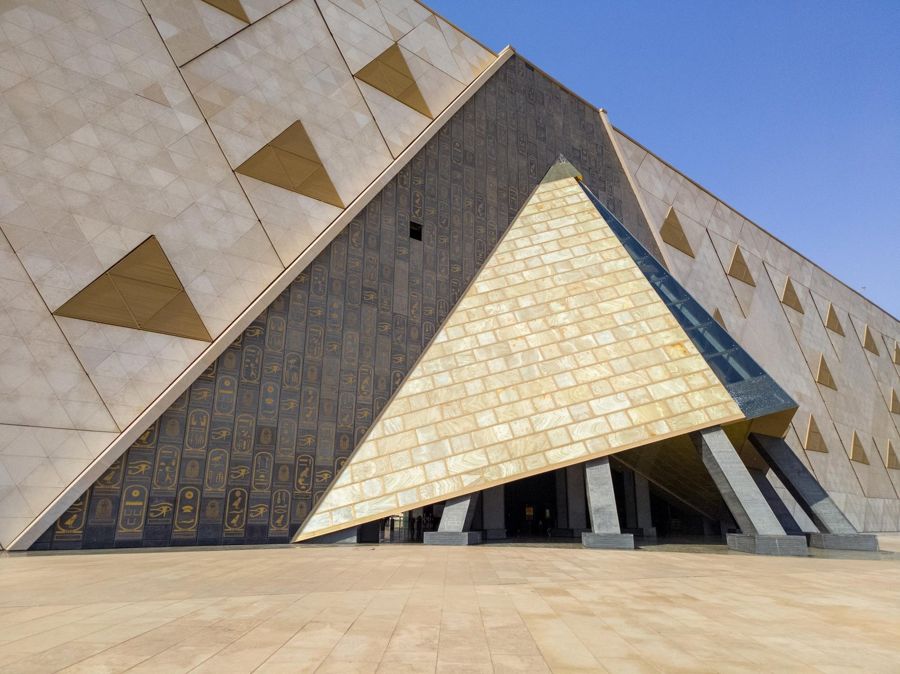
Private day tour to the plateau and the Grand Egyptian Museum
If you want to know what precision is actually measurable at this structure, the best thing is to ask someone in front of it. Seven hours, guided in German, with pickup, plateau entry, and lunch.
What All Must Be True for the Numbers to Fit
- The Meter
A length defined in France in 1793 and tied to the speed of light in 1983. In feet or cubits, a completely different sequence results.
- The Second
Defined since 1967 via a vibration of the cesium atom, set at 9,192,631,770 vibrations. Also an agreement, also recent.
- The Grid of Degrees
The equator as the zero line is obvious. The division of the circle into 360 parts comes from Mesopotamia, and counting in decimal degrees instead of degrees, minutes, and seconds is a cartographic convention.
- The Decimal Point
299792458 is unusable as a latitude. The decimal point must be placed, and at exactly one of several conceivable positions.
- The Number of Decimal Places
Exactly seven. With six or eight places, the sequence no longer emerges.
- The Choice of Latitude
The longitude of the structure yields nothing comparable. The coordinate that fits is taken.
The Calculation That Settles It
The last point is the decisive one, and it can be calculated.
One degree of latitude corresponds to about 111 kilometers. The seventh decimal place thus stands for about 1.1 centimeters. The base of the largest pyramid, however, measures about 230 meters in the north-south direction, which is a good 0.002 degrees. In this strip, there are about twenty thousand different latitudes with seven decimal places, and each one of them runs through the structure.
Add to that a second point that gets lost in the graphics. A latitude is not a point but a line. The circle on which the pyramid lies is about 34,700 kilometers long and goes once around the Earth, through the Sahara, across the Atlantic, through North America, Asia, and back. Everything that lies on this line shares the alleged peculiarity.
So you may choose one out of twenty thousand sequences. The British fact-checking organization Full Fact has done the same calculation and additionally points out something that does not appear in any of the graphics: The famous line does not run through the apex but a bit north of it. The value that best hits the apex would be 29.9791750. It does not make a nice story, so nobody takes it.
How Wide the Structure Is in Degrees of Latitude
- Base area in meters
- Base area in degrees
- The famous line
- The line through the apex
The number of latitudes results from 0.00207 degrees divided by 0.0000001 degrees and is rounded to the nearest thousand.
What Would Need to Be Present for It to Hold
What would need to be present for such an observation to hold? A quantity that is independent of human conventions. The ratio of two lengths on the structure itself, for example, remains the same whether you measure in meters, cubits, or feet. The sequence of digits of a latitude in decimal degrees does not.
The method behind it has a name and works everywhere. If you set a target number and are free to choose the unit, decimal point, rounding, and reference point, you will find it on almost any structure in the world. The match arises not in the object but in the number of allowed attempts. Therefore, the right question to ask about any number mysticism is not "is that true?" but "how many options were available?"
Looking at the surveying of this structure is still worthwhile, just elsewhere. The sides of the largest pyramid are aligned to true north, and the studies on the orientations of the Giza pyramids show deviations in the range of arcminutes. This was achieved without a compass, presumably through observation of stars, and it is a verifiable finding on a real structure with real edges.
The astonishing precision of this complex thus does not lie in the grid of degrees. It lies in the stone, and there it is measurable.
Frequently asked questions
Do the digits really match?
Yes. 299,792,458 meters per second and 29.9792458 degrees north contain the same digits in the same order. What is disputed is not the match but its significance.
Did the builders know the speed of light?
No. The meter and the second are millennia younger than the structure, and the numerical value itself was only set in 1983.
Why exactly seven decimal places?
Because only seven fit. With six or eight places, the sequence does not emerge, and both precisions would be just as arbitrary for a structure 230 meters wide.
What about the pyramid is really precise?
The alignment to true north, with deviations in the range of arcminutes, and the right angles of the base. Both are measured and verifiable.