The Tomb of Meresankh III lies a few steps east of the Great Pyramid of Khufu, costs a small separate ticket, and is almost empty on most mornings. If you're looking for the best ratio of effort to reward on the plateau, you'll find it here, not in a pyramid.
The reason is simple. The interiors of the three great structures are impressive, but they are bare: narrow passages, smooth walls, empty chambers. If you want to see color, hieroglyphs, people at work, you'll find none of that in the pyramids. In this tomb, you'll find all of it, in vivid colors and in a compact space.
What's more, almost no one goes here. The eastern cemetery lies beside the main path, it's not signposted like an attraction, and most visitors walk past it because they don't know they're allowed in.
This page explains what there is to see, who the woman was for whom it was built, and what you practically need to do to get in. One thing upfront, to save you disappointment: which tombs are open on a given day changes.
About the person, and here precision is worthwhile, because travel texts often claim more than can be verified.
Meresankh III was a granddaughter of Khufu, the builder of the largest pyramid. That is certain. With her husband, it gets fuzzier: The Giza Archives of Harvard University lists her as the wife of either Khafre or Menkaure, that is, the builder of the second or third pyramid. Wherever you read a clear attribution, you're reading a simplification.
Her mother was Hetepheres II, and she plays a bigger role in this story than the husband. According to the evidence, she commissioned the construction of the tomb, and she appears several times on the walls together with her daughter.
The titles recorded for Meresankh give an impression of her standing. She was a king's daughter and king's wife, as well as a priestess of Thoth and Hathor, and held several court offices that are difficult to translate. What was buried here was not a marginal figure of the Fourth Dynasty, but someone from the center of the family that built the plateau.
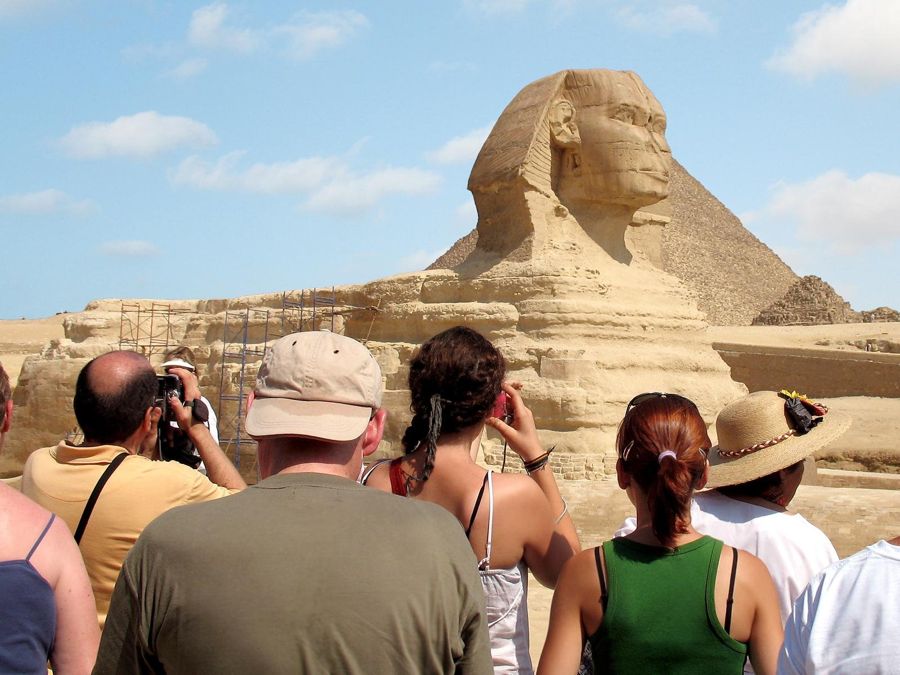
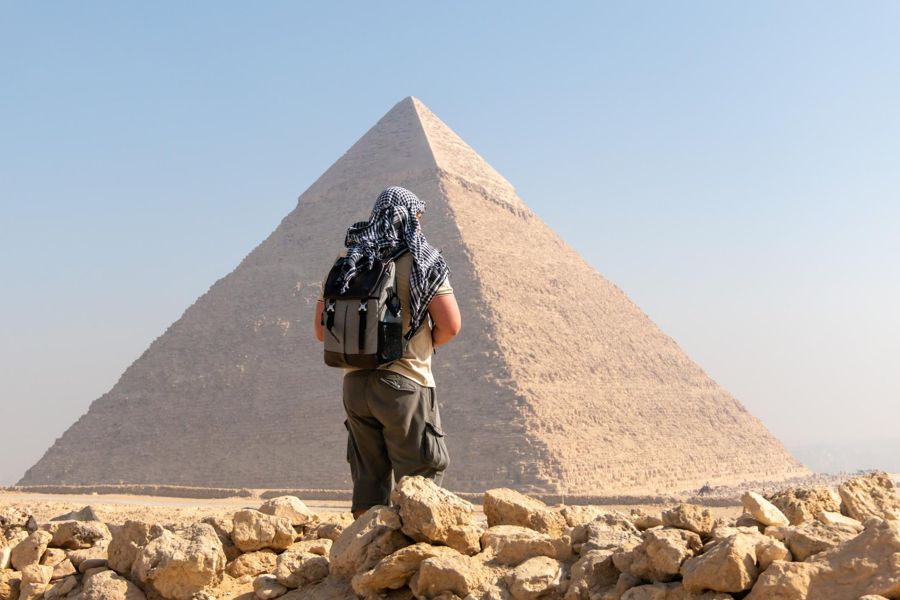
Guided tour of the site
- For painted walls, a guide is more worthwhile than for bare stone, because the scenes remain silent without explanation
- Entry to the site is included; pickup and interior visits are add-ons
- About three hours, German-speaking guide possible
- The ticket for the tomb is not part of the offer and is purchased separately on site
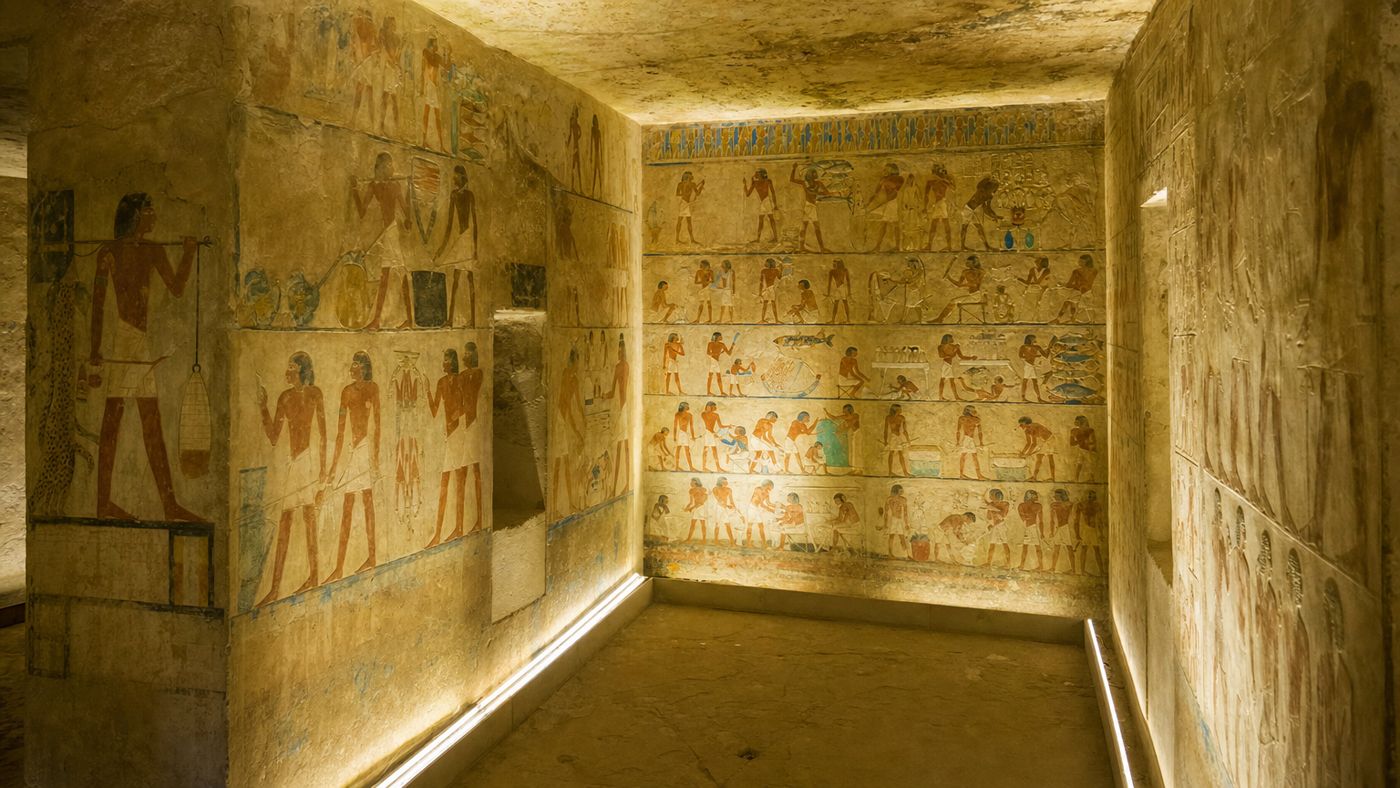
Its unique underground chapel preserves excellently crafted and painted scenes of the queen and her royal family, as well as of servants, craftsmen, and mortuary priests. The scenes also show the kind of rich grave goods that would have been placed in Meresankh's tomb: statues and fine furniture, boxes with food, clothing, and jewelry, and even a depiction of the black granite sarcophagus that was actually found in her burial chamber.Giza Archives of Harvard University, entry for tomb complex G 7530-7540 (translated from English)
Two details you won't learn on site
Two details make this tomb more than a pretty wall, and you won't learn either of them on site.
The first concerns the sarcophagus. It is made of black granite, over two meters long, and weighs more than four tons. On it is an inscription added later, indicating that Hetepheres II gave it to her daughter. A mother gives her daughter her own sarcophagus: that's the most human sentence this plateau has to offer, and it's carved in stone.
The sarcophagus itself, by the way, is no longer in Cairo, where older books place it. According to the object record of the archive, it now belongs to the collection of the Grand Egyptian Museum. If you want to see both, you see the chamber at the plateau and, in the museum, what stood in it.
The second detail is a number. An inscription in the tomb records that 272 days passed between the queen's death and her burial. Such information is extremely rare for the Old Kingdom, and it's the reason this tomb appears more often in scholarly literature than some pyramids. What the long period means is open: a common interpretation is that the death came unexpectedly and the tomb was only completed afterward.
A third detail is less spectacular and perhaps the most important for understanding: the walls depict what was to be placed in the tomb, right down to the sarcophagus itself. The chamber thus shows its own furnishings. For us, that's an inventory list from a fourth hand, painted instead of written, and it explains better than any display case what such objects were meant for. If you wonder why museums place folding stools and storage jars next to gilded shrines, you'll find the answer here on the wall.
And then there are the statues. In a niche on the north wall stand ten large female figures, carved directly from the bedrock. They are unlabeled, so it remains open whom they represent; it is assumed they are Meresankh herself, her mother, and other female relatives.
Ticket, opening, and time
Practically, the visit is straightforward if you know three things.
First, the ticket. The tomb is not included in the entry fee for the site, but costs a separate fee that is to be purchased at the entrance, not at the tomb. That's not a matter of interpretation: The official site page explicitly lists what the site ticket does not cover, and names exactly this tomb alongside the three pyramids and the workers' cemetery. It is bought at the entrance, not at the tomb itself, and that's where most people fail: if you only stand in front of it, you have to go back. So buy the ticket right when you enter, even if you're not sure yet whether you'll go.
And pay attention to the spelling at the ticket window. The name is not listed there in the form used on this page, but in an English transliteration that is drawn out and looks more like two words. If you ask for "Meresankh" and find nothing, you're looking for the wrong character sequence, not the wrong tomb.
Second, the opening. Which tombs are accessible on a day changes, and that has a conservation reason: painted walls react sensitively to the moisture of many breaths, which is why individual complexes are temporarily closed. There is no reliable advance information about this. Ask when buying your ticket; that's the only place where the answer is correct.
For this one tomb, however, the chances are better than for all others, and that's why it appears everywhere. It is the only one of the complex for which a separate ticket is sold, and since conservation it is considered almost continuously accessible. That's not a promise, but a difference from the mastabas next door, where the answer really depends on the day.
Third, the time. The complex is compact, but it deserves more than a quick look. Twenty to thirty minutes are well spent, and they hardly matter on a typical circuit of the site, because the eastern cemetery is on the way anyway.
A fourth point concerns the order on the site and costs nothing. Don't go in directly from the midday sun, but schedule the visit for the time when you're already in the eastern part of the site. The chambers are below the surface, it's cooler and shady there, and thus this tomb, alongside the valley temple, is the second place on the plateau where a break and a program point don't exclude each other.
If it doesn't work out on a day, there's a substitute that's better than its reputation. The antiquities administration, together with a digitization project of Harvard University, has published a walkable tour through exactly these chambers, free and in high resolution. It doesn't replace the visit, but it shows you beforehand what to look for.
- Location
- eastern cemetery, a few steps from the Great Pyramid of Khufu
- Ticket
- separate small ticket, to be bought at the entrance
- Included in site entry
- no
- Time needed
- twenty to thirty minutes
- Open
- varies, ask at the ticket counter
- Special feature
- ten female figures carved from the rock
Site entry as a code on your phone
If you go on your own, you first need the regular entry; the tomb ticket is added at the counter and is not included here. The code on your phone saves you the queue where you'd otherwise lose the time you wanted to spend in the tomb.
Frequently asked questions
Is the tomb included in the entry fee?
No. It costs a separate small ticket, which is bought at the entrance and not at the tomb itself.
Where exactly is it located?
In the eastern cemetery, a few steps from the Great Pyramid of Khufu and right on the usual circuit.
Is it always open?
No. Which tombs are accessible changes for conservation reasons. Ask when buying your ticket.
Is it more worthwhile than a pyramid interior?
If you want to see color and depictions, yes. The pyramid interiors are bare.
Whose wife was Meresankh III?
That is not clearly established. The Harvard archive names either Khafre or Menkaure.
Where is her sarcophagus?
In the Grand Egyptian Museum. Older books still place it in the museum at Tahrir Square.