Ramadan and public holidays in Giza are a planning issue that almost always starts from the wrong concern. People ask: Is it closed then? The answer is no, not on any of those days.
The site is accessible seven days a week, including Fridays, public holidays, and during the fasting month. There is no closing day. So if you feared your trip falls on a closed day, you can drop that worry.
What changes is everything else. Crowds shift significantly, up on some days and down on others. The daily rhythm of the surrounding city partly reverses during the fasting month. Restaurants, offices, and banks have different hours. And traffic, already the biggest unknown in any planning here, follows a completely different pattern on certain days.
That's what derails travel plans, not closed gates. So this page doesn't sort by opening hours but by what actually happens.
First, you need to know that Egypt operates three calendars side by side, and all three generate days off.
The state calendar provides fixed dates that fall on the same day every year: New Year's, several revolution and commemoration days in spring and summer, and Armed Forces Day in October. The Coptic calendar provides Christmas in January and Coptic Easter, which is shifted relative to the Western one. And the Islamic calendar provides the fasting month and the two Eid festivals, which move forward about eleven days each year and also depend on a moon sighting.
For travelers, this creates an awkward situation: You can't derive the calendar for your travel period from the previous year. The dates of the fasting month and the Eid festivals move forward about eleven days each year, and they are only finalized at short notice.
One of these fixed dates falls right in the best travel season: Coptic Christmas on January 7. It's a public holiday in the middle of high season, and if you're planning for January, you should know about it because it adds an extra excursion day to an already busy period.
A fourth day belongs here, one that few travel guides mention and that is the most important of all for this site. More on that below.
What Actually Applies on Holidays
- Site open
- on all holidays, seven days a week
- Visiting hours during Ramadan
- announced anew each year, only shortly before the month begins
- In the last documented case
- closed later than other sites, not earlier
- Busiest single day
- the spring festival after Coptic Easter
- Quietest time
- the mornings during the fasting month
- Calendar trap
- holidays are often moved to a Thursday
Half-day tour with pickup, timing handled by the operator
- On days with unusual traffic patterns, scheduling is in the hands of a local, not you
- Pickup from your accommodation and entry to the site are included, saving you the queue on busy days
- German-speaking guide available; interior visit is explicitly not part of the program
- Free cancellation up to 24 hours before, according to the provider, which helps with short-notice holiday shifts
The Calendar Trap
The calendar trap deserves its own paragraph because it strikes even if you've checked carefully.
Egypt regularly moves public holidays that fall on an inconvenient weekday to a Thursday, occasionally to a Sunday. So the commemoration day appears in the calendar on one date, but the day off is another. An example from the current year: The anniversary in June was moved by government decree to the following Thursday. In the overview of a European embassy, the same pattern appears with Armed Forces Day, which is observed on a different day than the one in the calendar.
For you, this means two things. First: A date from a list says nothing about when things are actually open. Second: The moved day often creates a long weekend, and a long weekend is the most reliable reason for crowded roads at this site.
So don't check the holiday list, but the short-term announcement, and expect it to come only a few weeks before.
One consequence concerns money and is often overlooked. On public holidays, banks and exchange offices are closed. Since small cash amounts are needed at several points on the site and ATMs can run empty if not refilled for days, you should start a longer holiday block with enough small change. This is especially true before the multi-day Eid festivals, and it's the point where an otherwise well-planned day hinges on a small detail.
As for visiting hours during the fasting month itself, there's good news that contradicts a common assumption. They are announced anew each year, and in the last documented case, the plateau closed later than other sites of the same administration rather than earlier. Still, don't rely on last year's times.
The Four Time Periods and Their Effects
Sorted by what you'll notice at the site. None of these days are closed.
| Time Period | Crowds at the Site | What's Different Around | What That Means |
|---|---|---|---|
| Fasting month, daytime | noticeably lower than usual | Many eateries closed during the day, offices with shorter hours | The best time for a quiet visit if you handle your own meals |
| Fasting month, last hour before sunset | empties quickly | The heaviest traffic of the year, then almost empty streets | Scheduling travel into that hour is the most expensive planning mistake |
| The two Eid festivals | very high, lasting several days | Transport and accommodation booked out early | Book early or avoid; the sites fill with local families |
| Spring festival and public holidays | high, on a single day | Offices and banks closed, excursion traffic | If you have the choice, move your visit by a day |
- Crowds at the Site
- noticeably lower than usual
- What's Different Around
- Many eateries closed during the day, offices with shorter hours
- What That Means
- The best time for a quiet visit if you handle your own meals
- Crowds at the Site
- empties quickly
- What's Different Around
- The heaviest traffic of the year, then almost empty streets
- What That Means
- Scheduling travel into that hour is the most expensive planning mistake
- Crowds at the Site
- very high, lasting several days
- What's Different Around
- Transport and accommodation booked out early
- What That Means
- Book early or avoid; the sites fill with local families
- Crowds at the Site
- high, on a single day
- What's Different Around
- Offices and banks closed, excursion traffic
- What That Means
- If you have the choice, move your visit by a day
Sham el-Nessim, the Day Without a Guidebook
That leaves the day that appears in no guidebook and is the most characteristic for this site: the spring festival, in Arabic Sham el-Nessim, literally 'smelling the breeze.'
It falls on the Monday after Coptic Easter, is a public holiday, and is celebrated by both Muslims and Copts alike. Its origin lies not in either religion but in pharaonic Egypt; the tradition goes back to the Old Kingdom, exactly the era when the structures were built in front of which people celebrate today. It is celebrated outdoors, with picnics, colored eggs, spring onions, and salted fish.
For a visit, this means: It is the busiest single day of the year at open sites because the whole country goes outside. If you seek peace, move your visit. If you want to see what this place looks like for the people who live here, choose exactly this day, and do so deliberately.
What matters during Ramadan, on the other hand, is less the crowds than the rhythm. During the day, the site is quieter than usual. From late afternoon, the picture flips: Traffic thickens to the worst hour of the year, and with the breaking of the fast, the streets empty abruptly. If you know this, you plan your return either well before or half an hour after, and you'll get through faster than on any ordinary evening.
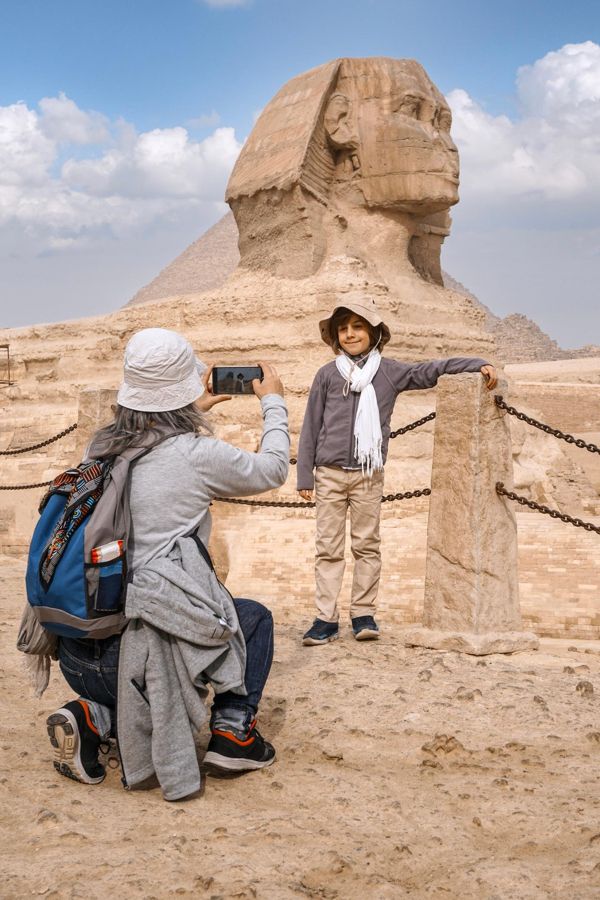
For families with children, it's worth reversing this consideration. On festival days, the areas are fuller, but the atmosphere is different from ordinary days: There's picnicking, playing, and photographing, and foreign guests stand out less in the crowd than usual. If you can handle the crowds, you'll experience the most relaxed interaction with vendors and sellers of the whole year on these days, because their attention is spread over many more people.
And a tip for etiquette that costs nothing: Eating and drinking in public is unusual during the fasting month during the day. On the site itself, no one drinks anything, especially since in the heat drinking remains necessary anyway; a bit of restraint in queues and vehicles is still the friendlier option.
Frequently asked questions
Is the site closed during Ramadan?
No. It's open seven days a week, including during the fasting month and on public holidays.
Are opening hours shorter during Ramadan?
Not necessarily. In the last documented case, the plateau closed later than other sites. It's announced anew each year.
When is it busiest?
During the Eid festivals over several days and on the spring festival after Coptic Easter on a single day.
Why doesn't the date in my holiday list match?
Because public holidays are often moved to a Thursday. The day off is then different from the one in the calendar.
Can I eat and drink during the day in Ramadan?
It's allowed but not customary. In the heat, you should still drink; a bit of restraint in public is appropriate.
When is traffic worst during Ramadan?
In the hour before sunset. Immediately after breaking the fast, the streets are unusually empty.