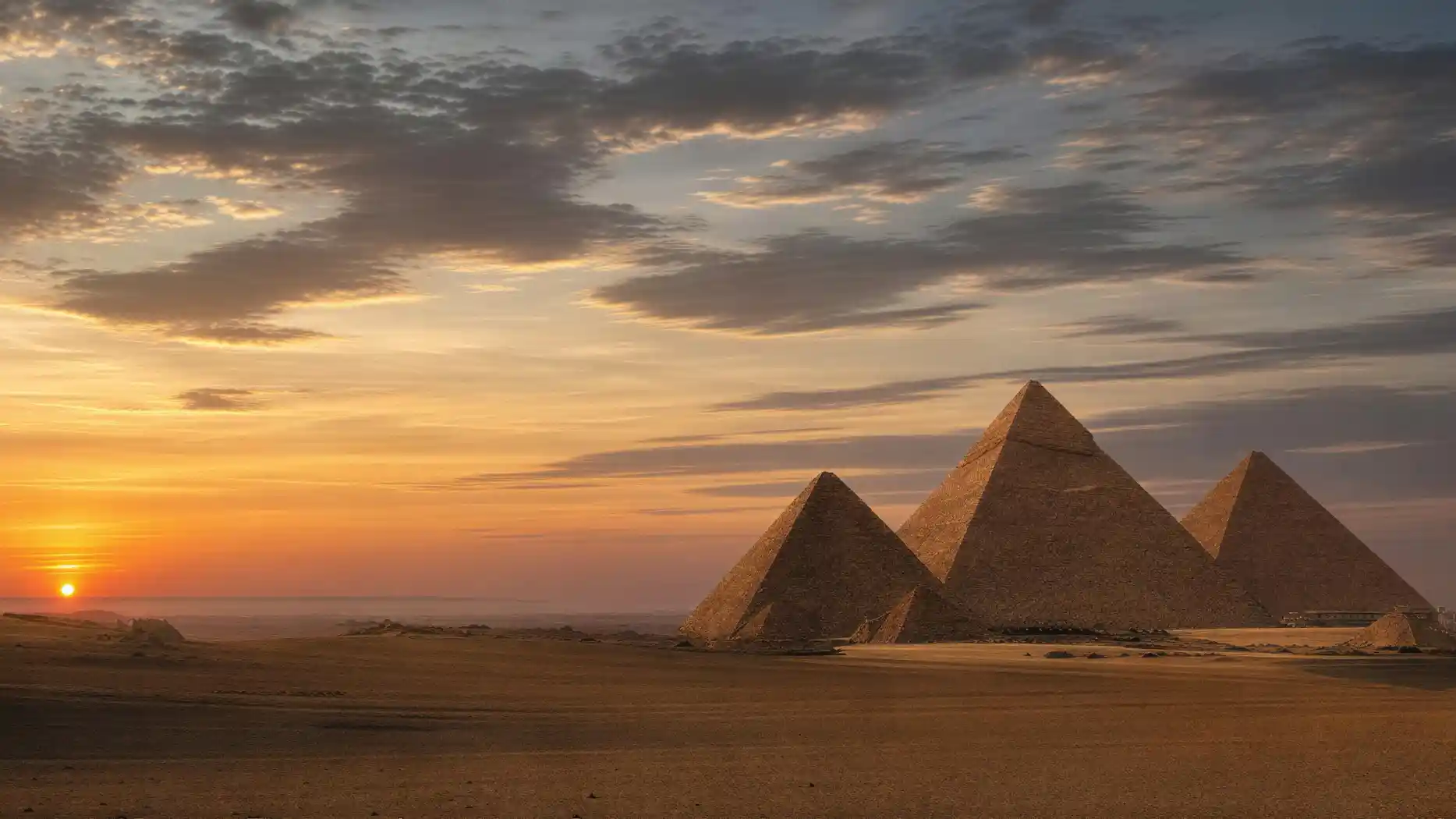
The redevelopment of the Giza Plateau can be assessed in an unusually satisfying way because there is a list. In November 2020, the project was publicly presented, and it was stated fairly precisely what was to be built.
Mentioned at the presentation in November 2020 were: a station for electric buses, a cable car, upscale restaurants and cafés, hotels, a helipad for special guests, expanded bazaar areas, cinemas, and an information center. In addition, a footpath and a cable car between the Grand Museum and the site, a metro connection, and replacement housing for the adjacent neighborhood.
Six years later, each item can be checked off or not, and that's exactly what this page does. This is more useful than any announcement because it shows how reliable such lists are and what to make of the promises currently circulating.
Here's the result in one sentence: The part concerning visitor operations is built and functioning. The part concerning additional facilities and attractions is largely not built, and for two projects there is a good reason for that.
From Contract to Operation
- 2018
A subsidiary of the Orascom Group receives a fifteen-year contract for visitor operations at the site. The excavation area remains with the antiquities authority.
- November 2020
Public presentation of the project with the full list of planned facilities, from the electric bus station to the helipad.
- 2022
Agreement between the operator and the antiquities authority on clean energy and electric buses on the site.
- Spring 2025
Trial operation: new entrance on the desert road, driving ban for private vehicles, electric shuttle. Protest by camel and horse providers against their relocation.
- November 2025
The Grand Museum, two kilometers away, opens fully and changes visitor flows throughout the area.
- 2026
Regular operation at the site. Several announced facilities are still not built.
What Actually Stands Today
What actually stands today is the part that a visitor immediately notices, and it concerns exclusively the course of the visit.
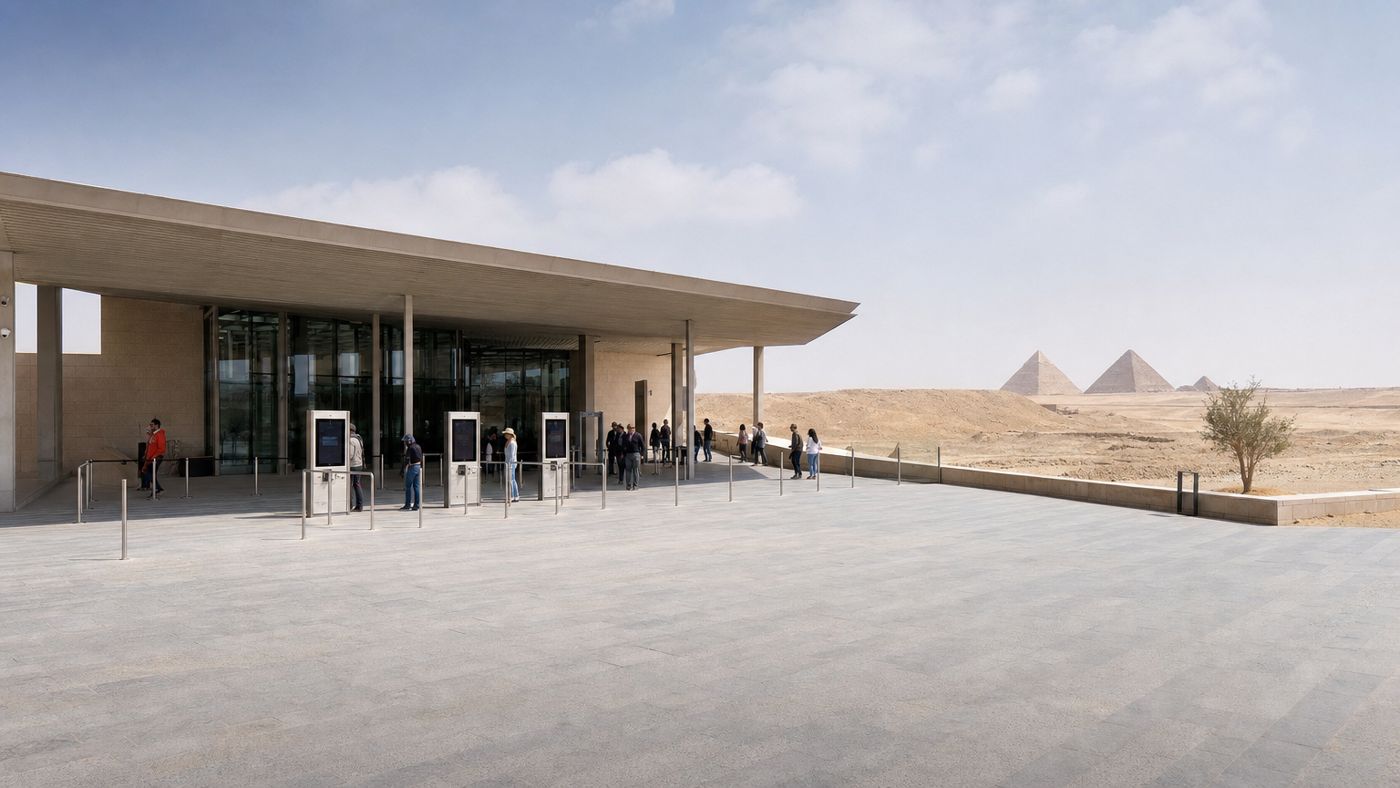
There is a new visitor center on the desert road in the southwest with ticket counters, machines, security, toilets, and a large parking area. Private vehicles and tour buses stay outside. On the site, small electric buses run in a loop, and their use is included in the entrance fee. At the foot of the largest pyramid, there is a managed complex with dining options, and in several places, paths, signage, and service buildings have been renewed.
Taken together, this is the core of the project, and it has been delivered without dispute. Anyone who knew the site before 2025 will immediately recognize the difference: fewer vehicles, less dust, orderly paths, a defined entrance instead of multiple access points with unclear rules.
Two things are remarkable about this list. First, all of it is infrastructure and none of it is an attraction: nothing was built that expands the visit in content, only what organizes it. Second, the result is clearly aimed at tour groups and throughput. A defined entrance, fixed paths, and a loop service are the answer to crowds, not to the question of how to best understand this site.
These individual components have their own pages because they are more important for planning a visit than the program behind them. Here, we focus on the balance sheet.
See the difference yourself. The redevelopment mainly affects the course of the visit, and that can only be judged on site. Three houses that cover this:
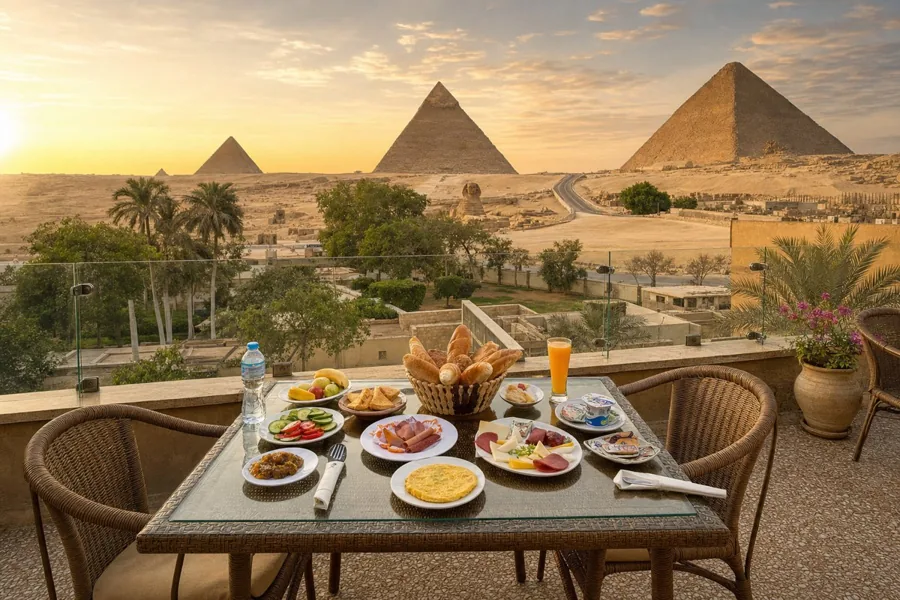 At the Sphinx
Giza Pyramids View Inn
- Good breakfast
- Airport shuttle
- Two restaurants
- 24-hour reception
- Free Wi-Fi
For those who want to see the Sphinx from their breakfast chair
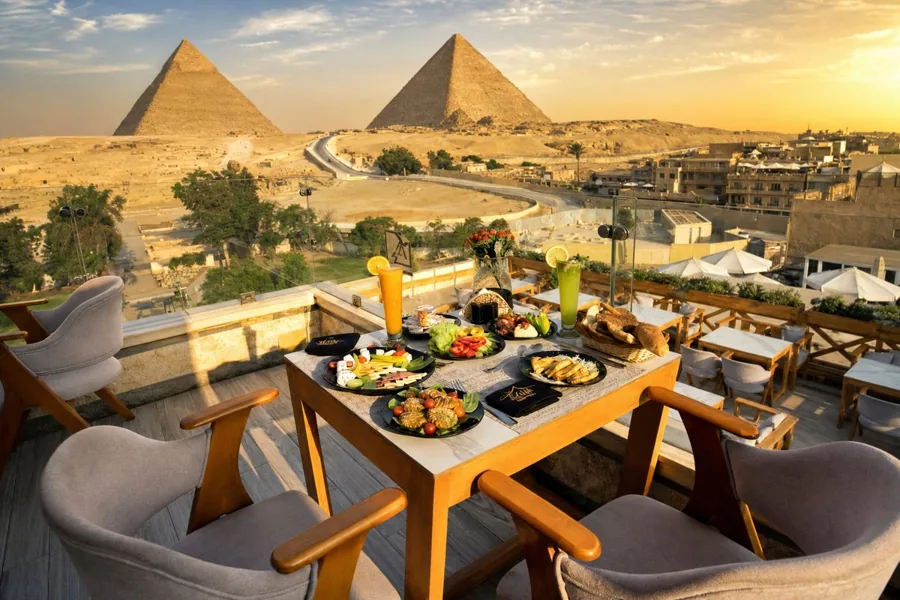 Most reviewed
Great Pyramid Inn
- Fabulous breakfast
- Rooftop terrace restaurant
- Bar
- Airport shuttle
- 24-hour reception
Most who want to stay in the neighborhood
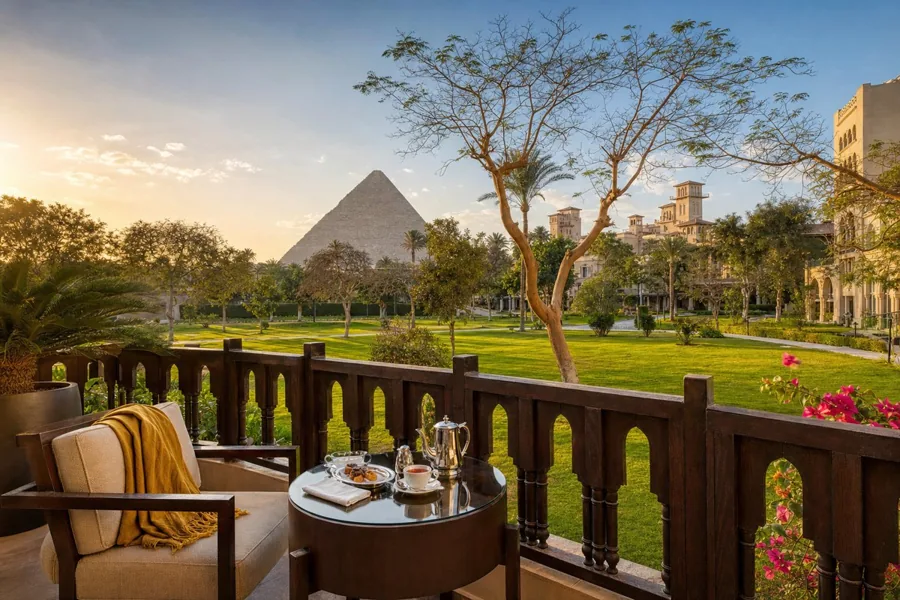 Garden & pool
Marriott Mena House
- Excellent breakfast
- Outdoor pool
- Spa and wellness center
- Three restaurants
- Fitness center
For those who want space, garden, and pool instead of a rooftop terrace
What Is Missing from the Announcement
Now for the other part of the list. Of the additional facilities announced in 2020, most are still missing today.
There is no cable car, no helipad, no hotels on the site, and no cinemas. The cable car between the Grand Museum and the plateau is still being announced, most recently with a double-digit number of stops. It is not built, and no confirmed date is known.
However, for two items on this list, there is more to say than just that they are missing, and that is the most interesting finding of this page. The announced footpath between the museum and the site was reviewed by the bodies of the World Heritage Convention and assessed as an unacceptable intrusion into the cultural landscape. The also-mentioned high-speed line through the region is the subject of an ongoing compatibility assessment, and implementation is suspended until that is completed.
These two cases are also instructive because they correct a widespread expectation. World Heritage status is not a prohibition or an approval authority; the bodies issue opinions that the state party can follow or not. What gives the recommendations weight is the convention's sharpest instrument: inclusion on the List of World Heritage in Danger and, in the extreme case, deletion. Why the state party followed in these two cases cannot be said from the outside; all that can be said is that it followed.
This shows what World Heritage status is good for, which is often doubted. Here, it did not prevent the redevelopment but stopped or halted two components of it, precisely the two that would have intervened in the landscape between the museum and the monuments. If you want to know whether such a title has an effect, here is a case to read about.
Finally, the replacement housing for the adjacent neighborhood is underway, but it is a separate and much more difficult chapter that does not belong on this page.
Has the Built Part Proven Itself?
That leaves the question of whether the built part has proven itself, and the answer is mixed.
On the credit side, the complaints that accompanied the site for decades are exactly at the points that were redeveloped: crowding at the entrance, vehicles among the monuments, pushy approaches, unclear ticket situation. The operator cites a visitor number of several million for the most recently completed period and a target of five million. However, this figure comes from the operator itself; official figures per site are not published, and there is no independent cross-check.
On the debit side are two things. First, the criticism of those whose business depended on the old order, especially the camel and horse providers, who blocked the access road in protest in spring 2025. Second, reports from visitors about waiting times at the shuttle and paths that had to be walked in the heat.
Also remarkable is what has not changed with the redevelopment. The interiors of the monuments are still paid for individually and additionally, the opening hours are still contradictory in official sources, and where exactly tickets are sold is nowhere bindingly stated. A program of this size could have taken care of these small things on the side, and that it hasn't says something about its priorities.
For you as a traveler, this results in a simple reading aid. If you read about a new facility at the site, first check whether it is built or announced. The announcements of this program have proven to be significantly more durable than its buildings, and between the two, here, there are regularly years.
And there remains a third, unanswered question. There is no publicly accessible study on vibration, sound, and lighting at major events on the site. That is not an accusation but the statement of a gap: a program that so thoroughly reorganizes visitor operations could also answer this part, and so far it does not.
Guided tour with entrance fee included
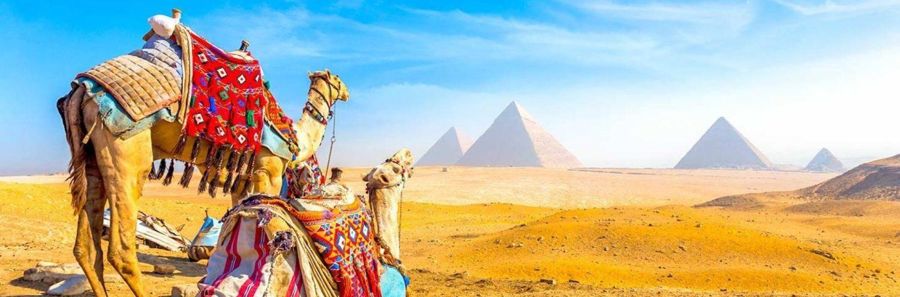
If you want to experience the reorganized process without organizing it yourself: four hours with German-speaking guide and plateau entrance fee included, pickup as an add-on, lunch not included.
Frequently asked questions
Who operates the redevelopment?
A subsidiary of the Orascom Group, since 2018 with a fifteen-year contract for visitor operations. The excavation area remains with the antiquities authority.
What is finished?
Visitor center, new main entrance, driving ban for private vehicles, electric shuttle, dining options, and renewed paths.
Is there a cable car?
No. It is still being announced, but it is not built, and no confirmed date is known.
Why was the footpath to the museum not built?
The bodies of the World Heritage Convention assessed it as an unacceptable intrusion into the cultural landscape.
Is the redevelopment complete?
Visitor operations are running in regular mode, but several announced facilities are still missing. No completion has been declared.
Will I notice it as a visitor?
Yes, immediately: different entrance, no private vehicles, shuttle instead of walking, orderly paths. If you were there before 2025, you'll notice the difference right away.