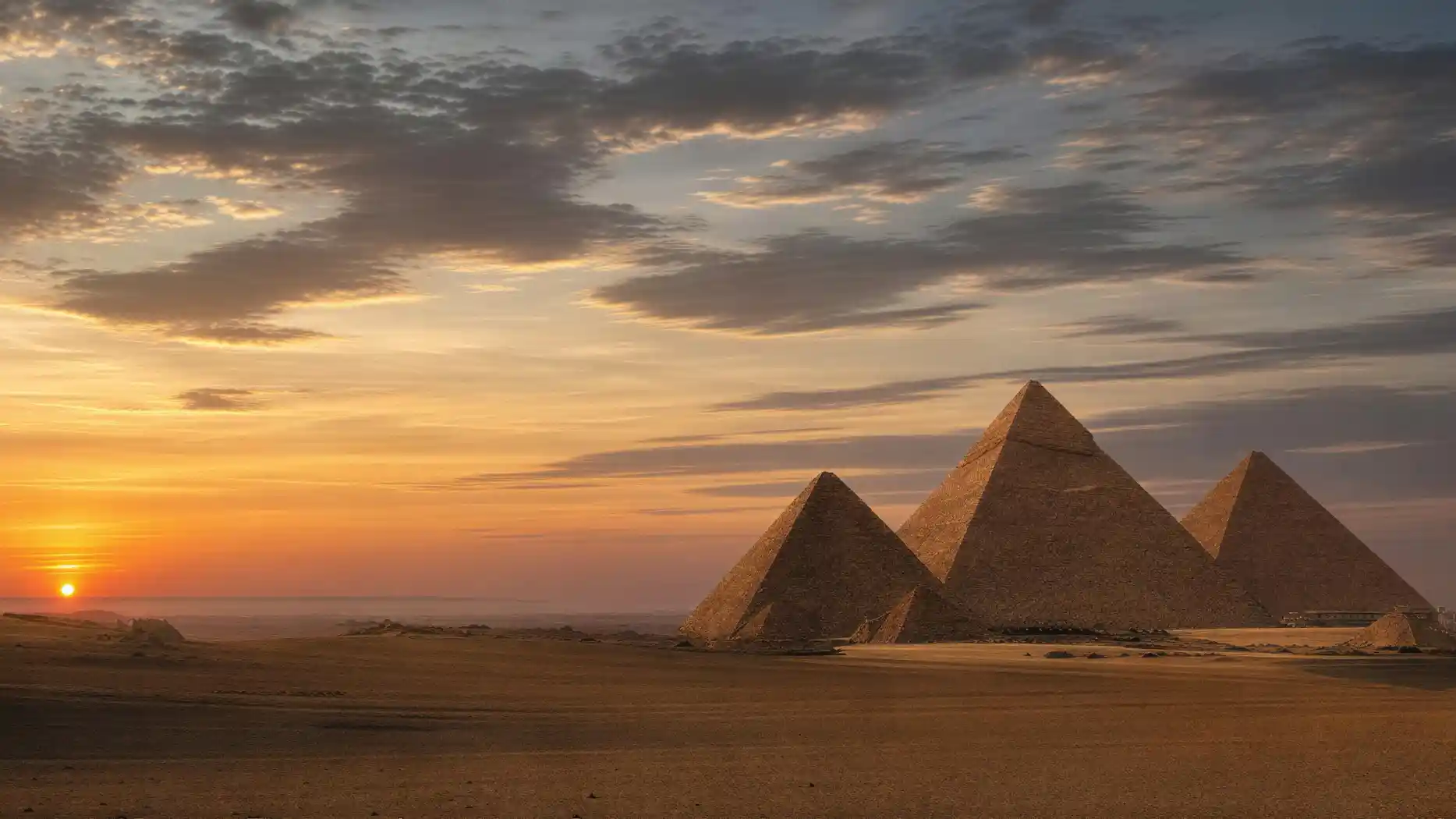
What lies beyond the Pyramids of Giza? The answer surprises many: more pyramids, and far more than the three famous ones suggest.
The Giza Plateau is not a single site but a section. Along the desert edge west of the Nile, a necropolis stretches for about thirty kilometers, from Abu Rawash in the north to Dahshur in the south. Along this stretch, depending on how you count, there are over two dozen pyramids, plus temples, mastabas, and the remains of a capital city. Giza is the most famous part, but neither the oldest nor the best preserved.
This is not a private compilation but the official view. The UNESCO World Heritage Site is not called the Pyramids of Giza but Memphis and its Necropolis – the Pyramid Fields from Giza to Dahshur, and it has included exactly this entire strip since 1979.
The reason the complexes are so spread out is not apparent from the terrain itself: each ruler built near his own residence, and that shifted over the centuries along the river. The necropolis is therefore not a planned layout but the result of many individual decisions over centuries.
One common assumption is wrong: the order on the map is not the order in time. The oldest major structure stands in the middle of the strip, at Saqqara. The two immediate predecessors of the Giza pyramids stand far to the south, at Dahshur. And north of Giza lies a complex built by a son of Khufu, while to the south, at Abusir, a whole dynasty later built. So to see the development, you don't drive the whole stretch but pick three points.
For a visit, this means two things. First, within half a day's reach there is more to see than most itineraries allow. Second, there are things there that no longer exist at Giza, above all a smooth outer casing.
The Pyramid Field from North to South
- Abu RawashNorthernmost complex, about eight kilometers north of Giza, little visited.
- GizaThe three famous structures, the Sphinx, and the subsidiary fields.
- AbusirAbout ten kilometers south, pyramids of the Fifth Dynasty, very quiet.
- SaqqaraAbout fifteen kilometers south, with the Step Pyramid of Djoser.
- Memphis and DahshurTwenty to thirty kilometers south, the ancient capital and two enterable pyramids.
Distances are as the crow flies from the plateau. Travel time depends on traffic and is almost always longer than the kilometer count suggests.
The Most Rewarding Detour Lies to the South
The most rewarding detour is at the southern end, and it is also the least known.
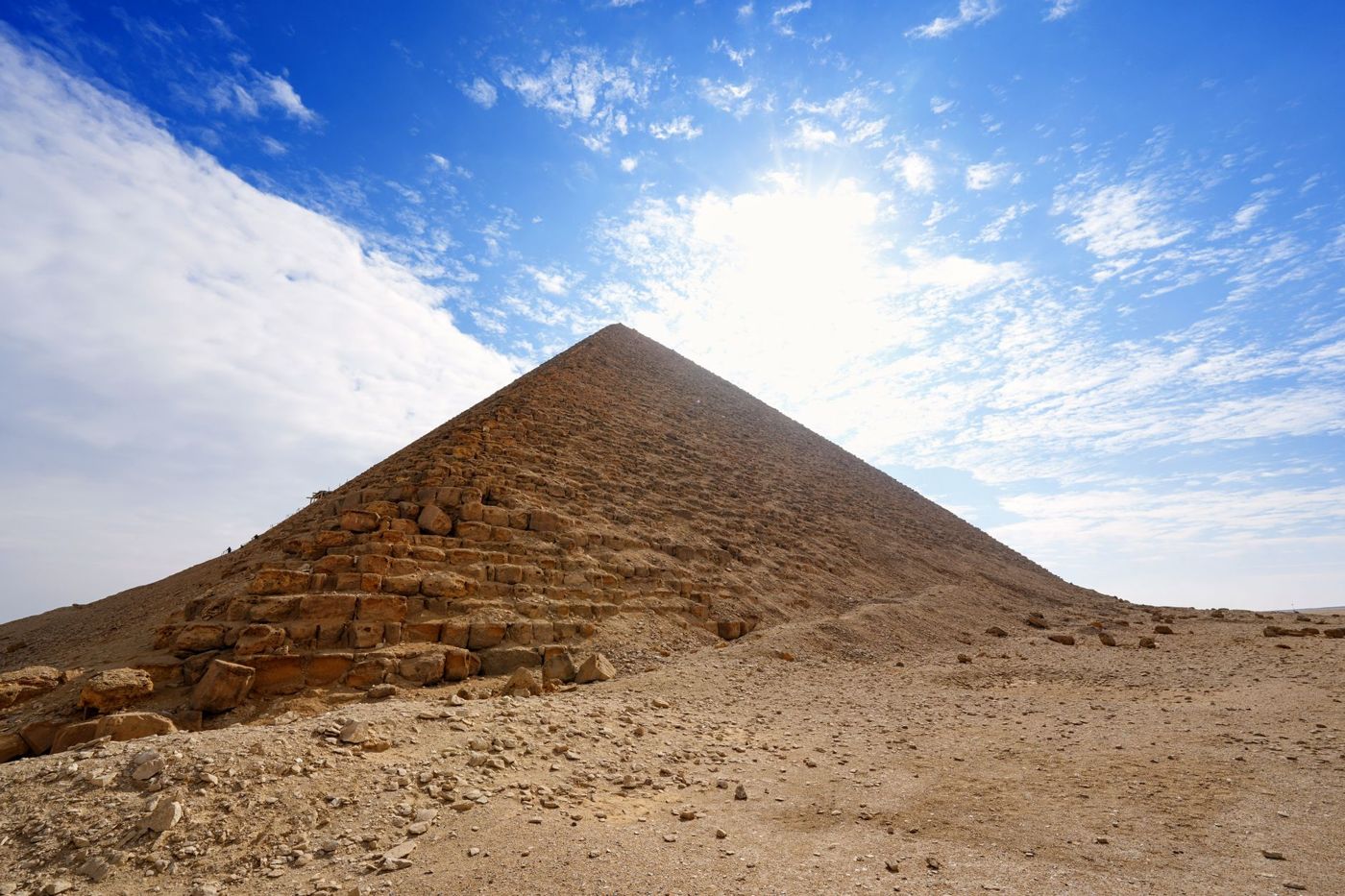
At Dahshur stand two pyramids from the time of Sneferu, Khufu's father. One is called the Bent Pyramid because its sides become flatter halfway up, presumably a correction during construction. The other, the Red Pyramid, is considered the first true pyramid to be completed. Both can be entered, both are usually almost empty, and the authorities maintain their own official pages.
But the real reason to go there is something else. The Bent Pyramid still retains much of its original limestone casing over large areas. What is missing at Giza and can only be seen in a few remnants at the base of the largest pyramid and at the top of the middle one is here preserved over wide expanses. If you want to know what a pyramid looked like four and a half thousand years ago – smooth, closed, and bright – you must go to Dahshur, not Giza.
It has only recently become accessible. The Bent Pyramid was closed for over fifty years and reopened in 2019, for the first time since 1965. So you won't find this in older guidebooks.
The reason so few people are there is simple: most day tours end at Saqqara and do not continue south. If you take the extra half hour, you will often stand alone before two structures, each of which is larger than anything most people have ever seen outside Egypt. But you need the same gear as at Giza: there is no shade, and the descent into the Red Pyramid is long, narrow, and warm.
Day Tour to Plateau, Saqqara, and Memphis
- Covers in eight hours what would otherwise mean three separate trips and three tickets
- German-speaking guide, hotel pickup, small group
- Entrance to the Giza site is included; lunch can be added
- Free cancellation up to 24 hours before start
Saqqara and Memphis in Between
Between Giza and Dahshur lie two more destinations that appear on almost every day tour.
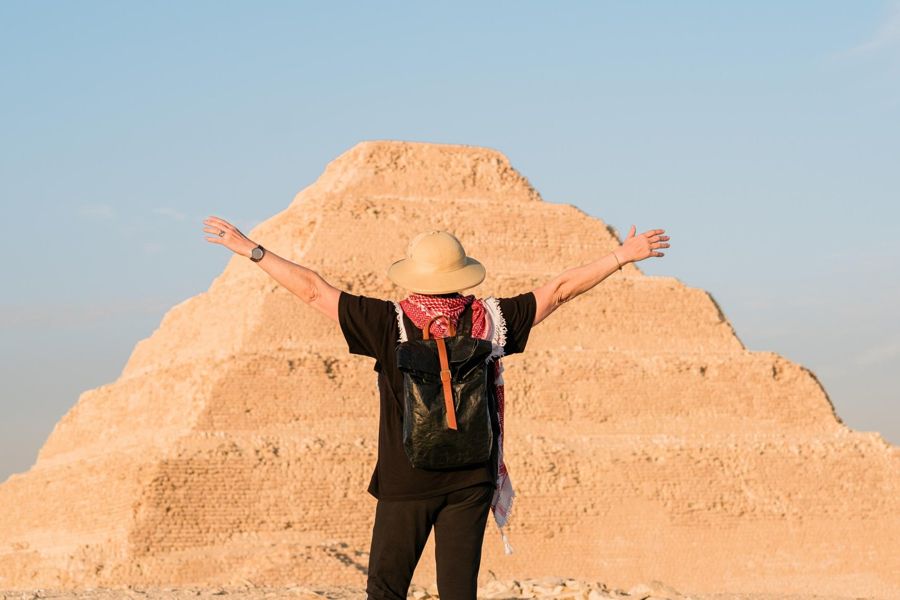
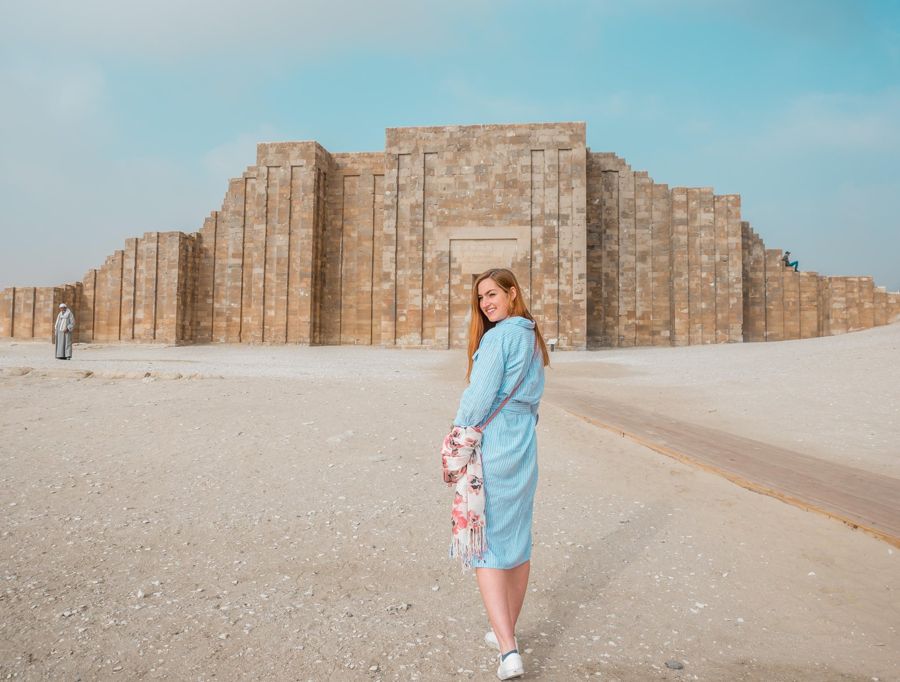
The first is Saqqara. If you combine the Pyramids of Giza and Saqqara in one day, you make a time jump in the wrong direction: the Step Pyramid of Djoser there is about a century older than anything at Giza and is considered the first monumental stone building in the world. It also looks correspondingly different – stepped rather than smooth, because the form had not yet been found. In addition, there are tombs with preserved reliefs and traces of color, which you do not find at Giza.
Saqqara is also home to the only place in the area where you can explore a tomb complex on a large scale without it being a pyramid: the Serapeum, the underground complex for the mummified Apis bulls. Chambers branch off from a long corridor, containing granite sarcophagi weighing many tons each. It has its own ticket and is not included in some offers, even though for many visitors it is the most impressive part of the day.
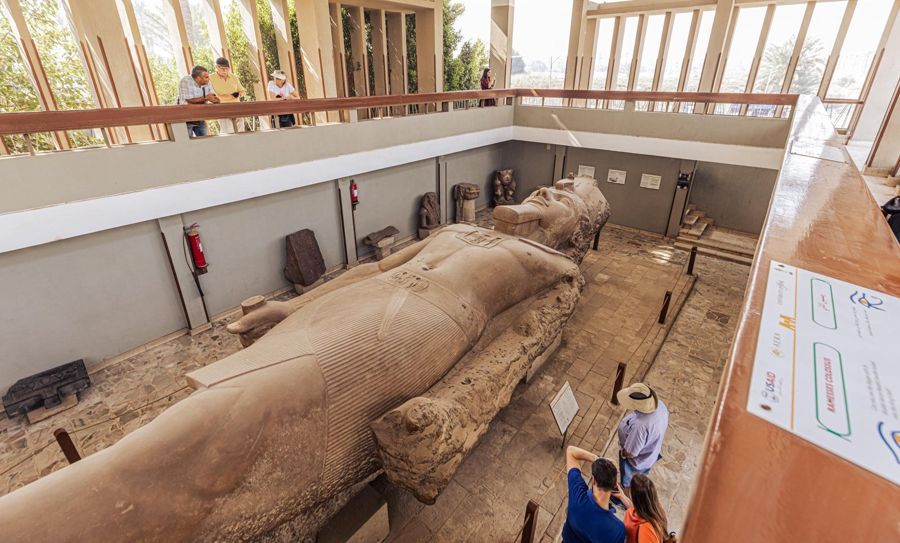
The second is Memphis, the ancient capital, now an open-air museum near the village of Mit Rahina. Little remains of the city itself, because its stones were quarried over centuries. What stands is a collection of statues and fragments, and among them is the colossal statue near the pyramids that many search for: a reclining Ramses II over thirteen meters long, missing his lower legs and feet, found in 1820. He lies on his back in a hall of his own, and you view him from above from a gallery.
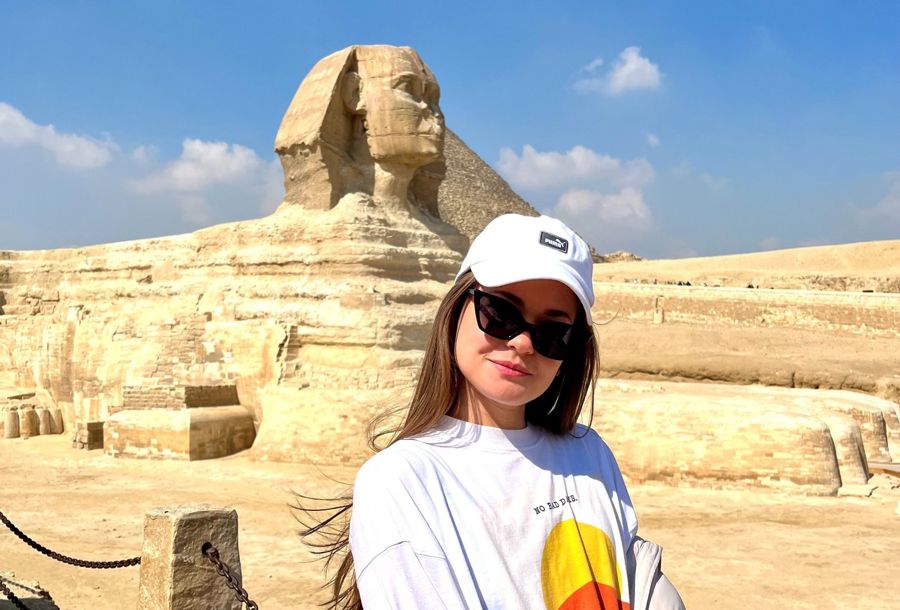
This statue is regularly confused with the Sphinx, and that is understandable. Both are colossal, both lie down, both are near the pyramids. Only the Sphinx stands on the plateau itself, while the colossus is twenty kilometers south. By the way, there is also a sphinx in Memphis, made of alabaster and much smaller.
Distances and What's There
Travel times from the plateau, outside rush hours. During rush hour, any figure can double.
| Destination | Distance | Travel Time | The Reason to Go |
|---|---|---|---|
| Grand Egyptian Museum | 2 km | under 10 minutes | The contents of the buildings that are empty outside |
| Abu Rawash | 8 km north | 20 to 30 minutes | A ruined complex, almost never visited |
| Abusir | 10 km south | 25 to 40 minutes | Pyramids of the Fifth Dynasty, very quiet |
| Saqqara | 15 km south | 30 to 45 minutes | Step Pyramid, relief tombs, Serapeum |
| Memphis | 20 km south | 40 to 60 minutes | Open-air museum with the reclining colossus |
| Dahshur | 30 km south | 50 to 70 minutes | Two enterable pyramids, preserved casing |
| Cairo city center | 20 km northeast | 40 to 90 minutes | Egyptian Museum, bazaar, citadel, Coptic quarter |
- Distance
- 2 km
- Travel Time
- under 10 minutes
- The Reason to Go
- The contents of the buildings that are empty outside
- Distance
- 8 km north
- Travel Time
- 20 to 30 minutes
- The Reason to Go
- A ruined complex, almost never visited
- Distance
- 10 km south
- Travel Time
- 25 to 40 minutes
- The Reason to Go
- Pyramids of the Fifth Dynasty, very quiet
- Distance
- 15 km south
- Travel Time
- 30 to 45 minutes
- The Reason to Go
- Step Pyramid, relief tombs, Serapeum
- Distance
- 20 km south
- Travel Time
- 40 to 60 minutes
- The Reason to Go
- Open-air museum with the reclining colossus
- Distance
- 30 km south
- Travel Time
- 50 to 70 minutes
- The Reason to Go
- Two enterable pyramids, preserved casing
- Distance
- 20 km northeast
- Travel Time
- 40 to 90 minutes
- The Reason to Go
- Egyptian Museum, bazaar, citadel, Coptic quarter
Saqqara, Memphis, and Dahshur each require a separate ticket. The plateau ticket does not cover any of them.
Two Destinations Within Walking Distance
Closer by are two destinations that can be reached on foot or in a few minutes, and both have their own page.
One is the Grand Egyptian Museum, two kilometers to the northwest, fully open since November 2025. It is the most obvious addition, because that is where what once lay in the buildings now stands. The other is the city zoo, a good five kilometers away, which has been closed since 2023 for renovation.
If you are planning excursions around Giza and thinking beyond the city limits, you cannot ignore Cairo. The older Egyptian Museum at Tahrir Square still exists and is a different experience from the new building: more cramped, more organic, old-fashioned in the best sense. In addition, there is the great bazaar, the citadel, and the Coptic quarter. All three lie east of the Nile, on the other side of the city, and the travel time there is the real hurdle.
In recent years, another major museum has opened in the south of the city, where the royal mummies are displayed. It is far less crowded than the two well-known museums and, for people more interested in the people behind the monuments than in the monuments themselves, is often the real destination.
A practical limitation should be mentioned: these destinations cannot sensibly be tacked onto a morning at the plateau. If you set off from Giza at two o'clock, you will sit in the heaviest traffic of the day and arrive as the sites are closing.

Private car with driver in Cairo, by the day
For the chain of Saqqara, Memphis, and Dahshur in one day, a car with driver is the practical solution, because the three sites lie on the same axis and are not reachable without a vehicle. You book the day, not individual routes; you decide the itinerary. Private vehicle, free cancellation, instant confirmation.
What Combines Sensibly
The question remains what combines sensibly, and here there is a clear answer.
Saqqara, Memphis, and Dahshur lie on the same road south and can be combined in one day. That is the usual combination; it takes eight hours including travel and breaks, and it works. If you have the choice, you should not visit Dahshur first but last: it is the quietest of the three, and the afternoon there is much more pleasant than the morning at Saqqara.
What does not fit is the plateau on the same day. It is theoretically possible, but practically you would have only an hour left for Giza, and the site is too large for that. Two days are not a luxury here but a prerequisite for both parts to be worthwhile.
And a tip that saves money: each of these sites requires its own ticket, and some areas within them, such as the Serapeum at Saqqara, require yet another. If you book a guided tour, you should therefore read carefully which admissions are included. In most offers, admission to Giza is included, but not always for the other sites.
Frequently asked questions
How many pyramids are there in the area?
Along the desert edge between Abu Rawash and Dahshur, depending on how you count, there are over two dozen. Giza is one section, not the whole.
Which pyramid can you see from the inside without queuing?
The two at Dahshur. They are enterable and usually almost empty, while at Giza the quota is often used up by morning.
Where is the large reclining statue?
In Memphis, about twenty kilometers south, in its own hall in the open-air museum. It is often confused with the Sphinx.
Can Saqqara be combined with Giza on the same day?
Only with compromises. Both on one day leaves little time for the plateau. Better to take two days or deliberately choose one.
Does the plateau ticket also cover Saqqara?
No. Each site has its own ticket, and some areas within them have yet another.
Is Abu Rawash worth it?
For specialists, yes; for a first visit, no. The complex is largely demolished, but you are usually alone there.