
A half day in Giza sounds like a compromise, but for most visitors it's the norm. And it's better than its reputation suggests, provided you don't plan it as a shortened full-day route.
This is due to a surprising number: the usual circuit around the site—the three great pyramids, the panoramic viewpoint, and the Sphinx—takes only three to four hours anyway. So a half day is enough for that. What a full day adds are the stops off the beaten path: the cemetery, the valley temple, the boat pits, and an interior.
That clarifies the matter. In a half day, you're not giving up the essentials. You're giving up the extras, and you make exactly one consequential decision.
That decision is: interior or breadth. Going inside a pyramid, including waiting in line, takes a good three-quarters of an hour, which is about a quarter of your total time budget when you have three to four hours on site. If you go inside, you lose two to three outdoor stops. You can't do both, and if you try anyway, you'll rush through both.
Interior or Breadth: The One Decision
Pros
- For the interior: It's the only experience that can't be replicated outside
- For the interior: The Grand Gallery has no counterpart, not even in pictures
- For the breadth: The panoramic viewpoint gives you the whole site in a few minutes
- For the breadth: The valley temple is included in the entrance fee, shaded, and two minutes from the Sphinx
Cons
- The interior requires a separate, limited, and expensive ticket in addition to the entrance fee
- It's warm, cramped, and not suitable for some visitors
- If you stay outside, you'll never see the structure from the inside, and you chose that yourself
- With the breadth, the decision is made casually rather than consciously
There is a third option that is rarely mentioned: the interior of one of the two smaller structures. The walk is shorter, the line is shorter too, and the ticket costs a fraction.
The Route Is a Cut List
Once you know how much time you have left, the route becomes a cut list. And the order in which you cut is the real content of this page.
First to go is the eastern cemetery with the painted rock tomb. Not because it's unimportant—quite the opposite—but because it requires its own small ticket, lies on the edge, and can easily take three-quarters of an hour. It's the classic full-day stop.
Second to go are the boat pits. They've been empty since the solar boat moved to the museum, and the detour is only worth it if you have time left.
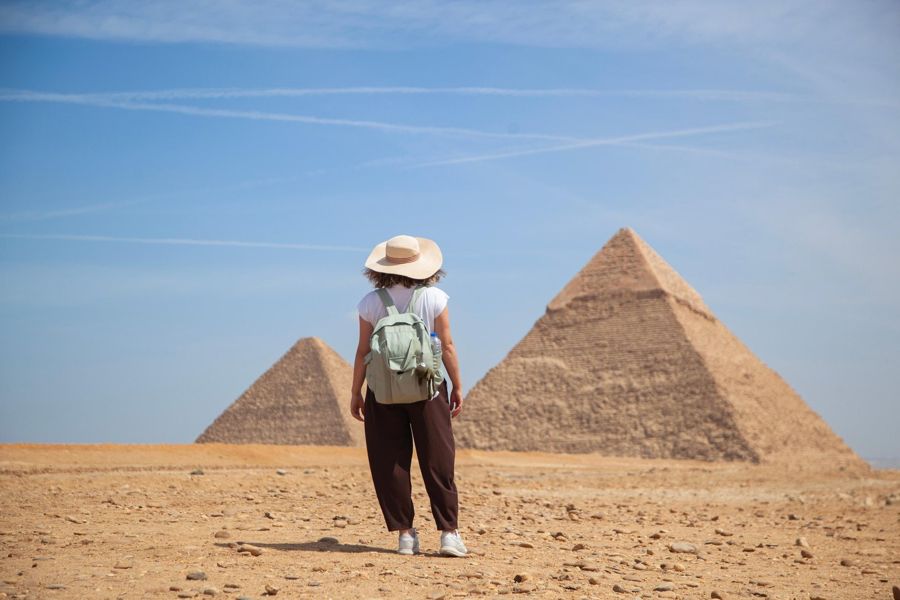
Third to go is one of the two smaller pyramids. Not both, because comparing the sizes of the structures is part of what you want to understand here, but having seen the Pyramid of Menkaure and the Pyramid of Khafre up close is a lesser gain than the view from above of the whole site.
One rule limits everything else, and it's easily overlooked when time is short: the ticket is valid for a single entry. You can't leave the site briefly and come back, neither for a drink at the gate, nor for a toilet outside, nor because a driver is waiting on the wrong side. On a half day, this is more consequential than on a full day, because such a mistake costs not just one stop but the rest of your visit. So take care of all logistics before the ticket control and arrange your return at the gate where your route ends.
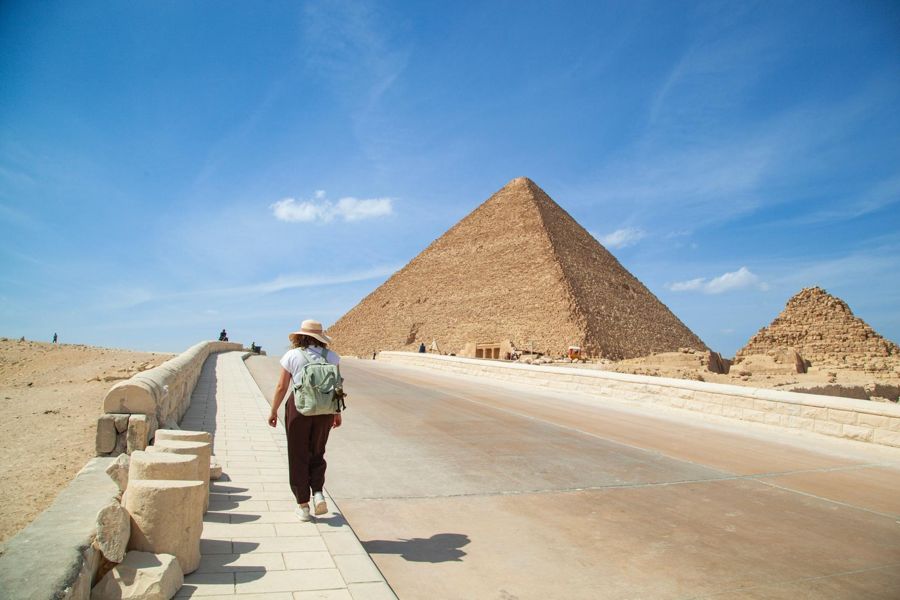
What is not cut, however, are three points. The panoramic viewpoint, because in ten minutes it achieves what would otherwise take an hour of walking. The Sphinx, because it's right at the exit anyway. And the valley temple next to it—and that's the real recommendation of this page: it's included in the entrance fee, it's shaded, it's one of the best-preserved Old Kingdom structures on the site, and it costs you ten minutes because it's right on the path. Leaving it out is the most common avoidable mistake of a short visit.

Guided tour of the site in three hours
- Tailored to the length of a half day, exactly the focus of this page
- Entrance to the site is included, which saves you the queue when time is tight
- German-speaking guide available; pickup and interior visit can be booked as add-ons
- Free cancellation up to 24 hours before, according to the provider
The Loop Line and the Stops of a Half Day
- Main entrance in the southwestStart. Visitor center, ticket control, boarding the shuttle.
- Panoramic viewpointFirst stop. Ten minutes, and you understand the site.
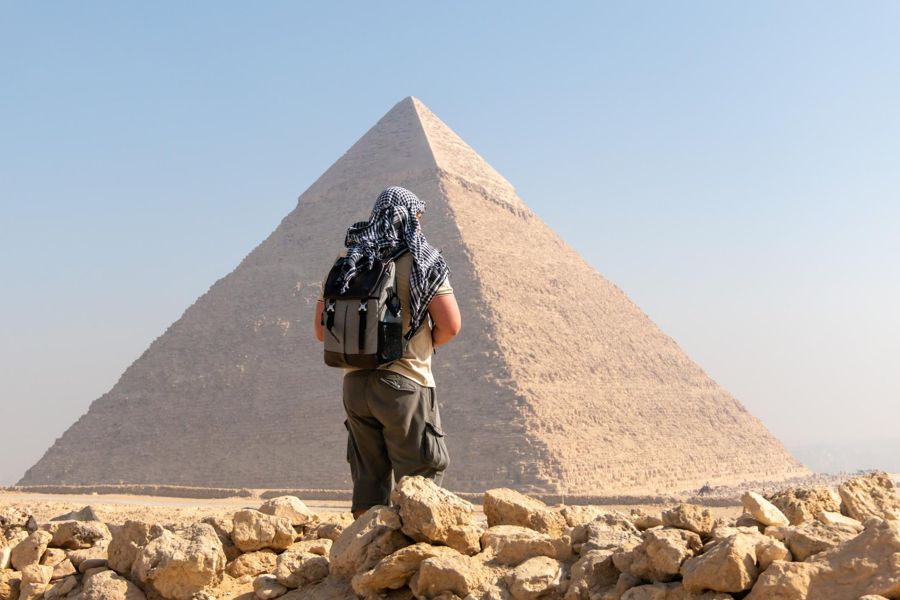
- Pyramid of KhafreSecond stop. From here, the best view of the remaining casing stones at the top.
- Great Pyramid of Khufu, north sideThird stop. Entrance, casing blocks. Here you make the decision about the interior.
- Pyramid of MenkaureSkipped when time is tight and seen from the shuttle.
- Eastern cemeteryCut on a half day. Separate ticket, separate time requirement.
- Valley Temple of KhafreFourth stop, included in the entrance fee, shaded, ten minutes.
- Sphinx and terraceLast stop, because the shuttle stop is at the eastern exit.
The order follows the shuttle's direction of travel. The Sphinx is at the end because the ticket allows only one entry and the eastern exit is right there.
Which Half of the Day?
The question remains: which half of the day? The answer is different from what most expect, because both halves have their own problem.
The morning half day starts at opening time and ends around noon. It's cooler, the light is flat, and the first hour is almost yours alone. Its problem lies in the middle: between nine and ten o'clock, the tour buses arrive, and if you're still out and about, the crowds catch up with you exactly in the middle of your time. So the morning only works if you really start at opening time and not at half past nine.
The afternoon half day starts when the groups leave, and it's quieter than its reputation suggests. Its problem is twofold: the heat lasts until the end, and ticket sales end before the site closes. If you come in the afternoon and don't have a ticket yet, you might lose the entire visit. With a ticket in your pocket, the late afternoon is a good choice, especially in winter.
One point also speaks for the morning, and it has to do with the shuttle: the newly organized paths and vehicles are empty early in the day. When the same vehicles are full by eleven o'clock, you wait at every stop, and with four stops that adds up to a quarter of an hour that you'll noticeably miss in a half day.
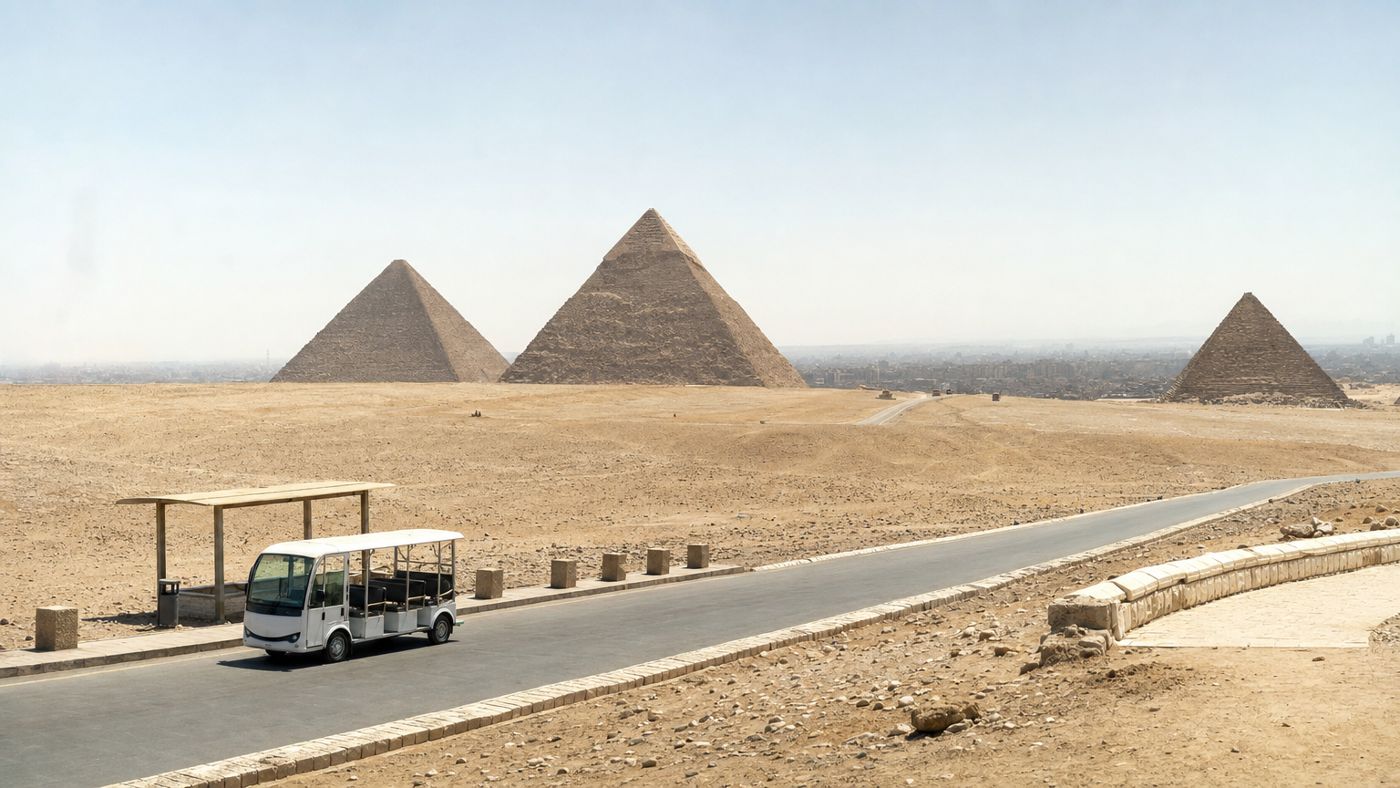
Three and a Half Hours, Stop by Stop
- 0:00
Main entrance, ticket control, boarding the shuttle. With a pre-purchased ticket, ten to fifteen minutes.
- 0:15
Panoramic viewpoint. Overview, photos, orientation. Twenty minutes is enough.
- 0:45
Pyramid of Khafre. Close-up view, remaining casing stones at the top, size comparison.
- 1:20
Great Pyramid of Khufu, north side. Entrance and casing blocks. If you go inside, plan an additional three-quarters of an hour from here.
- 2:15
Shuttle ride to the Sphinx. Along the way, see the Pyramid of Menkaure from the vehicle.
- 2:30
Valley Temple of Khafre. Ten minutes, shaded, included in the entrance fee.
- 2:45
Sphinx and terrace. The most extensive stop at the end, because the exit comes after.
- 3:30
Eastern gate. From there, continue without being able to re-enter.
Three Variations That Differ
Three variations deviate from this route, and for good reasons.
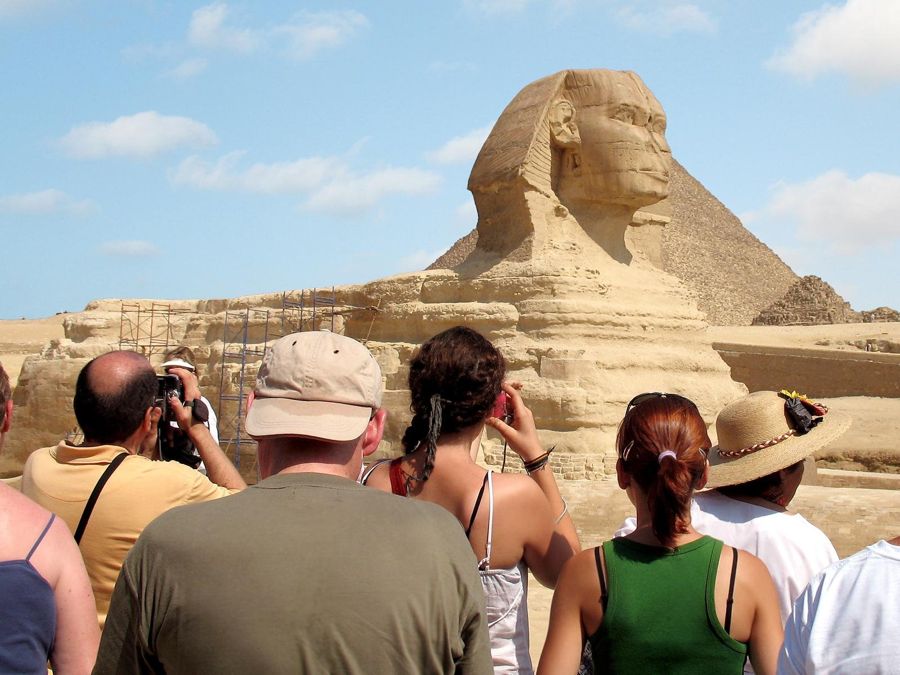
If you want to take photos, reverse the beginning. The Sphinx faces east, so its face is in the light in the morning and in the shade in the afternoon. In that case, get off at the Sphinx on the way there, take your photos, and get back on without using the exit. At the end, you'll pass by again anyway. This costs twenty minutes and resolves the conflict between light and order.
If you're traveling with small children, cut differently. The problem isn't the number of stops, but the time between them. Take the panoramic viewpoint, one single pyramid up close, and the Sphinx, and use the shuttle consistently instead of walking. That gives you two and a half hours with three clear images instead of four hours with tired legs.
If you're on a booked tour, you don't control the order, but you have two requests. Ask for the panoramic viewpoint if it's not on the program, and for the valley temple next to the Sphinx. Both are included in the entrance fee, both take a few minutes, and both are the first to be cut in crowded programs. A guide who gets asked will usually arrange it.
And if you only want to take away one single thing because your connection is tight, you should know that the official overview of the site treats all areas equally, but the impact is very unequal. The panoramic viewpoint gives you understanding; the Sphinx gives you the image everyone expects. If only one of them is possible, decide whether you want to comprehend the place or recognize it.

Private car with a knowledgeable driver in Cairo and Giza
On a half day, the ride determines the rest: every quarter hour on the road is missing on the site. A car for the period takes the search for the return trip out of the equation, and that's the item that most often breaks tight plans. Free cancellation.
Frequently asked questions
Is half a day enough for the pyramids?
Yes, for the usual circuit. The three structures, the panoramic viewpoint, and the Sphinx take three to four hours anyway.
Can I manage an interior in half a day?
Yes, but then two to three outdoor stops will be cut. Expect a good three-quarters of an hour including waiting in line.
What should I absolutely not miss?
The panoramic viewpoint and the valley temple next to the Sphinx. Both take little time and are included in the entrance fee.
Why is the Sphinx at the end?
Because its stop is at the eastern exit and the ticket allows only one entry. If you leave through there, you can't come back.
Morning or afternoon?
Morning, if you can be there at opening time. Otherwise afternoon, but only with a ticket already purchased.
Is the shuttle worth it with so little time?
Especially then. On foot, the same circuit costs significantly more time and energy, and both are missing at the end.