Anyone who wants to know what a camel ride in Giza costs will not get a satisfactory figure, and that is not due to a lack of research. There is no fixed rate. The price is freely negotiable, it varies by time of day, crowds, season, and bargaining skill, and any figure in a travel article is outdated within months.
But that is not the real problem. The complaints on this topic, which are numerous, almost never revolve around the agreed amount being too high. They revolve around the fact that at the end, a different amount was demanded than agreed.
Therefore, this page does not address the question of the sum, but rather the question of the agreement. Whoever agrees fully will pay at the end what they expected, regardless of whether they negotiated well or poorly. Whoever agrees incompletely has a problem, and in a situation where they are in a poor position to negotiate.
A fixed range cannot be given: negotiation happens before mounting, and the price depends on duration and distance. The question of the condition of the animals and animal welfare is a separate one and is covered on its own page; those who decide against it will find the reasons there.
Guided day where someone speaks for you
- With accompaniment, providers negotiate with the guide and not with you, which prevents the described situation from arising in the first place
- Eight hours with German-speaking guide, pickup, plateau entry, and lunch according to provider details included
- Access to the interior of the pyramids is explicitly not included in this offer
- A camel ride is not part of the offer
You don't dismount from a camel alone
To understand why the agreement is so important, you need to know one single fact: You don't dismount from a camel alone.
A dromedary kneels to mount and dismount, and it does so on the command of the handler. You sit up there at a height of two to two and a half meters, without stirrups, on an animal you don't know. You can't simply jump off and walk away. That is exactly the leverage, and practically every unpleasant story on this topic is based on it.
The sequence is always the same. The price is set low so that you mount. Out in the sand, away from the starting point, renegotiation happens. And if you refuse, dismounting becomes a bargaining chip.
Knowing this, you immediately understand why all advice on this topic has the same core: Everything essential must be clarified while you still have both feet on the ground. After that, you negotiate from a position that is none.
A second factor reinforces this, and it has to do with the location. The rides lead out into the open sand, away from the paths and away from other people, usually towards the panoramic viewpoint. That is the scenic point of the matter and also the reason why a discussion there goes differently than at the starting point: You are alone with the handler, far from the next supervision, and the way back belongs to him.
This is, by the way, no reason to treat the topic dramatically. It is an ordinary negotiation situation with an unusual pressure point, and it can be completely defused with five sentences beforehand.
Five points clarified before mounting
- The total price
Not the price per person, per minute, or per camel, but the amount your group pays in total at the end. Have it repeated.
- The number of people
Explicitly state for how many people the amount applies. The subsequent reinterpretation to a price per person is the most common demand.
- Round trip
The price applies to the entire round including the return. Without this sentence, it easily becomes a one-way trip.
- The duration
Agree on a time or a distance. Without it, the ride ends whenever the handler wants.
- Currency and tip
In Egyptian pounds, and the tip is included in the amount. Otherwise, a second demand comes at the end, often for the animal.
What the subsequent demands look like
What the subsequent demands look like is surprisingly well documented, because they have been the same for years.
The most common is the reinterpretation: The agreed amount supposedly applied per person, or only for the outward trip, or only for the first few minutes. Second is the tip demand after payment, often with the note that it is for the animal and not for the handler. Third is the currency switch: The amount was meant in dollars or euros, not pounds, which multiplies the price at once.
A fourth variant concerns the photo. The handler offers to take pictures with your phone, which is initially friendly and usually meant that way. Occasionally, it becomes an extra item on the bill at the end, and in a case that is repeatedly reported, the phone stays in the handler's hand until payment is made. If you don't hand over the device, you also avoid this issue.
All three come to nothing if the five points are clarified beforehand and you pay at the end, not before. Therefore, pay only when you are standing again. A ride paid in advance takes away the only leverage you have.
If a demand does occur, neither arguing nor giving in at any price helps. Stay friendly, calmly repeat the agreement, pay the agreed amount, and leave. In the vast majority of cases, it ends there. If not, there is supervisory staff on the premises, and the presence of a uniform typically changes such conversations quickly.
And keep the scale in mind: These disputes usually involve amounts that are small relative to the trip. That is no reason to let yourself be taken advantage of, but it is a good reason not to take the annoyance home with you.
Should you do it at all?
The question remains whether you should do it at all, and it has two sides.
One is the condition of the animals. There is documented criticism from animal welfare organizations, a government program, and, in the course of the reorganization of the site, a relocation of the providers, which was explicitly justified with animal welfare concerns. This page does not evaluate that, but refers to the page that presents the state of affairs in detail. Those who decide against it after reading have a good reason.
The other side is practical. A camel ride is not a means of transport. It does not get you faster from one monument to the next; for that, there are the electric shuttle buses that are included in the entry. What it offers is an image and an experience, and both can be had differently: on foot, with more time, and without negotiation.
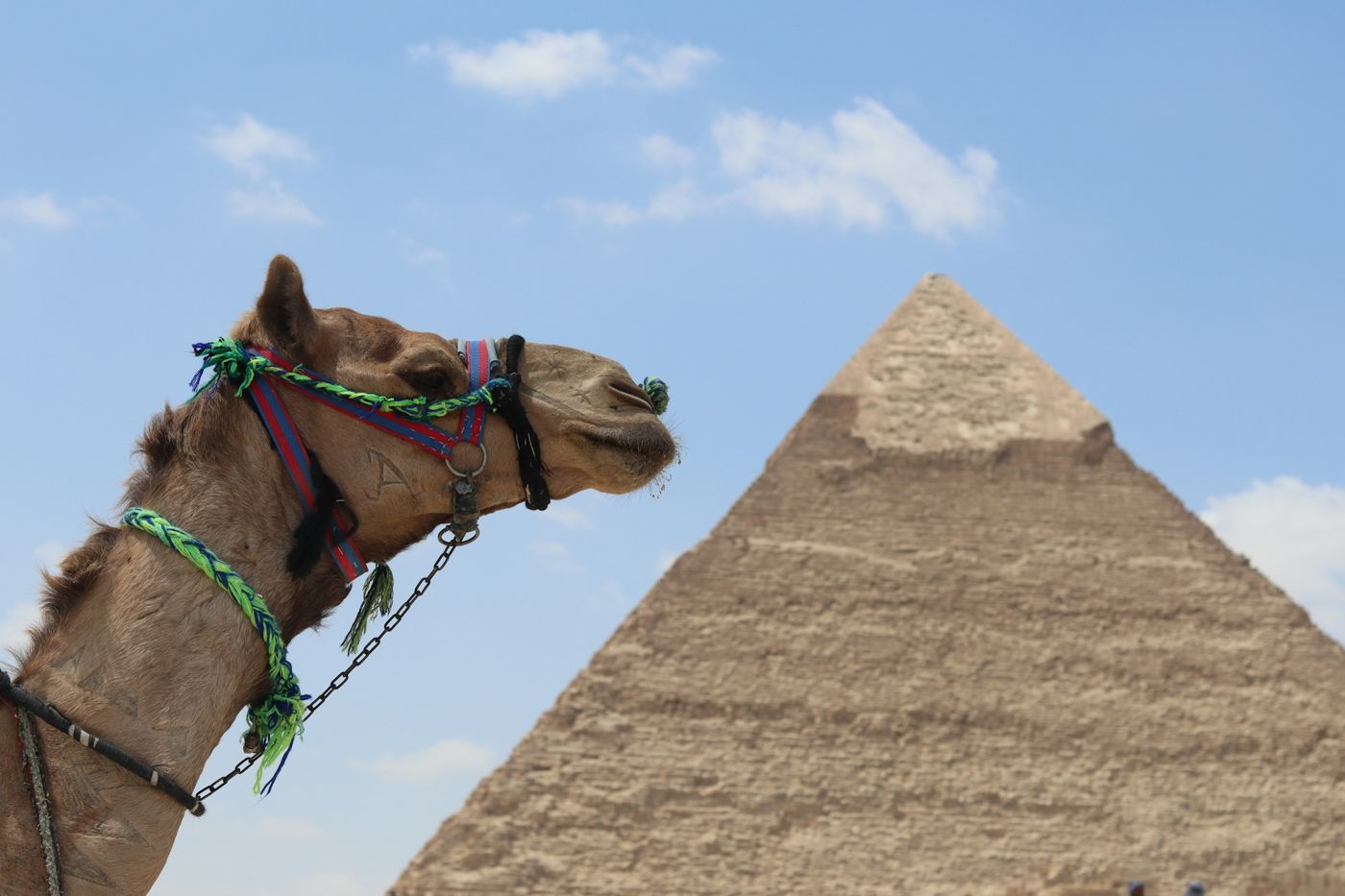
For a good picture, you don't necessarily need the animal anyway. The panoramic viewpoint provides the view with all three monuments, the way there is done in minutes with the shuttle, and the shot succeeds without negotiation and without time pressure. The classic shot with a camel in the foreground, by the way, is usually taken not from the saddle, but standing next to it.
If you still want to do it, then do it briefly, in the morning when it is cooler for both people and animals, and with the agreement from the box above. And look at the animal before you mount. An animal in poor condition is a reason to move on, and it is the only leverage travelers actually have in this matter.
Frequently asked questions
Is there a fixed price for a camel ride?
No. The price is freely negotiable and varies by time of day, crowds, and season. That is why no figure is deliberately given here.
What do I need to agree on beforehand?
Total price, number of people, round trip, duration, and currency and whether tip is included. All five, before you mount.
When do I pay?
At the end, when you are standing again. Paying in advance takes away your only leverage.
What do I do if there is an additional demand?
Stay calm, repeat the agreement, pay the agreed amount, and leave. There is supervisory staff on the premises.
Is a camel ride a sensible way to get around?
No. For the paths on the site, there are electric shuttle buses that are included in the entry.
What should I look out for with the animal?
The visible condition. An animal that looks bad is a reason to move on, and that is the most effective leverage travelers have.