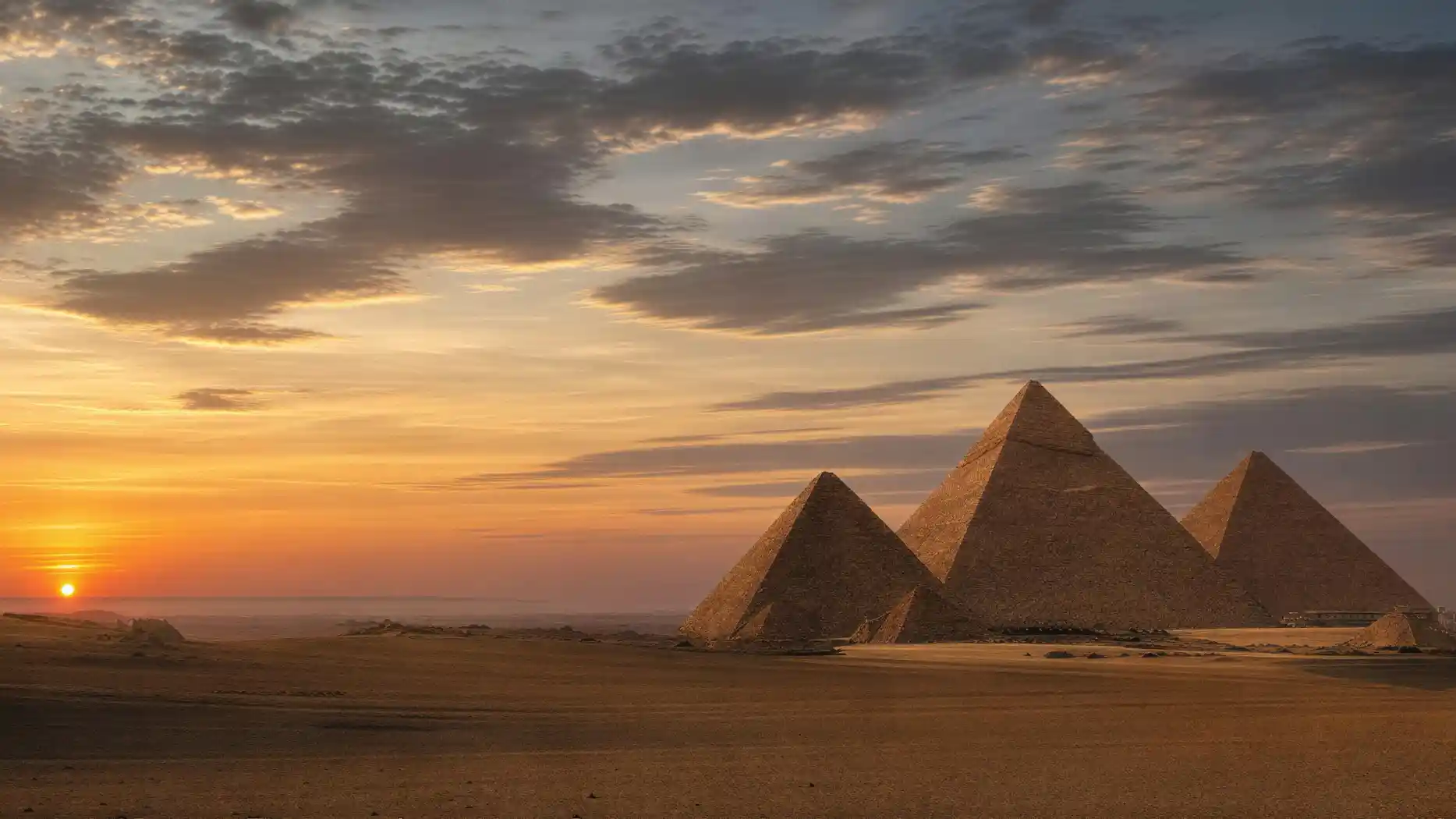
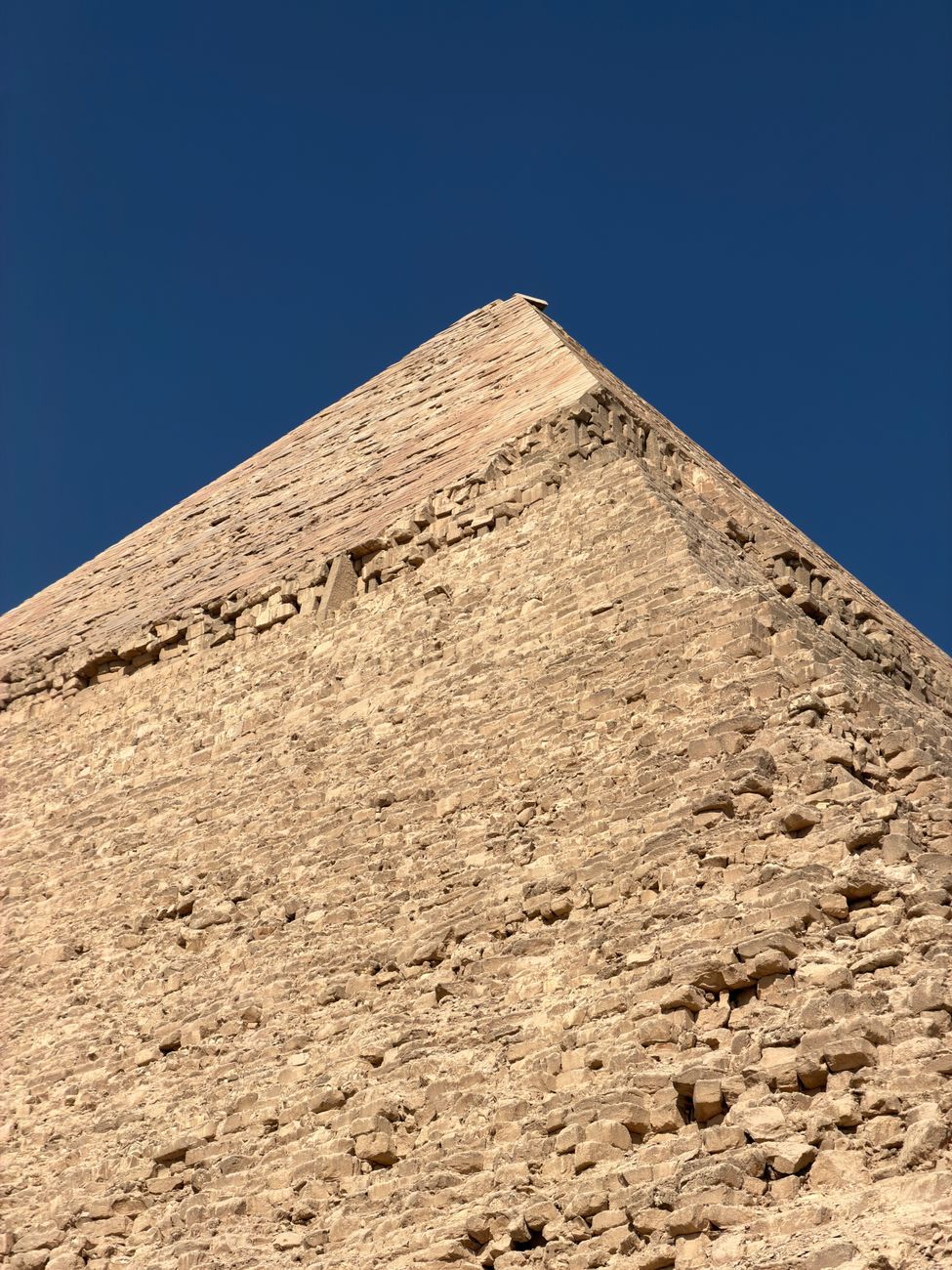
The Great Pyramid of Khufu up close is a different structure than the Great Pyramid of Khufu from a distance. That is the most common feedback from visitors, and it has a factual core.
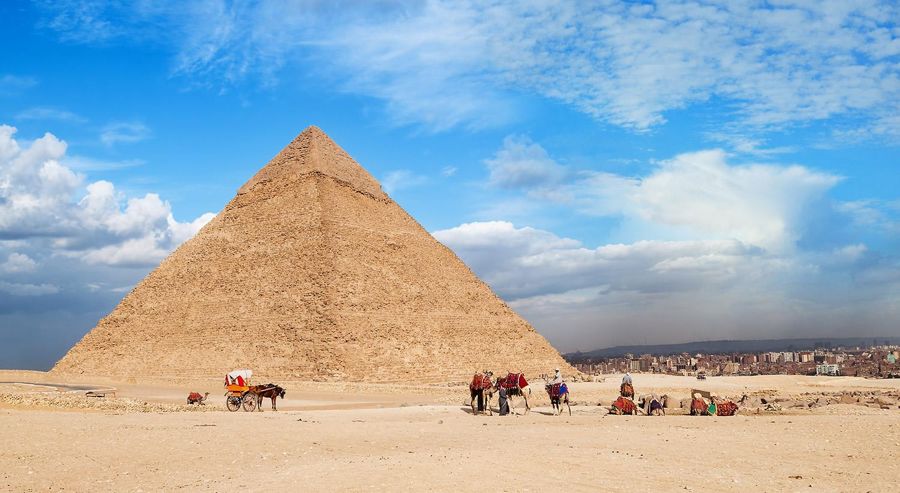
From a hundred meters away, you see a geometric shape: a smooth slope, a triangle, a silhouette. From two meters away, you see a quarry. The blocks of the lower layers reach above an adult's hip, their edges are broken rather than cut, the joints vary in width, and the surface feels rough like unpolished concrete.
Both are correct, and the contradiction is not a flaw of the building but its history: what you touch was never meant to be seen. It is the core masonry, over which a smooth, carefully polished skin once lay.
This page describes what is actually visible in this close view. And the most remarkable thing about it is about forty million years older than the pyramid itself.
The coins in the stone are fossils
Look at limestone blocks up close, and you will discover flat, coin-shaped disks about one and a half to five centimeters in diameter, packed densely in the rock.
These are nummulites, the shells of single-celled organisms, specifically foraminifera with a chambered calcareous shell. They lived about forty million years ago in a shallow, warm sea that covered the area, and sank in such numbers to the bottom that they formed a distinct rock type. The limestone of Giza is a nummulitic limestone, and the associated species still carries the place name in its name.
This was noticed even in antiquity. Herodotus mentioned the fossils in the fifth century BC. Strabo, who visited the site around 25 BC, was provided the explanation that they were petrified leftovers of the builders' meals, namely lentils. He considered this unlikely because he had seen the same disks in his homeland, and concluded they formed by water.
Thus, at the building, you have two time layers at once: a mistaken conclusion from two thousand years ago, which an ancient traveler already rejected, and a sea that dates back forty million years.
Private half-day tour of the site
- For close-up viewing, you need time at one spot, not more stops
- Privately guided, four hours, you decide how long to stay
- Plateau entry and pickup included, preferred access
- Free cancellation up to 24 hours before start
What you can see from arm's length
- Nummulites
- Coin-shaped fossils, one and a half to five centimeters, densely distributed in the stone
- Coursing heights
- Varies from course to course, lowest at the bottom, decreasing outward
- Joints
- Irregular widths, sometimes several centimeters, filled with mortar remains
- Tool marks
- Impact marks and break edges on sides, no smooth cuts
- Weathering
- Rounded edges, washed-out joints, smooth worn areas on frequently trodden spots
The work is rougher than its reputation
Whoever looks at the pyramids of Giza from the closest view also sees something that initially contradicts the world-class workmanship: extremely coarse craftsmanship.
The core blocks vary in size, the side faces are irregular, and the spaces between them are filled with mortar and rubble. Here, you see nothing of the famous precision where not even a sheet of paper can pass between two stones.
That is not a contradiction but a matter of components. The precision lay in the casing, in the granite chambers, and in the foundation, that is, where it was visible or load-bearing. The core masonry had to do one thing: go up quickly and carry. It was never meant to be seen, because a smooth skin was over it.
The heights of the courses also tell this story. They are theirs biggest at the bottom and decrease upward, though not evenly but in steps. Walking along the side and counting the courses, you see the construction organization of that time as a pattern in the stone.
How close you can get
The practical question remains: how close can you actually get? The answer: within arm's length on most parts of the sides.
Placing your hand on the stone with one hand is no problem. But as soon as you set foot on the first layer, that changes, because climbing is prohibited and since a law change it is expressly punishable. Also taking away stone fragments falls under heritage conservation, no matter how small the piece may be.
For photography, the close-up is rewarding because it does not need special light. However, low morning or late afternoon light brings out the fossils and tool marks much better than the midday sun, which flattens everything.
And a final note, often forgotten: the officially designated area includes far more than the three major structures. The mastaba tombs in between are made of the same stone and are likewise worth seeing up close, often without anyone standing next to them.
Frequently asked questions
What are the round disks in the stone?
Nummulites, fossilized shells of single-celled organisms from a sea that covered the area about forty million years ago.
Why does the masonry look so rough?
Because you see the core. The fine work was in the casing, which has been missing since the Middle Ages.
Are you allowed to touch the stone?
Putting your hand on it is okay. Climbing on it is not, and neither is taking fragments.
When is the best time to see the details?
In the early morning or late afternoon when the light is low. The structure disappears at noon.