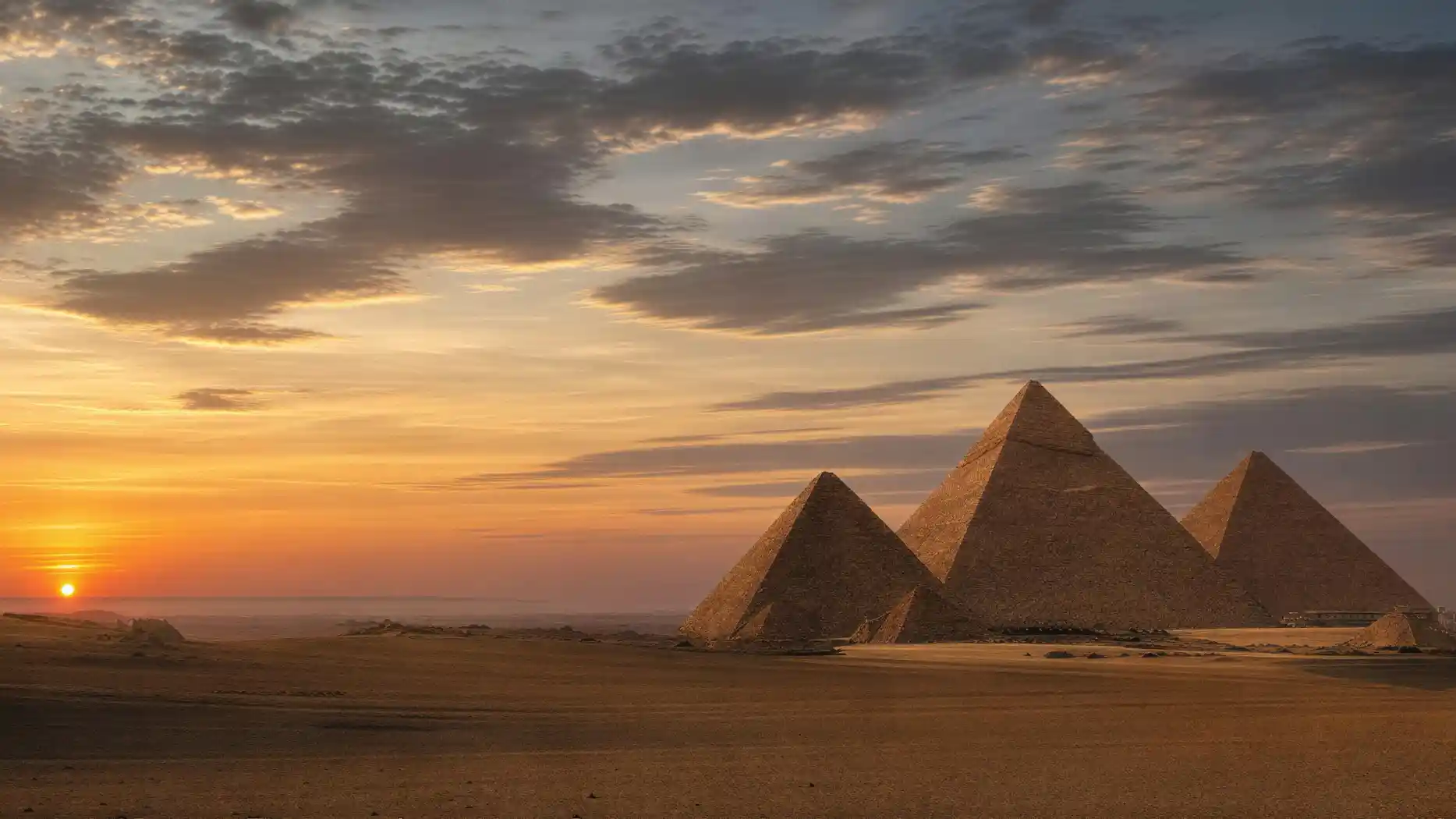
Egypt. That is the complete answer, and if that's all you wanted to know, you're done here.
The question is usually asked like this: In which country are the Pyramids of Giza? And the answer almost always comes with a wrong addition, namely that the structures are in Cairo. They are not. They stand on the western edge of Giza, an independent city of millions on the other bank of the Nile, which belongs to its own governorate. Cairo is a neighbor, not the location, and the river lies between them.
The official designation is recorded in the UNESCO World Heritage List. The necropolis has been listed there since 1979, together with Memphis and the pyramid fields up to Dahshur, and Egypt is registered as the state party.
The classification in five lines
- State
- Arab Republic of Egypt
- Continent
- Africa, with an Asian part of the country on the Sinai
- Governorate
- Giza, not Cairo
- Location
- Western edge of the city of Giza, at the edge of the Nile Valley
- World Heritage
- since 1979, together with Memphis and Dahshur
Africa or Asia?
The second question almost always follows: Africa or Asia?
Egypt is a country on two continents. The vast majority of the country lies in Africa, east of the Suez Canal the Sinai Peninsula connects, and that is geographically considered part of Asia. The canal is thus more than a waterway. It is a continental border with ship traffic.
For travelers, this has a consequence that is rarely mentioned. If you are vacationing at the Red Sea in Sharm el-Sheikh or Dahab and book a day trip to Giza from there, you change continents on the way there and back again. In the same country, with the same ID, without a single border control.
For the structures themselves, however, the matter is clear. Giza lies in the Nile Valley, clearly west of the canal, and thus undisputedly on the African mainland. If you are asked in a quiz which continent the plateau is on, you answer Africa and are right. If you are asked which continent Egypt is on, you may hesitate briefly.
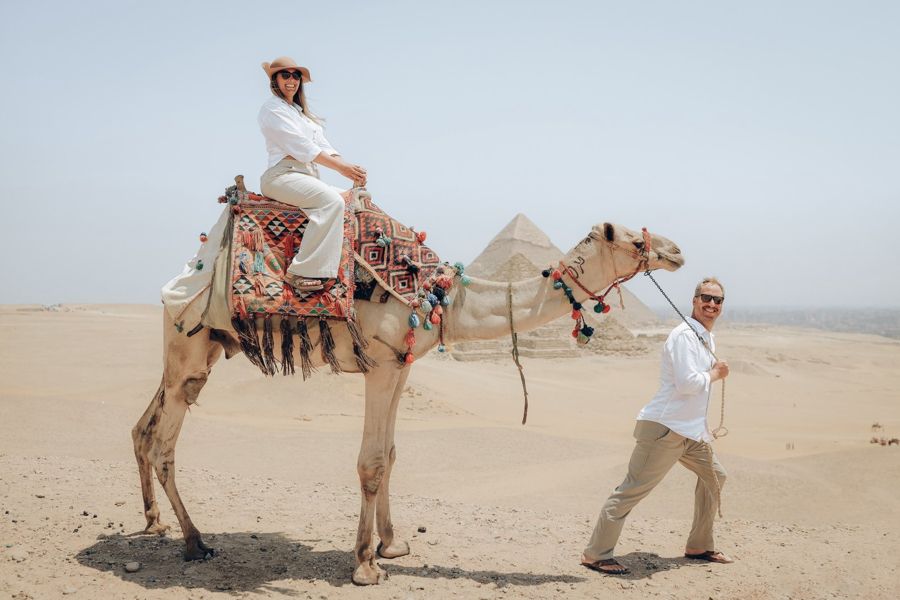
Day tour to the pyramids, Saqqara, and Memphis
Once the country question is settled, the next becomes interesting: Giza is only one of several pyramid fields in the country. This tour combines three of them in one day, guided in German, with pickup and plateau entry.
Two pyramid countries in comparison
The neighbors on the Nile both built, but at different times and on different scales.
| Egypt | Sudan | |
|---|---|---|
| Number of pyramids | well over a hundred, depending on the count | around 255 |
| Built by | the kings of the Old and Middle Kingdoms | the kings of Kush |
| Approximate period | around 2670 to 1700 BC | around 700 BC to 300 AD |
| Most famous site | Giza | Meroe |
| UNESCO World Heritage since | 1979 | 2011 |
- Egypt
- well over a hundred, depending on the count
- Sudan
- around 255
- Egypt
- the kings of the Old and Middle Kingdoms
- Sudan
- the kings of Kush
- Egypt
- around 2670 to 1700 BC
- Sudan
- around 700 BC to 300 AD
- Egypt
- Giza
- Sudan
- Meroe
- Egypt
- 1979
- Sudan
- 2011
The numbers vary depending on what is counted as a pyramid. The ranking between the two countries does not vary.
Which country has the most pyramids?
Now to the question that most people fail: Which country has the most pyramids in the world?
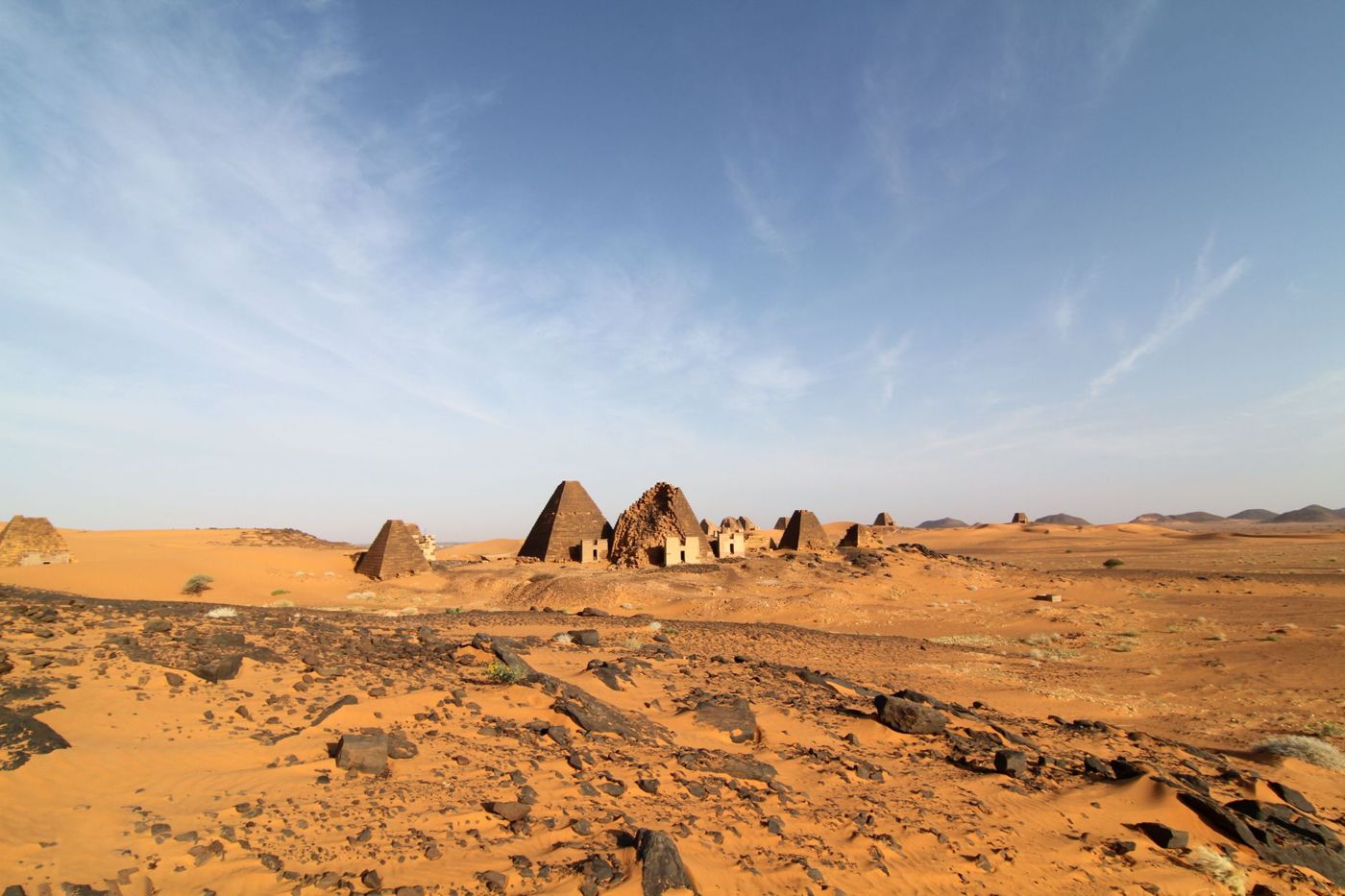
Not Egypt. There are more in Sudan, and significantly more. National Geographic puts the number at around 255 pyramids, more than twice as many as in the neighboring country. They were built by the kings of Kush, whose kingdom flourished long after the Old Kingdom and whose rulers at times even ruled over Egypt.
The structures look different: smaller, steeper, and closer together. The largest measure barely more than thirty meters at the base, while the Great Pyramid of Khufu measures over two hundred there. They are hardly known because Sudan is practically undeveloped for tourism.
Were the pyramids always in Egypt?
One question remains that is rarely asked and only makes the answer interesting: Were the pyramids always in Egypt?
The state that today is called the Arab Republic of Egypt is about four and a half millennia younger than the structures on the plateau. When the Great Pyramid of Khufu was built, there was neither a republic nor the country name in its current form. The residence was near Memphis, a few kilometers further south, and the necropolis belonged to its surroundings.
The name of the place has also changed. The word pyramid is Greek, not Egyptian; the builders called their structures differently and gave each one its own name. What today looks like a fixed assignment of structure, city, and state is a snapshot from the last of about forty-five centuries.
The Arabic name of the country is still Misr today, and that is what the people there call their country. The German form is borrowed via Greek. If you ask about the country, you are asking about a political order that only came into being long after the structures. The place has remained the same. Everything else has changed several times.
Who controlled this place
- around 2560 BC
The Great Pyramid of Khufu is built. The residence is near Memphis, the kingdom is the Old Kingdom.
- 30 BC
Egypt becomes a Roman province.
- 641 AD
Arab conquest. The country name Misr has been in use since then.
- 1922
The country becomes formally independent from the United Kingdom.
- 1953
Proclamation of the republic. The current state is about 4,500 years younger than the structures in its territory.
- 1979
The necropolis is added to the World Heritage List.
Frequently asked questions
In which country is the Great Pyramid of Khufu?
In Egypt, on the western edge of the city of Giza. Not in Cairo, even though the two cities have long since grown together.
On which continent are the pyramids?
In Africa. Egypt does have an Asian part with the Sinai, but that lies east of the Suez Canal and far from the plateau.
Does Egypt have the most pyramids in the world?
No. There are more than twice as many in Sudan, built by the kings of Kush.
What is Egypt called in Arabic?
Misr. The German form is borrowed via Greek and has nothing to do with the native name.