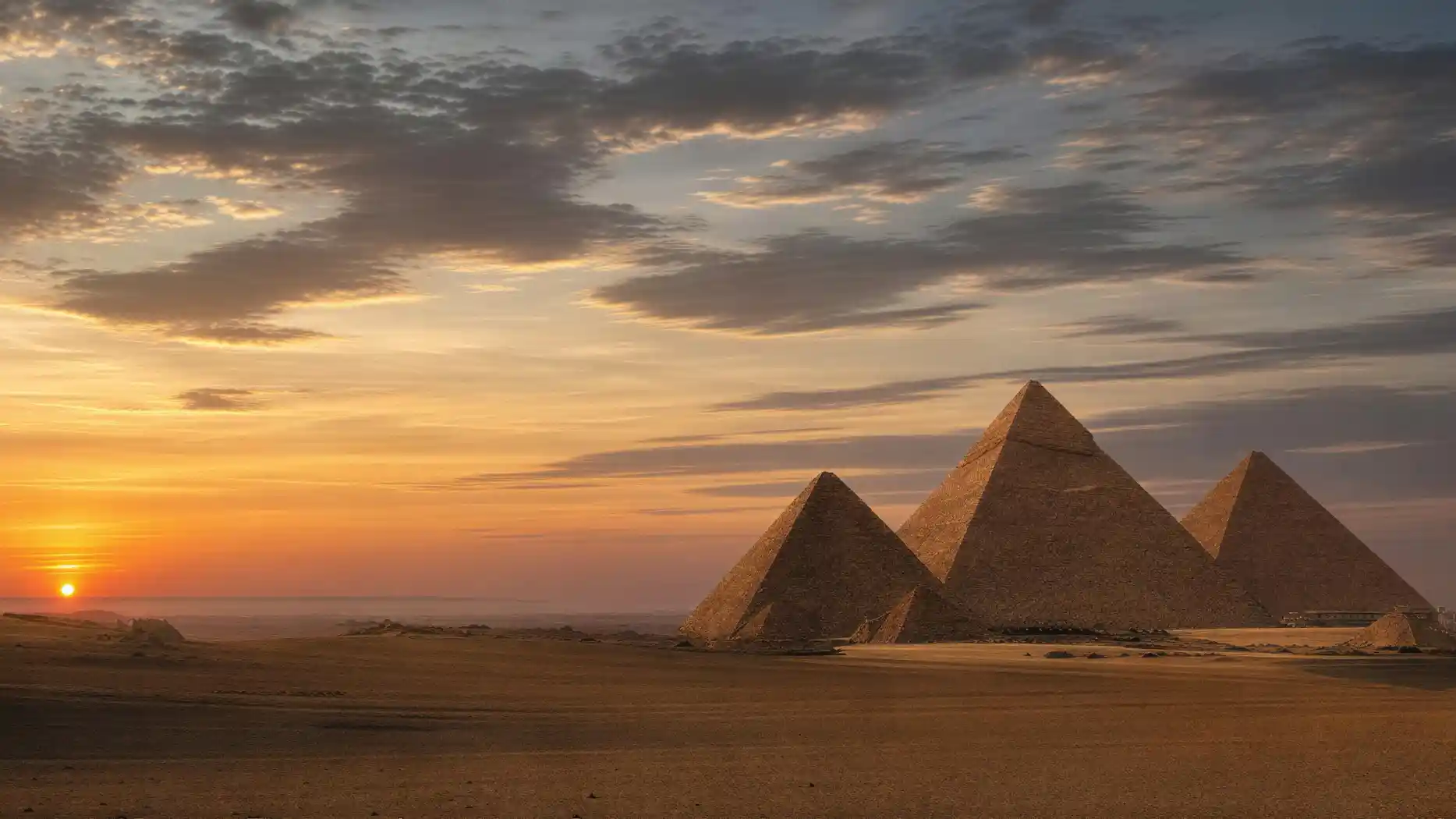
This question is often asked, and it contains two confusions that are easy to resolve.
The first concerns the structure. The reports about columns, shafts, and halls underground that went around the world in 2025 did not refer to the Great Pyramid, but to its middle neighbor. If you look for columns under the largest pyramid, you are looking for something that was never even claimed.
The second concerns the status of these reports. They were based on a radar analysis for which no peer-reviewed publication exists, and the methodological work behind it has since been withdrawn. More on that below.
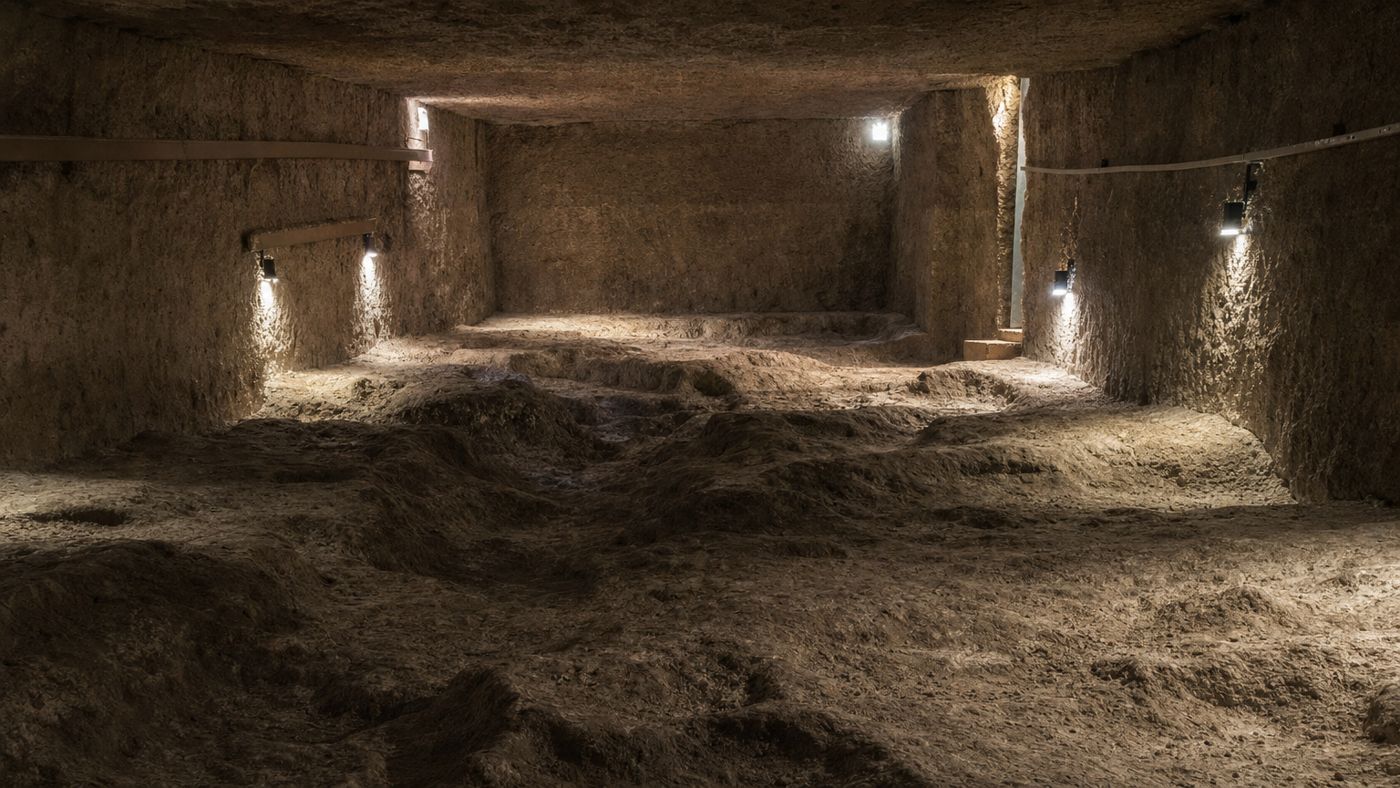
What actually exists is far less spectacular and far more interesting. About thirty meters below the structure, cut into the bedrock, lies a chamber. It is large, it is old, it is real, and it was never finished. Its floor is a rugged surface of half-removed rock, as if the stonemasons had laid down their tools in the middle of the work.
A note in advance to help with classification: Unfinished elements are not an exception at this site, but a pattern. At the base of the third pyramid stands rough granite, the mortuary temple of the same complex was completed in mudbrick, and the temple associated with the Sphinx was left unfinished. An abandoned chamber under the largest pyramid fits into this picture rather than standing out from it.
That is probably exactly what happened. And the question of why leads deeper into the construction process of this structure than any radar report.
Where This Chamber Lies
- North side with entrance
- Descending passage
- Base line
- Bedrock
- Rock chamber
The illustration is schematic and not to scale. The upper chamber area is only indicated for orientation.
The Descending Passage and the Chamber
The way there begins at the same place as everything else: at the original entrance on the north side.
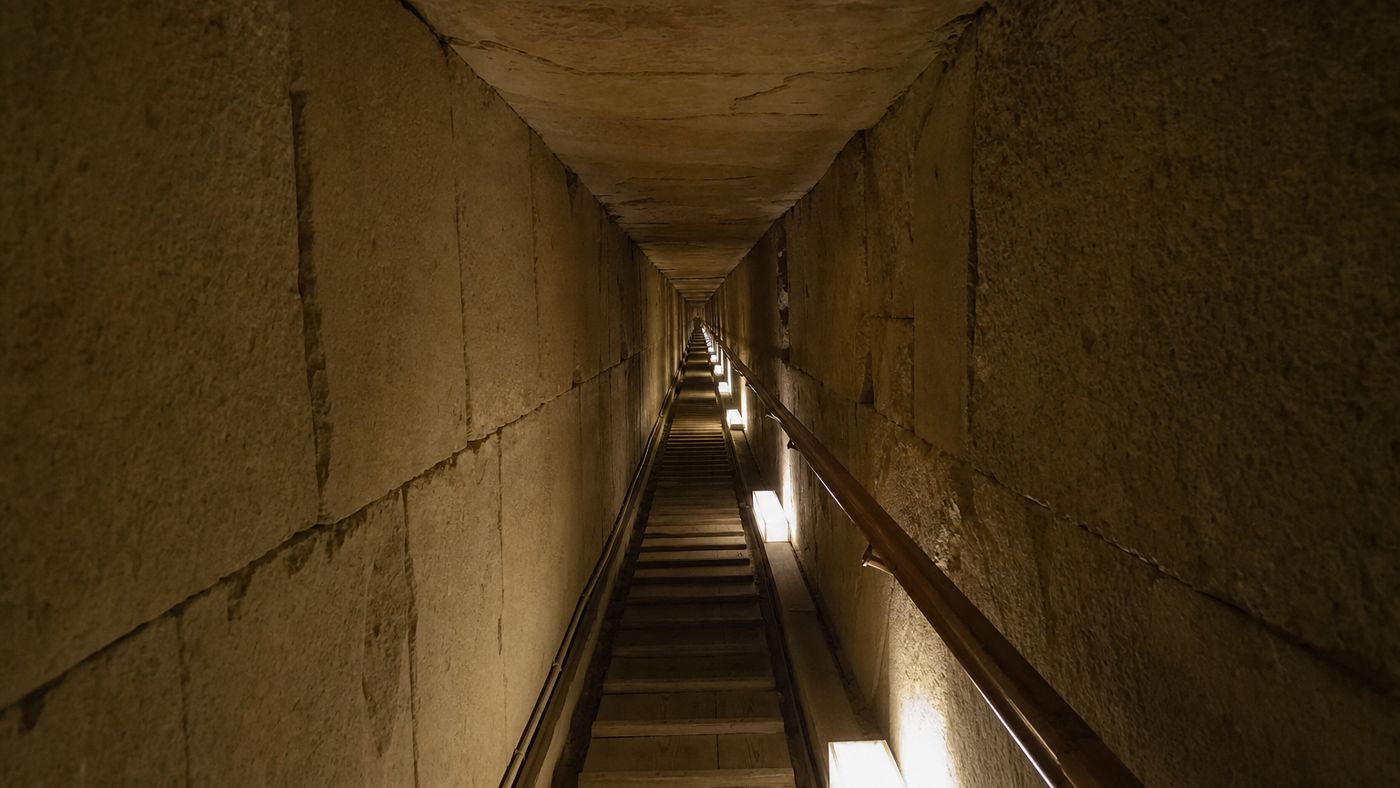
From there, a descending passage leads downward, first through the masonry, then through the bedrock. It maintains the same slope over its entire length, which in itself is a considerable surveying achievement: a passage over a hundred meters long that runs through two different materials and still remains straight.
At the lower end opens the rock chamber of the Great Pyramid of Khufu. It measures about fourteen meters in length and just over eight in width, with a height of about four meters. Thus, it is larger than the burial chamber in the upper section, but in a completely different state: the walls are rough, the ceiling is irregular, and the floor is a landscape of protrusions, pits, and left-behind rock.
Two further features belong to it. In the middle of the floor lies a shaft that was driven a short distance into the depths and then abandoned. And from the south wall, a low passage runs about fifteen meters horizontally into the rock, where it ends without a chamber and without any recognizable destination.
Remarkable is the contrast to the execution. The passage leading there is laid out with great care, the walls are smooth, and the slope is constant over the entire distance. The chamber at the end is the exact opposite. Anyone who sees both in succession immediately recognizes that this was not sloppy work, but that work was stopped at a certain point. The precision of the access proves that the roughness of the destination reflects not a lack of skill, but a decision.
Photographs, measurements, and excavation reports for this area are available in the digital archive of Harvard University, including images from times when the access was still open.



Guided day tour with option for interior visit
- The walkable route leads up to the burial chamber, not down into the rock
- The interior visit of the Great Pyramid of Khufu is available as an add-on
- Plateau entry, German-speaking guide, pickup, and lunch are included
- Free cancellation up to 24 hours before start
Redesigned Twice
The common explanation for this state is also the explanation for the entire layout of the structure, and it is: it was redesigned twice.
According to this reading, the rock chamber was the original destination. A burial chamber deep in the rock under the pyramid corresponds exactly to what was customary for earlier royal tombs. The work began, progressed to the shaping of the chamber, and then was stopped.
After that, a second chamber was created, this time in the masonry above the base. It too was not used as the final burial place. Only the third, high in the structure, was completed, lined with granite, and provided with a sarcophagus.
Why it was redesigned is open. A change in religious ideas during the construction period is conceivable, a construction difficulty is conceivable, and it is also conceivable that the expectation of the remaining reign simply changed. A king who realizes that he has more time than thought can afford something more elaborate.
In favor of the redesign also speaks the construction sequence in the masonry. The ascending passage attaches to the descending passage at a point that is structurally unfavorable, and it was partly cut into already laid masonry. A passage upward planned from the beginning would have looked different. Such traces are hard to argue away because they mean additional effort that no one undertakes without reason.
There is, however, a counterposition. Some experts do not consider the rock chamber an abandoned plan, but a deliberately unfinished chamber with its own significance, for example as a representation of the underworld. Evidence for this is weak, but the thesis explains why a chamber that was supposedly abandoned was at all fully excavated and accessed via a carefully surveyed passage.
Are There Columns Under the Pyramid?
Now to the columns. The question dates from spring 2025, when an Italian working group claimed to have found extensive structures under the middle structure of the site using satellite radar: several similar buildings, connected by paths, plus vertical shafts several hundred meters deep.
Three things are to be said about this, and all three are verifiable. First, the claim did not concern the Great Pyramid of Khufu. If you look for underground pillars in Giza, you end up with reports about the neighboring structure. Second, to this day there is no peer-reviewed publication on it; it was presented at a press conference. Independent checks found no solid basis, and the Egyptian antiquities administration publicly contradicted it.
Third, and this is new: The work in which the same group described its radar method in 2022 was withdrawn by the journal on August 10, 2026. After a review, the editors cite serious methodological flaws and statistical errors. The authors dispute this decision.
Added to this is a factual argument that applies independently of everything else. Satellite radar penetrates dry soil a few meters, into solid rock practically not at all. Structures at depths of hundreds of meters cannot be imaged by this method, no matter how the data are subsequently processed.
Remarkable at this point is how persistent the confusion is. Search queries for columns under the Great Pyramid of Khufu are more frequent than those for the actually existing chamber. A claim about one structure thus migrates in the public mind to the more famous neighboring structure, and the real finding disappears behind it. This is not a peculiarity of this topic, but a rather general property of popular science reports.
Under the Great Pyramid, then, lies what has been known since the 19th century: an unfinished chamber, an abandoned shaft, and a passage to nowhere.
Four Statements About the Underground
- False
There are columns under the Great Pyramid of Khufu.
There is no evidence for this. The 2025 report concerned a different structure and is itself unsubstantiated.
- True
There is indeed a chamber under the Great Pyramid of Khufu.
About thirty meters below the base lies a large, unfinished chamber in the bedrock, long known and documented.
- False
The chamber was never finished because it was forgotten.
It is accessed via a carefully surveyed passage over a hundred meters long. It was abandoned, not forgotten.
- False
You can visit the rock chamber.
The area is closed to visitors. The walkable interior route leads upward to the burial chamber.
You Won't Get There
For the visit, the information is short: You won't get there.
The descending passage branches off shortly behind the forced entry shaft and is blocked off. The walkable route leads in the other direction, upward through the ascending passage and the gallery to the burial chamber. The lower area was accessible at times in the past, but has not been for a long time, and that is unlikely to change in the foreseeable future: The passage is low, long, poorly ventilated, and has only one entrance and exit.
What you can see is the beginning. When entering the structure, you cross the point where the descending passage continues. A brief look down into this tube conveys the dimension better than any description, because it disappears into the darkness without an end being visible.
Anyone interested in the lower area has to rely on documentation. There are measurements, photographs, and surveys from several centuries, and the chamber is one of the best-documented inaccessible places in archaeology.
A side effect is worth mentioning. Because the lower area is closed, visitors do not spread out, and the ascending path is correspondingly crowded. If the rock chamber were accessible, there would be two routes and half as much oncoming traffic. From a conservation and safety point of view, however, everything speaks against it: A single access over a hundred meters long without a second exit is utterly unsuitable for public traffic.
And perhaps that is the fitting punchline. The most spectacular question about this structure concerns an underground that does not exist. The underground that does exist has been surveyed for two hundred years and is hardly ever mentioned.
Frequently asked questions
Are there columns or halls under the pyramid?
No. There is no evidence for that. The 2025 report concerned the middle pyramid, was never peer-reviewed, and the associated methodological work was withdrawn in August 2026.
What lies under the structure then?
An unfinished chamber about fourteen by eight meters in size in the bedrock, about thirty meters below the base, accessible via the descending passage.
Why was the chamber not finished?
Probably because there was a redesign during the construction period. The burial chamber moved up in two steps into the masonry.
Can you enter the chamber?
No, the area is closed. The interior visit leads upward to the burial chamber.
Where does the passage at the south wall lead?
Nowhere. It runs about fifteen meters horizontally into the rock and ends without a chamber.
Plateau entry as QR code on your phone
The basic ticket covers the grounds, not the interior of the Great Pyramid of Khufu. The lower area is not accessible to anyone anyway.